

Shooting past 300 yards in total darkness is a different game. You need a thermal scope that can detect, identify, and help you hit targets at distance — not just show you a glowing blob. At Pixfra, we build thermal imaging devices used by hunters across 30+ countries, and we know what separates a real long-range thermal scope from a spec-sheet wonder.
Not every thermal scope can handle long-range work. A scope that performs well at 100 yards might turn into a blurry mess at 400. If you plan to reach out past 300 yards at night — whether you’re hunting coyotes across open fields, running hog eradication on ranch land, or just want confidence at distance — you need to pay attention to a few specific things before you spend a dime.
The first thing to look at is sensor resolution. This is the number of pixels your thermal sensor uses to build the image you see through the eyepiece. If your shots stay within 100–150 meters, a 384×288 sensor will often suffice. If you’re shooting 250+ meters, go for a higher-resolution sensor (640×480 or 1024×768) and better thermal sensitivity (<20 mK NETD). A higher pixel count means the animal you’re looking at is rendered by more pixels on the screen, which lets you see ears, legs, body posture, and movement — all details you need for positive target ID before pulling the trigger. If you look at a coyote at 400 yards through a 256-resolution sensor, the animal might only be rendered by 4 or 5 pixels — it will look like a blurry Lego brick. With a 640×512 sensor, that same coyote is rendered by dozens of pixels. That’s a night-and-day difference when it comes to making an ethical shot.
Second, your long-range thermal scope needs a laser rangefinder (LRF) and a ballistic calculator — period. A laser rangefinder integrated with a ballistic calculator eliminates guesswork on longer shots by automatically adjusting your reticle for range and angle. This is particularly valuable for ethical hunting in low-visibility conditions where distance estimation is difficult. At night, you can’t judge distance by landmarks the way you can during the day. An integrated LRF gives you exact yardage in a fraction of a second, and when that feeds into a ballistic calculator, your reticle adjusts automatically for bullet drop. If you want a deeper look at what features set a great thermal device apart, we put together a guide on the top features needed in the best thermal device in 2026 that covers this in detail. Finally, don’t overlook build quality, refresh rate, and battery life. A scope with a 50Hz refresh rate tracks moving animals smoothly, while anything below 30Hz creates lag that can cost you a clean shot. And a battery that dies four hours into a night hunt is a deal-breaker — look for 7+ hours of runtime or swappable 18650 batteries so you can keep going.
After testing, field feedback, and engineering-level analysis of what performs at distance, here are our top seven picks for long-range thermal shooting in 2026. We’ve pulled from our own Pixfra lineup because we know these devices inside and out — and because they’re built to perform in exactly these conditions. Each model below brings something different to the table depending on your shooting style, terrain, and budget.
1. Pixfra Pegasus 2 LRF — Our flagship thermal scope for long-range precision. The Pegasus 2 LRF is built around the tagline “Make Precision Target Locking Effortless,” and it delivers. It features an integrated laser rangefinder, a high-sensitivity thermal sensor with NETD ≤18mK, and detection range that stretches well past what most hunters will ever need. The LRF feeds distance data directly to the scope, taking the guesswork out of holdovers at 300+ yards. If you want one scope that does everything for long-range thermal hunting, this is the one.
2. Pixfra Chiron LRF — Designed with one purpose: “Lock-On, Readiness, Fire.” The Chiron LRF pairs its integrated laser rangefinder with a built-in ballistic calculator, giving you real-time adjusted aiming points for different ranges and angles. This is the thermal rifle scope you want if you’re running predator control across big open ground. It computes bullet drop, angle compensation, and other ballistic factors so your reticle is already where it needs to be when you’re ready to squeeze the trigger.
3. Pixfra Pegasus Pro Series — When the slogan says “Shoot in a Pro Way,” it’s talking about features that matter to serious shooters. The Pegasus Pro is a thermal scope built for hunters who want a step up in optical performance and target clarity without the added weight and cost of full LRF integration. It offers excellent thermal imaging, smooth magnification, and a sensor that punches above its class for target identification at mid-to-long range.
4. Pixfra Taurus T650 LRF — This is a thermal front attachment, which means it clips onto the front of your existing daytime scope and turns it into a thermal imaging system. Why does that matter for long-range shooters? Because you get to keep using the high-quality glass optic you already trust for daylight work. The T650 LRF adds thermal detection with an integrated laser rangefinder and a ballistic calculator. Its zeroing precision sits at an ultra-fine 0.9cm@100m click value — that’s seriously tight for a thermal front attachment.
5. Pixfra Taurus T450 LRF — Similar DNA to the T650 but in a slightly different configuration, the T450 LRF gives you thermal front attachment capability with LRF and ballistic support. It’s ideal for shooters running mid-range optics on bolt-action rifles or AR platforms who want thermal capability at distance without re-zeroing or swapping their entire scope setup. Both Taurus LRF models are built for fast mounting and solid zero retention — key when you need to switch between day and night shooting.
6. Pixfra Volans Series — “See Beyond Time” isn’t just a marketing line. The Volans is a digital day-and-night vision scope with an adjustable aperture (F1.2–F3.0) that adapts to different lighting conditions. This gives you an all-day scope that handles bright daylight, low light, and total darkness without swapping optics. For hunters who don’t want to carry separate day and night rigs, the Volans solves that problem. LRF-equipped models also include a ballistic calculator for accurate targeting at distance.
7. Pixfra Draco — Lightweight design meets multi-functional performance. The Draco stands out as a thermal front attachment that keeps your rifle balanced and maneuverable, even on long stalks. While it’s not as feature-loaded as the Taurus LRF models, the Draco delivers reliable thermal imaging, solid detection range, and a compact form factor that won’t throw off your shooting position. It’s a smart entry into thermal front-attachment shooting for hunters who want thermal capability without the bulk.
Here’s a quick side-by-side comparison to help you see how these stack up:
| Model | Type | LRF | Ballistic Calculator | Best For |
|---|---|---|---|---|
| Pegasus 2 LRF | Thermal Scope | Yes | Yes | All-around long-range precision |
| Chiron LRF | Thermal Scope | Yes | Yes | Predator control, open terrain |
| Pegasus Pro | Thermal Scope | No | No | Mid-to-long range, value |
| Taurus T650 LRF | Front Attachment | Yes | Yes | Pairing with existing optics |
| Taurus T450 LRF | Front Attachment | Yes | Yes | Versatile clip-on thermal |
| Volans | Day/Night Scope | Available | Available | 24-hour all-day shooting |
| Draco | Front Attachment | No | No | Lightweight, portable thermal |
Key stat: Detection ranges across the Pixfra lineup run from around 500m on entry-level devices up to 3,600m on premium models like the Sirius HD series. For long-range shooting, our LRF models provide accurate ranging out to 1,000m — which covers virtually every realistic hunting scenario in North America.
This is the single biggest source of confusion in thermal scopes, and it trips up both new buyers and experienced hunters. When shopping for thermal optics, you will often see specs like “Detection Range: 2,500 yards.” Do not mistake detection for identification. Detection means the scope can sense a heat source — at 1,500 yards, a cow and a truck engine might look exactly the same, just a white dot. Identification means you can clearly see the animal’s shape, legs, and gait. This is the absolute maximum range at which you can ethically shoot. This is the point we want to drive home: your detection range is always going to be much farther than the range at which you can positively ID a target and take a responsible shot.
For thermal scopes, anything past 250 yards starts to become “long range.” Hitting a target at 500+ yards with a thermal scope requires a perfect storm of environmental conditions, high-end sensor resolution, and a very large objective lens. That’s why we build our Pixfra thermal scopes and front attachments with high-resolution sensors and wide germanium objective lenses. A larger lens collects more infrared radiation, which directly translates to a cleaner image at distance. When paired with a sensor that has NETD values as low as ≤18mK, you get exceptional target separation in conditions that wash out cheaper thermals — high humidity, fog, or low temperature contrast between animals and their environment. Our Taurus LRF series, for example, offers that ultra-fine 0.9cm@100m click value for zeroing, which gives you the precision to actually use those long identification ranges for shot placement, not just spotting.
If you’re shopping for a thermal scope specifically for long-range shooting, here are the specs you should zero in on. First, sensor resolution — we’ve already covered why 640×480 or higher is the sweet spot for long-range work. A 384×288 sensor works fine for close-to-mid range hog hunting inside 200 yards. If you’re pushing past 300 yards or targeting smaller game like coyotes, step up to a 640×480 or 640×512 sensor for cleaner target ID. If your budget limits you to a 384 sensor, you can still get decent performance at moderate distances, but you’ll hit a ceiling faster when you zoom in digitally.
NETD (Noise Equivalent Temperature Difference) is the second spec to watch. NETD measures how sensitive your thermal sensor is to tiny temperature differences. Lower numbers are better. Our Pixfra devices hit ≤18mK, which means the sensor can pick up extremely subtle heat variations — like the difference between a coyote’s warm body and the cooling ground around it on a mild evening. Premium models from top-tier brands typically range from 15mK to 25mK. Anything above 30mK is going to struggle in low-contrast conditions, and those are exactly the conditions where long-range shots are hardest. Temperature differentials shrink as the night goes on, and a sensitive sensor is what keeps your image sharp when conditions get tough.
Magnification is where a lot of buyers get tricked. Digital zoom simply enlarges the pixels you already have. If you want to shoot at 400 yards, you need a scope with a higher optical base magnification (like 3x or 4x), so you don’t have to rely heavily on digital zoom. A scope advertising 16x magnification sounds impressive, but if that’s achieved through 2x base mag and 8x digital zoom, your image quality at high zoom will be soft. For long-range thermal work, look for a base optical magnification of at least 3x to 5x, and treat digital zoom as a bonus — not the foundation of your long-range plan. Our Pegasus 2 LRF and Chiron LRF are engineered with this philosophy: strong base magnification so you get real optical clarity where it counts.
Choosing a thermal rifle scope for long-range shooting comes down to three things: where you hunt, what you hunt, and how you hunt. Open fields or farmland require a scope with a long detection and identification range, typically a 50–60mm lens and 640+ resolution sensor. Woodland or brush calls for wide field of view, compact form, and fast handling — 35mm lenses and lighter builds are ideal. Mixed terrain means a balanced scope with a mid-range lens (50mm), moderate magnification, and decent FOV. If you’re sitting in a blind over a Texas grain field waiting for hogs, the Pegasus 2 LRF gives you maximum detection and precision. If you’re walking fence lines looking for coyotes, the lighter Draco front attachment keeps your rifle from wearing you out over miles.
Budget matters too. Thermal units range in price from around $1,000 for basic thermal viewers to over $7,000 for the most sophisticated rangefinding scopes. Thermal scopes depend on a rare-earth element called germanium, which supplies temperature-sensitive glass for thermal units. Generally speaking, the best combination of attributes, capability, and overall utility of thermal units will set you back around $3,000. Don’t chase the highest-specced scope if your shots never go past 200 yards. A mid-range Pixfra thermal scope or front attachment will serve you better than an overbuilt unit that’s too heavy for your style. On the flip side, if you’re seriously working open country at 400+ yards, invest in LRF integration and a ballistic calculator — those features pay for themselves in first-round hits and ethical shots. Our Chiron LRF and Taurus LRF both include ballistic calculators that compute factors like bullet drop and angle for accurate targeting at different distances, making them a solid pick for anyone who wants long-range confidence without external accessories.
How far can you actually shoot with a thermal scope?
It depends on the scope and the target, but here’s the honest answer: most thermal scopes let you detect heat signatures well beyond 1,000 yards. However, your actual shooting range — the distance at which you can positively identify the target and make an ethical shot — is usually limited to 400–600 yards with a high-end 640-class sensor and a 50mm+ lens. Our Pixfra thermal scopes with NETD ≤18mK push that identification range further by delivering sharper thermal contrast, but we always recommend knowing your identification limits before taking any shot.
Is a 640 sensor worth the extra money over 384?
If you’re shooting past 200 yards regularly, yes — it’s absolutely worth it. A 640×480 or 640×512 sensor puts significantly more pixels on your target at distance, which translates directly into better target identification. At 400 yards, the difference between a 384 and a 640 sensor is the difference between guessing and knowing what you’re aiming at. For close-range work under 200 yards, a 384 sensor handles the job, but for long-range thermal shooting, the 640 is the baseline we recommend.
Do I need a built-in laser rangefinder on my thermal scope?
For long-range shooting — yes. At night, your ability to judge distance drops off a cliff compared to daylight. An integrated LRF gives you accurate yardage in under a second, and when it’s paired with a ballistic calculator (like on our Chiron LRF and Taurus LRF), it adjusts your aiming point automatically. You range, you aim, you shoot. No fumbling for a separate rangefinder, no breaking your eye from the scope. If you mostly shoot under 150 yards from a fixed position where you already know the distances, you can skip the LRF. But for anything past 200 yards in unfamiliar terrain, it’s a game-changer.
Can I use a thermal scope during the day?
Yes. Thermal scopes detect heat, not light, so they work in daylight, total darkness, fog, smoke, and glaring light. Our Pixfra Volans Series takes this a step further with an adjustable aperture (F1.2–F3.0) that adapts to different lighting conditions, giving you true all-day vision capability. You won’t get the same color image as a traditional daylight optic, but you’ll see heat signatures that you’d miss with regular glass — like a bedded deer in tall grass or a coyote tucked into a shady tree line.
What NETD rating should I look for in a long-range thermal scope?
Lower is better. NETD stands for Noise Equivalent Temperature Difference, and it measures how small of a temperature change the sensor can detect. For long-range work, look for anything ≤25mK. Premium scopes sit around 15–18mK, which is where our Pixfra lineup lands. At ≤18mK, you get clear thermal contrast even in tough conditions like high humidity or when ambient temperatures are close to your target’s body temperature. Anything above 35mK will struggle at distance and in challenging weather.
If you need to negotiate MOQ with a thermal optics manufacturer, start by reducing the manufacturer’s production risk, then trade something concrete: deposit, forecast, standard packaging, or a dated reorder. MOQ changes when you ask for a 640×512 detector, a 35 mm lens, app changes, reticle presets, private-label packaging, or compliance paperwork for a U.S. sales channel. The first job is to find which part of your request is setting the floor.
A new buyer often asks the wrong question: “Can you do 20 units?” A stronger question is: “Which requirement makes the MOQ 300, and what changes would make a 50-unit pilot workable?”
1. Ask which cost sets the MOQ: sensor, lens, tooling, packaging, or compliance.
2. Keep first order on standard hardware, firmware, and carton.
3. Pay for samples, engineering, and inspection instead of asking the factory to absorb them.
4. Split commitment into pilot order plus dated reorder.
5. Trade lower MOQ for deposit, shared packaging, simple SKU mix, and clear forecast.
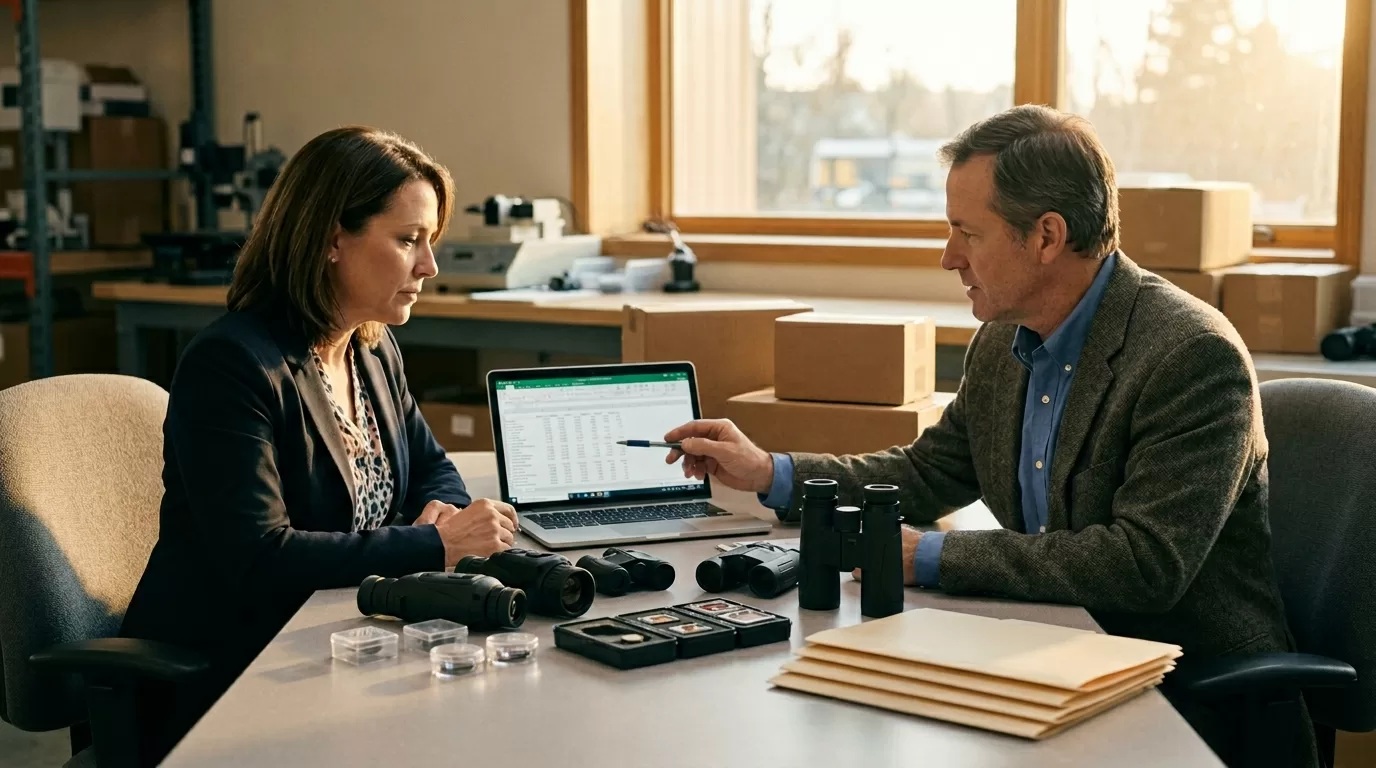
Thermal optics MOQs are built from setup costs. Detector purchasing, lens assembly, waterproof housing checks, firmware loading, image calibration, and packaging print runs all create small minimums inside the bigger MOQ. A 384×288 thermal monocular in a standard housing might hit one factory threshold; the same unit with a branded startup screen, U.S. carton, custom manual, and changed Wi-Fi app can hit four.
The best way to negotiate MOQ with a thermal optics manufacturer is to turn “small order” into a low-risk production plan. Say what you’ll keep standard. Say what you’ll pay for. Give the supplier a real reorder window, such as “80 units now, 220 units within 90 days if field testing passes.”
| Factory answer | Better buyer question | Possible path |
|---|---|---|
| MOQ is 300 units | Which part requires 300? | Reduce branding or split into pilot plus reorder |
| Custom carton needs MOQ | Can we use standard carton with a label? | Lower first order, brand later |
| 640 sensor supply is tight | Can we start with one 384 SKU? | Prove demand before higher trim |
| Firmware change adds MOQ | Can logo stay on packaging only? | Avoid engineering work |
| Tooling is required | Can we pay tooling separately? | Separate unit MOQ from tooling cost |
Don’t negotiate only on quantity. Negotiate the order shape.
An 80-unit order of one thermal monocular SKU is cleaner than 20 units each across four trims. The warehouse picks one carton. Production loads one firmware version. QC checks one optical setup. Your sales team also learns faster because every dealer demo, return, and customer question points to the same model.
A factory MOQ is rarely one fixed number. It moves with customization. For thermal optics, the biggest cost drivers are detector resolution, focal length, housing changes, firmware requests, app work, private-label packaging, accessories, and certifications. The low-friction items are usually labels, outer cartons, quick-start inserts, and batch timing. The hard items are sensor changes, new molds, new lens assemblies, and model-specific test reports.
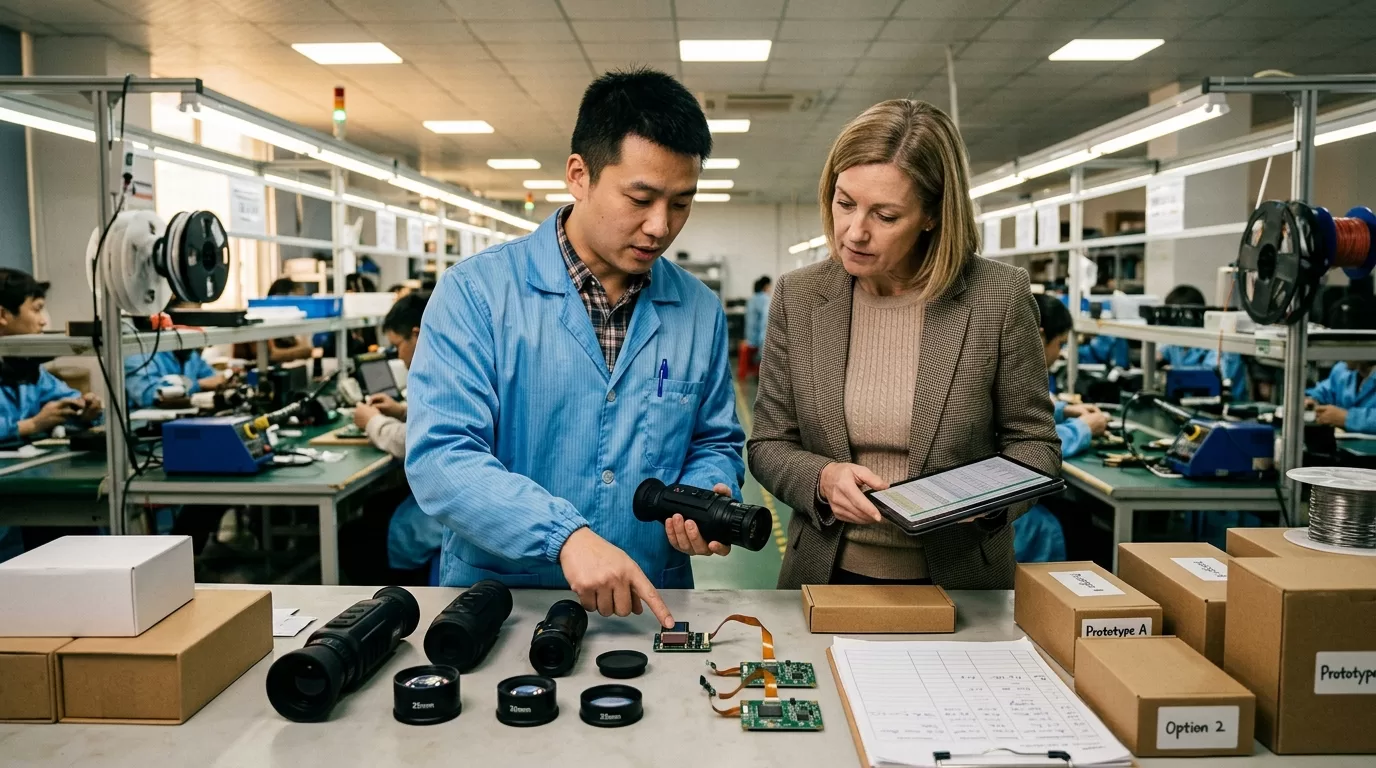
Detector choices matter because a 256×192, 384×288, and 640×512 device may sit on different purchasing plans. Pixfra’s Mile 2 range, for example, includes 256×192, 384×288, and 640×512 options across different model trims. That doesn’t mean a buyer can freely mix all detector levels in one tiny pilot. From a production view, those are different builds with different cost stacks.
Before you trade MOQ for a private-label carton, confirm the compliance packet, because Pixfra’s guide to thermal optics certifications buyers should demand explains why CE, FCC, and RoHS paperwork has to match the actual model, charger, battery, wireless module, and sales market. A PDF from a similar model isn’t enough for a serious U.S. dealer program.
| Usually negotiable | Usually harder |
|---|---|
| Logo sticker on standard carton | New molded housing |
| Standard manual plus insert | Full manual rewrite in multiple languages |
| One SKU pilot | Mixed detector resolutions |
| Standard accessories | New mount, case, or battery pack |
| Paid sample order | Free engineering on first order |
Here’s the blunt version: custom branding is cheap until it touches production. A logo on a carton is simple. A logo molded into the housing means tooling, color matching, material testing, and a longer approval loop. That’s why “same product, just my brand” can still raise MOQ if the request reaches beyond packaging.
A one-SKU pilot works better than a mixed trial pack. If you’re entering the U.S. hunting, wildlife, farm security, or outdoor retail channel, pick the product level that matches your first customer. A store selling entry thermal monoculars may test a 256×192 or 384×288 unit first. A dealer selling long-range scanning may need a 640×512 model with a 25 mm or 35 mm lens. Mixing all of them in the first PO slows learning.
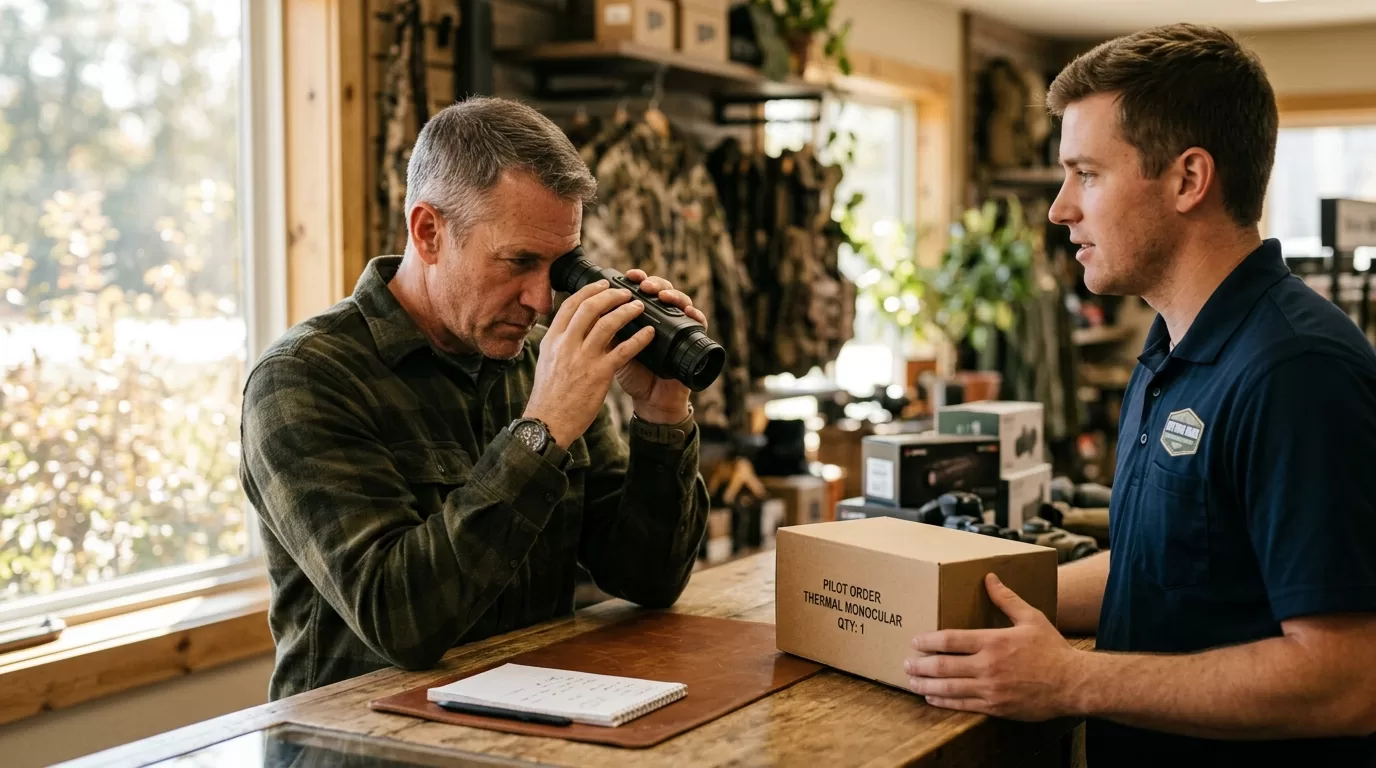
The strongest MOQ levers are the ones that remove doubt for the manufacturer. A signed forecast beats vague optimism. A 50% deposit beats a request for net 30. A standard carton beats a new print run. A dated reorder beats “we’ll buy more if it sells.” Suppliers hear that line every week.
| Buyer lever | Why it helps MOQ talks |
|---|---|
| 50% deposit | Reduces factory cash risk |
| Standard packaging | Avoids carton print minimums |
| One SKU | Cuts setup and QC changes |
| Paid sample fee | Covers engineering time |
| 90-day reorder plan | Gives production a reason to reserve parts |
| Third-party inspection | Reduces dispute risk before shipment |
Try this structure: “We can accept your standard packaging and standard firmware for the first 80 units. If the pilot passes U.S. dealer testing, we’ll place 220 units within 90 days with private-label carton artwork.” That’s a deal a production manager can discuss.
What doesn’t work? Asking for the lowest MOQ, lowest price, custom box, custom startup logo, free samples, net 60 payment, and DDP delivery to Ohio in the same email. That reads like risk from every angle. Pick your battle. For a first order, MOQ matters more than a perfect carton.
Payment terms can move MOQ because they change who carries the risk. The U.S. International Trade Administration says cash-in-advance reduces exporter credit risk because the seller receives payment before shipment, while full prepayment is less attractive for the buyer. That tension is useful. If you want a smaller first order, offer payment terms that make the smaller run easier to approve.

For a new buyer, asking for 30 units and open-account payment is a weak position. Asking for 50 or 80 units with 50% deposit and 50% before shipment is much stronger. If you need extra protection, add pre-shipment inspection instead of pushing the supplier to finance your inventory.
| Order type | Practical term |
|---|---|
| 2-5 samples | 100% prepaid |
| 50-unit pilot | 50% deposit, 50% before shipment |
| 100-200 units | 30/70 or 40/60 after relationship starts |
| 300+ units | Better unit price, stronger delivery slot |
| Annual forecast | Quarterly releases tied to reorder dates |
Incoterms also affect the conversation. EXW gives the buyer more logistics work. FOB gives a cleaner handoff at port. DDP to a U.S. warehouse may sound convenient, but it pushes customs, duties, delivery issues, and paperwork onto the seller. If MOQ is your main concern, keep logistics simple for the first order.
There’s a tradeoff. Better payment terms can lower MOQ, but they shift cash-flow pressure onto you. A 50% deposit on 80 units of thermal scopes is real money. Use that lever when you have dealer demand, not when you’re still guessing.
Some MOQ requests should be rejected, even if the supplier agrees. Thermal optics aren’t generic plastic accessories. Image quality depends on detector grade, lens focus, calibration, firmware behavior, screen quality, and waterproof assembly. A cheap 30-unit batch with inconsistent sensors can burn a new dealer faster than a higher MOQ with stable quality.
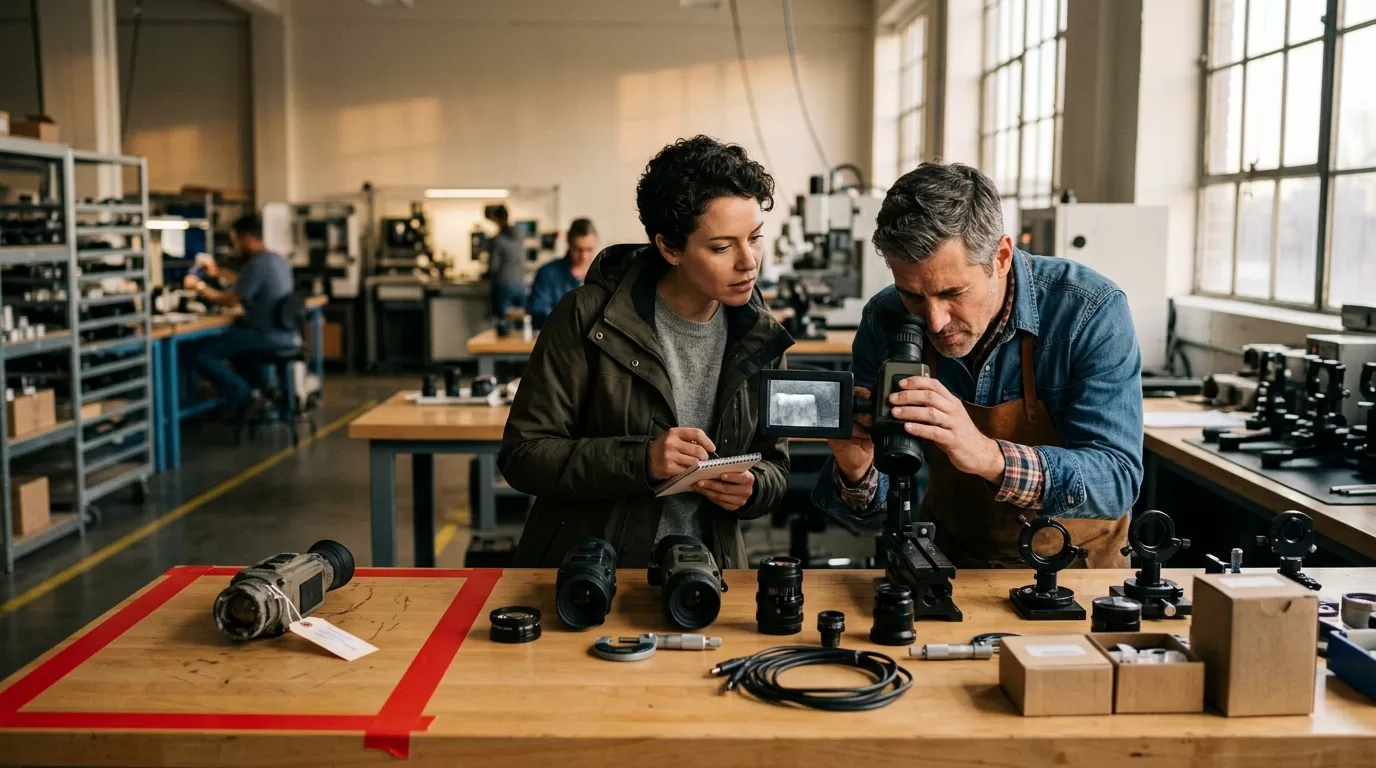
Compliance is another red line. The U.S. Bureau of Industry and Security’s Commerce Control List Category 6 includes controls for some thermal imaging cameras under ECCN 6A003, so classification and destination checks matter. This is especially sensitive if products include thermal imaging, laser rangefinding, wireless functions, or military-adjacent use cases.
Don’t negotiate these away:
The advice in this guide doesn’t apply to every purchase. If you’re buying closeout stock from an older batch, MOQ may be lower because the factory wants space back. That can be fine for a discount retailer, but check firmware age, battery condition, accessory completeness, and warranty path. A low price with dead batteries and no replacement parts isn’t a win.
Be careful with “same as branded model” claims too. Two thermal monoculars can share a detector resolution and still perform differently because of lens quality, NETD, image processing, display, housing seal, and calibration. A 640×512 badge alone doesn’t tell you enough.
Send the MOQ email after you know the product category, detector level, lens size, target price band, and sales channel. “Thermal monocular for hunting” is too broad. “384×288 thermal monocular, 19 mm lens, standard housing, U.S. dealer pilot, 80 units” gives the manufacturer something real to quote.

Use this version as a starting point:
> Subject: Pilot order request for standard thermal monocular SKU
>
> Hi [Name],
>
> We’re preparing a U.S. dealer pilot for one thermal monocular SKU: 384×288 detector, standard housing, standard firmware, and standard accessories.
>
> Your quoted MOQ is 300 units. For the first order, can you quote these two options?
>
> Option A: 80 units, standard packaging, 50% deposit, 50% before shipment.
> Option B: 80 units now plus 220 units within 90 days after field testing, same SKU.
>
> Please also tell us which requirement sets the 300-unit MOQ: detector purchase, lens setup, carton printing, firmware, certification, or another cost.
>
> We can delay private-label packaging until the second order if that helps.
That last sentence does a lot. It tells the supplier you’re serious about volume, but you’re also realistic about factory costs. It gives them room to say yes without eating setup expense.
If you’re comparing two manufacturers, send both the same format. Then compare answers, not only price. The better partner will explain the MOQ driver, offer a workable pilot structure, and flag any compliance limits early. The weaker partner will answer only with “MOQ 300, best price attached.”
Yes. MOQ is negotiable when your order reduces setup risk or pays for the setup cost directly. A buyer asking for 30 private-label 640×512 scopes with new firmware has little room; a buyer ordering 80 standard 384×288 monoculars has much more.
For standard thermal monoculars, a 50-100 unit pilot can be realistic when the model, carton, manual, and firmware stay standard. Custom housing, molded accessories, new app features, or special detector procurement can push the first order toward 300, 500, or more.
Yes, if private labeling includes custom cartons, manuals, molded logos, startup screens, or app changes. If branding stays on a removable label or carton sleeve, the first-order MOQ may stay closer to the standard product minimum.
Often, yes. A higher deposit, prepaid sample fee, or 50/50 payment split can make a smaller pilot easier for the manufacturer to approve. Don’t ask for low MOQ and buyer-friendly credit terms in the same first order.
Yes, if the SKU, firmware language, warranty path, and compliance files match your market. Avoid odd lots with missing accessories, old batteries, EU-only chargers, or unclear FCC files, because the savings disappear when returns start.
For a first U.S. dealer order, send Pixfra your target category, detector level, lens size, branding needs, forecast, and compliance market. We’ll help you separate the pieces worth negotiating from the pieces that protect image quality, safety, and after-sales support.
Thermal optics certifications buyers should demand are FCC for US radio-frequency compliance, CE for EEA market access, and RoHS for hazardous-substance control in electronic parts. Ask for model-specific certificates, declarations, test reports, label artwork, and manual text before you place an order, because a logo on a catalog page won’t protect a dealer when customs, Amazon, a distributor, or a retailer asks for evidence.
The thermal optics certifications buyers should demand are FCC authorization evidence for United States sales, a CE Declaration of Conformity for EEA sales, and RoHS substance-control evidence for electronic parts. Match every document to the exact SKU, firmware/radio configuration, label, and manual before deposit.

Start with the sales market, then work backward. A US dealer selling a Pixfra Mile 2 PFI-M625 to hunters needs FCC evidence. A German distributor will ask for CE and RoHS files. A marketplace seller may ask for both sets because one listing can end up serving buyers in several countries.
This is where low-price thermal optics get expensive. A $60 discount per unit looks good until 200 units sit in a warehouse because the FCC ID doesn’t match the product label, or the CE Declaration lists a generic “thermal camera” with no model codes. Buyers notice. Dealers notice faster.
| Evidence | Demand it when | Ask for | Red flag |
|---|---|---|---|
| FCC authorization | Selling or marketing in the United States | FCC ID or Supplier’s Declaration of Conformity, Part 15 report, manual statement | “FCC pending” or a report for another camera |
| CE Declaration | Selling in the European Economic Area | EU Declaration of Conformity, applicable directives, standards, model list | CE logo only, no signed declaration |
| RoHS evidence | Selling electronics into EU-linked channels | RoHS declaration, material evidence, accessory coverage | Report covers only one cable or old PCB |
| Label and manual package | Any B2B resale channel | Rating label, carton mark, manual compliance pages | Label says one model, invoice says another |
One file can cover several variants, but only when the report says so. Pixfra Mile 2 PFI-M619 and PFI-M625 are both 640 x 512 thermal monocular variants with different optics; if one compliance file covers both, the model list or technical rationale should make that clear. Silence is not proof.
A buying team should treat certification like payment terms. No matching file, no clean order.
FCC proof is the sales gate for the United States. The FCC doesn’t judge thermal image quality, NETD, detection range, or recoil resistance. It cares whether the product’s radio-frequency behavior fits US rules so the device doesn’t cause harmful interference.
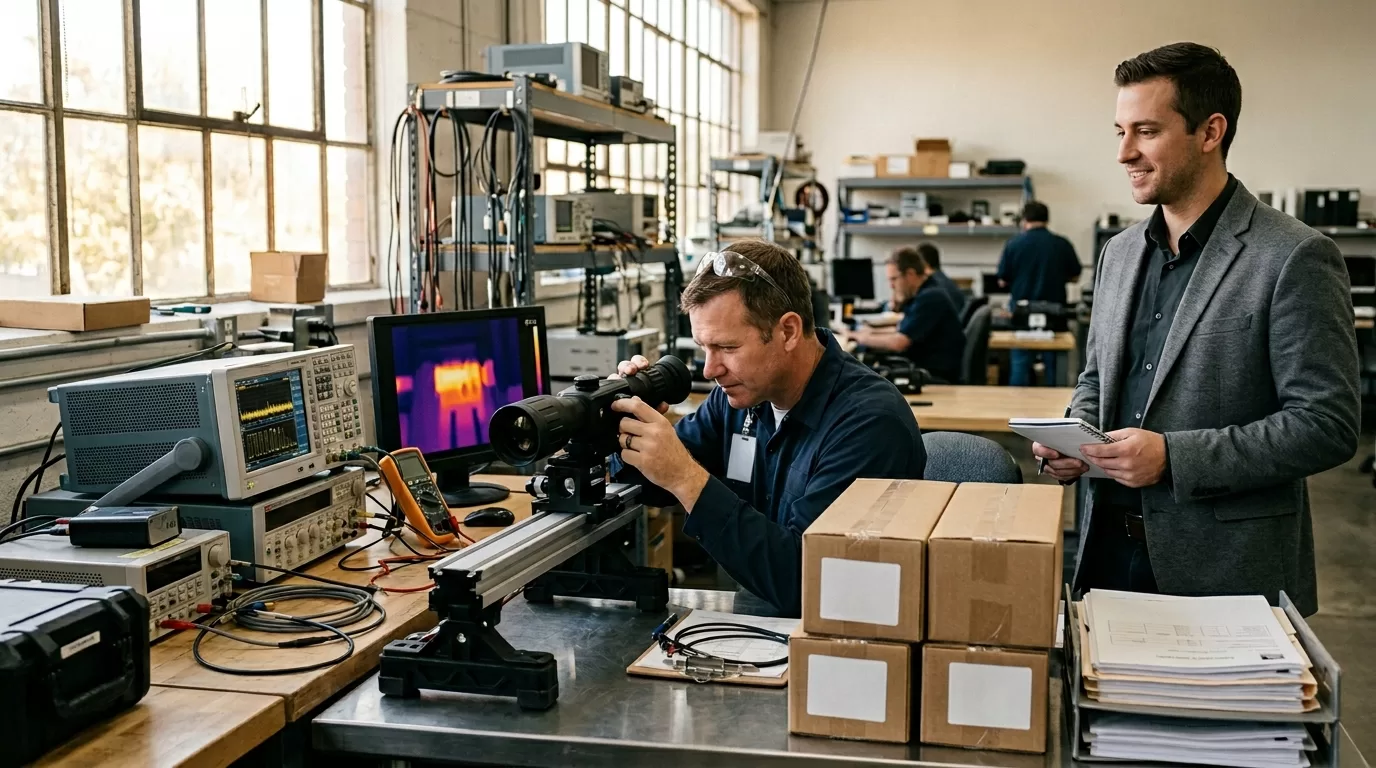
The Federal Communications Commission equipment marketing rules state that radio-frequency devices must meet authorization, labeling, and technical requirements before they’re marketed in the United States, with the route depending on device type. For thermal optics, that usually means asking whether the product is an intentional radiator or an unintentional radiator.
A thermal monocular with Wi-Fi or Bluetooth app pairing usually needs FCC Certification and an FCC ID. A no-radio digital device may use Supplier’s Declaration of Conformity, often called SDoC. The difference matters because SDoC puts real responsibility on the US responsible party. “The lab passed FCC” is not enough by itself.
Ask the supplier for:
The variant list is where shortcuts show. If a Ranger thermal monocular has the same processor board but a different lens, the FCC file may still fit. If a new SKU adds Wi-Fi, changes the radio module, or ships with a different powered accessory, you need fresh evidence or a clear engineering justification.
For US dealers, FCC proof also builds buyer trust. A customer may never read the manual, but a retail platform can. So can a distributor’s compliance desk. If the FCC ID on the label doesn’t match the listing file, the conversation gets slow and awkward.
CE marking is easy to print and hard to defend without the file behind it. For the European Economic Area, CE is the manufacturer’s declaration that the product meets the applicable EU requirements. It is not an EU agency approval stamp.

The European Commission CE marking guidance explains that manufacturers must carry out conformity assessment, prepare technical documentation, issue an EU Declaration of Conformity, and affix the CE mark where CE legislation applies. For buyers, the practical move is simple: ask for the declaration and the evidence behind it.
Thermal optics can touch several EU rule sets. EMC is common for electronic emissions and immunity. RED applies when the optic includes wireless communication. RoHS applies to electrical and electronic equipment. Laser rangefinder models can require extra attention to laser-related standards. Battery, packaging, and local language duties may sit outside the CE file, depending on the channel.
| CE file item | What to check |
|---|---|
| EU Declaration of Conformity | Legal manufacturer name, address, model codes, directives, standards, signature, date |
| Test reports | EMC, RED if wireless, RoHS where listed, and any product-specific standards |
| Technical file index | Photos, circuit diagrams, risk assessment, labels, manual pages |
| Importer or EU contact | Needed when the channel requires an EU economic operator |
| Manual and label set | CE mark placement, warnings, language versions, model consistency |
This advice doesn’t apply the same way to a US-only resale plan. CE is useful as a quality screen, but it doesn’t replace FCC authorization for US marketing. Don’t pay extra for “CE certified” if the supplier can only send a logo screenshot. The document is the value.
A strong CE file should name the exact product family. “Thermal imaging device” is too broad for a distributor buying Arc LRF units with app connection and laser rangefinding. You want model codes, applicable standards, and a signed declaration from the real legal manufacturer.
RoHS is the quiet file that often gets checked late. Too late, usually. A distributor approves pricing, sales sends samples, the product page is ready, then someone asks whether the PCB solder, cable jacket, charger, and plastic components meet restricted-substance limits.

As of June 2026, the European Commission describes RoHS as EU rules restricting hazardous substances in electrical and electronic equipment. The restricted list includes lead, cadmium, mercury, hexavalent chromium, PBB, PBDE, DEHP, BBP, DBP, and DIBP. Those names are not decoration. They map to real materials in electronics.
For thermal optics, RoHS evidence should cover the device and the shipped bundle. A handheld thermal monocular may include a battery, USB-C cable, charger, wrist strap with metal parts, and packaging inserts. A front attachment or thermal scope may ship with mounts, caps, tools, and powered accessories. The buyer’s risk follows the box, not just the optic body.
Good RoHS evidence usually includes:
Don’t demand fresh chemical testing for every screw in every reorder. That burns time and money without improving the file much. For a stable bill of materials, annual declarations plus component-level evidence may be enough. For a new charger supplier, new cable jacket, new PCB finish, or new molded housing, ask again.
RoHS also matters outside Europe. US retailers, distributors, and government-adjacent buyers often use RoHS as a screen for electronics risk. It’s not the same as FCC. It’s not a performance badge. It answers a narrower question: does this electrical product avoid restricted hazardous substances at the levels the rule demands?
Ask for the file before the deposit. Once a factory has your money and production is moving, every missing document becomes a schedule problem, not a paperwork problem.

For the import side, especially HS codes, duties, customs broker files, and product descriptions, pair this certification review with our guide to importing thermal cameras from China so the PO, invoice, packing list, and compliance folder tell the same story. A broker reading “thermal camera” and a certificate reading “digital night vision device” will ask questions.
Use this pre-PO checklist:
The boring part saves the order. If the quote says Pixfra Mile 2 Series, the invoice says PFI-M625, the label says PFI-M619, and the FCC file says “Model A,” someone in the chain has to explain the mismatch. That person may be you.
A practical buyer also asks for sample photos. Get a photo of the rating label on the actual production sample, not a clean PDF label template. Get a photo of the manual compliance page. Get the carton mark. Small mismatches are easier to fix before 500 units are sealed.
Certifications reduce channel risk, but they don’t answer every legal question. FCC, CE, and RoHS don’t decide whether a thermal scope can be used for hunting in a specific US state. They don’t replace export-control review. They don’t prove a laser rangefinder is safe for every use case.
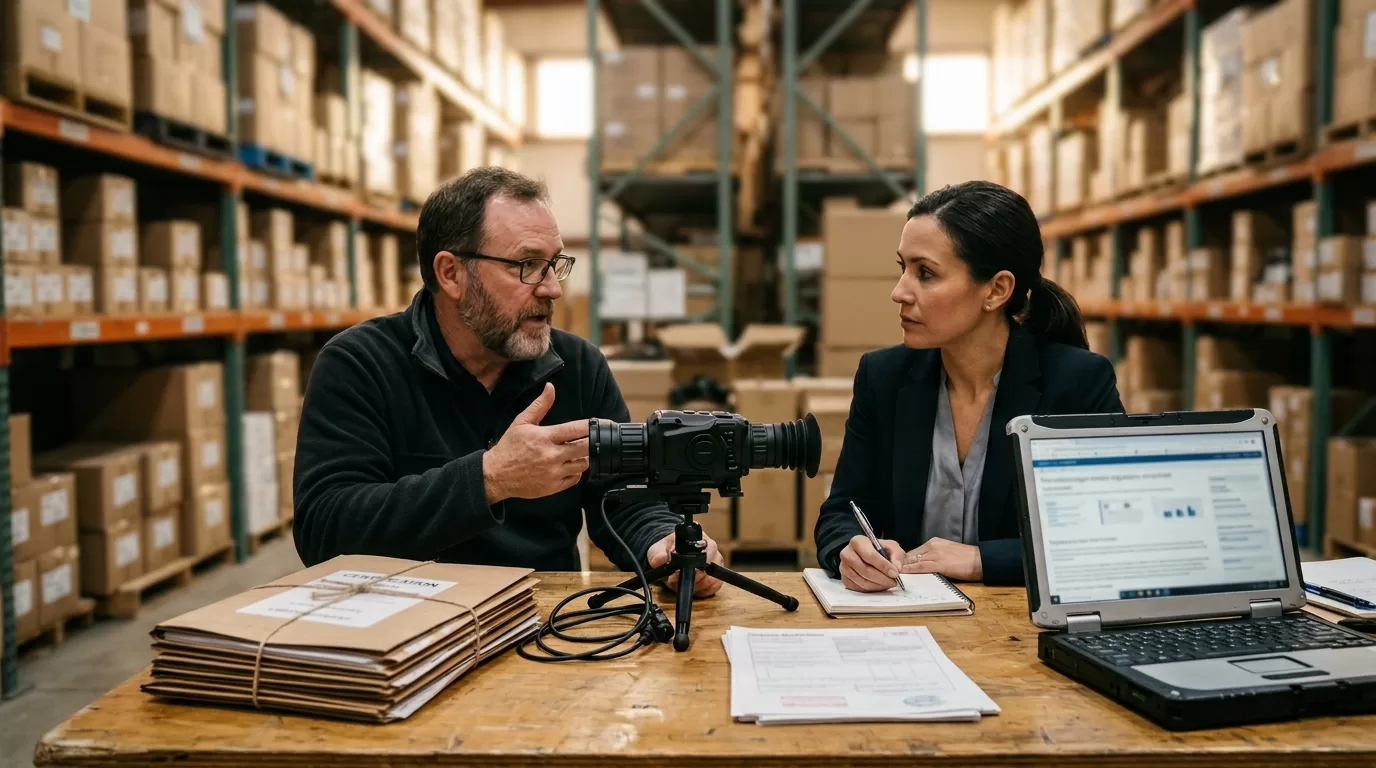
Channel risk changes by sales route. A field-service company buying five thermal monoculars for internal use has a different risk profile than a distributor listing 1,000 units across Amazon US, Amazon Germany, and a dealer portal. Same product. Different file pressure.
| Channel | Extra pressure point |
|---|---|
| Amazon or Walmart Marketplace | FCC ID, label photo, manual statement, invoice match |
| EU distributor | CE Declaration, RoHS evidence, local language manual, importer details |
| Government or utility buyer | Supplier traceability, warranty terms, data/security questions |
| Hunting or shooting dealer | Product classification, state rules, mounting use, return policy |
| OEM or private label buyer | Brand owner responsibility, label control, retesting after changes |
SDoC is cheaper and faster than FCC Certification for eligible no-radio devices, but it puts more burden on the responsible party. FCC Certification costs more, yet an FCC ID gives marketplace reviewers and distributors a cleaner lookup path. For a US reseller, that clarity is often worth the extra lab time.
CE has a similar tradeoff. A supplier may offer one global package with CE, RoHS, FCC, multilingual manuals, and stricter label control. The unit price may be higher. The cheaper package may work for a narrow domestic order, but it can trap you later when a dealer asks for EU files or a marketplace listing expands.
A clean buying file keeps thermal optics certifications buyers should demand from turning into a launch delay. Ask early, match every model, and write change control into the PO.
FCC authorization is usually needed before a radio-frequency device is marketed or imported for sale in the United States. Thermal optics with Wi-Fi or Bluetooth often need FCC Certification; no-radio digital models may use Supplier’s Declaration of Conformity.
CE marking can include RoHS when RoHS is one of the applicable EU requirements, but ask for RoHS evidence separately. A CE logo on the housing doesn’t prove the PCB, cable, battery accessory, and charger materials were reviewed.
Yes, if the variants are listed or the report explains why they are electrically identical. A different radio module, charging board, display driver, or wireless firmware version can force a new authorization or extra test evidence.
No. Amazon, Walmart, and EU marketplace teams may ask for the certificate, test report, label photo, manual statement, responsible party details, and invoice match. Keep the files ready before the listing goes live.
Demand CE if you sell into the EEA, support EU dealers, or use one global product file. For US-only resale, FCC evidence matters more, while RoHS still helps retail buyers screen electronics risk.
For distributor, OEM, or agency purchasing, ask Pixfra for model-level FCC, CE, and RoHS evidence before the PO locks. Send the target market, exact SKU, quantity, channel, and bundle contents; the Pixfra team can help match the right thermal optic to the file package your buyer will ask for later.


