















From nighttime patrols to perimeter sweeps, thermal devices give security teams and law enforcement a tactical edge that flashlights and standard cameras can’t touch. At Pixfra, we build thermal monoculars, scopes, and front attachments designed for real-world field conditions — and we’ve put together this list of the 8 best thermal devices for security and law enforcement in 2026.
Why Security Teams Need Thermal Devices
Thermal imaging has gone from a niche military tool to a standard piece of gear for police departments, private security firms, and property patrol teams across the United States. Thermal imaging cameras detect heat, enabling law enforcement professionals to see in complete darkness. Unlike night vision cameras, thermal imaging cameras require no ambient light and retain their clarity in any lighting condition. If someone is hiding behind a bush, under a car, or crouching in a dark alley, their body heat shows up on a thermal display like a glowing outline. Handheld thermal imagers work by creating a virtual display showing the heat signatures of objects in the field of view, and these devices can provide responders with a covert method of surveillance, providing a tactical advantage at night. For law enforcement officers working the late shift or responding to a call in a wooded area, that’s not a nice-to-have — it’s a lifeline that keeps them safer and more effective on every shift.

The thermal device market in 2026 looks very different from a few years back. Sensor resolutions have climbed while prices have dropped. What used to be a premium 640×512 resolution is now a mid-range standard, and NETD sensitivity levels below 20mK are available outside of strictly military-grade equipment. These advances mean police departments, security agencies, and private property owners can now access thermal imaging that delivers clear, high-contrast imagery for a fraction of what it cost just three or four years ago. If you want a deeper look at what separates a great thermal device from a forgettable one, check out our breakdown of the top 6 features needed in the best thermal device in 2026.
Whether you’re a patrol officer scanning a parking lot, a SWAT team member clearing a building, a border security agent watching a fence line, or a private guard patrolling a warehouse district, the right thermal device changes how you operate at every level. You spot threats earlier. You make faster, better decisions. You stay safer while doing it. In today’s rapidly evolving security landscape, law enforcement thermal imaging technology has become an indispensable tool for police departments, SWAT teams, and security professionals worldwide. And with features like built-in laser rangefinders, Wi-Fi streaming to smartphones, onboard video recording, and rugged IP67 weatherproofing now standard on serious devices, today’s thermal imaging equipment is a complete field toolkit — not just a fancy scope.
8 Best Thermal Devices for Security and Law Enforcement
We built this list based on what actually matters for security and law enforcement work: detection range, sensor sensitivity, durability, battery life, and the kind of smart connectivity features that keep you efficient during a 10-hour shift. Every device on this list comes from our Pixfra lineup, and each one is built for real outdoor conditions — from freezing winter nights to dusty summer patrols. Our proprietary heat-detection technology powers every model with NETD values of ≤18mK, placing them at the top end of thermal sensitivity for tactical-grade optics. Here’s how our 8 picks stack up side by side:
| # | Device | Type | Detection Range | LRF | Best For |
|---|---|---|---|---|---|
| 1 | Sirius HD | Thermal Monocular | Up to 3,600m | — | Long-range surveillance & border patrol |
| 2 | Arc LRF | Thermal Monocular | ~500m+ | Yes (1,000m) | Patrol & perimeter checks |
| 3 | Mile 2 | Thermal Monocular | ~500m+ | — | Everyday patrol & scouting |
| 4 | Chiron LRF | Thermal Scope | Mid-long range | Yes (1,000m) | Tactical ops & SWAT |
| 5 | Pegasus 2 LRF | Thermal Scope | Mid-long range | Yes | Precision target locking |
| 6 | Taurus LRF | Thermal Front Attachment | Mid-long range | Yes (1,000m) | Weapon-mounted thermal |
| 7 | Draco | Thermal Front Attachment | Mid range | — | Lightweight tactical use |
| 8 | Volans | Day & Night Vision Scope | Mid range | Available | 24-hour all-day operations |
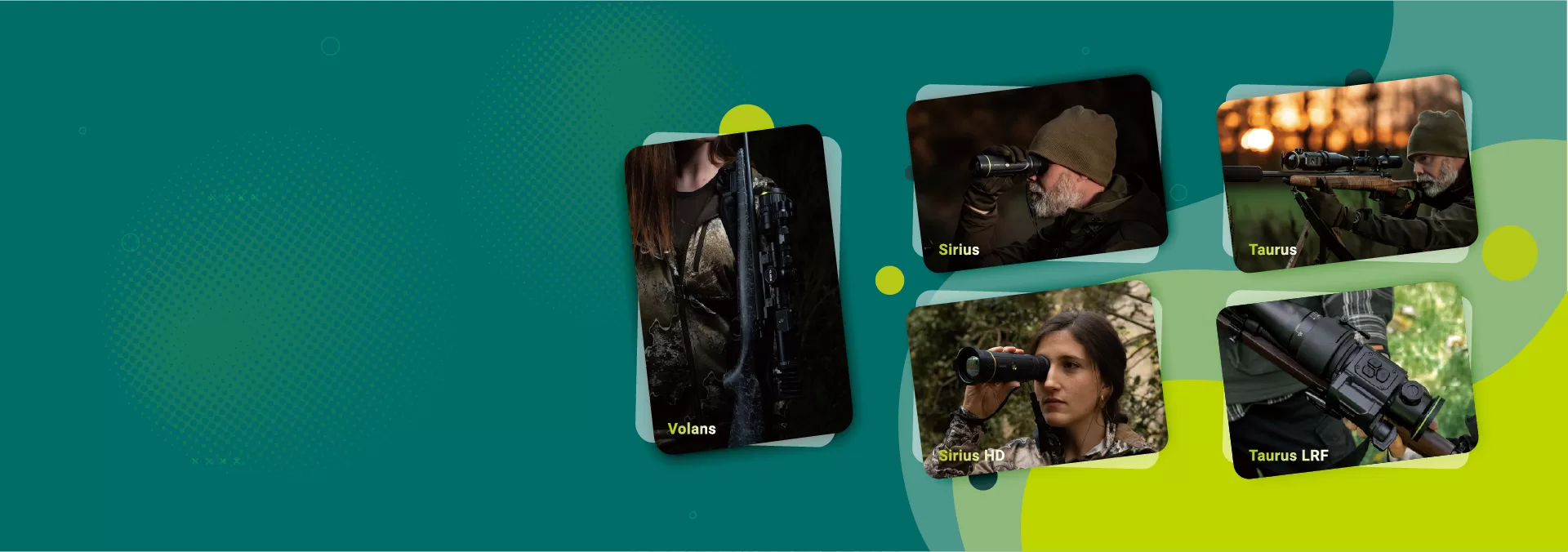
The Sirius HD is our heavy hitter for agencies that need to cover massive areas. With a detection range stretching out to 3,600 meters, it’s built for border patrol operations, large property surveillance, and any scenario where you need to scan wide-open ground from a fixed position. At the other end of the spectrum, the Arc LRF and Mile 2 series are your best options if you need a compact, pocketable thermal monocular for nightly patrol. The Arc LRF packs an integrated laser rangefinder with 1,000-meter capability, so you can get instant distance-to-target data with a single button press — no fumbling for a separate device in the dark. The Mile 2 keeps things simple and reliable for officers who need thermal imaging every shift without extra complexity. Both models deliver ≤18mK NETD sensitivity, so you’ll see crisp outlines of people and objects even on warm nights when the temperature difference between a suspect and the background is small.

For tactical teams and officers who need thermal imaging mounted on their rifle, the Chiron LRF and Pegasus 2 LRF are our top thermal scopes. The Chiron LRF comes with an integrated laser rangefinder and a built-in ballistic calculator that computes bullet drop and adjusts your aiming point on the fly — a full targeting solution in one device for SWAT teams and tactical units operating in zero-visibility conditions. The Taurus LRF and Draco series work as thermal front attachments, mounting in front of your existing daytime scope to convert it into a thermal optic without changing your zero. The Taurus LRF features ultra-fine zeroing precision with a 0.9cm@100m click value, which matters when every shot counts. The Draco stands out for its lightweight design, built for officers who need multi-functional performance without adding weight to their gear. And if your team pulls shifts that span daylight and darkness, the Volans series delivers all-day vision with an adjustable aperture from F1.2 to F3.0, adapting to any lighting condition you’ll encounter — making it one of the few thermal devices that performs just as well at noon as it does at midnight.
Key Specs for Tactical Thermal Devices
Two specs will make or break your thermal device in the field: NETD and sensor resolution. NETD — Noise Equivalent Temperature Difference — measures how sensitive the thermal sensor is to small temperature changes. Lower numbers equal clearer, more detailed images. For law enforcement and security operations, you want ≤25mK at a bare minimum, and ≤18mK if you’re doing any serious nighttime or tactical work. All of our Pixfra devices hit ≤18mK, which means you’re seeing defined, high-contrast outlines of people and vehicles — not washed-out blobs. Pair that with 12μm pixel pitch technology and you get sharp imagery across sensor resolutions from 256×192 (good for close-range patrol) up to 640×512 (the go-to for professional security and law enforcement use). Resolution alone isn’t the whole story, though. A 50Hz refresh rate is the baseline for any thermal device worth carrying on duty in 2026 — it delivers smooth, fluid imaging that lets you track moving targets like fleeing suspects without blur or chop. Anything below 30Hz will give you stuttering video that makes fast-moving targets hard to follow.
According to a 2024 IACP survey, 78% of police departments using thermal cameras reported a 40% reduction in nighttime accidents, 35% faster suspect apprehension, and 60% improvement in search-and-rescue success. Numbers like that don’t come from spec sheets — they come from image quality, sensor sensitivity, battery reliability, and overall toughness. Our Pixfra devices range from approximately 4.5 to 15 hours of battery life depending on the model, and many use standard 18650 batteries that swap in seconds when power runs low. For durability, IP67 is the gold standard — fully sealed against dust and rated for temporary water submersion, which handles rain, stream crossings, snow, and accidental drops into puddles. Our Pixfra Outdoor App connects to every current model (Sirius, Arc LRF, Mile 2, Pegasus Pro, Chiron LRF, Taurus, and Taurus LRF) for firmware updates, settings control, and image transfer directly to your phone. Wi-Fi streaming, onboard video recording, and multiple color palettes — White Hot, Black Hot, Red Hot, Iron Bow — round out the feature set that field professionals rely on daily.
How Law Enforcement Uses Thermal Imaging
On a typical night patrol, a handheld thermal monocular turns a routine area scan into a real security sweep. Officers can use thermal imaging devices to spot a recently pursued car — a dark, parked car in a lot full of them, or alone in the middle of an open field, can be difficult to spot, but seen through an IR scope, the hot car stands out as if lit by a spotlight. Beyond vehicle pursuits, officers can detect people hiding in tree lines, spot discarded evidence like a warm firearm tossed into bushes, or sweep a wide perimeter from a single vantage point using a device with 500+ meter detection range. Thermal imagers have the capability to display the difference in temperature between objects, as well as an object’s heat signature and residual heat signature, and these devices are used by responders for search and rescue operations, for investigations, and to increase visibility through fog, smoke, dust, rain, and excessive glare. That kind of all-conditions performance means an officer with a thermal monocular like our Arc LRF or Mile 2 never has to rely on ambient light, street lamps, or a flashlight beam that gives away their position.

For SWAT and tactical teams, thermal scopes and front attachments allow target engagement in zero-visibility scenarios — smoke-filled buildings, blacked-out warehouses, or outdoor operations in dead-of-night conditions. SWAT thermal imaging gear provides specialized tactical teams with enhanced capabilities during high-risk operations, enabling teams to conduct reconnaissance, track suspects through complex environments, and maintain situational awareness during dynamic entries. Thermal front attachments like our Taurus LRF mount to existing optics, so officers don’t need to re-zero or retrain on a new sighting system — they just clip it on and gain full thermal capability. For search and rescue, a thermal monocular can locate a lost person in a wooded area in minutes instead of hours. And for covert surveillance, thermal imaging gives you a passive, no-light-required view that doesn’t reveal the observer’s position. Prosecutors increasingly use thermal imaging recordings to secure convictions, and onboard recording features in devices like our Chiron LRF make it simple to document everything in real time.
Private security firms are adopting thermal devices at a growing rate, too. Warehouse patrols, industrial facility sweeps, and residential estate monitoring all benefit from handheld thermal monoculars that can cover large areas fast. Handheld thermal cameras are increasingly used for personal security applications, and these portable devices allow security personnel to perform quick heat detection in any environment — whether you’re patrolling a large area, monitoring a crowd, or looking for intruders in a remote location. Our Volans series is especially practical for security teams pulling 12-hour shifts that span daylight and darkness. Instead of switching between daytime optics and night gear, your team carries one device that handles both — all-day vision through an adjustable aperture means no more mid-shift equipment swaps.
Thermal Imaging vs. Night Vision for Security
If you’re deciding between thermal imaging and traditional night vision for security or law enforcement work, here’s the straight answer: thermal wins in almost every real-world scenario. Thermal imaging in security uses cameras that detect infrared radiation — heat — rather than visible light, producing images based on temperature differences between objects and their surroundings. Unlike standard optical cameras, thermal cameras work in complete darkness, through light fog, and are unaffected by shadows, glare, or deliberate lighting changes. Night vision amplifies available light — moonlight, starlight, street lamps — and produces a visible image. It works OK in low-light conditions with some ambient illumination, but it goes blind in total darkness, heavy fog, or smoke. Thermal imaging detects heat, not light, so it performs in pitch-black environments, through fog, light rain, dust, and even partial foliage cover. For any security team or law enforcement agency operating at night, that gap is the difference between spotting a suspect and walking right past them.

The one area where night vision holds an edge is producing high-resolution, color-accurate images in very low light — useful for facial identification or reading license plates. But for detection, tracking, and situational awareness, thermal is the better tool. For security applications, thermal imaging excels at detection — confirming that something is there — while optical cameras and AI analytics handle classification. With devices like our Volans series offering all-day vision through an adjustable aperture (F1.2 to F3.0), you don’t even have to choose between day and night capability. You get both in one device — and one fewer piece of gear to carry, charge, or worry about breaking. For most security and law enforcement professionals, a quality thermal device will outperform night vision on every patrol, every shift, every time conditions get ugly.
FAQs
Can police use thermal imaging without a warrant?
This is one of the most debated legal questions around thermal imaging in law enforcement. In the landmark Kyllo v. United States case, the Supreme Court held that thermal imaging of a home constitutes a “search” under the Fourth Amendment. That means using a thermal device to scan the inside of someone’s home from outside generally requires a warrant. However, using thermal imaging in open outdoor areas — during a foot pursuit, a perimeter search, or a patrol sweep of public spaces — is a different situation and is widely practiced by law enforcement agencies across the country. Officers should always check their department’s policies and consult legal counsel for specific scenarios.
How far can a thermal device detect a person?
Detection range depends on the device’s sensor resolution, lens size, and NETD sensitivity. Entry-level thermal monoculars typically detect human-sized heat signatures at around 300 to 500 meters. Mid-range models with 384×288 or 640×512 sensors push that out to 1,000–1,500 meters. Our Pixfra Sirius HD series reaches up to 3,600 meters, which covers wide-area surveillance and border patrol applications. Keep in mind that detection range — where you can tell “something is there” — is always longer than identification range, where you can confirm exactly what you’re looking at. For security work, always ask about both numbers before you buy.
Can thermal cameras see through walls?
No. Thermal cameras detect surface-level heat radiation — they don’t see through solid walls, glass, or metal. However, if someone is standing against a thin wall or door and transferring body heat to the surface, a thermal device can sometimes pick up that heat signature on the surface itself. This makes thermal imaging useful for detecting the presence of people near walls, doors, or windows, even though it can’t produce an image of what’s behind them. For law enforcement, this is a helpful detection tool during building searches, but it’s not X-ray vision.
What’s the best NETD for a law enforcement thermal device?
For most law enforcement, security, and outdoor patrol work, you want a thermal device with NETD of ≤25mK or lower. A device with ≤18mK — like every model in our Pixfra lineup — picks up extremely small temperature differences, producing sharp, detailed images even in challenging conditions like fog, humidity, or warm summer nights when everything radiates heat at similar levels. Lower NETD numbers translate directly to better image contrast, which means you can distinguish a person from their background faster and at greater distances.
Is thermal better than night vision for security?
For most security applications, yes. Thermal imaging works in total darkness, through fog, smoke, and light rain, and it detects heat signatures that are completely invisible to night vision. Night vision needs at least some ambient light to function and can be blinded by bright light sources like headlights or flashlights. Thermal devices are also passive — they don’t emit any light or signal, so they won’t reveal your position during covert operations. The only edge night vision holds is higher-resolution color imagery in low-light scenes with some available illumination, which helps with facial identification. For detection, tracking, and all-conditions awareness, thermal imaging is the stronger tool.