


Dealer margins on thermal scopes usually look better in a pricing sheet than they do after freight, card fees, returns, demos, and markdowns. In the U.S. optics channel, a dealer may buy 30% to 45% below MSRP, advertise near MAP, and still finish with a much smaller net profit than a simple “wholesale versus retail” calculation suggests.
Dealer Margins On Thermal Scopes
Dealer margins on thermal scopes are usually measured as the gap between landed dealer cost and actual selling price. A healthy thermal optics target is often 25% to 40% gross margin at MAP, while real net margin can fall to 8% to 18% after shipping, payment fees, demos, returns, and aged inventory.
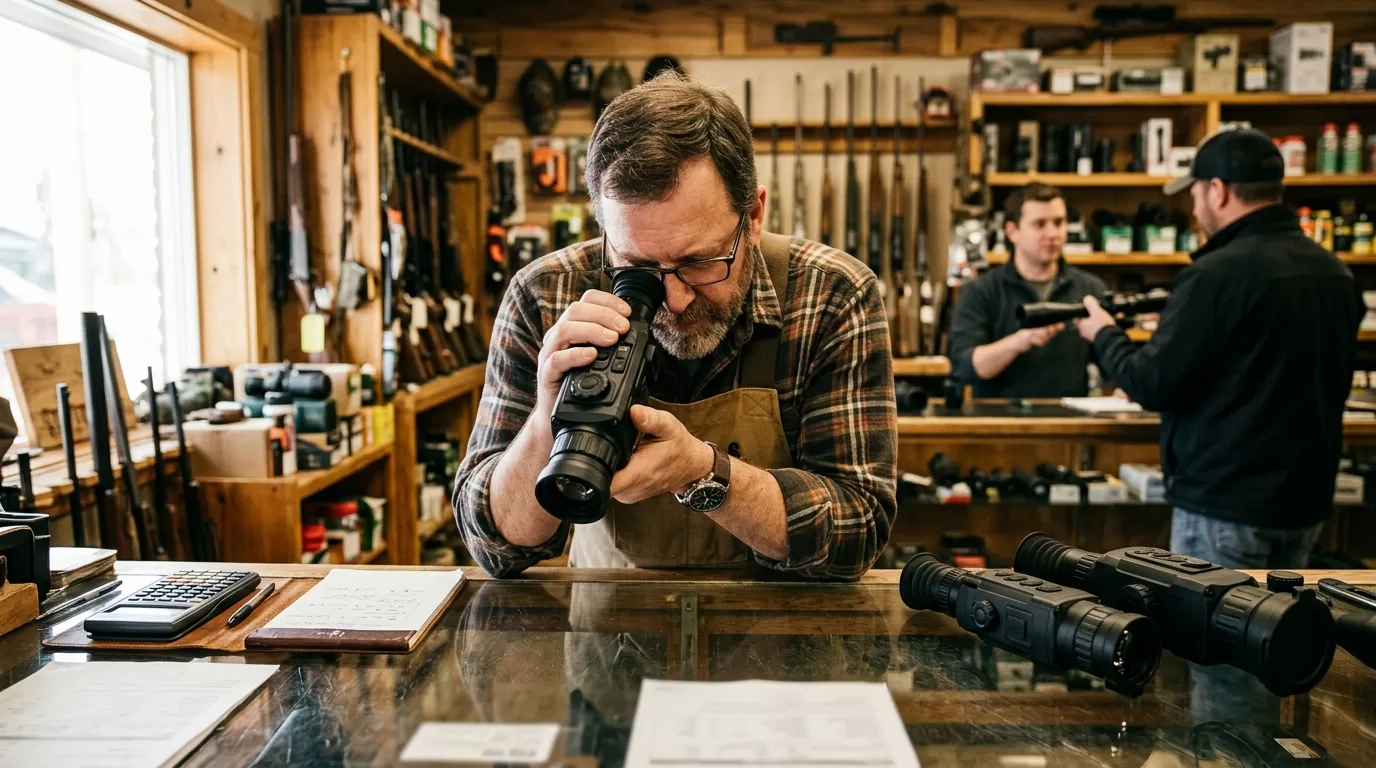
Start with the math. If a thermal scope has a $2,999 MSRP and the dealer buys it for $1,800, the paper gross profit at full MSRP is $1,199. That sounds rich. Sell it at a $2,599 street price, pay 3% card fees, cover outbound shipping, and discount a mount or battery pack, and the deal feels different by Friday afternoon.
“Keystone” pricing means buying at half of retail. In plain English: a $3,000 scope costs the dealer $1,500. That creates a 100% markup on cost and a 50% gross margin on retail. Reddit threads often treat keystone as normal retail math, but thermal scopes don’t always behave like apparel, holsters, or small accessories. Unit cost is high, model cycles are fast, and one wrong bet on sensor resolution can tie up cash for months.
| Pricing term | Example | What it means |
|---|---|---|
| MSRP | $2,999 | Brand’s suggested retail price |
| Dealer cost | $1,800 | Invoice price before landed costs |
| MAP | $2,699 | Lowest advertised price allowed by policy |
| Street price | $2,499 | Real selling price after calls, bundles, or promos |
| Gross profit | $699 | Street price minus dealer cost |
| Gross margin | 28.0% | Gross profit divided by street price |
If you treat dealer margins on thermal scopes as “MSRP minus invoice,” you’ll overestimate profit. Use landed cost. That means product cost, inbound freight, import fees if you’re buying direct, insurance, payment processing, demo wear, and the chance that a customer sends back a $2,500 optic after one weekend because the menu felt different from his old Pulsar Thermion.
Thermal also has a confidence cost. A dealer selling a $199 red dot can absorb a slow support call. A dealer selling a $3,500 Trijicon IR-HUNTER, Pulsar Thermion 2 LRF XP50 Pro, AGM RattlerV2 35-384, iRayUSA RICO RH50R, or Pixfra thermal optic needs staff who can explain NETD, detection range, refresh rate, zeroing, app pairing, and warranty process without guessing.
Wholesale Terms That Matter
A distributor quote and a manufacturer-direct quote can look similar until you read the fine print. One includes net-30 terms, returns, co-op ad funds, and mixed-SKU ordering. The other gives a sharper unit cost but asks for prepaid inventory, a higher opening order, and slower warranty routing. Your margin lives in those details.

Volume tiers matter, but they’re not magic. A new dealer might see 30% off MSRP. A regional retailer with steady sell-through might get 38% off. A large account taking container-level volume, committing to launch buys, or agreeing to training requirements may get better pricing. The tradeoff is obvious once the invoice lands: lower cost usually asks for more cash, more shelf risk, or less flexibility.
If you’re still working through opening order size, payment timing, and SKU mix, Pixfra’s guide on how to negotiate MOQ with a thermal optics manufacturer pairs well with this pricing discussion because MOQ can quietly decide whether a dealer’s margin is real or just trapped in unsold inventory.
| Wholesale variable | Good for margin | Risk for dealers |
|---|---|---|
| Lower unit cost | More room at MAP | Larger cash outlay |
| Net-30 terms | Better cash timing | Credit limits and late fees |
| Mixed model buys | Less dead stock | Smaller discount tier |
| Demo program | Easier customer conversion | Open-box resale loss |
| Co-op marketing | Helps local ads | Often requires approval |
| Price protection | Reduces closeout pain | Usually limited by policy |
The best wholesale deal isn’t always the lowest invoice. A $1,760 unit cost with no price protection can be worse than a $1,840 unit cost with 60-day protection if the brand cuts MAP two weeks after your delivery. That happens in electronics. Thermal optics sit close to consumer electronics in one respect: sensor, display, battery, rangefinder, and firmware changes make older stock feel old fast.
For Pixfra dealers and distributors, we’d rather see a disciplined first order than an ego order. A tighter mix of proven SKUs, clear use cases, and staff training usually beats a wall of every model. Thermal buyers ask pointed questions. “Can I identify a coyote at 250 yards?” “Will this hold zero on .308?” “How does the image look in humidity?” Inventory depth only helps when your team can answer those questions cleanly.
MAP, MSRP, Street Price
MSRP is a suggestion. MAP is an advertising policy. Street price is what the buyer actually pays. Mix those up and your margin forecast turns into fiction, especially when a customer compares your website, a phone quote, a gun show table, and a marketplace listing in the same ten minutes.
The Federal Trade Commission explains that manufacturers may suggest resale prices, but antitrust risk rises when pricing agreements restrain competition. See the FTC’s guidance on manufacturer-imposed requirements for the U.S. baseline. Translation for dealers: MAP policy is usually about advertised price, not every private transaction, but you need the written policy and your own counsel for edge cases.
There’s also a truth-in-advertising angle. The FTC’s Guides Against Deceptive Pricing warn against misleading price comparisons. If a brand lists a $3,499 MSRP but nobody sells near that price, “$700 off” starts to smell bad. Thermal buyers are price-aware. They’ll check.
| Term | Dealer mistake | Better practice |
|---|---|---|
| MSRP | Treating it as expected sale price | Use it as an anchor only |
| MAP | Assuming it protects all margin | Track private offers and bundles |
| Street price | Ignoring phone quotes | Mystery-shop key competitors |
| Promo price | Forgetting sell-through dates | Mark calendar before buying deep |
| Bundle value | Discounting everything | Bundle accessories with real margin |
MAP can still help. It prevents the fastest online seller from turning a $2,699 optic into a public $2,199 race by breakfast. But MAP doesn’t make a buyer loyal. If two dealers advertise the same Pulsar, AGM, ATN, iRayUSA, or Pixfra model at MAP, the sale goes to the dealer who answers faster, explains use case fit better, and ships without drama.
Street price is where the market tells the truth. A dealer might advertise a Pixfra thermal scope at MAP, then close the sale with a mount bundle, a store credit, free expedited shipping, or a private quote. That can be fine if the brand policy allows it. It can also erase 6 margin points before anyone notices.
Thermal Scope Profit Leaks
The biggest profit leak is slow inventory. A thermal scope that sells in 20 days is a very different business from one that sells in 160 days. The unit may have the same gross margin on paper, but the second one eats cash, display space, staff time, and markdown risk while newer sensor specs appear in customer searches.

Payment fees matter more than dealers admit. On a $2,699 sale, a 2.9% card fee is about $78. Add $28 insured shipping, $18 packaging and handling, $45 in staff time across pre-sale and post-sale support, and a $35 discounted accessory. Your $699 gross profit is now closer to $495 before rent, payroll, ads, and returns.
Returns sting. A box-opened thermal scope can’t always go back into stock as new, especially if the rail has clamp marks or the buyer registered the warranty. Even a clean open-box unit may need a 7% to 12% discount to move. On a $2,500 optic, that’s $175 to $300 gone because someone changed his mind after scanning a tree line behind the house.
| Profit leak | Typical hit | Dealer control |
|---|---|---|
| Card fee | 2.6% to 3.5% | Medium |
| Outbound shipping | $20 to $60 | Medium |
| Return/open-box loss | 7% to 12% | Low to medium |
| Demo discount | 10% to 20% | High |
| Marketplace fee | 8% to 15% | Medium |
| Closeout markdown | 15% to 35% | Medium |
Support is real cost. Thermal buyers ask about recoil rating, zero profiles, reticle choices, detection versus identification range, fog, rain, firmware updates, batteries, and recording. A dealer with trained staff earns the sale faster. A dealer without training spends 35 minutes on the phone and still loses to a shop that has a night-hunt staffer who can say, “For hogs under 200 yards, I’d rather put you in the 384 sensor with better base magnification than stretch you into a model you’ll fight.”
This is where Pixfra’s B2B approach should stay practical. Good product pages, clear spec sheets, real range language, and clean warranty routing help the dealer protect margin because fewer buyers need hand-holding after checkout. Fewer surprises means fewer returns. Pretty simple.
Pricing Strategy For Dealers
Price the buyer’s decision, not just the optic. A first-time coyote hunter shopping under $2,000 doesn’t need the same sales path as a ranch owner comparing a $4,500 thermal scope with an LRF model. If you flatten every buyer into one discount bucket, your best customers get trained to wait for coupons.
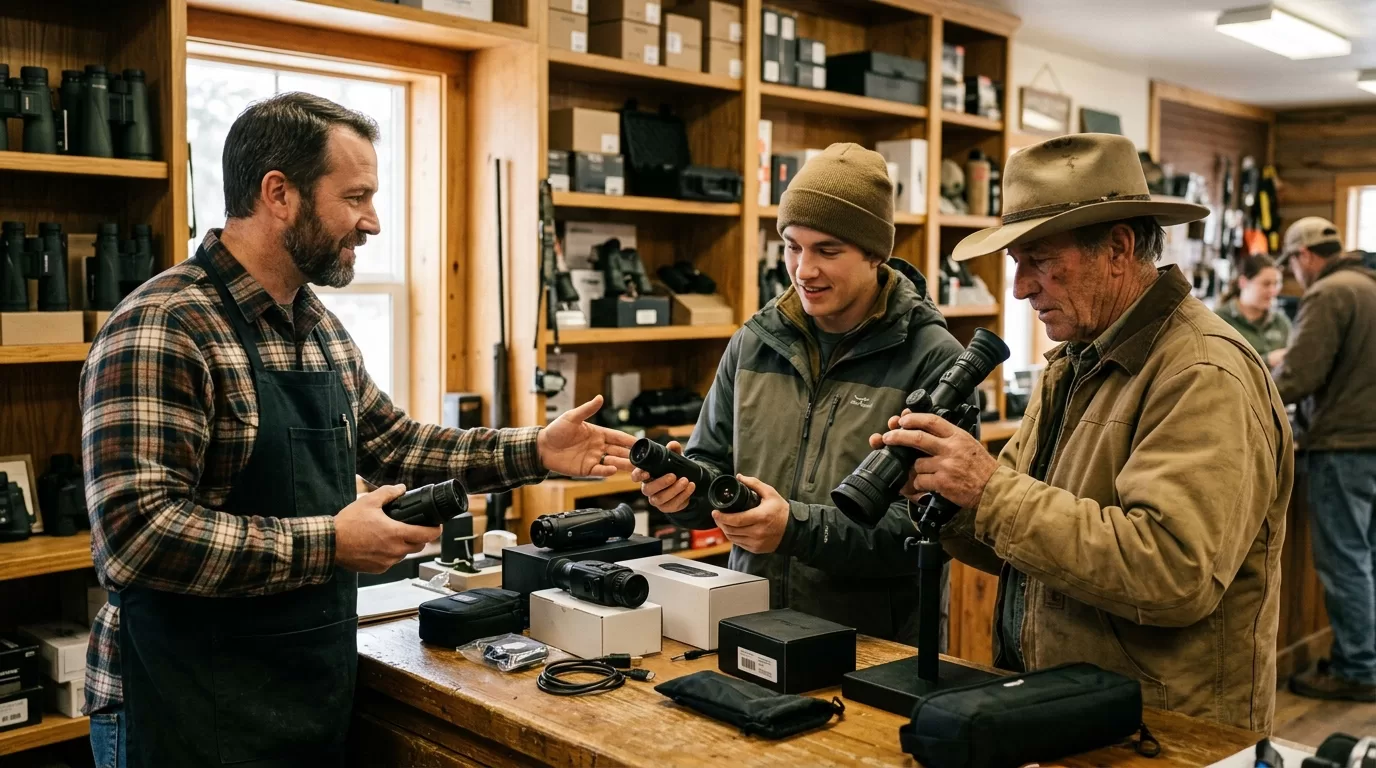
For new dealers, start with two or four thermal SKUs instead of eight. Cover a clear entry point, a high-confidence midrange model, and one premium option only if your staff can sell the difference. A Pixfra-heavy mix might pair an accessible thermal monocular with a hunting-ready thermal scope, then add mounts, spare batteries, and a zeroing support offer. Accessories can carry better margin without making the optic look overpriced.
For established dealers, segment by sales channel. In-store buyers can pay MAP when they get live setup help. E-commerce buyers compare harder, so bundles and fast shipping matter. Outfitter and ranch accounts care about uptime and repeatability. Law-enforcement or nuisance-control buyers may ask for documentation, purchase orders, and service timing. One policy won’t fit all four.
A simple dealer rule works better than chasing every competitor: protect margin on current models, move aging models early, and never discount a scarce SKU unless the buyer gives you something back, such as a multi-unit order, accessory attach, or deposit on the next shipment.
| Dealer situation | Better move | Avoid |
|---|---|---|
| New thermal dealer | Narrow SKU mix | Buying every trim |
| Local gun shop | Sell setup help | Matching online price instantly |
| E-commerce seller | Bundle smart | Public under-MAP pricing |
| Outfitter account | Offer fleet terms | One-off coupon chaos |
| Old inventory | Mark down early | Waiting until specs feel stale |
The hardest part is saying no. If your landed cost is $1,820 and your real all-in selling cost is $180, a $2,199 sale leaves about $199 before overhead. That’s thin for a high-support product. You might accept it to clear aging stock. You shouldn’t build your normal business around it.
FAQ
What margin do dealers make?
Thermal scope dealers often target 25% to 40% gross margin at MAP. Net margin can drop to 8% to 18% after fees, freight, support, returns, and markdowns.
Is keystone pricing realistic?
Keystone pricing can happen, but it isn’t reliable for current thermal scopes. High unit cost, fast model cycles, MAP rules, and warranty support often push real dealer economics below keystone.
Are MAP and MSRP the same?
No. MSRP is the brand’s suggested retail price, while MAP is the lowest advertised price allowed under a brand policy. Street price can still differ depending on private quotes, bundles, and promotions.
Why do street prices vary?
Street prices vary because dealers have different costs, inventory age, promo support, shipping policies, and appetite for margin. A dealer clearing old stock can price far below one selling fresh inventory.
How can dealers protect profit?
Dealers protect profit by tracking landed cost, training staff, limiting slow SKUs, bundling high-margin accessories, and moving aging inventory before major model updates. Price protection terms also matter.
Pixfra works with dealers who want thermal imaging products they can explain, support, and sell with confidence. If you’re building a thermal optics program, compare wholesale cost, MAP, street pricing, and support burden before you chase the lowest invoice.