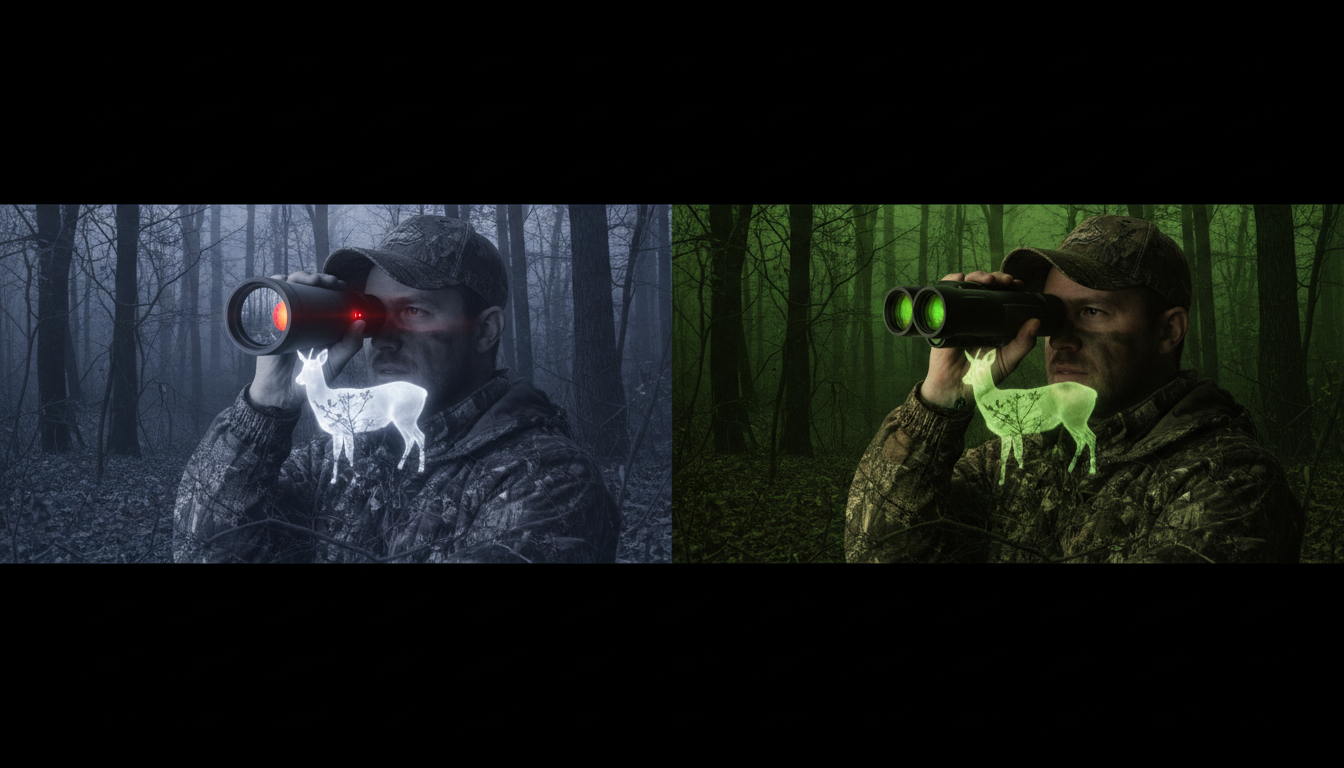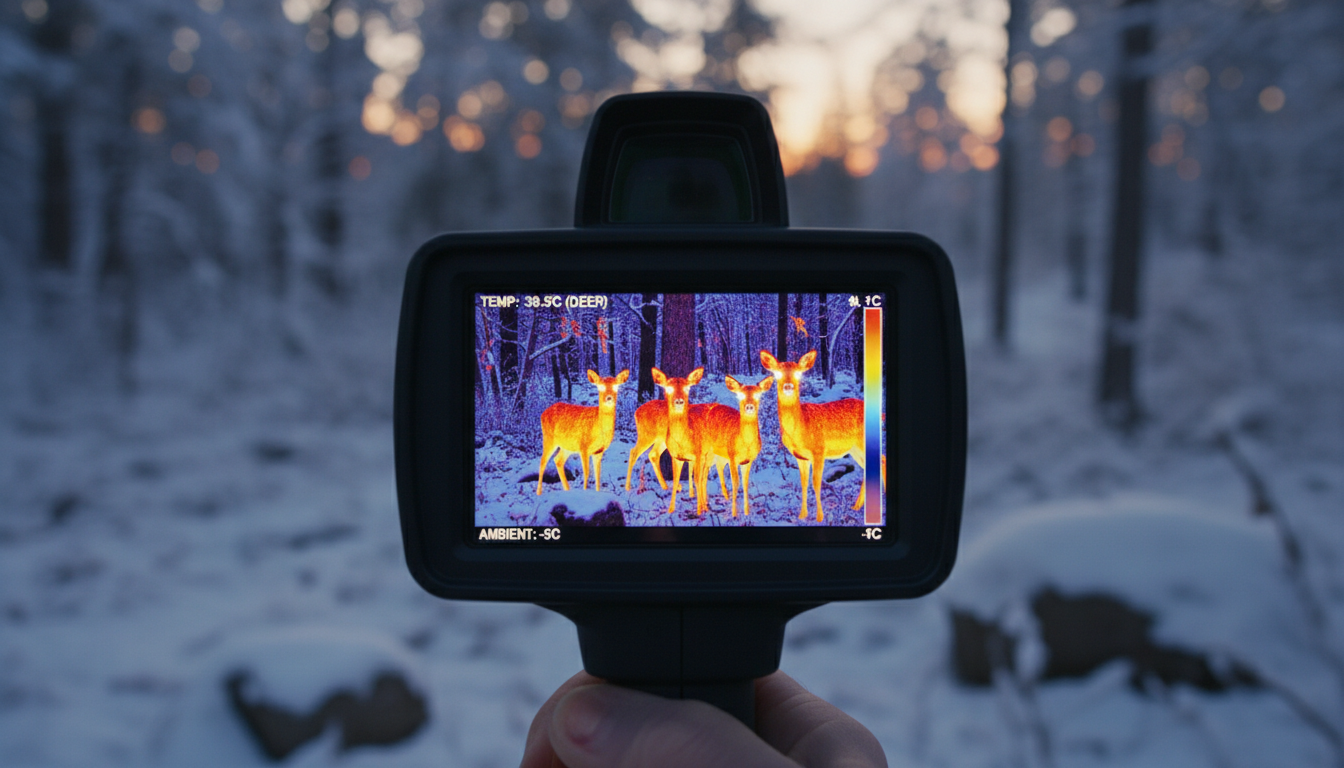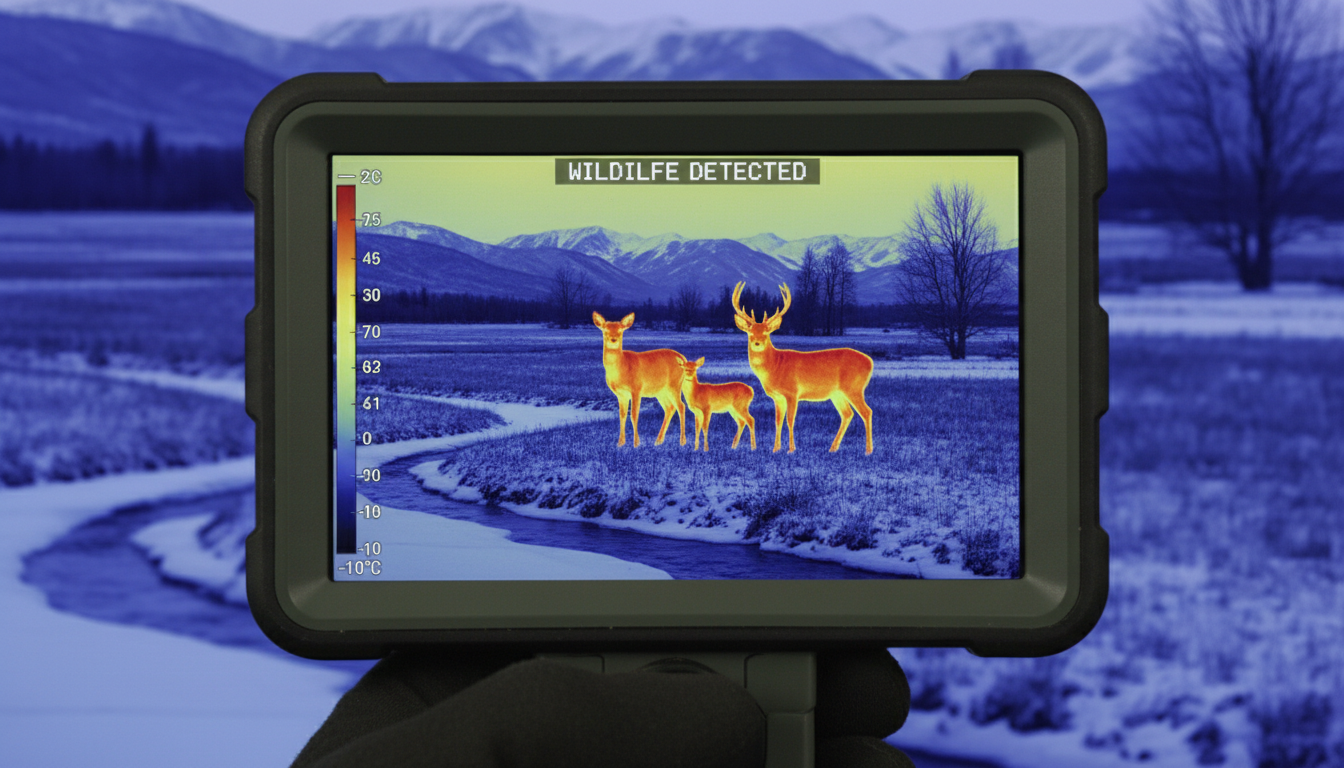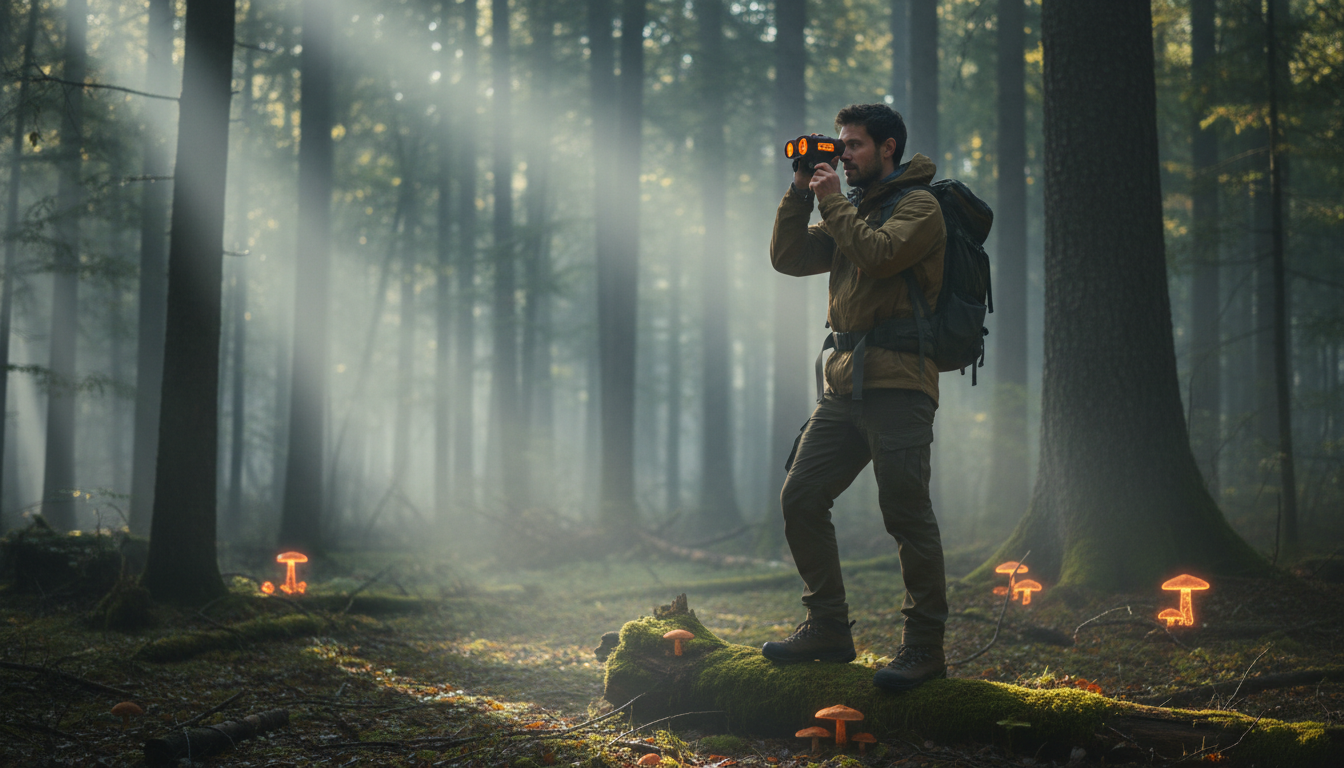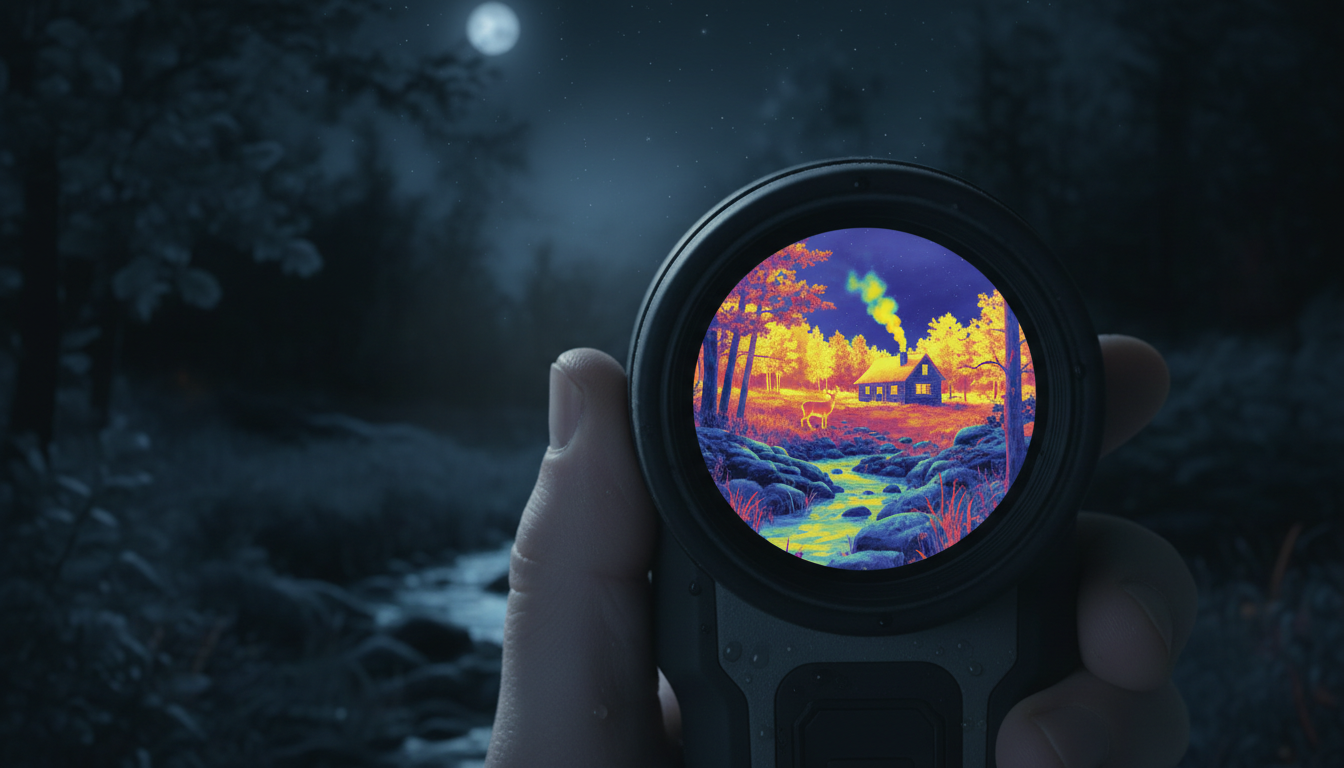
When you’re out there in the dark, trying to track down that elusive coyote or looking for deer after sunset, you need every advantage you can get. That’s where a thermal monocular for hunting comes into play. We’re talking about game-changing gear that lets you see heat signatures in complete darkness, through fog, and even through light brush.
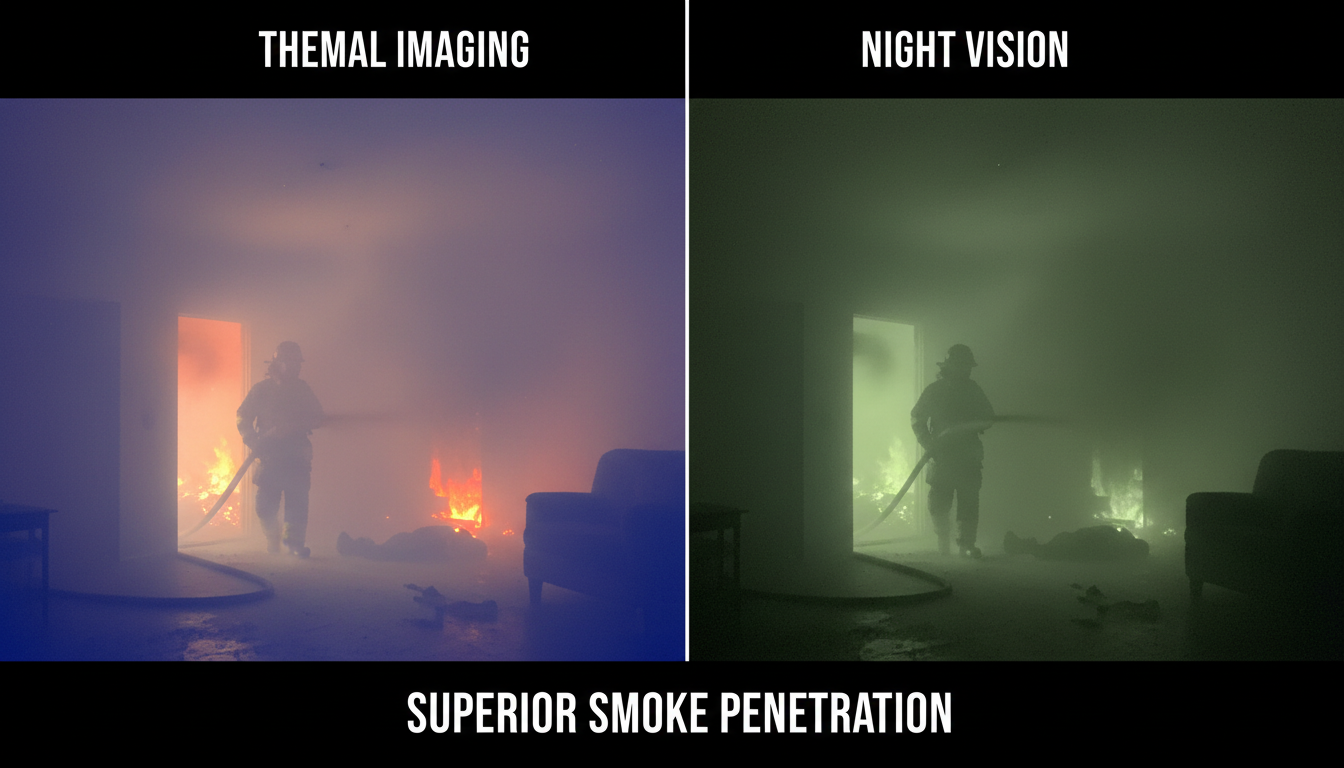
Unlike your grandpa’s night vision that needs some moonlight to work, thermal imaging picks up the heat that animals naturally give off. It doesn’t care if it’s pitch black outside or if there’s dense fog rolling in. If there’s something warm out there, you’re going to see it. And trust us, once you start hunting with thermal, there’s no going back to squinting in the dark.
Thermal monoculars have become the go-to tool for serious hunters, and it’s easy to see why. These compact devices detect infrared radiation (heat) instead of relying on visible light, which means they work in conditions where traditional optics fail. Whether you’re tracking nocturnal predators or scanning fields at dawn, thermal monoculars give you eyes that can see what’s hiding in the darkness.
The beauty of a monocular setup is that you keep one hand free for your rifle, rangefinder, or just navigating rough terrain. You can pull it out of your pocket, glass an area quickly, and get back to the hunt without lugging around bulky gear. Plus, using one eye helps preserve your natural night vision in the other eye—something binoculars can’t do as well.
Modern thermal monoculars are also surprisingly tough. Most models come with waterproof ratings (look for IP67 or better), so a little rain or snow won’t stop your hunt. They’re built to handle getting knocked around in your pack, dropped in the dirt, and used in freezing temperatures. That’s the kind of reliability you need when you’re miles from your truck.
Picking the right thermal monocular isn’t about grabbing the most expensive one on the shelf. It’s about matching the specs to how you actually hunt. Here’s what really matters when you’re shopping around.
Sensor resolution directly impacts image quality and how much detail you can see. Common resolutions you’ll find are 160×120, 320×240, 384×288, and 640×480. Think of it like your phone’s camera—more pixels mean a clearer picture.
For most hunting situations, a 320×240 or 384×288 resolution hits the sweet spot between performance and price. You’ll be able to identify whether that heat signature is a deer, coyote, or just a stump that’s been soaking up sun all day. If you’re hunting larger properties or need to spot animals beyond 500 yards, stepping up to 640×480 makes sense. But if you’re hunting thick woods where shots are inside 200 yards, don’t break the bank on resolution you won’t use.
The refresh rate (measured in Hertz) is another spec to watch. A 50Hz or 60Hz refresh rate gives you smooth, real-time images without lag. Lower refresh rates like 25Hz or 30Hz can work fine for stationary targets, but if you’re tracking fast-moving predators, that smoother image helps you keep up.
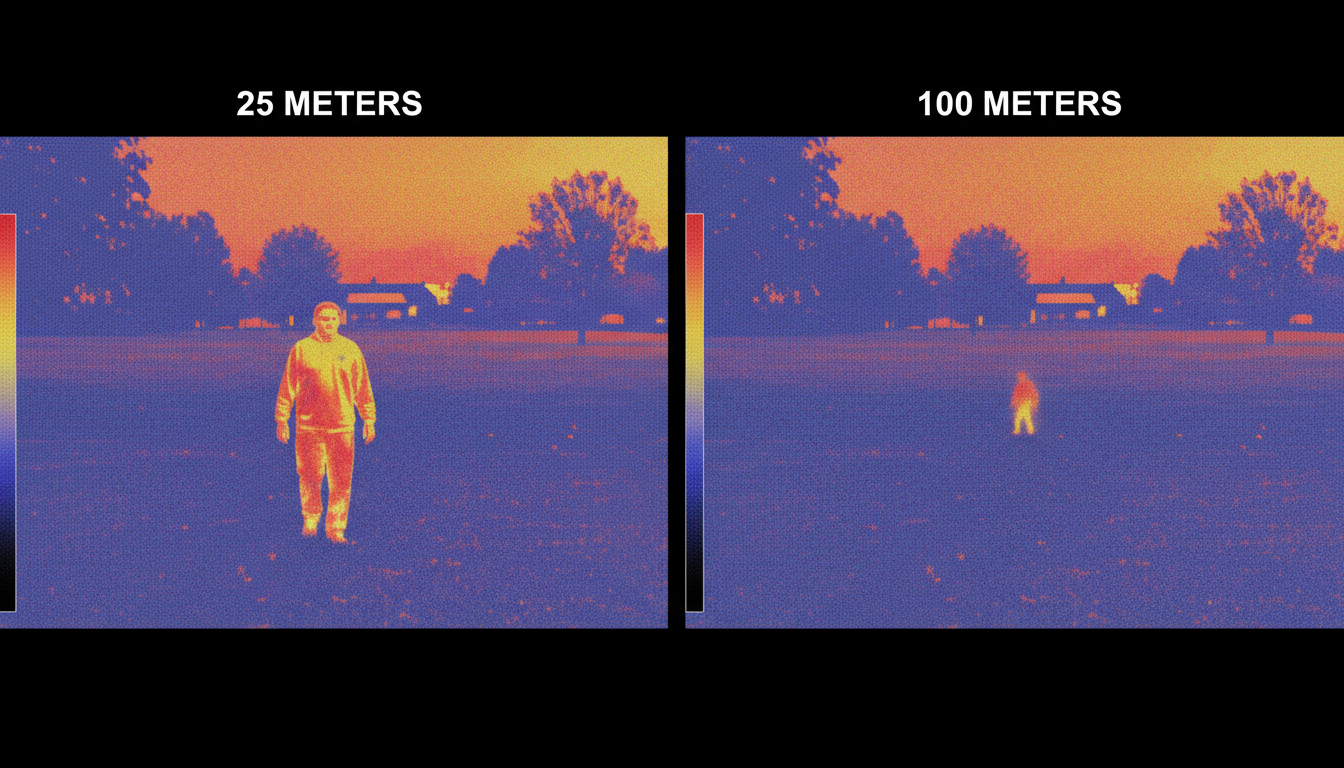
Detection range tells you how far out you can spot a heat signature. A human-sized target? Most quality thermal monoculars can detect that anywhere from 500 to over 1,500 yards, depending on the sensor and lens combination. But here’s the thing—detection and identification are two different animals.
You might detect something at 800 yards, but you won’t know if it’s a deer or a cow until you’re closer. That’s why identification range matters more for hunters. For most of us, being able to positively ID game at 200-400 yards is plenty. Check the Pixfra Sirius Series for models that balance detection and identification ranges perfectly for hunting applications.
Magnification is usually digital on thermal monoculars, ranging from 1x base magnification up to 4x, 8x, or even higher. A wider field of view at 1x-2x helps you scan and find targets quickly. Then you can zoom in for a closer look once you’ve spotted something. Just remember that cranking up digital zoom can make the image pixelated, especially on lower resolution sensors.
Nothing kills a hunt faster than a dead battery. Modern thermal monoculars offer wildly different battery performance, from as little as 2.5 hours to over 16 hours of continuous use. Look for models that give you at least 5-8 hours of runtime—that covers most hunting sessions without leaving you in the dark.
Some monoculars run on rechargeable lithium batteries built into the unit, while others use standard CR123A batteries you can swap out in the field. Each approach has pros and cons. Built-in batteries are convenient, but if they die, you’re done unless you packed an external power bank. Swappable batteries mean you can carry spares and stay operational longer, but you need to remember to pack extras.
A few higher-end models offer extended battery packs that attach to the monocular and can double or triple your runtime. If you’re doing long observation sessions or all-night predator hunts, that extra juice is worth its weight in gold.
Beyond the basic specs, certain features can make your thermal monocular way more useful in the field. Here’s what to look for when comparing models.
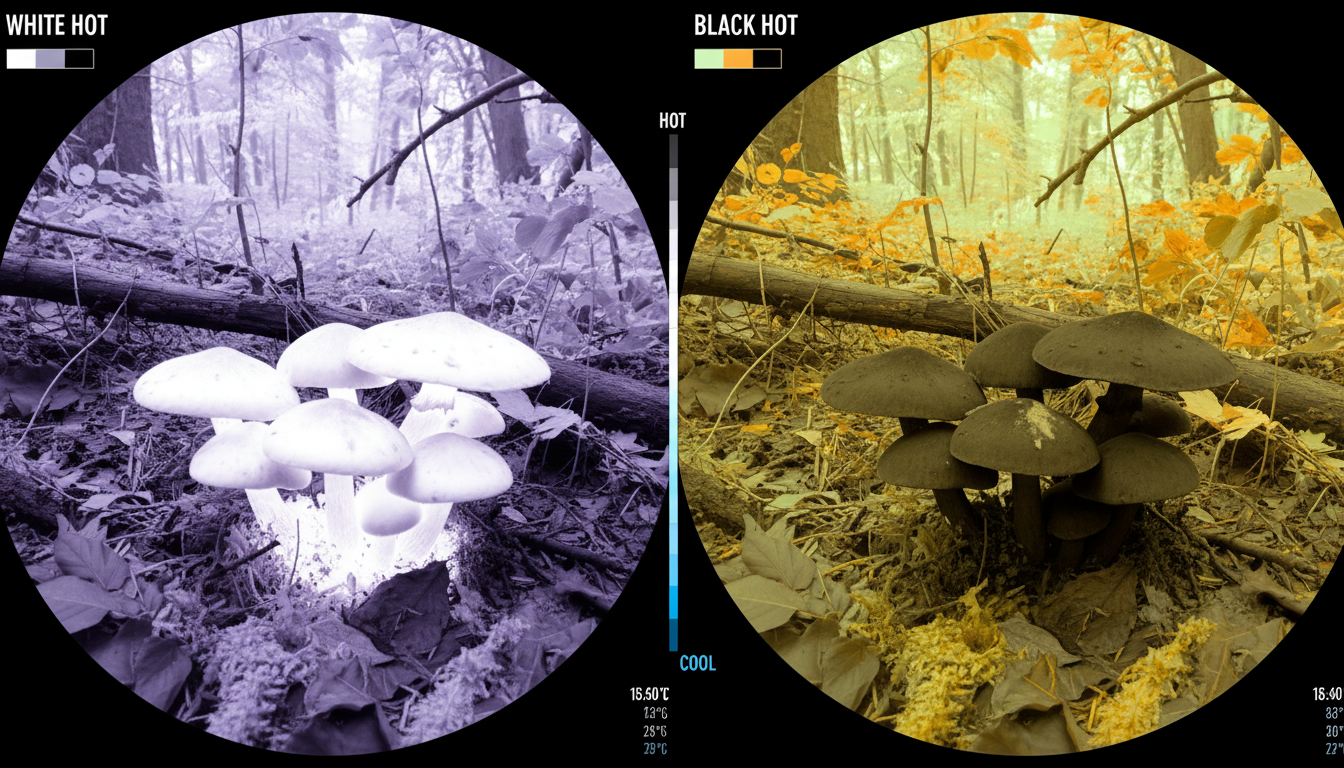
Color palettes might sound like something for artists, but they matter. White Hot and Black Hot are the standards—hot objects show up white or black against the background. Some monoculars add Iron Red, Rainbow, or other palettes that can help you pick out details in different conditions. Having multiple options lets you adjust to what your eyes see best.
Built-in rangefinders are a huge upgrade if you’re serious about making ethical shots. Point at your target, click a button, and know exactly how far away it is. No more guessing or pulling out a separate rangefinder that might spook game. Some models even include ballistic calculators that can help dial in your shot.
Video recording and Wi-Fi connectivity let you capture what you’re seeing and share it later. That’s great for reviewing your hunts, showing your buddies that monster buck you spotted, or just documenting your outdoor adventures. Some apps even let you control the monocular from your phone and stream the thermal image to a bigger screen.
Stadiametric rangefinders use a reticle pattern to estimate range based on the size of known targets (like a deer). They’re not as accurate as laser rangefinders, but they work without batteries and can give you a ballpark distance when you need it.
Let’s clear up some confusion about the different types of thermal gear and when you’d want each one.
Thermal monoculars are your scanning and spotting tools. Compact, lightweight, easy to use with one hand. They’re what you pull out to glass a field, check a treeline, or track an animal’s movement. You spot with the monocular, then transition to your rifle when it’s time to shoot. The single-eye design helps preserve your night vision and they’re generally more affordable than binoculars with similar specs.
Thermal binoculars use two eyepieces, which can be more comfortable for extended viewing sessions. Using both eyes feels more natural and can reduce eye strain when you’re glassing for hours. The downside? They’re bulkier, heavier, and usually cost significantly more than comparable monoculars. They also cause “night blindness” in both eyes, making it harder to transition back to navigating in the dark without them.
Thermal scopes mount directly to your rifle and are designed for aiming and shooting, not general observation. They have reticles, zeroing systems, and are built to handle recoil. You wouldn’t want to scan around with a rifle all night—that’s exhausting and potentially dangerous. That’s why most serious hunters run both a thermal monocular for spotting and a thermal scope for shooting.
For most hunters, a thermal monocular is the best place to start. You get maximum versatility, portability, and value. Add a thermal scope later if you’re doing a lot of night shooting.
You don’t need to spend five grand to get a solid thermal monocular. Here’s how different price brackets stack up and what you can expect.
Budget Range ($500-$1,500): Entry-level monoculars with 160×120 or 256×192 resolution. These work fine for close-range detection (under 300 yards) and are great starter units to see if thermal hunting is for you. Battery life might be shorter and features more basic, but they’ll still spot game you’d never see with your eyes alone. Brands like AGM and some ATN models hit this price point.
Mid-Range ($1,500-$3,500): This is the sweet spot where most hunters land. You’re looking at 320×240 or 384×288 resolution, decent detection ranges (500-1,000+ yards), and useful features like multiple color palettes, video recording, and 6-10 hours of battery life. Models in this range are rugged enough for serious hunting and have the image quality to make solid identification calls. Check out options from ATN, Pulsar, and AGM in this bracket.
Premium Range ($3,500+): High-resolution sensors (640×480 or higher), exceptional detection ranges (1,500+ yards), integrated laser rangefinders, ballistic calculators, and premium build quality. These monoculars are what professionals and dedicated hunters use. Brands like Pulsar’s Telos series, Trijicon, and top-tier ATN models live here. If you hunt regularly in challenging conditions or need maximum performance, this is where you invest.
What is the best resolution for a hunting thermal monocular? For most hunters, a 320×240 or 384×288 resolution offers the best balance of image quality and price, providing clear identification out to 300-500 yards depending on conditions.
How far can you see with a thermal monocular when hunting? Detection ranges vary from 500 yards on budget models to over 2,000 yards on premium units, but practical identification range for hunting is typically 200-600 yards depending on sensor quality and environmental conditions.
Can thermal monoculars work in complete darkness? Yes, thermal monoculars detect heat signatures and work perfectly in total darkness, fog, smoke, and light vegetation where traditional night vision would fail completely.
Do I need a monocular or binocular for hunting? Most hunters prefer monoculars for their lighter weight, lower cost, one-handed operation, and the advantage of preserving night vision in one eye while scanning.
What battery life should I expect from a thermal monocular? Quality hunting thermal monoculars typically offer 5-10 hours of continuous use, with some budget models at 3-4 hours and premium units exceeding 15 hours with extended battery packs.
A thermal monocular for hunting isn’t just another gadget—it’s a tool that fundamentally changes how you hunt after dark. Whether you’re tracking predators, recovering wounded game, or just scouting your property, thermal gives you capabilities that were only available to military and law enforcement a decade ago. Take the time to match your monocular to your actual hunting needs, don’t get sucked into paying for specs you won’t use, and invest in a reputable brand that stands behind their products. Your next hunt will never be the same.
When the sun sets and darkness blankets the landscape, a whole different world comes alive. While most of us are winding down for the evening, nocturnal predators are just getting started with their nightly hunt. These remarkable creatures have spent millions of years perfecting the art of hunting in darkness, developing extraordinary senses and abilities that make them some of nature’s most efficient killers. Whether you’re a wildlife enthusiast, a night hunter looking to understand your quarry better, or simply curious about the creatures that roam after dark, understanding these animals gives us a deeper appreciation for the complex ecosystem that thrives when we’re asleep.
Nocturnal animals aren’t just creatures that happen to stay up late—they’ve evolved specific biological adaptations that make nighttime their optimal hunting period. These animals have internal circadian rhythms that are essentially the opposite of ours, making them naturally alert and active when darkness falls. The advantages of being nocturnal are significant: less competition for food, cooler temperatures in hot climates, and most importantly, the cover of darkness to ambush unsuspecting prey. For predators specifically, the night offers a tactical advantage that diurnal hunters simply don’t have. Their prey might be sleeping, less alert, or struggling to see danger approaching. Evolution has shaped these hunters into perfectly designed nighttime killing machines, each species developing unique adaptations that suit their specific hunting style and environment. From the thermal-sensing abilities of some snakes to the incredible hearing of owls, nocturnal predators prove that you don’t need sunlight to be an apex predator. For those interested in observing these creatures, modern technology like thermal scopes has revolutionized our ability to witness their nocturnal activities without disturbing their natural behavior.
The most striking feature of nocturnal predators is their sensory adaptations that allow them to navigate and hunt in near-total darkness. Vision is the most obvious adaptation—many nocturnal animals have significantly larger eyes relative to their body size compared to diurnal species. These enlarged eyes contain a higher concentration of rod cells, which are photoreceptors specialized for low-light conditions. Additionally, many nocturnal predators possess a reflective layer behind their retina called the tapetum lucidum, which acts like a mirror to bounce light back through the retina a second time, effectively doubling their ability to capture available light. This is what causes the characteristic “eyeshine” when you spot animals at night with a flashlight.
But vision is just one piece of the puzzle. Nocturnal predators often rely on a combination of enhanced senses working together to create a complete picture of their environment. Owls, for instance, have asymmetrical ear placement that allows them to pinpoint the exact location of a mouse rustling in grass with terrifying accuracy. Bats use echolocation, emitting high-frequency sounds and interpreting the echoes to create a “sound map” of their surroundings. Some snakes have heat-sensing pit organs that detect the infrared radiation emitted by warm-blooded prey, allowing them to “see” heat signatures in complete darkness. Cats and other feline predators have extremely sensitive whiskers that detect air currents and vibrations, helping them navigate tight spaces and sense nearby movement. These combined sensory superpowers make nocturnal predators incredibly effective hunters that we’re only beginning to fully understand.
When we talk about nocturnal predators, owls are often the first creatures that come to mind, and for good reason. These birds of prey are perhaps the most perfectly adapted aerial hunters of the night. With over 200 species worldwide, owls have diversified to fill various ecological niches, but they all share common adaptations that make them formidable predators. Their large, forward-facing eyes give them excellent binocular vision and depth perception, crucial for accurately judging distances when swooping down on prey. Some owl species can see in light levels 100 times dimmer than what humans need to see clearly.
What truly sets owls apart is their ability to fly in complete silence. Their flight feathers have specialized structures with soft fringes on the leading edges and a velvety surface that dampens sound, allowing them to approach prey without any warning whistle of wings. This silent flight, combined with their exceptional hearing, makes them devastating hunters. A barn owl, for example, can catch a mouse in complete darkness using hearing alone, pinpointing the location with such precision that it rarely misses. Great horned owls are powerful enough to take down prey much larger than themselves, including skunks, rabbits, and even other raptors. The great grey owl can hear a vole moving under two feet of snow and punch through the snow to grab it. These adaptations have made owls successful predators across diverse habitats, from Arctic tundra to tropical rainforests, cementing their reputation as one of nature’s most efficient nocturnal hunters.
While some big cats like lions and cheetahs are known for daytime hunting, many feline predators are actually most active during twilight hours and nighttime. Leopards, jaguars, tigers, and even smaller wild cats like bobcats and ocelots are predominantly nocturnal or crepuscular hunters. These cats possess the physical prowess, stealth, and sensory adaptations that make them among the most dangerous nocturnal predators on the planet. Their eyes contain a high concentration of rods and a well-developed tapetum lucidum, giving them vision that’s six to eight times better than humans in low light conditions. This means they can hunt effectively in conditions that would leave their prey essentially blind.
Beyond vision, big cats are masters of stealth and patience. Their retractable claws remain sharp because they’re kept sheathed when not in use, and their padded paws allow them to move in near silence. Leopards are particularly impressive nocturnal hunters, capable of dragging prey twice their weight up into trees to keep it safe from scavengers. They’re ambush predators that rely on getting as close as possible before launching a lightning-fast attack. Jaguars have the strongest bite force relative to size of any big cat, allowing them to pierce turtle shells and caiman skulls with ease—hunting tactics often employed during their nocturnal riverside patrols. In North America, bobcats and mountain lions (also called cougars or pumas) are skilled nocturnal hunters that can take down prey much larger than themselves. These solitary hunters exemplify the efficiency of nocturnal predation, using darkness as their ally to become nearly invisible until the moment they strike.
Bats represent one of the most diverse groups of nocturnal predators, with over 1,400 species found across the globe. While many people think of bats as simply flying rodents, they’re actually more closely related to primates and have evolved one of the most sophisticated hunting systems in the animal kingdom. Most insectivorous bats use echolocation—a biological sonar system where they emit high-frequency calls and listen for the echoes bouncing back from objects and prey. This allows them to build a three-dimensional sound picture of their environment with astonishing detail, detecting insects as small as mosquitoes in complete darkness.
The sophistication of bat echolocation is truly remarkable. Different species have evolved specialized calls optimized for their specific hunting environments and prey types. Bats hunting in open spaces use lower frequency calls that travel farther, while those navigating dense forest use higher frequency calls that provide more detail at shorter ranges. Some bats can adjust their call frequency in real-time to avoid interference from other bats hunting nearby. Certain species like the greater bulldog bat can even detect tiny ripples on water surfaces, allowing them to catch fish swimming just below the surface in complete darkness. Beyond echolocation, some bat species are formidable predators in other ways. The spectral bat and false vampire bat are carnivorous species that hunt other vertebrates including birds, rodents, and even other bats, using both echolocation and acute hearing to locate prey. Their role as nocturnal insect controllers is also ecologically vital, with some bat colonies consuming tons of insects nightly, making them valuable allies for farmers and reducing pest populations naturally.
When darkness falls, various snake species emerge as highly effective predators, particularly in warmer climates where nighttime activity helps them avoid overheating. Pit vipers, including rattlesnakes, copperheads, and cottonmouths, are among the most sophisticated nocturnal reptilian hunters. Their namesake “pits” are heat-sensing organs located between their eyes and nostrils that detect infrared radiation. These specialized organs are so sensitive they can detect temperature differences as small as 0.003 degrees Celsius, allowing them to create a thermal image of their surroundings and locate warm-blooded prey with deadly accuracy even in pitch-black conditions.
Pythons and boas, though lacking the specialized pit organs of pit vipers, are still effective nocturnal hunters with heat-sensitive scales around their lips that serve a similar function. These constrictors combine thermal sensing with other adaptations like excellent chemoreception through their flickering tongues, which collect scent particles from the air and transfer them to the Jacobson’s organ in the roof of their mouth. This gives them a detailed chemical map of their environment. Nocturnal hunting allows these snakes to target prey like rodents and birds that are resting and less vigilant after dark. Crocodilians, while not snakes, are also formidable nocturnal reptilian predators. Species like the American alligator and Nile crocodile are most active at night, using their excellent night vision, pressure-sensitive scales that detect water disturbances, and patient ambush tactics to catch prey coming to the water’s edge to drink. These ancient predators have remained virtually unchanged for millions of years, proving that their nocturnal hunting strategies are tremendously effective.
North America hosts a impressive variety of nocturnal predators that range from relatively harmless to genuinely dangerous. Understanding which predators are active in your area is important for anyone spending time outdoors after dark, whether you’re camping, hiking, or night hunting. The most dangerous nocturnal predator in most of the United States is arguably the American alligator, found throughout the southeastern states. These prehistoric predators are most active between dusk and dawn, particularly during warmer months, and are responsible for occasional attacks on humans and pets, especially near bodies of water.
Mountain lions (cougars) are another significant nocturnal threat across the western United States and increasingly in some eastern regions. While attacks on humans are rare, they do occur, particularly during dawn and dusk when these big cats are most active. Coyotes have expanded their range dramatically and are now found in all 49 continental states, becoming increasingly bold in urban and suburban areas where they hunt primarily at night. While typically not dangerous to adult humans, they pose a serious threat to pets and small children. Black bears, though omnivorous, are powerful predators that are often most active at night, especially in areas with human activity during the day. Bears searching for food can be dangerous if surprised or if they’ve become habituated to human food sources. Bobcats, while generally avoiding humans, are skilled nocturnal hunters throughout much of the country. Venomous snakes like rattlesnakes and copperheads are also active nocturnal hunters in many regions, and accidental encounters can result in dangerous bites. Understanding the nocturnal predators in your specific area and taking appropriate precautions—like making noise while hiking, securing food properly, and keeping pets indoors at night—significantly reduces the already small risk these animals pose.
The evolutionary adaptations that allow animals to thrive as nocturnal predators go far beyond just good night vision. These creatures have developed an entire suite of specialized characteristics that work together to make them supremely effective in darkness. Physiologically, many nocturnal predators have adapted their body temperatures and metabolic rates to function optimally during cooler nighttime hours. Some have evolved darker coloration that provides better camouflage in low-light conditions, while others have coloring that breaks up their outline, making them harder to spot.
Behavioral adaptations are equally important. Nocturnal predators often exhibit patience and energy conservation strategies, remaining motionless for extended periods before striking with explosive speed and precision. Many species have developed enhanced memory and spatial awareness, creating mental maps of their territories that allow them to navigate effectively even when visual cues are minimal. Some nocturnal hunters have also adapted their reproductive and social behaviors around nighttime activity, with many species communicating through sounds, scents, and other non-visual cues that work well in darkness. The hunting strategies themselves are often adapted for nighttime success—ambush predation becomes more effective when prey can’t see the attack coming, and persistence hunting works well when predators can track prey through the night without overheating. These combined adaptations demonstrate that becoming nocturnal isn’t just about staying awake at night; it’s about fundamentally restructuring biology, behavior, and hunting strategy to exploit a temporal niche that offers significant advantages to those adapted for it.
Not all nocturnal predators hunt in the dark for the same reasons, and the specific advantages vary considerably based on species, habitat, and prey type. For some predators, nighttime activity is primarily about temperature regulation. Desert-dwelling hunters like fennec foxes, many snake species, and certain cats avoid the brutal daytime heat that could lead to dangerous dehydration or heat exhaustion. The cooler nighttime temperatures allow them to be active and hunt without the physiological stress of extreme heat. In tropical regions, the temperature difference between day and night may be less dramatic, but reduced sun exposure still offers comfort advantages.
For other species, the darkness itself is the weapon. Predators that rely heavily on stealth and ambush tactics benefit enormously from reduced visibility that makes it harder for prey to detect their approach. The cover of night allows certain prey species to be more active as well, creating opportunities that don’t exist during daylight hours—essentially, some predators are nocturnal because their prey is nocturnal. Competition avoidance is another significant advantage. In ecosystems with multiple predator species, temporal partitioning—where different species are active at different times—reduces direct competition for the same resources. A hawk and an owl might hunt the same prey species in the same area, but because one hunts by day and the other by night, they’re not competing directly. Finally, for prey species that have become nocturnal, predators must follow or miss out on food sources. This predator-prey arms race has driven the evolution of increasingly sophisticated adaptations on both sides, creating the remarkable diversity of nocturnal life we see today.
What is the deadliest nocturnal predator in the world?
While “deadliest” can be measured in different ways, saltwater crocodiles and Nile crocodiles are among the most dangerous nocturnal predators to humans, responsible for hundreds of deaths annually. For sheer hunting efficiency within their ecosystems, owls, big cats like leopards and jaguars, and various snake species are all apex nocturnal predators. The answer really depends on whether you’re measuring danger to humans, hunting success rate, or ecological impact.
Why do predators hunt at night instead of during the day?
Predators hunt at night for several key advantages: darkness provides cover for stealthy approaches, many prey species are less alert or sleeping at night, nighttime temperatures are cooler which prevents overheating during physical exertion, there’s less competition from diurnal predators, and some prey species are only active at night. Many nocturnal predators have evolved specialized sensory adaptations that give them a significant advantage over their prey in low-light conditions.
Can nocturnal predators see in complete darkness?
No animal can see in truly complete darkness—vision requires at least some light. However, nocturnal predators have eyes adapted to function in extremely low light conditions that would appear pitch black to humans. Many species supplement vision with other senses: bats use echolocation, snakes use heat-sensing organs, and owls rely heavily on hearing. These combined sensory abilities allow them to hunt effectively in conditions humans would consider complete darkness.
What time are nocturnal predators most active?
Most nocturnal predators are most active during twilight hours—dusk and dawn—when there’s still some ambient light but prey animals are transitioning between day and night activities. These crepuscular periods offer optimal hunting conditions. However, many species remain active throughout the night, with activity levels often peaking around midnight and again before dawn. Activity patterns also vary by season, moon phase, weather conditions, and prey availability.
How do I stay safe from nocturnal predators when camping or hiking?
To stay safe around nocturnal predators, make noise while moving to avoid surprising animals, never approach or feed wildlife, store food properly in bear-proof containers or hung from trees, keep pets on leashes and indoors at night, carry a flashlight or headlamp, stay on established trails, camp in designated areas away from animal trails leading to water sources, and research which predators are common in your specific area so you can take appropriate precautions. Most nocturnal predators naturally avoid humans and attacks are extremely rare when proper precautions are followed.
Night hunting presents unique challenges that even the most experienced hunters struggle with. Limited visibility can make identifying targets nearly impossible, and traditional night vision often fails when there’s no ambient light or when facing dense vegetation. This is where thermal scopes come in—they’ve completely transformed how hunters operate after dark.
Unlike traditional night vision that amplifies existing light, thermal scopes detect heat signatures from animals, making them visible regardless of lighting conditions. This technology can spot a deer’s body heat from hundreds of yards away, even through moderate fog, light rain, or brush cover. For hunters pursuing nocturnal game or controlling predator populations, this capability isn’t just helpful—it’s revolutionary.
The market for thermal scopes has exploded in recent years, with technological advancements making these devices more affordable and feature-rich than ever before. What was once military-grade technology available only to special forces has now become accessible to civilian hunters. Today’s thermal scopes offer incredible detection ranges, high-definition displays, recording capabilities, and battery life that can last entire hunting expeditions.
While standard rifle scopes rely on ambient light to function, thermal imaging works by detecting infrared radiation (heat) emitted by all living things. This fundamental difference means you can spot a coyote, wild hog, or other game animal in complete darkness, through light fog, or even partially obscured by vegetation. The animal’s heat signature appears as a bright silhouette against a cooler background, making target identification substantially easier than with any other night hunting technology.
The practical applications for hunters are immense. Feral hog control, which often occurs at night when these destructive animals are most active, becomes dramatically more effective with thermal imaging. Predator hunters pursuing coyotes can detect their targets at distances that would be impossible with traditional optics. Conservation efforts that require population surveys or management can be conducted with minimal disturbance to wildlife. Even tracking wounded game becomes more reliable when you can follow the heat signature of the animal’s trail.
Despite these advantages, many hunters hesitate to invest in thermal scopes due to concerns about price, complexity, or effectiveness. In this comprehensive guide, we’ll address these concerns while showcasing the five best thermal scopes for night hunting available in 2025. We’ll cover options across different price ranges and feature sets, helping you find the right thermal scope for your specific hunting needs and budget.
The technology behind these devices continues to evolve rapidly, with each new generation offering better resolution, longer battery life, and more intuitive features. By understanding the key specifications and capabilities that matter most for hunting applications, you’ll be better equipped to make an informed decision on this significant investment in your hunting arsenal.
When shopping for a thermal scope, certain specifications directly impact your hunting success. Understanding these key features will help you choose a device that delivers exceptional performance in real-world hunting situations rather than one that looks impressive on paper but disappoints in the field.
Resolution stands as perhaps the most important specification for any thermal scope. This is typically expressed in pixels (such as 640×480 or 384×288) and determines the clarity and detail of the image you’ll see. Higher resolution devices allow you to identify animals with greater certainty at longer ranges and make positive target identification more reliable. While budget thermal scopes often feature 384×288 resolution, stepping up to 640×480 provides a noticeable improvement in image quality that can make the difference between a successful hunt and a missed opportunity. The highest-end models now offer stunning 1280×1024 resolution, though these come with significantly higher price tags.
Detection range determines how far away you can spot an animal’s heat signature. This specification varies widely between models and directly impacts your ability to spot game before it spots you. Entry-level thermal scopes typically offer detection ranges of 500-800 yards for deer-sized animals, while premium models can detect heat signatures at distances exceeding 2,000 yards. Remember that detection range differs from recognition range (ability to classify an object) and identification range (ability to specifically identify the exact animal), which are always shorter than the maximum detection distance.
Refresh rate, measured in Hertz (Hz), affects how smoothly the image updates when scanning or tracking moving animals. Budget thermal scopes typically offer 30Hz refresh rates, which create noticeable lag when panning or following moving targets. Premium models feature 60Hz or even 120Hz refresh rates that provide much smoother imaging, which proves particularly valuable when tracking running game or when you need to make quick target acquisitions on multiple animals.
Battery life can make or break your hunting experience, especially during all-night expeditions. Standard battery life for modern thermal scopes ranges from 4-10 hours, though this varies based on operating temperature, feature usage, and battery type. Many premium models now offer hot-swappable batteries that allow for continuous operation, while others include sleep modes that extend battery life during periods of inactivity. Always consider carrying spare batteries for extended hunts, and pay attention to whether the scope uses proprietary or standard battery types, as this affects long-term ownership costs.
Magnification capabilities vary widely between thermal scopes, with most hunting-focused models offering variable magnification ranging from 1-8x optical zoom with additional digital zoom options. For most predator or hog hunting scenarios, 2-4x optical magnification provides the ideal balance between field of view and detail, with digital zoom available when needed for positive identification at longer ranges. Be wary of marketing that emphasizes extreme digital zoom capabilities, as image quality degrades significantly at higher digital magnification levels.
Recoil rating indicates how much punishment the scope can withstand from powerful rifle calibers. Quality thermal scopes are designed to handle significant recoil forces without losing zero or suffering internal damage. Look for scopes rated for calibers up to .300 Win Mag or higher if you plan to mount them on powerful hunting rifles. Lesser thermal scopes may specify limitations on which calibers they can safely be used with.
Weather resistance proves essential for reliable field performance. Look for IPX7 or higher ratings, which indicate the scope can withstand temporary immersion in water. This ensures your expensive thermal scope will continue functioning even in heavy rain or if accidentally submerged briefly. Many premium thermal scopes also feature fog-proof designs using nitrogen or argon gas purging, preventing internal fogging when moving between temperature extremes.
Mounting systems deserve careful consideration when selecting a thermal scope. Most quality thermal optics use standard Picatinny or Weaver rail systems, but confirming compatibility with your specific rifle setup is essential before purchase. For reliable, stable mounting that maximizes accuracy and prevents shifting during recoil, consider pairing your thermal scope with a specialized mounting system like the Pixfra Rail. These mounting systems provide the rock-solid foundation necessary for maintaining zero and maximizing the performance of your thermal optic.
Recording capabilities have become standard on most modern thermal scopes, allowing you to capture still images or video of your hunts. These recordings serve multiple purposes: reviewing shots for improvement, sharing experiences with fellow hunters, documenting harvests, or creating content for hunting channels. Premium models offer higher resolution recording, onboard storage, and wireless streaming options that make sharing your thermal footage simple and convenient.
User interface and controls significantly impact field usability, especially when operating in darkness. Intuitive button layouts, customizable settings, and easy menu navigation make a substantial difference during actual hunting scenarios. Some manufacturers excel at creating user-friendly interfaces that require minimal fumbling or light use, while others create unnecessarily complex systems that prove frustrating in field conditions. Always research the user experience before investing in a particular thermal scope model.
After extensive testing, interviews with professional guides, and countless hours of field research, we’ve identified the five best thermal scopes currently available for night hunting. These selections represent different price points and feature sets, ensuring options for both budget-conscious hunters and those seeking the absolute best performance regardless of cost.
Leading our list is the remarkable Pixfra Thermal Pro Series, which represents the perfect balance of cutting-edge technology and practical hunting features. With its 640×480 thermal sensor and 60Hz refresh rate, this scope delivers exceptionally clear images with minimal lag when tracking moving targets. What truly sets this scope apart is its industry-leading 12-hour battery life—sufficient for even the longest night hunting expeditions without requiring battery changes.
The Pixfra Thermal Pro excels in adverse weather conditions thanks to its IPX8 waterproof rating and fog-proof design. Hunters particularly appreciate the intuitive control layout, which allows for one-handed operation even while wearing gloves—a seemingly small detail that makes a significant difference during cold-weather hunts. The scope’s ballistic calculator feature compensates for environmental factors like temperature and elevation, substantially improving long-range accuracy when pursuing distant targets.
For mounting stability, the scope pairs perfectly with the Pixfra Rail mounting system, which uses the standard Picatinny interface to provide a rock-solid foundation that eliminates any concerns about shifting during recoil. The Pixfra Thermal Pro’s recording capabilities include 4K video and 12MP still images, with 64GB of onboard storage and WiFi connectivity for easy sharing. While the price point places this in the premium category, the performance justifies the investment for serious hunters who demand reliability and superior image quality.
The ATN ThOR 5 XD has earned its place as one of the most popular thermal scopes among dedicated night hunters thanks to its outstanding balance of performance and value. This scope features a 640×480 sensor with impressive 60Hz refresh rate, delivering smooth imaging that makes tracking running game significantly easier than with lower refresh rate models. The dual-core processor provides rapid startup and responsive operation, with minimal lag when cycling between different magnification levels or menu options.
What makes the ThOR 5 XD particularly appealing is its one-shot zero feature, which dramatically simplifies the sighting-in process compared to traditional thermal scopes. The scope’s 10+ hour battery life ensures all-night reliability, while the recoil-activated video recording automatically captures footage before, during, and after each shot without requiring manual operation. This feature proves invaluable for shot review and creates compelling hunting footage with minimal effort.
The scope’s profile sensor technology automatically adjusts contrast and brightness based on environmental conditions, delivering optimal image quality without constant manual adjustments as lighting conditions change throughout the night. For hunters who frequently change positions or stalking locations, the scope’s multiple weapon profile feature allows quick transitions between different rifles while maintaining zero for each. The ATN ThOR 5 XD represents a significant investment but delivers professional-grade performance that justifies its position in the mid-to-high price range for serious hunters.
The Pulsar Thermion 2 XQ38 deserves special recognition for its innovative design that maintains the familiar look and feel of traditional day scopes while delivering exceptional thermal performance. This approach significantly reduces the learning curve for hunters transitioning to thermal technology, with conventional eyepiece design and standard mounting heights that maintain natural shooting positions. The 384×288 sensor delivers clear imaging at practical hunting distances, with detection capabilities extending beyond 1,300 yards for deer-sized game.
Battery life represents one of the Thermion’s strongest features, with hot-swappable power packs allowing for unlimited runtime during extended hunting sessions. The scope’s 8 color palettes provide versatility across different environments and hunting scenarios, while the picture-in-picture mode displays a magnified view of the target area alongside a wider field of view—extremely helpful when monitoring multiple animals simultaneously.
The Thermion’s all-metal housing and IPX7 waterproof rating ensure durability in harsh field conditions, while its 13 reticle options allow customization based on hunting style and preferred targeting method. The scope’s WiFi capability enables streaming to smartphones or tablets, making it perfect for guided hunts where communication between hunters is essential. Though the price falls in the upper-mid range, the Thermion 2 XQ38’s combination of traditional design and modern thermal performance makes it particularly appealing to hunters who appreciate familiar ergonomics with advanced capabilities.
For hunters seeking quality thermal performance at a more accessible price point, the AGM Rattler TS35-384 delivers remarkable value without compromising essential features. This scope utilizes a 384×288 sensor with 50Hz refresh rate, providing smooth imaging sufficient for most hunting scenarios at ranges up to 1,200 yards. The simplified user interface focuses on core functionality rather than complex features, making this an excellent choice for hunters who prioritize reliability and ease of use over advanced options they may never utilize.
The Rattler’s 8-hour battery life covers most hunting sessions, while its compact design and lightweight construction (just 28 ounces) minimize the impact on rifle balance and handling. The scope maintains impressive durability despite its lighter weight, with shock resistance certified for calibers up to .375 H&H—more than adequate for most hunting rifles. The standard Picatinny mounting system ensures compatibility with most rifles and aftermarket mounts, including specialized systems like the Pixfra Rail for enhanced stability.
Recording capabilities include 1080p video and 5MP still images with 32GB internal storage, providing ample capacity for documenting hunting experiences. The scope’s intuitive three-button control system proves particularly valuable in field conditions, allowing operation without removing gloves or taking eyes off the target area. For hunters entering the thermal market with budget considerations, the AGM Rattler represents an excellent entry point that delivers core thermal performance without unnecessary complexity or cost.
Completing our list is the Trijicon IR-HUNTER MK3, a scope that reflects Trijicon’s legendary reputation for bombproof optical durability translated into the thermal world. This scope features a 640×480 sensor with 60Hz refresh rate, delivering exceptional image clarity and smooth tracking. What distinguishes the IR-HUNTER is its extraordinary ruggedness—tested to military standards for shock, vibration, and extreme temperature performance, this scope will continue functioning reliably in conditions that would disable lesser optics.
The IR-HUNTER’s intuitive thumbstick control system allows rapid navigation through menus and features without removing your eye from the eyepiece, while the EdgeDetect mode enhances target outlines for improved identification in challenging environments like thick brush or partially obscured positions. The scope’s 4.5-hour battery life falls below some competitors, but the quick-change battery system allows for rapid power replacement without losing zero or removing the scope from the rifle.
Particularly impressive is the scope’s ability to maintain zero even under punishing recoil from magnum calibers, making it ideal for hunters pursuing dangerous game or using heavy-recoiling rifles. The MK3’s MilSpec environmental sealing ensures performance in extreme conditions from arctic cold to desert heat. This scope represents a premium investment but delivers unmatched reliability for hunters who demand equipment that won’t fail regardless of conditions or circumstances.
To make an informed decision when purchasing a thermal scope, it helps to understand the basic principles behind how this technology works and the specific terms manufacturers use in their specifications. This knowledge ensures you focus on features that truly matter for hunting applications rather than being swayed by marketing hype.
Thermal imaging fundamentally differs from traditional night vision in how it creates images. Night vision devices amplify tiny amounts of available light (including infrared light invisible to the human eye) to create a viewable image. In contrast, thermal imagers detect the heat (infrared radiation) naturally emitted by all objects, including animals, and convert those temperature differences into visible images. This distinction explains why thermal scopes can function in complete darkness or through visual obstacles that would defeat conventional night vision.
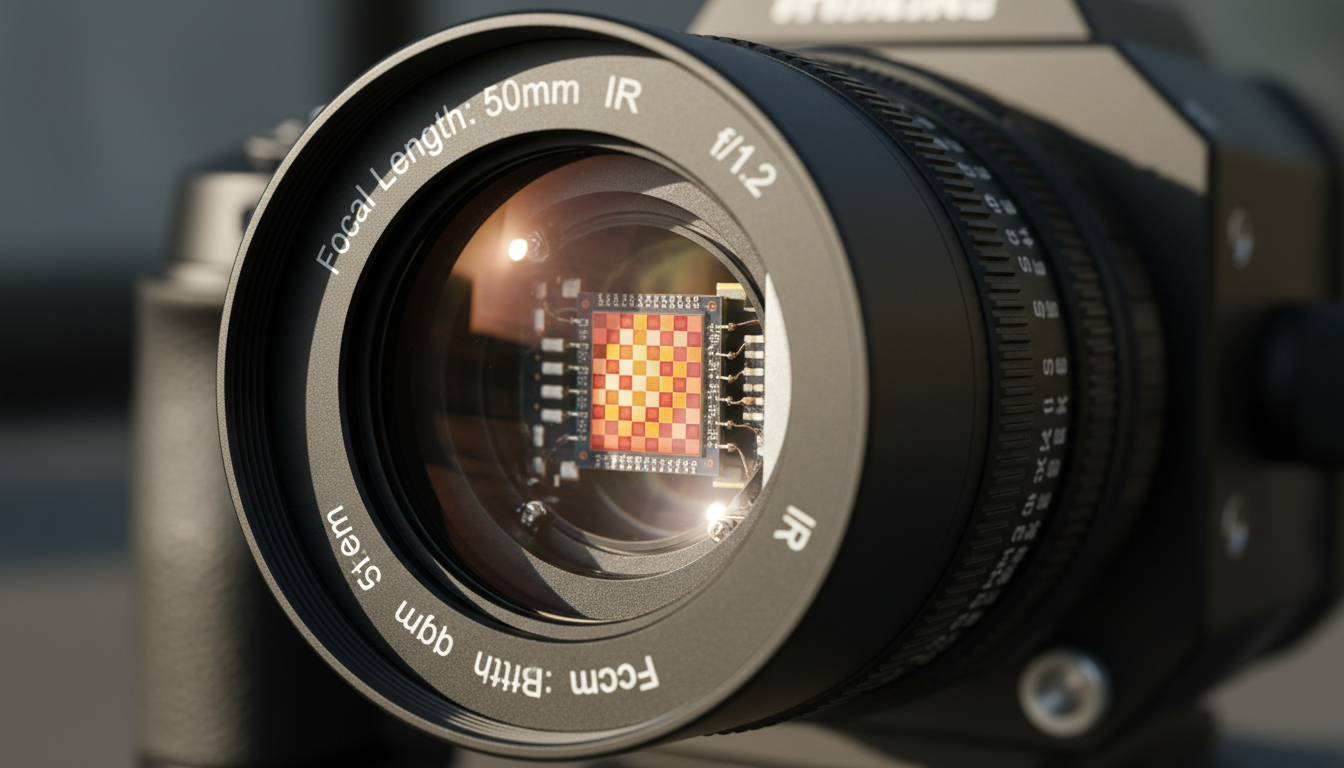
The core component in any thermal scope is the microbolometer—an array of tiny heat sensors that detect temperature variations and convert them into electronic signals. These sensors don’t require cooling (unlike older thermal technologies), which allows for compact, lightweight designs suitable for mounting on hunting rifles. The density of these sensors directly correlates to the scope’s resolution; more sensors mean higher resolution and better image quality.
When evaluating thermal scope specifications, you’ll encounter several key technical terms:
Thermal sensitivity (measured in milliKelvins, mK) indicates how small a temperature difference the scope can detect. Lower numbers are better, with premium hunting scopes typically offering sensitivity of 25-50mK. This specification directly impacts your ability to spot animals against backgrounds with similar temperatures, such as during summer evenings when environmental temperatures approach animal body temperatures.
Detection, recognition, and identification ranges represent different capabilities. Detection range indicates the maximum distance at which you can spot a heat signature, recognition range is the distance at which you can classify an object (animal versus person), and identification range is the distance at which you can specifically identify the exact animal. Manufacturers typically advertise the most impressive detection range, but the more relevant hunting metrics are recognition and identification ranges.
Focal length (measured in millimeters) affects both magnification and field of view. Longer focal lengths provide higher magnification but narrower fields of view, while shorter focal lengths offer wider viewing areas with less detail. Most hunting-optimized thermal scopes feature focal lengths between 35mm and 75mm, with the ideal choice depending on your typical hunting environment and target distances.
“Understanding the difference between detection and identification ranges is crucial for ethical hunting with thermal scopes. Just because you can detect a heat signature at 2,000 yards doesn’t mean you can responsibly identify your target at that distance. Always prioritize positive identification before considering any shot.” – Veteran Hunting Guide and Thermal Specialist
Color palettes in thermal scopes provide different visualization options for the same thermal data. The most common include:
Most quality thermal scopes allow switching between palettes to adapt to different hunting scenarios and personal preferences.
Digital image processing features significantly enhance the usability of thermal imagery for hunting. These include:
Modern thermal scopes increasingly incorporate ballistic calculators and environmental sensors that account for factors like temperature, pressure, humidity, and incline angle when calculating bullet trajectories. These features prove particularly valuable for long-range thermal hunting, where precise shot placement becomes challenging without computational assistance.
Mounting considerations deserve special attention when selecting a thermal scope. Unlike traditional day scopes, thermal optics tend to be heavier and place different balance demands on your rifle system. Specialized mounting solutions like the Pixfra Rail provide the stability needed to maintain zero despite the additional weight and recoil forces. This mounting system uses the standard Picatinny interface to create a rock-solid foundation that prevents shifting during recoil—essential for maintaining accuracy with thermal optics.
The technology behind thermal scopes continues advancing rapidly, with manufacturers regularly introducing new features and improvements. Current development focuses on extending battery life, improving sensor resolution, reducing weight, and enhancing image processing algorithms. Staying informed about these technological trends helps ensure your investment remains relevant as the technology evolves.
With numerous options available across various price points, selecting the ideal thermal scope requires matching features to your specific hunting needs and preferences. By considering several key factors relevant to your hunting style, you can narrow down choices to find the perfect thermal scope for your situation.
First, honestly assess your hunting environment and typical shooting distances. Hunters pursuing feral hogs in dense brush or timber may need different specifications than those hunting coyotes across open prairie landscapes. For close-range hunting (under 200 yards) in heavy cover, prioritize a wider field of view and faster target acquisition over extreme magnification or detection range. Conversely, if you typically hunt open country with shots beyond 300 yards, higher magnification capabilities and superior resolution become more critical for positive target identification at distance.
Your hunting frequency and budget considerations should align realistically. For occasional hunters who might use thermal technology a few times annually, mid-range options likely provide the best value proposition. Dedicated night hunters who spend dozens of nights afield each season will generally find greater satisfaction with premium models that offer enhanced durability, better image quality, and more intuitive controls. Remember that thermal scopes represent significant investments, but dividing the cost across the number of planned hunting trips helps put the expense in perspective.
The specific game animals you target influence which features deserve priority. When hunting fast-moving predators like coyotes, higher refresh rates (60Hz minimum) prove essential for tracking running animals. For stationary or slow-moving targets like wild hogs feeding in agricultural areas, you might prioritize resolution and detection range over refresh rate. If you hunt multiple species under varying conditions, versatile scopes with adjustable settings and multiple color palettes offer advantages for adapting to different scenarios.
Your rifle setup and caliber choice impact thermal scope selection significantly. Heavier recoiling calibers require thermal scopes with stronger recoil ratings, while lightweight rifles benefit from compact thermal options that don’t compromise balance and handling. Consider whether you’ll dedicate a rifle specifically to thermal hunting or need to switch the scope between multiple firearms. If the latter, quick-detach mounting systems and the ability to save multiple zeroing profiles become particularly valuable features.
Technical comfort level varies dramatically between hunters. Some users prefer simplified interfaces with minimal buttons and straightforward operation, while others appreciate advanced features and customization options. Be honest about your technology comfort level and choose accordingly. Even the most advanced thermal scope proves useless if its complexity prevents you from effectively using its features in field conditions.
| Hunting Scenario | Priority Features | Recommended Resolution | Optimal Refresh Rate |
|---|---|---|---|
| Close-range hogs in timber | Wide FOV, Quick detection | 384×288 sufficient | 30Hz minimum |
| Open-country predators | Range, Resolution, Magnification | 640×480 recommended | 60Hz+ preferred |
| Mixed-use/versatile | Balanced features, Multiple profiles | 640×480 recommended | 50-60Hz ideal |
| Dedicated long-range | Extreme detection, Ballistics | 640×480 or higher | 60Hz+ essential |
| Budget-focused | Core functionality without extras | 384×288 acceptable | 30Hz acceptable |
Weather and climate conditions in your hunting region should influence your selection. Hunters in rainy Pacific Northwest environments need higher waterproof ratings than those in arid regions. Cold-weather hunters should prioritize scopes with simple controls that can be operated while wearing heavy gloves and battery systems that perform well in low temperatures. Hot climate hunters benefit from scopes with heat-resistant components and efficient power management that prevents overheating during extended use.
Consider your recording and sharing needs when evaluating thermal scopes. If documenting hunts for social media, YouTube channels, or hunting shows represents a priority, focus on models with higher-resolution recording capabilities, adequate storage capacity, and convenient file transfer options. Some thermal scopes even offer live streaming capabilities through WiFi connectivity, perfect for creating content or sharing experiences in real-time with hunting partners or online audiences.
The scope’s mounting system compatibility deserves careful consideration. Most quality thermal optics use standard Picatinny or Weaver rail systems, but confirming compatibility with your specific rifle setup is essential. For maximum stability and accuracy, consider pairing your thermal scope with a specialized mounting system like the Pixfra Rail. These mounting systems provide the rock-solid foundation necessary for maintaining zero and preventing shifting during recoil—particularly important with the additional weight of thermal optics.
Future-proofing your investment requires balancing current needs with anticipating technological advancements. Some manufacturers offer upgradeable firmware that adds features or improves performance over time, extending the useful life of your thermal scope. Others provide trade-in or upgrade programs that help mitigate the cost of staying current with evolving technology. Research manufacturer support policies and upgrade paths before committing to a particular thermal scope model or brand.
Thermal technology provides unprecedented advantages for night hunters, but these capabilities come with additional ethical responsibilities. Using thermal scopes ethically ensures not only legal compliance but also promotes responsible stewardship of wildlife resources and maintains positive public perception of hunting activities.
Legal considerations must always come first when using thermal technology for hunting. Regulations regarding night hunting and thermal imaging vary dramatically between states and jurisdictions. Some areas prohibit night hunting entirely, others allow it only for specific species like feral hogs or predators, while some permit it under limited circumstances with special permits. Additionally, some regions explicitly prohibit electronic sighting devices for certain game species. Always thoroughly research and understand local regulations before using thermal equipment for hunting, as violations can result in severe penalties including fines, license revocation, and even equipment confiscation.
Positive target identification represents the cornerstone of ethical thermal hunting. Never take a shot unless you have absolutely confirmed your target and what lies beyond it. While thermal technology excels at detecting heat signatures, it can sometimes make species identification challenging, particularly at extreme ranges or in cluttered environments. Ethical hunters take time to positively identify their target, ensuring it’s both the intended species and a legal animal to harvest. This may require observing the animal’s movement patterns, size comparison to surrounding objects, or using additional verification methods before deciding to shoot.
Shot placement becomes even more critical when hunting at night with thermal optics. Responsible hunters must maintain the same shot placement standards they would apply during daylight hunting, taking only shots that ensure quick, humane harvests. This often means passing on marginally ethical shots that might be attempted in better visibility conditions. Most ethical thermal hunters self-impose stricter distance limitations for night shooting compared to their daytime standards, recognizing the additional challenges of night hunting despite technological assistance.
Property boundaries and safety zones require heightened awareness during thermal hunting. The extended detection capabilities of thermal scopes mean you might spot animals on neighboring properties where you don’t have permission to hunt or in areas too close to roads or structures for safe shooting. The excitement of spotting game through thermal technology should never override safety considerations or respect for property boundaries. Many experienced thermal hunters use GPS technology in conjunction with their thermal equipment to maintain precise awareness of their location relative to property lines and safety zones.
Noise discipline takes on added importance during night hunting. Animals often become more sensitive to unusual sounds during darkness hours, and the silence of night allows sounds to travel further than during daylight. Quality thermal scopes help reduce the need for artificial lights that might spook game, but hunters must still practice disciplined movement, careful equipment handling, and strategic positioning to minimize noise that could alert prey or disturb others.
Conservation-minded use of thermal technology means balancing hunting effectiveness with sustainable wildlife management. Just because thermal equipment allows you to potentially harvest more animals doesn’t mean you should always maximize your take. Ethical hunters consider local population dynamics, hunting pressure, and management objectives when deciding how many animals to harvest during thermal hunting sessions. This restraint ensures wildlife resources remain sustainable for future generations of hunters.
Thermal equipment maintenance and accuracy verification should become routine practices for responsible hunters. Regularly check your thermal scope’s zero on the range, as the additional weight and different mounting considerations of thermal optics can lead to shifts in point of impact, particularly after rough field use. Establishing a consistent pre-hunt verification process ensures your thermal equipment performs as expected when it matters most, preventing wounded animals due to equipment issues.
Public perception of hunting faces increasing scrutiny in today’s media environment, with thermal and night hunting sometimes portrayed negatively by those unfamiliar with its legitimate applications. Ethical thermal hunters serve as ambassadors for the activity by following all regulations, practicing restraint, properly utilizing harvested animals, and educating others about the legitimate role of thermal hunting in wildlife management. This includes explaining how thermal technology often improves hunting selectivity and success rates for management-focused activities like controlling destructive feral hog populations or managing predator numbers in areas with declining game bird populations.
The Pixfra thermal imaging technologies seen in nature can serve as a reminder of how thermal detection occurs naturally in the animal world. Just as owls have evolved specialized hunting adaptations for nocturnal predation, human hunters now utilize advanced thermal technology to operate effectively in darkness. Understanding these natural parallels helps place thermal hunting within the broader context of predator-prey relationships and natural systems.
Can thermal scopes really see through trees and brush?
No—despite popular misconceptions, thermal scopes can’t actually see “through” solid objects like trees, thick brush, or buildings. What they can do is detect heat differences around these obstacles. Animals give off heat signatures that sometimes remain partially visible through light vegetation or around obstacles. Think of it like seeing a flashlight behind a thin curtain—you don’t see through the curtain, but you can detect light around edges or where the material is thinner. Thermal scopes excel at spotting game that would be completely invisible to the naked eye, especially in gaps between cover or when partially obscured. Where thermal truly shines is detecting animals in complete darkness, fog, or light rain—conditions that would defeat traditional optics. For maximum effectiveness in heavily wooded areas, pair your thermal scope with a Pixfra Rail mounting system for quick, stable target acquisition when those brief viewing opportunities appear.
Are expensive thermal scopes really worth three times more than budget models?
The performance gap between budget ($1,500-2,500) and premium ($4,000-8,000) thermal scopes is substantial and immediately noticeable in actual hunting conditions. Premium models offer significantly better image clarity, longer detection ranges, smoother image processing, and more reliable performance in challenging environments. The difference becomes particularly apparent when hunting in difficult conditions—like spotting a partially obscured hog in thick brush at 300 yards, or quickly identifying a coyote moving through tall grass at dusk. Budget scopes can certainly get the job done in ideal conditions, but premium options dramatically expand your effective hunting window and target identification confidence. The value equation depends entirely on your hunting frequency and situations—occasional hunters might find budget models perfectly adequate, while those spending 30+ nights afield annually typically report that premium models pay for themselves through improved success rates, longer useful lifespans, better warranties, and reduced frustration during critical hunting moments.
How far can thermal scopes really detect game animals at night?
Real-world detection distances for thermal scopes depend on multiple factors beyond just the advertised specifications. While manufacturers might claim detection ranges of 2,000+ yards, practical hunting identification distances are substantially shorter. In ideal conditions (clear night, open terrain, significant temperature differential), quality thermal scopes can reliably detect deer-sized animals at 500-800 yards and allow for positive species identification at 300-500 yards. Larger animals like elk or moose may be detectable beyond 1,000 yards. However, these distances decrease significantly in challenging conditions like fog, rain, dense vegetation, or when environmental temperatures approach animal body temperatures (common during summer evenings). The animal’s size, movement, and exposure also dramatically impact detection range. For hunting scenarios requiring maximum detection capabilities, combine your thermal scope with the stability of a Pixfra Rail mounting system to eliminate hand tremor and movement that might obscure distant heat signatures.
Will thermal scope technology become outdated quickly?
While thermal imaging technology continues advancing rapidly, quality thermal scopes remain effective hunting tools for many years after purchase. The core functionality—detecting animal heat signatures in darkness—doesn’t become obsolete even as newer models offer incremental improvements in resolution, features, or battery life. Many hunters successfully use thermal scopes that are 4-6 years old without significant disadvantages. Most major manufacturers now offer firmware update capabilities that add features and improve performance over time, extending the useful lifespan of your investment. That said, thermal technology is following similar development patterns to smartphones and digital cameras, with noticeable improvements every 2-3 years. To maximize long-term value, focus on established manufacturers with strong warranty support and upgrade paths rather than chasing the absolute latest features. Consider how the natural world has utilized “thermal technology” for millennia—as we explain in our article about how owls hunt in total darkness, these specialized predators have evolved remarkable adaptations for detecting prey using minimal heat and sound differences.
When darkness falls across the landscape, most predators face significant limitations. But for owls, nighttime is prime hunting time. These extraordinary birds have evolved into what might be the most perfectly designed nocturnal hunters on our planet, capable of locating and capturing prey in conditions that would render most predators effectively blind and helpless.
Owls represent nature’s pinnacle of specialized night hunting adaptations. Unlike other predators that might compromise between daytime and nighttime capabilities, owls have evolved almost exclusively for after-dark hunting efficiency. Their entire physical structure – from specialized feathers to asymmetrical ears – serves a single purpose: to detect and capture prey in minimal light conditions with maximum effectiveness.
The true mastery of owl hunting becomes apparent when you consider their success rates. Studies tracking hunting efficiency across different predator species show that some owl species achieve success rates approaching 80% under ideal conditions – far exceeding the 10-20% success rates typical for most mammalian predators. This extraordinary efficiency stems from multiple specialized adaptations working in perfect concert rather than relying on a single hunting advantage.
Most impressive about owl hunting behavior is the near-complete silence with which they operate. While we often associate predators with dramatic chases or fierce struggles, owls represent the opposite end of the hunting spectrum – deploying stealth, precision, and surprise to such a degree that prey animals often remain unaware of the owl’s presence until the moment of capture. This hunting approach requires remarkable sensory capabilities combined with specialized physical adaptations that we’ll explore in depth.
The role of owls as nocturnal apex predators shapes entire ecosystems. Their hunting prowess helps control rodent populations, influencing everything from disease transmission to seed dispersal patterns in forest ecosystems. A single barn owl family can consume over 3,000 rodents annually, creating ripple effects throughout the food web. This ecological impact makes understanding owl hunting behavior relevant beyond mere fascination with their abilities.
Advances in night observation technology have revolutionized our understanding of owl hunting. Traditional research methods using visible light inevitably disturbed natural hunting behaviors, creating observation artifacts that misrepresented true patterns. Modern thermal imaging equipment like that from Pixfra allows researchers to document complete hunting sequences without detection by either owls or their prey, providing unprecedented insights into their true hunting behaviors.
The seasonal changes in owl hunting activity reveal another layer of sophistication. Most owl species adjust their hunting patterns throughout the annual cycle, with particularly intense activity during breeding seasons when they must provide for growing chicks. GPS tracking studies show some species like Great Horned Owls can expand their hunting territories by 30-40% during these high-demand periods, demonstrating remarkable behavioral flexibility despite their specialized hunting adaptations.
The visual capabilities of hunting owls represent one of the animal kingdom’s most remarkable sensory adaptations. While we often say someone has “eagle eyes” to denote exceptional vision, owls possess visual adaptations specifically evolved for the unique challenges of locating prey in extremely low-light conditions where even eagles would struggle to function.
The physical structure of the owl eye differs dramatically from human vision. While our eyes account for approximately 2% of our head weight, owl eyes can represent up to 5% of their total head weight – a disproportionate allocation that indicates their evolutionary priority. These oversized eyes feature significantly larger corneas and pupils relative to the eye size, allowing maximum light capture. The tubular shape of owl eyes, rather than the spherical structure of human eyes, creates greater distance between lens and retina, effectively functioning as a built-in telephoto lens that magnifies images.
Perhaps the most critical aspect of owl night vision involves their exceptional rod cell concentration. These specialized photoreceptor cells detect light and motion but not color, making them ideal for low-light conditions. While human retinas contain approximately 200,000 rods per square millimeter, owl retinas feature up to 1,000,000 rods per square millimeter. This five-fold density increase dramatically enhances their ability to detect even minimal light reflected from prey animals at night. This adaptation comes at the expense of cone cells (responsible for color vision), which explains why owls sacrifice color perception for superior night vision.
The position of owl eyes differentiates them from most birds. Their forward-facing placement creates binocular vision with approximately 70-degree overlap between the visual fields of both eyes. This arrangement provides exceptional depth perception – crucial for precisely judging striking distance when hunting. However, this frontal orientation limits peripheral vision, which owls compensate for with their extraordinary neck rotation capabilities. They can rotate their heads up to 270 degrees, allowing them to effectively see behind themselves without moving their bodies and potentially alerting prey.
“Owl visual systems represent one of evolution’s most remarkable sensory specializations. They don’t just see better than humans at night – they operate in a completely different visual realm, detecting and processing light information at levels that would appear as complete darkness to us. When combined with their other sensory adaptations, this creates a hunting system operating at the theoretical limits of biological possibility.” – Dr. Amanda Chen, Raptor Research Institute
The fovea structure within owl eyes – the region of highest visual acuity – shows interesting variations between species that reflect different hunting strategies. Unlike eagles that possess two foveal regions (one for forward vision, one for peripheral), most owl species have a single, highly concentrated fovea optimized exclusively for forward vision and striking accuracy. This represents another evolutionary trade-off, sacrificing wide-field scanning capabilities for unsurpassed precision in the area directly relevant to prey capture.
Light amplification capabilities within owl eyes far exceed human abilities. Research measuring minimum light thresholds shows that owls can effectively hunt in light conditions approximately 10-100 times dimmer than what humans require for basic functional vision. This extraordinary sensitivity comes partly from specialized enzymes that regenerate light-detecting molecules in rod cells much faster than in human eyes, allowing continuous function in extremely low light. This regeneration speed means owls can maintain visual function under sustained low-light conditions where human night vision would gradually deteriorate.
Despite these remarkable adaptations, owls don’t rely exclusively on vision when hunting in complete darkness. When light levels fall below even their exceptional detection thresholds, they seamlessly transition to their backup sensory system – their extraordinary hearing capabilities. Modern thermal imaging equipment from companies like Pixfra mimics these capabilities, detecting prey heat signatures that would be invisible to both human eyes and traditional night vision systems that require some ambient light.
The Pixfra Rail mounting system provides a stable platform for thermal imaging equipment that allows researchers and wildlife enthusiasts to observe these remarkable visual capabilities without disrupting the owls’ natural behavior. The standardized Picatinny interface ensures compatible mounting with various observation devices, facilitating detailed documentation of how owls use their extraordinary vision during complete darkness.
The auditory capabilities of hunting owls represent perhaps their most extraordinary adaptation for nocturnal hunting. While their vision excels in low light, their hearing allows them to locate prey with pinpoint accuracy in complete darkness or when prey is hidden under vegetation, snow, or leaf litter – conditions where visual detection becomes impossible regardless of light sensitivity.
The most distinctive feature of owl hearing involves the asymmetrical placement of their ear openings. Unlike humans and most animals with ears positioned symmetrically on both sides of the head, many owl species have one ear opening positioned higher on the skull than the other. This vertical offset creates minute differences in sound arrival time and intensity between the ears. These differences allow owls to triangulate sound sources with remarkable precision in three-dimensional space – not just direction but also exact distance and depth. Studies measuring this accuracy have documented Great Grey Owls precisely locating mice under 18 inches of snow with no visual cues whatsoever.
The facial disc structure that gives owls their distinctive appearance serves a critical acoustic function. This concave arrangement of specialized feathers acts as a parabolic sound collector, gathering and focusing sound waves toward the ear openings. High-speed video analysis shows owls can subtly adjust the shape of this facial disc, effectively “aiming” their acoustic reception toward specific sound sources – similar to how a satellite dish can be repositioned to capture different signals. This adjustable sound collection system significantly enhances their ability to isolate prey sounds from background noise.
The extreme sensitivity of owl hearing exceeds human capabilities by orders of magnitude. Scientific measurements demonstrate that some owl species can detect sound intensities approximately 10-100 times fainter than the quietest sounds detectable by human ears. This sensitivity allows them to hear the minuscule sounds produced by prey animals at considerable distances – a mouse’s heartbeat from several meters away or the sound of rodent teeth gnawing on seeds through substantial ground cover.
The frequency range of owl hearing shows interesting specialization for prey detection. While humans hear frequencies between approximately 20 Hz and 20,000 Hz, barn owls can detect sounds between 200 Hz and 12,000 Hz – a narrower overall range but with dramatically enhanced sensitivity within the specific frequencies produced by their prey animals. This specialized frequency detection represents another evolutionary trade-off, sacrificing broader hearing range for extraordinary sensitivity within the most relevant sound spectrum for hunting success.
Brain processing of auditory information represents another remarkable aspect of owl hearing. Approximately 25% of an owl’s midbrain is dedicated to auditory processing, compared to about 4% in humans. This disproportionate allocation demonstrates the evolutionary priority placed on sound processing. The specialized auditory neurons in this enlarged region create detailed acoustic maps allowing owls to maintain continuous spatial awareness of sound sources even when those sounds are brief or intermittent. This neural architecture explains how owls can strike with remarkable accuracy at the exact location where they last heard prey movement, even after complete silence for several seconds.
Laboratory studies measuring owl response to artificial sound sources demonstrate their extraordinary acoustic precision. Barn owls consistently locate sound sources within 1-2 degrees of the actual direction in complete darkness – the equivalent of pinpointing a sound within a circle the size of a quarter from 8 feet away. This precision exceeds what humans can achieve even under ideal conditions and with conscious effort. For owls, this level of acoustic accuracy happens automatically and instantaneously during high-speed hunting approaches.
The combination of these auditory adaptations creates what researchers call “acoustical gaze” – the ability to maintain precise awareness of prey location using sound alone. This capability means owls can successfully hunt in conditions that defeat most other predators: complete darkness, dense fog, heavy vegetation cover, or even prey hidden under snow. When combined with their specialized flight adaptations that we’ll explore next, this creates a hunting system with remarkably few environmental limitations.
Perhaps the most extraordinary aspect of owl hunting involves their specialized feather adaptations that create nearly silent flight. This acoustic stealth represents a remarkable evolutionary achievement, essentially eliminating the sound of air movement over their wings and body that would otherwise alert prey to their approach. The resulting silent flight capability allows owls to maintain their acoustic advantage throughout the final approach and strike phases of hunting.
The leading edge of owl wings features unique serrated feathers unlike those found in any other bird group. These comb-like serrations, called fimbriae, break up the smooth airflow over the wing surface, eliminating the whistling sound typically produced by air passing over a smooth edge. High-speed photography reveals these serrations creating thousands of tiny micro-turbulences that effectively silence the airflow across the entire wing surface. This adaptation represents nature’s solution to the same aerodynamic challenge that military stealth aircraft designers struggle with – how to move through air without creating detectable acoustic signatures.
The trailing edge of owl wings contains another specialized feature: a flexible fringe of soft feathers that further reduces flight noise. This fringe essentially muffles the sound of air flowing off the back of the wing, preventing the formation of noisy vortices that occur in other birds. Aerodynamic testing of owl feathers versus other birds of similar size shows this trailing edge adaptation reduces flight noise by approximately 10-18 decibels – the difference between a normal conversation and a whisper. This noise reduction proves particularly critical during the final moments of an attack when the owl is closest to prey with acute hearing.
The overall surface of owl feathers differs significantly from other birds. Microscopic examination reveals a velvety texture with specialised barbules (small hook-like structures) that dampen sound by absorbing acoustic energy rather than reflecting it. This soft surface effectively absorbs most of the minimal sound created by feathers moving against each other during flight. The acoustic benefit comes with a cost – these specialized feathers require more maintenance and are less water-resistant than the smoother feathers of other birds, demonstrating the evolutionary priority placed on silent flight over other potential advantages.
Flight patterns during hunting approaches show another layer of acoustic strategy. Unlike many birds that maintain constant wingbeat patterns, owls frequently adjust their flight cadence when approaching prey – often shifting to a gliding approach for the final meters before striking. This variable flight pattern minimizes repetitive sounds that might otherwise alert prey to their approach. GPS tracking studies show owls consistently selecting flight paths that take advantage of ambient sounds (like wind through trees) to further mask their approach, suggesting they actively consider the acoustic environment when hunting.
Foot structure complements the silent flight adaptations with specialized features for silent prey capture. Owls possess unusually long legs for their body size, covered with specially adapted feathers that both silence movement and provide insulation during cold weather hunting. Their feet feature reversible outer toes that can rotate forward or backward, allowing different grip configurations depending on prey size and type. This adaptability enables secure capture with minimal struggle, reducing sounds that might alert other nearby prey animals.
The combined result of these adaptations is truly remarkable. Laboratory measurements using highly sensitive microphones have documented owl flight producing sound levels below 20 decibels (comparable to human breathing) at distances where other birds of similar size produce sounds exceeding 40-50 decibels. This 30+ decibel reduction represents an enormous acoustic advantage, essentially making owls acoustically invisible to prey until the moment of contact. For context, each 10-decibel reduction represents a halving of perceived loudness, meaning owl flight registers approximately 1/8th as loud as comparable birds.
Thermal imaging equipment from Pixfra has enabled unprecedented documentation of these silent hunting approaches without disrupting natural behavior. By detecting the heat signatures of both owl and prey, researchers can now observe complete hunting sequences that would be virtually impossible to witness using traditional observation methods, particularly in complete darkness when owls are most active.
Owl hunting techniques show remarkable diversity across different species, reflecting specialized adaptations to particular prey types and habitat conditions. While all owls share core adaptations for nocturnal hunting, their specific tactical approaches reveal fascinating variations that maximize hunting success in their particular ecological niches.
Perch-and-pounce hunting represents the most common owl hunting strategy, employed primarily by woodland and field-edge species like Barred Owls and Great Horned Owls. This method involves selecting elevated observation points with good acoustic and visual coverage of hunting grounds, then waiting patiently until prey is detected. GPS tracking studies show these owls typically maintain a network of 8-15 preferred perches distributed throughout their territory, rotating between them strategically based on prey activity patterns, wind direction (for scent detection), and recent hunting success. The perches typically provide both concealment and clear flight paths to likely prey locations. Once prey is detected, these owls launch with remarkable acceleration – reaching speeds of 20-30 mph within just 2-3 wingbeats.
Quartering flight patterns characterize the hunting approach of open-country specialists like Barn Owls and Short-eared Owls. Rather than hunting from static perches, these species fly continuously along systematic search paths, typically 3-6 feet above ground level. This methodical coverage allows them to bring their exceptional hearing to bear across large open areas where suitable perches might be limited. Thermal imaging studies show these flight patterns aren’t random but highly structured, with owls maintaining precise spacing between search lines to ensure complete acoustic coverage of hunting territories. This active hunting approach requires greater energy expenditure than perch hunting but allows exploitation of prey-rich open habitats where the perch-and-pounce method would be impractical.
Specialized fishing techniques appear in species like Fishing Owls (Ketupa spp.) and occasionally Great Grey Owls. These remarkable adaptations involve detecting fish near water surfaces using a combination of visual identification and subtle surface movement detection. Unlike other owl prey that can be located acoustically, fish require specialized hunting approaches involving precisely timed strikes that penetrate water surfaces with minimal splash. These owl species possess modified talons with specialized scales and spicules that improve grip on slippery prey. Some fishing specialists even have reduced facial discs compared to other owls – a modification that suggests reduced reliance on acoustic hunting in favor of visual detection when targeting aquatic prey.
| Owl Species | Primary Hunting Technique | Peak Activity Hours | Main Prey Types |
|---|---|---|---|
| Barn Owl | Quartering Flight | 10 PM – 2 AM | Small rodents, shrews |
| Great Horned Owl | Perch-and-Pounce | Dusk and Dawn | Medium mammals, birds |
| Northern Saw-whet | Systematic Forest Search | All Night | Mice, small birds |
| Burrowing Owl | Mixed (Ground ambush) | Crepuscular | Insects, small rodents |
| Great Gray Owl | Perch-Pounce + Dive | Variable | Voles, pocket gophers |
Dive techniques used by several northern species like Great Gray and Boreal Owls show remarkable physical capabilities. When hunting prey beneath snow cover, these owls can strike with sufficient force to break through crusted snow surfaces that would support animals weighing 10-15 times more than their prey. High-speed video analysis reveals they achieve this through a combination of precise targeting (hitting with focused force rather than distributed weight) and specialized plunging techniques that maximize impact energy. The dive force generated can exceed 3-4 times their body weight, allowing them to punch through surfaces that would otherwise protect prey from most predators. This specialized technique enables winter hunting success when many other predators struggle to access food sources.
The striking accuracy of hunting owls demonstrates the extraordinary precision of their sensory systems. Research measuring strike precision shows Barn Owls consistently capturing prey within 1-2 centimeters of their intended target point, even in complete darkness. This accuracy reflects the perfect integration of their sensory adaptations with the neural mapping systems that coordinate their physical movements. Perhaps most impressive, this precision occurs during extremely high-speed attacks – with final approaches often exceeding 20-25 mph, requiring calculations that account for both the owl’s movement and potential prey responses.
Seasonal and weather-based variations in hunting techniques demonstrate considerable behavioral flexibility. During heavy rainfall that might dampen their specialized feathers and reduce acoustic efficiency, many owl species shift toward more visually-based hunting methods and target different prey types. Similarly, deep winter snow conditions trigger technique adaptations in northern species, with modifications to striking force and foot placement that maintain hunting success despite challenging environmental conditions. This tactical flexibility extends their hunting capabilities across seasonal extremes that might otherwise limit their effectiveness.
Modern observation technologies have revealed previously unknown hunting behaviors. Thermal equipment from Pixfra has documented cooperative hunting behaviors between mated owl pairs – behaviors rarely observed using traditional methods. These coordinated tactics typically involve one owl deliberately flushing prey toward areas where the partner waits in ambush. While not as complex as the pack hunting strategies seen in some mammals, these cooperative behaviors show more sophisticated coordination than previously attributed to typically solitary owls.
The stable mounting capabilities provided by the Pixfra Rail system have proven invaluable for documenting these varied hunting techniques. The standardized Picatinny interface ensures compatible mounting with various observation devices, allowing extended monitoring sessions that capture the full range of hunting behaviors across different conditions and seasons.
The dietary patterns of hunting owls reveal fascinating ecological relationships and hunting specializations. While popular imagination often associates owls primarily with mice, their actual prey selection shows remarkable diversity across species, with dietary compositions that reflect both evolutionary adaptations and tactical hunting opportunities.
Small mammal specialization represents the core dietary focus for most temperate zone owls, with rodents constituting 60-90% of prey items for species like Barn Owls, Great Gray Owls, and Long-eared Owls. This specialization makes ecological sense – small mammals represent the most abundant and reliable nocturnal prey base in most terrestrial ecosystems. The high reproductive rates and year-round activity patterns of many rodent species provide consistent food sources even when other prey might be seasonally limited. Analysis of owl pellets (regurgitated indigestible remains) shows remarkable diversity within this category, with some specialists like Barn Owls documented consuming over 30 different rodent species across their range.
Bird predation features prominently in the diets of several larger owl species, particularly Great Horned Owls and Eurasian Eagle Owls. These powerful hunters regularly target sleeping birds, with hunting patterns that specifically exploit the vulnerability of roosting prey. Research using GPS tracking collars shows these owls systematically checking known bird roosting sites during their nightly hunting circuits, with particular focus on communal roosts that concentrate potential prey. Their powerful talons allow them to capture birds up to their own body weight, including other raptors like hawks and smaller owl species. This bird predation capability significantly expands their potential prey base beyond what’s available to strict mammal specialists.
Insect consumption plays a surprisingly important role for many owl species, particularly during summer months when insects reach peak abundance. Small owl specialists like Elf Owls and Screech Owls may derive 70-80% of their summer diet from large insects like moths, beetles, and grasshoppers. Even larger species that primarily target vertebrates often opportunistically consume substantial insect biomass when available. This dietary flexibility allows exploitation of seasonally abundant food sources while maintaining hunting skills for larger prey. The smallest owl species may consume hundreds of individual insects nightly during peak abundance periods.
Amphibian and reptile predation becomes significant in the diets of many tropical and subtropical owl species, with frogs, lizards, and snakes featuring prominently in dietary analyses. Species like the Spectacled Owl of Central and South America show specific hunting adaptations for capturing tree frogs and arboreal lizards from vegetation surfaces. The Australian Powerful Owl includes a high percentage of arboreal reptiles in its diet. These prey types provide important protein sources in ecosystems where mammal diversity or abundance might be lower than in temperate regions.
Specialized diet components appear in several owl species with unique hunting adaptations. The cave-dwelling Oilbird (technically not a true owl but a nightbird with convergent adaptations) specializes in fruit consumption despite hunting nocturnally. Several fishing owl species target aquatic prey almost exclusively. The Pel’s Fishing Owl of Africa shows extreme specialization, with fish constituting over 90% of its diet, while the Blakiston’s Fish Owl of Asia includes significant percentages of aquatic invertebrates like crabs alongside fish prey. These specialized diets reflect both habitat adaptations and reduced competition by exploiting prey types that most other owls ignore.
Seasonal dietary shifts demonstrate remarkable flexibility across many owl species. Great Horned Owls show substantial seasonal variation, with mammal consumption peaking during winter months when other prey is limited, then diversifying to include more birds, reptiles, and even insects during spring and summer. These shifts reflect both changing prey availability and the energetic demands of breeding seasons when provisioning nestlings requires maximizing overall food acquisition rather than specializing on preferred prey that might be limited in availability.
“Owl dietary analysis reveals not just what they eat, but how ecosystems function at night. Their pellets provide snapshots of nocturnal biodiversity otherwise invisible to researchers. When we study what owls hunt, we’re essentially using them as ecological sampling tools that reveal entire communities of nocturnal animals that would be extraordinarily difficult to document using traditional survey methods.” – Dr. Marcus Rodriguez, Nocturnal Ecology Research Center
Unusual prey items documented in owl diets demonstrate their opportunistic hunting capabilities. Great Horned Owls have been recorded taking prey as diverse as skunks, domestic cats, and even young foxes – animals that themselves are typically predators rather than prey. Barn Owls occasionally capture bats in flight, demonstrating remarkable interception capabilities against extremely agile prey. These unusual items rarely constitute significant dietary percentages but highlight the adaptability and hunting prowess that allows owls to exploit situational opportunities despite their specializations.
Geographic variations in owl diets reflect local prey availability and ecological conditions. The same owl species often shows dramatically different dietary compositions across different portions of its range. For example, Barn Owl diets in coastal regions may include up to 15-20% shorebirds and waterfowl, while individuals just 50 miles inland might consume 95%+ rodents. These regional adaptations demonstrate considerable behavioral flexibility that maximizes hunting success across diverse habitat conditions despite consistent hunting method specializations.
Witnessing owl hunting in its full nocturnal glory represents one of wildlife observation’s greatest challenges. The combination of darkness, owl stealth, and the brief, explosive nature of their attacks means that traditional observation methods capture only fragments of their true hunting behavior. Modern technology has revolutionized this field, creating unprecedented opportunities to witness and document complete owl hunting sequences without disturbing natural behaviors.
Thermal imaging technology represents the single most significant advancement for nocturnal owl observation. Unlike traditional night vision that requires some ambient light source, thermal devices detect the heat signatures of animals directly, allowing observation in complete darkness, through light vegetation, and even in adverse weather conditions like fog or light rain. High-quality thermal imaging equipment like that from Pixfra can detect owl-sized heat signatures at distances exceeding 500 yards under optimal conditions, providing unprecedented observation opportunities while maintaining distances that don’t influence natural behavior.
The non-invasive nature of thermal observation represents its greatest advantage for owl research. Unlike traditional wildlife viewing methods that often require lights or close approaches, thermal observation allows completely passive monitoring without alerting owls to human presence. This technology reveals truly natural behaviors rather than reactions to human disturbance. For enthusiasts interested in this approach, the Pixfra Rail mounting system provides stable mounting options for extended observation sessions without the fatigue of hand-holding equipment.
Location selection dramatically influences successful owl observation. Studies of owl movement patterns identify several high-probability locations for witnessing natural hunting sequences:
When selecting observation positions, maintaining awareness of wind direction proves essential, as owls’ excellent sense of smell can detect human scent if positioned downwind. Situating yourself with wind carrying your scent away from likely owl approach directions significantly improves observation opportunities without influencing natural behavior.
Equipment stabilization represents another critical factor for successful observation, particularly when using high-magnification thermal devices at extended distances. Hand-holding thermal optics becomes impractical during extended observation sessions, leading to missed opportunities during crucial hunting moments. The Pixfra Rail mounting system provides a stable platform compatible with various observation devices through its standardized Picatinny interface, enabling hours of comfortable observation without the fatigue that would otherwise limit viewing sessions.
Seasonal timing significantly impacts observation success rates. Owl hunting activity doesn’t distribute evenly throughout the year but concentrates during specific seasonal windows. For most temperate zone species, late winter represents the peak period for observing hunting behavior, as breeding season approaches and territories are actively defended. This period combines increased hunting activity with slightly longer daylight that helps locate likely observation areas before complete darkness. Spring brings another excellent observation window when adults must hunt intensively to feed growing nestlings, often making more hunting attempts within smaller geographic areas around nest sites.
The ethical considerations for owl observation deserve careful attention. The fundamental principle should always be non-disturbance – if your presence alters natural behavior patterns, you’re too close or otherwise detectable. Responsible observation practices include:
Remember that habituating owls to human presence, even for observation purposes, can create dangerous situations for both owls and other humans who may encounter them later. Thermal technology’s greatest advantage may be allowing observation without habituation risks that come with repeated detection.
Audio recording technology provides another valuable dimension for owl observation, documenting vocalizations and hunting sounds typically inaudible at normal observation distances. Specialized parabolic microphones or wildlife-specific recording systems can capture the subtle sounds of owl movements and prey capture events that would otherwise remain undetected. When synchronized with thermal video documentation, these recordings create comprehensive records of hunting behaviors that span multiple sensory dimensions.
Remote camera technologies offer another approach to owl observation, particularly for monitoring regular perching or nesting locations. Modern trail cameras with no-glow infrared flash systems can document owl activities without visible light that might disturb natural behavior. The latest systems include cellular connectivity that transmits images in real-time, allowing observers to monitor activity without repeatedly visiting sites and leaving human scent that might alter owl behavior patterns.
The specialized adaptations that make owls such extraordinary night hunters also create unique vulnerabilities to environmental changes and human activities. Understanding these conservation challenges helps ensure these remarkable predators can continue their ecological roles and provides context for appreciating their specialized hunting adaptations.
Habitat loss represents the most significant threat to owl populations globally. The specialized hunting requirements of many owl species mean they cannot simply relocate to any available woodland or field when their preferred habitats disappear. Species like the Spotted Owl require large contiguous tracts of old-growth forest with specific structural characteristics that support both their hunting techniques and prey base. Research tracking owl territory abandonment shows direct correlations with habitat fragmentation thresholds – many species cannot maintain viable populations when their habitat becomes fragmented below certain patch sizes, even if the total habitat area remains substantial.
Light pollution creates a growing threat specifically targeting nocturnal hunters. Artificial lighting disrupts natural darkness in expanding areas worldwide, interfering with owl hunting in multiple ways. Direct illumination of hunting areas can eliminate the sensory advantages owls depend on, while diffuse sky glow affects prey behavior and activity patterns. Studies measuring hunting success rates under different artificial lighting conditions show some owl species experience 35-50% reductions in prey capture rates in areas with significant light pollution. Unlike habitat loss that creates obvious population impacts, light pollution often produces subtle sub-lethal effects that gradually reduce reproductive success and population viability.
Rodenticide poisoning has emerged as a particularly insidious threat to owls worldwide. As specialized predators of rodents, owls consume prey that has ingested poison, creating secondary poisoning effects that have decimated populations in some regions. Research analyzing tissues from dead owls in suburban and agricultural areas shows alarming prevalence of anticoagulant rodenticide compounds, with studies in California documenting these compounds in 70-90% of owls tested. These poisons cause internal hemorrhaging, reduced hunting efficiency through impaired coordination, and ultimately death. The compounds persist in owl tissues for months, gradually accumulating with each poisoned prey item consumed.
Vehicle collisions cause significant owl mortality, particularly among species that hunt along roadside verges where small mammal populations often concentrate. Road design features like vegetated medians create artificial hunting corridors that attract owls while simultaneously exposing them to traffic hazards. Species with hunting styles involving low quartering flight, like Barn Owls and Short-eared Owls, suffer particularly high mortality rates. GPS tracking studies in the UK documented 40-55% of tracked Barn Owls dying from vehicle collisions within their first year, highlighting the magnitude of this threat in developed landscapes.
Climate change affects owl populations through multiple mechanisms, many specifically impacting their specialized hunting capabilities. Changing precipitation patterns alter prey abundance and activity, while temperature shifts affect both prey distribution and the timing of owl breeding relative to peak prey availability. Species with highly specialized prey relationships face particular challenges as climate disruptions cascade through food webs. Northern species that hunt through snow, like Great Gray Owls, face additional challenges as snow conditions become less predictable, affecting both their hunting success and the insulative properties of snow that their prey depend on for winter survival.
Conservation solutions specific to owl hunting needs have shown promising results when properly implemented. These include:
These targeted conservation approaches recognize the specialized nature of owl hunting adaptations and seek to preserve the conditions they require rather than simply protecting generic habitat area.
Public education about owl ecology plays a crucial role in conservation efforts. While many people appreciate owls aesthetically, fewer understand their ecological importance and specific conservation needs. Thermal imaging technology from companies like Pixfra has created new opportunities for public engagement, allowing people to witness the extraordinary hunting capabilities of owls without disturbing natural behaviors. These education opportunities build broader support for conservation initiatives that might otherwise lack public understanding or support.
The ecological consequences of owl population declines extend far beyond the birds themselves. As top nocturnal predators, owls exert controlling influences on numerous prey species, creating ripple effects throughout ecosystems when their populations decline. Research in areas where owl populations have been experimentally removed shows significant changes in rodent behavior, plant community composition, and disease prevalence – demonstrating the keystone role these predators play in maintaining ecological balance.
How can owls see in complete darkness?
They can’t actually see in complete darkness – but they don’t need to! While owls have incredible night vision (5-10 times better than humans in low light), their true superpower is their asymmetrical ears. One ear sits higher on their skull than the other, allowing them to triangulate prey location with astonishing precision using sound alone. This 3D acoustic mapping is so accurate that Great Gray Owls can locate and catch mice running beneath 18 inches of snow without seeing them at all. Their specialized facial disc feathers function like a satellite dish, collecting and focusing sound waves toward their ear openings. When combined with their exceptional night vision that can function in moonlight or starlight, this multi-sensory hunting system works in conditions that would leave most predators completely helpless. Modern thermal imaging equipment from Pixfra works similarly, detecting prey heat signatures that would be invisible to both human eyes and traditional night vision systems.
Why is owl flight completely silent?
Owl flight represents nature’s perfect stealth technology through three specialized feather adaptations. First, their leading wing edges have unique comb-like serrations (called fimbriae) that break up airflow and eliminate the whistling sound other birds create. Second, their trailing wing edges have soft flexible fringes that prevent noisy vortices as air flows off their wings. Finally, their overall feather surface has a velvet-like microstructure that absorbs rather than reflects sound. Laboratory measurements show owl flight produces sounds below 20 decibels (quieter than human breathing) compared to 40-50 decibels for similar-sized birds – a difference that makes them effectively acoustically invisible to prey with sensitive hearing. This silent flight capability provides their critical final approach advantage, allowing them to maintain their hearing advantage throughout the entire hunting sequence. The specialized feathers require more maintenance and provide less water resistance than other birds’ feathers, showing the evolutionary priority placed on silent hunting over other potential advantages.
What makes owls more efficient night hunters than other predators?
Owls achieve night hunting success rates up to 80% in ideal conditions – dramatically higher than most mammalian predators’ 10-20% success rates – through the perfect integration of specialized adaptations. Their exceptional hearing can detect a mouse heartbeat from several meters away, while their silent flight prevents prey from detecting their approach. Unlike many predators that must chase prey, owls employ precision strike hunting – capturing prey with a single deadly accurate attack rather than energy-intensive pursuits. Their specialized foot structure, with two toes pointing forward and two backward (unique among birds), creates a remarkably effective gripping mechanism that immediately immobilizes prey upon impact. Most impressively, these adaptations work in concert rather than independently – creating a hunting system that functions across varied conditions from moonlit nights (where vision dominates) to complete darkness under dense canopy (where hearing becomes primary). This multi-sensory flexibility allows successful hunting in conditions that would defeat most other predators.
How far can owls detect prey at night?
Owl prey detection distances vary dramatically depending on conditions and sensory methods used. Their visual system can detect small rodent movement up to 150-300 feet away under moderate moonlight, while their acoustic system can pinpoint prey sounds at distances of 75-100 feet in quiet conditions. Most impressively, their olfactory capabilities (often overlooked) can detect concentrations of rodent scent from distances exceeding 150 feet when wind conditions are favorable. Research using controlled sound sources shows Barn Owls consistently locate penny-sized sound sources in complete darkness with 1-2 degree accuracy – equivalent to targeting a mouse-sized object within a quarter-sized area from 25 feet away. This multi-sensory detection capability explains how owls maintain hunting effectiveness across dramatically different environmental conditions. For wildlife observers, thermal imaging equipment from Pixfra provides similar detection capabilities, allowing observation of complete hunting sequences without disrupting natural behaviors with visible light that would alter both owl and prey behavior.
Do all owls hunt using the same methods at night?
No – owl hunting techniques vary dramatically between species, reflecting specialized adaptations to particular habitats and prey types. Woodland specialists like Barred Owls typically employ perch-and-pounce techniques, systematically moving between elevated hunting posts until they detect prey below. Open-country specialists like Barn Owls use quartering flight patterns, flying methodically back and forth across fields while using their exceptional hearing to detect prey. Northern specialists like Great Gray Owls employ plunge-diving techniques that allow them to break through snow crust to capture hidden prey. Small owl specialists like Screech Owls often use systematic searching behaviors in dense vegetation, moving deliberately through complex habitats while listening intently for prey movements. These specialized techniques allow different owl species to partition hunting resources within the same general areas, reducing direct competition. The specialized mounting systems from Pixfra Rail allow wildlife observers to document these varied hunting techniques through stable positioning of thermal equipment during extended observation periods, revealing behavioral details previously invisible to researchers.
Bears have fascinated humans for centuries, yet many of their behaviors remain shrouded in mystery—particularly what they do after the sun goes down. The question “do bears hunt at night?” isn’t as straightforward as it might seem. Bears don’t fit neatly into the categories of nocturnal, diurnal, or crepuscular animals. Instead, their activity patterns show remarkable flexibility and adaptability based on several factors including species, location, season, and human presence.
Research using GPS collar data has revealed that bears generally display what biologists call “cathemeral” activity patterns—they can be active at any time during a 24-hour cycle. However, when we look at wild bears living in areas with minimal human disturbance, they typically show peaks of activity during dawn and dusk hours. These natural patterns shift dramatically in areas with human presence, where bears often become more nocturnal as a direct response to human activity.
Studies conducted in Yellowstone National Park showed that bears in remote regions maintained fairly consistent activity throughout daylight hours with slight increases during morning and evening. However, the same research documented that bears living near developed areas or hiking trails shifted over 70% of their feeding and hunting activities to nighttime hours. This behavioral adaptation helps bears avoid human encounters while still accessing needed resources.
The term “hunting” when applied to bears requires some clarification. Unlike dedicated carnivores such as wolves or mountain lions that actively stalk and chase down prey, bears employ a more opportunistic approach to obtaining animal protein. They might ambush young deer or elk, scavenge carrion, fish for salmon, dig for rodents, or raid bird nests—all activities that can and do occur during nighttime hours when the opportunity presents itself.
Modern technology has dramatically improved our understanding of nocturnal bear behavior. Thermal imaging devices like those from Pixfra allow researchers to observe bears during complete darkness without disturbing their natural behavior patterns. These observations have revealed that bears often use the cover of darkness to move through human-populated areas, access food sources they might avoid during daylight, and engage in hunting behaviors that minimize competition with other predators.
The seasonal changes in bear activity patterns also influence their nighttime behavior. During hyperphagia—the intensive feeding period before hibernation—bears may become almost continuously active, feeding during both day and night in their urgent quest to gain sufficient fat reserves. During this critical period, bears can spend up to 20 hours per day actively foraging, with little distinction between their daytime and nighttime activities.
Not all bears share the same nighttime activity patterns or hunting preferences. North America’s three bear species—black bears, brown/grizzly bears, and polar bears—each demonstrate unique approaches to nocturnal behavior that reflect their evolutionary adaptations and ecological niches.
Black bears (Ursus americanus) show the strongest tendency toward nocturnal behavior among North American bears, particularly in areas with human presence. Research conducted across multiple states shows that black bears in developed areas shift up to 90% of their activity to nighttime hours. This adaptability has allowed black bears to thrive even in regions with significant human development. Their nighttime foraging frequently focuses on plant foods, but they readily hunt small mammals, insect larvae, and occasionally young deer or elk under the cover of darkness. Their exceptional night vision and acute sense of smell make them effective nighttime hunters despite their omnivorous diet.
In contrast, brown bears (Ursus arctos)—including the inland grizzly subspecies—typically maintain more crepuscular (dawn and dusk) activity patterns even in areas with moderate human presence. However, studies using GPS collar data from Alaska and Montana have documented that when salmon runs or berry patches provide concentrated food sources, brown bears will readily feed throughout the night. Their hunting behavior during nighttime hours often focuses on ambushing salmon in streams or raiding ungulate calving grounds where they can catch newborn elk or moose calves. Their massive strength allows them to take down larger prey than black bears can manage, even in limited visibility conditions.
Polar bears (Ursus maritimus) represent a special case as they inhabit the Arctic where seasonal light patterns create periods of continuous daylight in summer and continuous darkness in winter. During the dark Arctic winter, polar bears hunt seals at breathing holes in the sea ice, using their exceptional sense of smell to locate prey in complete darkness. Research has shown that polar bears show no significant difference in hunting success rates between daylight and darkness periods, demonstrating their complete adaptation to hunting in low-light conditions.
The specialized hunting techniques bears employ at night vary by species. Black bears often use stealth and ambush tactics, approaching potential prey with remarkable quietness despite their size. Brown bears may employ more direct approaches, using their speed (they can run up to 35 mph in short bursts) to chase down prey even in darkness. All bear species show increased reliance on their acute sense of smell during nighttime hunting, which can detect food sources from over a mile away under favorable conditions.
“Bears’ sensory adaptations for nighttime activity are extraordinary. Their night vision is approximately 7-8 times more sensitive than human vision in low light, while their sense of smell is estimated to be 2,100 times more powerful than ours. These sensory advantages transform the nighttime forest from a place of darkness to a rich sensory landscape filled with detectable food opportunities.” – Dr. Eleanor Thompson, Large Carnivore Research Institute
Interestingly, research has documented that bears often modify their hunting techniques based on available light levels. During moonlit nights, they may use more visual hunting approaches similar to their daytime tactics. On darker nights, they shift to hunting methods that rely almost exclusively on smell and hearing, moving more slowly and deliberately as they track potential prey.
Bears possess remarkable sensory adaptations that make them formidable nighttime hunters and foragers. Their specialized senses allow them to navigate, locate food, and avoid danger during low-light conditions with an efficiency that far surpasses human capabilities.
Bear vision is specifically adapted for low-light conditions. Like many nocturnal and crepuscular mammals, bears possess a reflective layer behind their retina called the tapetum lucidum. This structure effectively functions as a biological mirror, reflecting light back through the retina for a second chance at detection. This adaptation provides bears with night vision estimated to be 7-8 times more sensitive than human vision in darkness. Additionally, bears have a higher proportion of rod cells in their retinas compared to humans, enhancing their ability to detect movement and shapes in low light, though at the expense of some color discrimination.
While bear night vision is impressive, their sense of smell represents their truly extraordinary sensory capability. Bears possess one of the most powerful olfactory systems in the animal kingdom, with a scent detection ability estimated at 2,100 times more acute than humans. Their specialized nasal architecture includes an extensive network of turbinate bones covered with scent-detecting cells—about 100 times more than humans possess. This remarkable olfactory capability allows bears to detect food sources from astonishing distances: research has documented black bears detecting bacon cooking from over a mile away and locating buried carrion under several feet of soil.
During nighttime hunting and foraging, bears rely heavily on this acute sense of smell. They can track scent trails in complete darkness, distinguish between different types of foods, detect prey hiding underground or under rocks, and even assess the nutritional value of potential food sources through smell alone. This olfactory dominance explains why bears often appear to move with such confidence through pitch-black forests—they’re navigating primarily through a detailed olfactory map rather than visual cues.
Bears’ hearing also plays a crucial role in their nocturnal activities. While not as specialized as their sense of smell, bear hearing operates in a broader frequency range than human hearing, allowing them to detect both higher and lower sounds than we can perceive. This auditory advantage helps them locate small prey moving through underbrush or detect larger animals at considerable distances, even in complete darkness. Their mobile, cupped ears can independently rotate to pinpoint sound sources with remarkable precision.
The integration of these sensory systems creates a multidimensional awareness that makes bears extremely effective at nighttime navigation and food location. Modern thermal imaging technology like the equipment from Pixfra has allowed researchers to observe how bears synthesize these different sensory inputs during nighttime hunting. Typical sequences show bears initially detecting potential food through smell, then using hearing to pinpoint its exact location, and finally employing their night vision for the final approach and capture.
Temperature sensitivity represents another important but less discussed sensory adaptation in bears. Research suggests bears can detect the slight temperature differences between disturbed and undisturbed soil, helping them locate burrowing animals at night. They may also be able to detect the body heat of prey animals at close range, similar to how some snakes use heat-sensing pits. This multi-sensory approach to hunting makes bears remarkably successful nighttime predators despite their generalist feeding strategy.
The nocturnal feeding habits of bears involve a diverse menu that varies by species, season, and opportunity. While all bears are technically omnivores, the proportion of animal protein in their diet and their preferred hunting methods show significant variation—especially during nighttime hours when different food sources become available or more accessible.
Black bears demonstrate the most omnivorous diet among North American bears, with plant materials typically comprising 70-80% of their annual food intake. However, their nighttime feeding activities often involve a higher proportion of animal protein than their daytime feeding. Research documenting stomach contents from black bears harvested during legal hunting seasons shows that bears killed in morning hours (after nighttime feeding) contained nearly twice the animal protein of those harvested in evening hours. This suggests a preference for hunting and consuming animal foods during darkness.
Common nighttime hunting targets for black bears include:
Black bears employ different hunting techniques depending on their target. For small mammals, they use their powerful sense of smell to locate prey, then dig rapidly to unearth it. When hunting deer fawns, they methodically search bedding areas, using their nose to detect the nearly odorless young deer. Around human settlements, nighttime bear activity often centers on anthropogenic food sources including garbage, bird feeders, pet food, and agricultural crops—all accessed preferentially during darkness to avoid human detection.
Brown bears, including grizzlies, consume a higher proportion of animal protein than black bears, with studies in some regions documenting animal foods comprising up to 30-40% of their diet. Their larger size and strength allow them to take down bigger prey, and their nighttime hunting often targets:
Grizzly bear hunting behavior shows distinct day/night differences. Research using GPS collar data combined with field investigations of kill sites indicates that grizzlies make approximately 60% of their ungulate kills during nighttime or twilight hours. This likely reflects both the vulnerability of prey during low-light conditions and the bears’ strategy for minimizing competition with wolf packs, which tend to hunt during similar times.
Seasonal shifts dramatically affect what bears hunt at night. During spring, bears of all species focus heavily on protein-rich foods after emerging from hibernation with depleted body reserves. This creates a period of more active hunting behavior, particularly at night when prey may be more vulnerable. One study in Yellowstone documented that nearly 80% of elk calf predation by grizzly bears occurred between dusk and dawn during the first three weeks of calving season.
| Bear Species | Primary Nighttime Animal Foods | Hunting Methods |
|---|---|---|
| Black Bear | Rodents, insects, occasional fawns | Digging, ambush, opportunistic scavenging |
| Brown/Grizzly | Ungulates, fish, ground squirrels | Ambush, active pursuit, fishing |
| Polar Bear | Seals (almost exclusively) | Still-hunting at breathing holes, stalking |
Thermal imaging has revolutionized our understanding of nocturnal bear hunting techniques. Using equipment similar to the Pixfra thermal devices, researchers have documented previously unknown hunting behaviors. For example, grizzly bears have been observed using a “sit and wait” technique at game trails during new moon phases when darkness is most complete, suggesting they strategically exploit conditions that maximize their sensory advantages over their prey.
Bears’ nighttime foraging efficiency often exceeds their daytime success rates for certain foods. Studies measuring feeding rates show that bears excavating army cutworm moths from alpine talus slopes at night can consume approximately 40,000 moths per day—a rate significantly higher than daytime feeding on the same food source. This increased efficiency likely results from the moths’ reduced mobility at cooler nighttime temperatures.
The most documented and widespread human impact has been the shift toward increased nocturnality in bears living near human development. Multiple studies across different regions and bear species have confirmed this pattern. GPS collar research on black bears in the eastern United States found that bears living within 5 miles of developed areas shifted over 70% of their active time to nighttime hours. Similar studies with brown bears in Europe documented that bears in areas with regular human recreation became almost exclusively nocturnal, despite showing natural crepuscular patterns in more remote regions.
This behavioral shift represents an adaptive response that allows bears to avoid direct human contact while still accessing resources within human-dominated landscapes. By becoming more active at night, bears can utilize habitat that would otherwise be unavailable to them, including areas close to houses, roads, and recreational trails. This adaptation has been key to bear population recovery in many regions where complete avoidance of human infrastructure would be impossible.
Human food sources create powerful attractants that shape nocturnal bear behavior. Unsecured garbage, bird feeders, pet food, agricultural crops, and other anthropogenic foods often become focal points for nighttime bear activity. These high-calorie resources can significantly alter natural movement patterns and hunting behaviors. Bears that become habituated to these food sources may reduce their natural hunting activities in favor of exploiting these reliable, energy-rich options during nighttime hours when human activity is minimal.
The consequences of this attraction to human foods extend beyond simple changes in foraging patterns. Bears that regularly feed on anthropogenic food sources often show decreased home range sizes, increased body weights, higher reproductive rates, and—most concerning—reduced fear of humans. These behavioral changes can create dangerous situations when the same bears eventually encounter humans during daylight hours.
“The shift to nighttime activity represents bears’ primary strategy for coexisting with humans in shared landscapes. By becoming nocturnal, bears effectively create a temporal separation that allows them to utilize the same physical spaces humans occupy during daylight. This remarkable behavioral plasticity has been essential to bear conservation in developed regions, but it also creates new challenges for human-bear conflict management.” – Wildlife Conservation Society
Hunting pressure from humans has also shaped bear nocturnal behavior. In regions with active bear hunting seasons, studies show that bears become significantly more nocturnal during and immediately following hunting periods. This learned response appears to persist even in protected areas adjacent to hunted lands, suggesting that hunting pressure can influence bear behavior across broader landscapes than just the hunted areas themselves.
The increasing use of outdoor recreation technology has created new dimensions to human-bear interactions during nighttime hours. Thermal imaging devices like those from Pixfra allow humans to detect bears in complete darkness at distances exceeding 500 yards. While these technologies provide important safety benefits for people in bear country, they also remove the cover of darkness that bears have evolved to rely on for avoiding human contact. Responsible use of such technologies requires awareness of how they may influence wildlife behavior.
Climate change represents an emerging factor influencing nocturnal bear behavior. As warming temperatures alter food availability and timing, bears in some regions have shown changes in their nighttime activity patterns. For example, studies in Yellowstone have documented bears becoming increasingly nocturnal during hot summer periods—a behavioral thermoregulation strategy that may become more common as climate warming continues. These shifts can place bears in greater conflict with humans as they seek cooler temperatures and available food during nighttime hours.
Navigating bear habitat after dark requires specialized knowledge and precautions beyond standard daytime safety measures. As we’ve discussed, bears often increase their activity during nighttime hours, particularly in areas with human presence, making proper preparation essential for anyone spending time in bear country after sunset.
Sound management represents your first and most effective safety strategy when moving through bear habitat at night. Bears rely heavily on their acute hearing to detect potential threats, and they typically prefer avoiding humans when given adequate warning of your presence. Make deliberate noise while traveling—conversation at normal volume, occasional calls, or purpose-made “bear bells” all serve this function. Contrary to popular myth, whispers can actually attract bears’ curiosity more than normal speech, as they may associate hushed tones with predator behavior. During rainfall, dense fog, or near loud streams where ambient noise may mask your sounds, increase your noise level accordingly.
Camp setup requires careful consideration to minimize nocturnal bear encounters. The essential triangle concept—separating your sleeping area, cooking area, and food storage by at least 100 yards—creates critical safety spacing that reduces the likelihood of bears associating your tent with food smells. Always establish camp before darkness falls to properly implement this spacing and identify any natural bear attractants like berry patches or game trails that should be avoided. Cooking odors represent particularly powerful bear attractants during nighttime hours when bears’ already exceptional sense of smell operates at peak efficiency due to temperature inversions that help scent molecules travel farther.
Food storage takes on heightened importance during overnight stays in bear country. Options include:
Remember that “food” includes anything with an odor—toothpaste, deodorant, scented medications, and even clothes worn while cooking should all be secured using these methods.
Personal detection equipment can significantly enhance safety during necessary nighttime movement in bear country. Thermal imaging devices like those from Pixfra allow you to detect bear heat signatures at distances that provide ample reaction time, even in complete darkness or dense vegetation where bears might otherwise remain hidden until uncomfortably close encounters occur. The Pixfra Rail mounting system provides hands-free options for mounting such devices during nighttime activities, allowing continuous scanning while maintaining awareness of your surroundings.
Deterrents should be readily accessible during any nighttime activity in bear habitat. Bear spray has proven the most effective option for deterring aggressive bears, with studies showing success rates exceeding 90% when properly deployed. During nighttime hours, keep bear spray in a consistent, easily accessible location—either in a specialized chest holster or side holster that allows one-handed access. Practice drawing and removing the safety in darkness so the motions become automatic if needed in a high-stress situation. Some commercial products now include glow-in-the-dark components to aid nighttime deployment.
Understanding bear night vision capabilities should inform your flashlight use strategy. Bears can see the beam of your headlamp or flashlight from considerable distances—far beyond where you might detect them. Some research suggests using lights with red filters, as this wavelength is less disruptive to wildlife while still providing adequate illumination for human movement. When detecting eye shine with your light, be particularly alert to green-yellow reflections at the height consistent with bears (2-3 feet off the ground), which may indicate a bear watching you.
Travel protocols should adapt to the increased risk of nighttime bear encounters. Moving in groups of 3 or more creates noise levels that typically alert bears to human presence well before close encounters occur. Maintain awareness of wind direction, as bears downwind from you may not detect your scent until you’re much closer than during daytime conditions when thermal mixing helps disperse scent molecules more effectively. When camping with multiple tents, arrange them in a single line rather than a circle—this provides clear escape routes for both humans and bears if an encounter occurs.
For wildlife enthusiasts, researchers, and photographers, observing bear behavior after dark offers extraordinary insights into these animals’ natural patterns—behaviors that often remain hidden during daylight hours. Modern technology has revolutionized our ability to witness these nocturnal activities while maintaining safe distances that don’t disturb natural behavior.
Thermal imaging technology represents the most significant advancement in nighttime bear observation. Unlike traditional night vision that requires some ambient light source, thermal devices detect the heat signatures of animals directly, allowing observation in complete darkness, through light vegetation, and even in adverse weather conditions like fog or light rain. High-quality thermal monoculars and scopes like those from Pixfra can detect bear-sized heat signatures at distances exceeding 1,000 yards under optimal conditions, providing unprecedented observation opportunities while maintaining distances that don’t influence natural behavior.
The primary advantage of thermal technology for bear observation involves the non-invasive nature of the technique. Unlike traditional wildlife viewing methods that often require lights, close approaches, or baiting, thermal observation allows completely passive monitoring without alerting bears to human presence. This technology reveals truly natural behaviors rather than reactions to human disturbance. For enthusiasts interested in this approach, the Pixfra Rail mounting system provides stable mounting options for extended observation sessions without the fatigue of hand-holding equipment.
Remote camera systems designed for nighttime wildlife monitoring have also transformed our understanding of nocturnal bear behavior. Modern trail cameras utilize infrared flash systems invisible to wildlife, preventing the startle response often triggered by traditional visible flashes. When properly deployed on travel corridors, feeding areas, or marking trees, these systems can document behavioral patterns with minimal human presence in the area. The latest systems include cellular connectivity that transmits images in real-time, allowing observers to monitor activity without repeatedly visiting the site and leaving human scent that might alter bear behavior.
Strategic observation locations dramatically influence nighttime bear viewing success. Bears utilize landscape features differently after dark compared to daytime patterns. Key locations for nocturnal observation include:
When selecting observation locations, consider prevailing wind patterns to ensure your scent doesn’t alert bears to your presence. Position yourself downwind or perpendicular to expected travel routes, ideally elevated above the area to reduce the likelihood of detection.
Seasonal timing significantly impacts nighttime bear observation opportunities. During hyperphagia (the intensive feeding period before hibernation), bears often become less cautious and more visible as they focus intently on calorie acquisition. For black bears in most regions, September and October represent peak months for observing concentrated feeding activity. Similarly, spring represents excellent observation opportunities as hungry bears emerge from dens and focus on finding available food sources, often becoming more active during nighttime hours when human disturbance is minimal.
Sign interpretation skills help locate promising observation areas. Bears leave distinctive evidence of their nighttime activities that careful observers can use to pinpoint high-probability viewing locations. Fresh tracks showing nighttime movement patterns, regularly used marking trees with fresh claw marks, overturned rocks or logs from feeding activity, and bent vegetation along travel routes all indicate recent bear presence. Digitally cataloging these sign locations and correlating them with factors like food availability, weather conditions, and moon phase can help develop predictive models for nighttime bear activity in specific areas.
Ethical considerations must guide any nighttime bear observation. The fundamental principle should always be non-disturbance—if your presence alters natural behavior patterns, you’re too close or otherwise detectable. This means:
Remember that habituating bears to human presence, even for observation purposes, can create dangerous situations for both bears and other humans who may encounter them later.
The scientific understanding of bear nighttime activity has evolved significantly in recent decades, moving from anecdotal observations to data-driven research using advanced tracking technologies. This research has revealed the complex drivers behind bear nocturnal behavior, including both innate biological factors and learned responses to environmental conditions.
Circadian rhythm studies using implanted body temperature monitors and activity sensors have shown that bears possess flexible internal clocks that can readily adapt to changing conditions. Unlike strictly nocturnal animals that show hardwired activity patterns, bears demonstrate what chronobiologists call “weak circadian dependency”—their internal systems suggest preferred activity times, but these can be easily overridden by external factors like food availability, human pressure, or weather conditions. This physiological flexibility explains why bears can rapidly shift to nighttime activity in response to human presence, then return to more natural patterns when that pressure is removed.
The hormonal basis for this adaptability involves bears’ unique melatonin response system. In most mammals, melatonin production increases during darkness, promoting sleep and rest. Bears show a modified response where melatonin levels rise but exert less control over activity levels, allowing them to remain alert and active during nighttime hours when ecological conditions favor it. This specialized hormonal response likely evolved to help bears maximize feeding opportunities during critical hyperphagia periods when 24-hour foraging becomes necessary to build adequate fat reserves for hibernation.
Metabolic research has revealed another fascinating aspect of bear nocturnal biology. Studies measuring energy expenditure through doubly-labeled water techniques show that bears operating at night actually achieve greater caloric efficiency than during daytime activity. This metabolic advantage appears linked to cooler nighttime temperatures that reduce overall energy demands, particularly during summer months. For bears focused on maximizing weight gain before hibernation, this metabolic efficiency makes night activity particularly advantageous from an energy budget perspective.
Sensory ecology research explains how bears’ specialized sensory adaptations facilitate their nighttime activities. While bear visual acuity is modest compared to dedicated nocturnal hunters like owls, their integration of multiple sensory inputs creates a comprehensive awareness of their environment regardless of light levels. Scientific measurement of bear olfactory capability has documented their ability to detect food sources at extraordinary distances—in controlled experiments, bears successfully located buried food items at distances exceeding one kilometer, even with confounding scents intentionally added to the test area.
GPS tracking studies have transformed our understanding of bear spatial use patterns after dark. By collecting location data at 15-minute intervals throughout 24-hour cycles, researchers can now map detailed movement patterns that reveal how bears utilize landscapes differently during nighttime hours. These studies consistently show that bears:
Bear cognition research suggests their nighttime activity involves sophisticated decision-making rather than simple responses to stimuli. Problem-solving tests conducted with captive bears demonstrate remarkable spatial memory, tool use capabilities, and adaptation to changing conditions—all cognitive skills that facilitate successful nighttime foraging in complex environments. Bears appear to create detailed mental maps of food resources within their home ranges, allowing them to navigate efficiently between these locations even in complete darkness.
Thermal imaging technology from companies like Pixfra has enabled entirely new research approaches focused on direct observation of nighttime behavior. These studies have documented previously unknown hunting techniques, social interactions, and movement patterns that occur exclusively after dark. For example, thermal observation revealed that brown bears hunting ungulates at night use different stalking techniques than during daylight hours—moving more slowly, pausing more frequently, and relying heavily on scent tracking rather than visual cues.
The evolutionary perspective on bear nocturnality suggests this flexibility represents an adaptation to their omnivorous feeding strategy. Unlike specialized carnivores that evolved strict activity patterns matched to their prey, bears’ diverse diet creates advantages in being able to shift activity times to match whatever food source is most available or accessible during different seasons, weather conditions, or competitive scenarios. This adaptability has proven particularly valuable as bears have had to adjust to increasing human presence throughout their range.
Do bears attack humans more often at night?
No, bears don’t attack humans more frequently at night despite their increased activity levels after dark. Statistical analysis of bear attacks across North America shows approximately 80% occur during daylight hours, with peak times between 9 AM and 3 PM. This pattern exists because most human-bear encounters happen during daytime recreational activities when people unexpectedly surprise bears at close range. Nighttime attacks remain relatively rare because bears typically detect humans earlier in darkness using their superior night senses and have more time to avoid the encounter. The actual highest-risk scenario involves surprising a bear with cubs or on a food source during daylight hours when the bear has fewer escape options and less warning of human approach.
Can thermal imaging really help you spot bears in complete darkness?
Yes, thermal imaging technology like the Pixfra thermal devices can detect bears in absolutely zero light conditions. Unlike night vision that requires some ambient light, thermal optics detect the heat signature bears naturally emit—typically 7-10°F above the surrounding environment. High-quality thermal devices can spot bear-sized heat signatures at distances exceeding 1,000 yards in optimal conditions, and can even detect bears partially obscured by vegetation or lying behind logs. This technology works in fog, light rain, and smoke conditions where traditional optics fail. For those traveling in bear country after dark, thermal imaging provides awareness of bear presence long before any potential encounter might occur.
Which bear species is most active at night?
Black bears show the strongest nocturnal tendencies among North American bears, particularly in areas with human activity. Research using GPS collar data shows black bears in developed regions shift up to 90% of their activity to nighttime hours, compared to more balanced day/night activity in remote areas. Grizzly/brown bears typically maintain more crepuscular (dawn/dusk) patterns regardless of human presence, though they readily become nocturnal when concentrated food sources like salmon runs are available. Polar bears represent a special case—in the Arctic winter’s 24-hour darkness, they hunt whenever opportunity presents, while during summer’s constant daylight, they often rest during the warmest hours and hunt during “night” periods that still have full light but cooler temperatures.
Do bears see better than humans at night?
Yes, bears have significantly better night vision than humans, but their advantage isn’t as dramatic as truly nocturnal animals like owls. Bears possess a reflective layer behind their retina called the tapetum lucidum that effectively gives light a second chance at detection, making their vision approximately 7-8 times more sensitive than human vision in darkness. They also have a higher proportion of rod cells for motion detection in low light. However, bears’ true nighttime advantage comes from integrating multiple senses—their extraordinary sense of smell (2,100 times more sensitive than humans) and excellent hearing work together with their night vision to create comprehensive awareness in darkness. This multi-sensory approach makes them remarkably effective at nighttime navigation and food location despite not having the specialized night vision of dedicated nocturnal predators.
What attracts bears to your campsite at night?
Food odors represent the primary nighttime bear attractant, with cooking smells being particularly powerful. Bears can detect these scents from miles away under favorable wind conditions. The highest-risk items include meat products, fish, cooking oils, sweet foods, garbage, pet food, scented toiletries (toothpaste, deodorant, lip balm), and even clothes worn while cooking. Contrary to popular belief, unopened canned foods and sealed drink containers still emit detectable odors for bears. Bears also associate certain sounds with food opportunities—ice cooler lids opening, food wrappers crinkling, and cans opening can all attract investigative approaches. To minimize attraction, implement the “bear triangle” by separating your sleeping area, cooking area, and food storage by at least 100 yards, and store all scented items in bear-resistant containers at least 100 feet from your tent.