
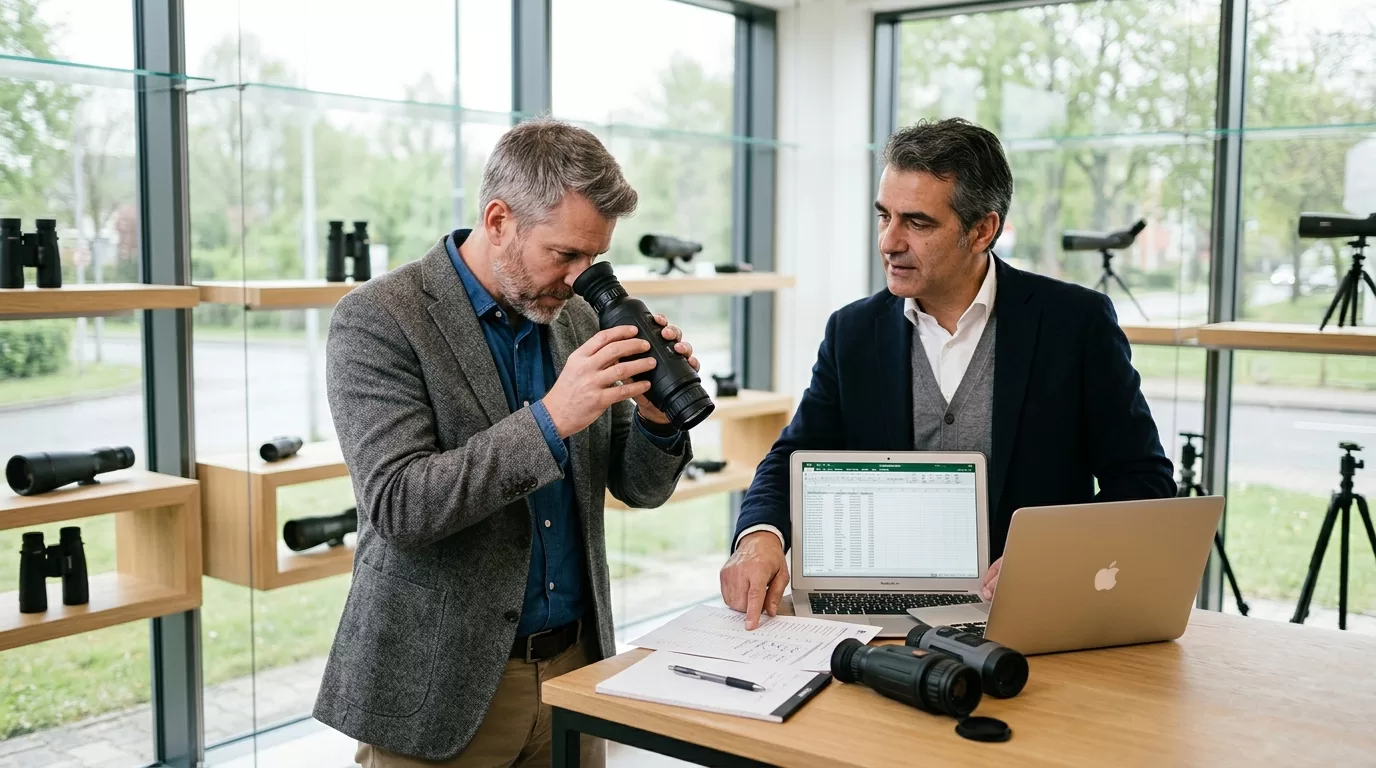
To become a thermal optics dealer, you need a real buyer base, clear resale terms, compliant sales processes, trained staff, and the right starter inventory. The fastest path is to prove you can sell thermal monoculars, thermal scopes, and multispectral optics to specific US buyers without treating every device like a generic outdoor gadget.
Become a Thermal Optics Dealer Steps
1. Define your buyer group.
2. Match Pixfra SKUs to that use.
3. Register business and resale tax paperwork.
4. Set export, age, and hunting-rule controls.
5. Build demo inventory.
6. Train staff on sensors and rangefinders.
7. Agree margin, MAP, warranty, and reorder terms.
8. Apply and report sell-through.
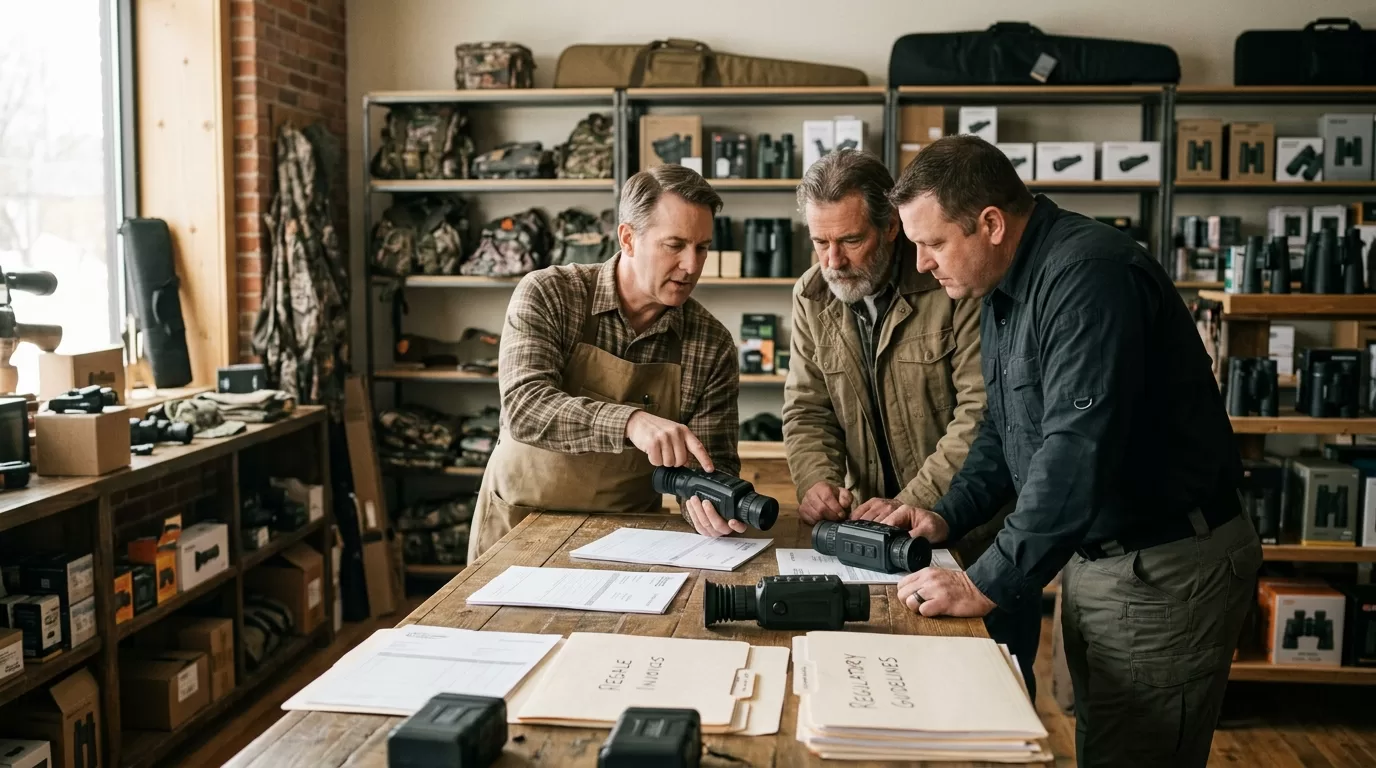
A thermal dealer isn’t just a store with a shelf. You’re the person a ranch owner calls before buying a handheld scanner for coyotes at 2 a.m. You’re also the person who explains why a 640×512 thermal scope costs more than a compact entry monocular, and why a built-in laser rangefinder matters when the customer can’t judge distance in a black field.
If your real aim is to become a thermal optics dealer, start by narrowing the buyer. Predator hunters, hog hunters, ranch security teams, outdoor retailers, tactical resellers, and property managers do not ask the same questions. A coyote hunter cares about field of view and fast target ID. A ranch manager cares about battery life, warranty handling, and whether an employee can learn the menu in ten minutes.
The mistake is ordering inventory first. Don’t. First, write down your top 25 likely buyers by name: local hunting clubs, firearm stores, feed stores, ranches, outfitters, security installers, and night-hunting guides. If you can’t name 25, your dealer application is still a theory.
Dealer readiness checklist
| Area | Minimum proof | Strong proof |
|---|---|---|
| Buyer access | 25 named prospects | 100+ opt-in buyers or retail foot traffic |
| Product knowledge | Basic thermal terms | Staff can compare NETD, resolution, FOV, LRF |
| Sales channel | Website or store | Store, e-commerce, demos, local events |
| Compliance | State hunting links | Written export and use-policy workflow |
| Service | Email support | Intake form, serial tracking, warranty process |
Thermal Optics Dealer Market Fit And Buyers
The best thermal dealers pick one primary customer first. “Outdoor people” is too broad. A store that already sells e-callers, tripods, gun safes, and predator hunting lights can add Pixfra outdoor thermal optics without teaching customers a new buying habit. A camera dealer or security installer may still sell thermal devices, but the sales motion is different: fewer impulse buys, more quote requests, more training.
For US outdoor optics, the strongest B2B fit usually comes from four buyer groups. Predator and hog hunters want fast detection. Ranch and farm users want perimeter awareness. Outdoor retailers want reliable turn. Security installers want repeatable specs and support. Pick one. Then build the offer around that buyer’s real night problem.
| Buyer type | What they ask first | Better starter product angle |
|---|---|---|
| Predator hunter | “How far can I detect?” | Thermal monocular plus thermal scope path |
| Hog hunter | “Can I identify before I shoot?” | Higher resolution, stable image, range help |
| Ranch owner | “Will my staff use it?” | Simple controls, warranty, rugged carry setup |
| Retail store | “Will it move?” | Demo unit, MAP clarity, staff training |
| Security installer | “Can we document specs?” | Data sheets, repeatable model naming |
Here’s a real scenario. A customer walks into a shop after watching five thermal videos online. He asks for “the long-range one.” If your staff only repeats detection range, he may leave with the wrong device. If your staff asks where he hunts, typical shot distance, terrain, target species, and whether he needs recording or a laser rangefinder, the sale changes. That’s dealer value.
This advice doesn’t apply if you’re only trying to flip a few units on a marketplace. Thermal optics customers ask expensive questions. They expect after-sale help. If you can’t support firmware questions, app connection issues, mount selection, or warranty routing, stay out of the category until you can.
Thermal Optics Dealer Requirements And Margins
A manufacturer or distributor will usually want proof that you’re a real business. Expect to provide legal business name, resale certificate, website or storefront details, contact person, shipping address, sales channels, and the product category you want to carry. Some brands may ask for projected monthly volume or current outdoor optics lines. That’s normal.

The money needs plain math. Suppose your wholesale cost on a thermal optic is $1,200 and the minimum advertised price is $1,599. Your gross margin is $399 before card fees, freight, staff time, demos, returns, and tax handling. That’s 24.9%. If you discount to $1,450 to win a quick order, the margin drops to $250, or 17.2%. One warranty-heavy return can erase that.
For a dealer, MAP discipline beats chasing every sale. A store that protects price, trains staff, and sells accessories often keeps healthier margin than a seller who cuts price online and ships boxes with no support. Thermal optics are explanation products. Explanation products reward dealers who can teach.
Dealer cost model
| Cost item | Why it matters | Practical target |
|---|---|---|
| Demo unit | Customers want to look through thermal | 1 unit per key product tier |
| Staff training | Bad explanations cause returns | 2 trained staff minimum |
| Freight and insurance | Higher-value devices need safer shipping | Price it before quoting |
| Card processing | 2.5% to 3.5% can hurt margin | Build it into price math |
| Warranty intake | Serial numbers and photos save time | Use a written form |
| Accessories | Mounts, cases, batteries, tripods | Attach rate above 20% |
Don’t promise what your policy can’t support. If you offer “free returns” on mounted thermal scopes after field use, you’ll pay for it. A tighter policy works better: demo before purchase, inspect on delivery, document serial numbers, and handle warranty claims through the approved process.
Thermal Optics Dealer Inventory And Demo SKUs
Starter inventory should cover use cases, not every SKU. A good first order might include one compact thermal monocular for entry buyers, one 640-class monocular for serious detection, one thermal scope line for hunters ready to mount, and one multispectral or rangefinder option for customers who want more than basic heat detection. That’s enough to teach, demo, and sell without tying up cash in slow-moving variants.
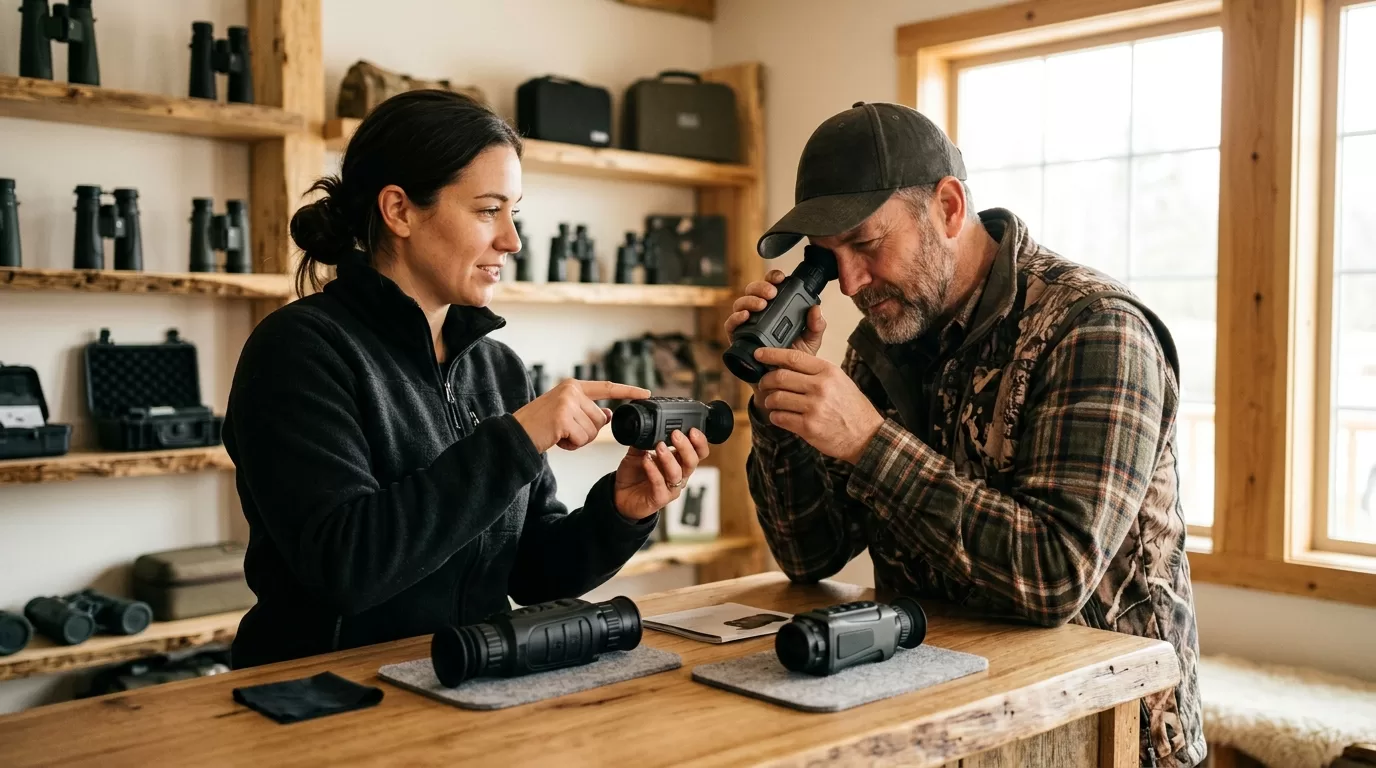
Pixfra gives dealers a useful spread. Sirius 640 is positioned as a long-range thermal monocular with up to 2600m detection, 18mK NETD, and an F0.9 lens. Arc LRF adds laser rangefinder use, with a 1000m rangefinder claim on Pixfra’s product page. Draco combines thermal imaging, 4K digital night vision, laser rangefinder, and infrared illumination. Mile 2 fits the compact buyer. Taurus fits thermal scope customers who ask for up to 640×512 detector resolution and 18mK NETD or lower.
| Starter role | Pixfra example | Best buyer match |
|---|---|---|
| Compact scanner | Mile 2 Series | First thermal buyer, backpack user |
| Long-range handheld | Sirius 640 | Ranch, predator, open-field scanning |
| Rangefinder handheld | Arc LRF | Hunters who need distance confidence |
| Multi-mode optic | Draco | Buyers comparing thermal and night vision |
| Thermal scope | Taurus Series | Mounted hunting setup |
A dealer should demo at dusk, not at noon in a parking lot. Thermal sells when a buyer sees heat contrast: tree lines, parked trucks, dogs at distance, warm rocks cooling after sunset. A daytime demo can still explain ergonomics, menus, and screen quality, but it won’t close as well.
If your team needs brand context before choosing models, the Pixfra thermal imaging optics site is a practical place to compare current outdoor lines before building a stocking plan. Keep the product story simple: what the customer sees, how far the customer can detect, how easy the device is to carry, and what problem the device solves at night.
Thermal Optics Dealer Compliance And Buyer Safety
Thermal optics sales touch export control, hunting law, platform rules, and customer safety. The Electronic Code of Federal Regulations, 2026, publishes the Export Administration Regulations Commerce Control List under 15 CFR Part 774, including Category 6 for sensors and lasers. The Bureau of Industry and Security regulations are the source dealers should check before export, reexport, or international shipment.
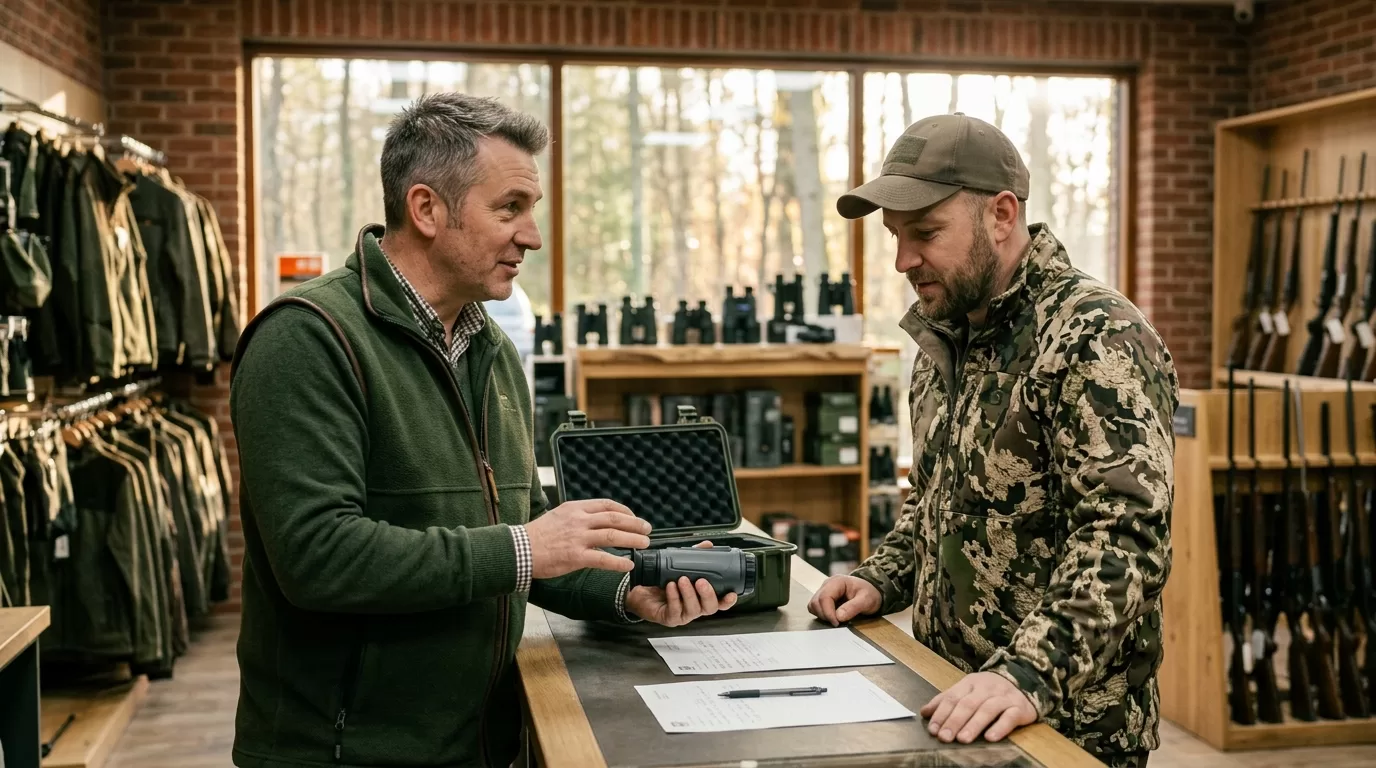
Domestic hunting use is a separate issue. Thermal devices may be legal for scouting, predator control, or certain night hunts in one state and restricted in another. The U.S. Fish and Wildlife Service says refuge hunting can be limited by federal, refuge-specific, and state law, according to its General Hunting Laws. Train staff to say, “Check your state wildlife agency before using thermal equipment to hunt.” That sentence prevents bad advice.
Dealer rule: sell the device, document the buyer, explain lawful-use limits, and avoid giving legal advice beyond official links.
Online sales need their own controls. If you sell through your website, block international checkout until export classification and destination rules are reviewed. If you sell through marketplaces, read the platform’s weapon accessory and optics policies before listing. If you sell in-store, keep a short written script near the counter. Staff turnover is real; the script keeps answers consistent.
This is where expert dealers separate themselves from box movers. A buyer may ask, “Can I take this to Mexico for a hunt?” The answer isn’t a shrug. It’s a process: identify the exact model, classify the item, check export rules, check destination rules, then decide whether the sale or shipment is allowed. Fast answers can be expensive.
Pixfra Thermal Optics Dealer Application
Before you contact Pixfra or a distributor, build a one-page dealer profile. Keep it factual. Include your company name, state, business type, current product categories, website, monthly foot traffic or online traffic, target customer group, requested Pixfra product lines, and who will manage service. If you’re a new business, say that. A clear new dealer is better than a vague established one.

Add a 90-day launch plan. For example: two staff training sessions in week one, one evening demo event in week three, 20 outreach calls to ranches or hunting guides, five short product videos, and a reorder review after the first 10 units sold. You don’t need a giant plan. You need a believable one.
Dealer application packet
| Document | Why it helps |
|---|---|
| Business license or registration | Confirms legal business identity |
| Resale certificate | Supports wholesale purchasing |
| Website or storefront photos | Shows sales channel quality |
| Product-line list | Shows related category fit |
| Buyer segment plan | Proves you know who will buy |
| Service contact | Gives warranty and support ownership |
| Compliance workflow | Shows responsible thermal optics sales |
When you apply, ask direct commercial questions. What are the opening order requirements? Which SKUs are best for US outdoor dealers? Is MAP enforced? What is the warranty process? Are demo units available? Who handles replacement parts or firmware questions? How long do reorders take? What marketing assets can dealers use?
The strongest dealer applications sound like operators wrote them. “We sell to predator hunters in Texas and Oklahoma through a retail store and two night-hunting demo events per month” beats “we want to expand into thermal.” Specific wins.
Become a Thermal Optics Dealer FAQ
Is thermal optics resale profitable?
Yes, thermal optics resale can be profitable when margin, MAP, freight, card fees, and warranty time are priced correctly. A dealer chasing discounts can lose money even on high-ticket products.
Do thermal dealers need licenses?
A normal US resale business may not need a special optics license for domestic sales, but export control and hunting-use rules still matter. Check BIS rules and state wildlife agency rules before shipping or advising buyers.
Which Pixfra models sell first?
Compact monoculars often sell first because the price is easier for new thermal buyers. Serious hunters usually move toward Sirius, Arc LRF, Draco, or Taurus once they understand range, resolution, and use case.
Can dealers sell thermal scopes online?
Yes, dealers can sell thermal scopes online if manufacturer terms, platform rules, tax setup, shipping limits, and export controls are handled. Block international orders until classification and destination checks are complete.
How long does dealer approval take?
Dealer approval time varies by brand, paperwork quality, and territory review. A complete application with resale documents, sales channels, buyer plan, and compliance workflow will usually move faster than a casual inquiry.
If you’re ready to build a serious thermal category, start with one demo kit for hunters, one kit for ranch or property use, and a written staff script for compliance questions. Pixfra can support dealers who treat thermal optics as a specialist category, not a side shelf.