


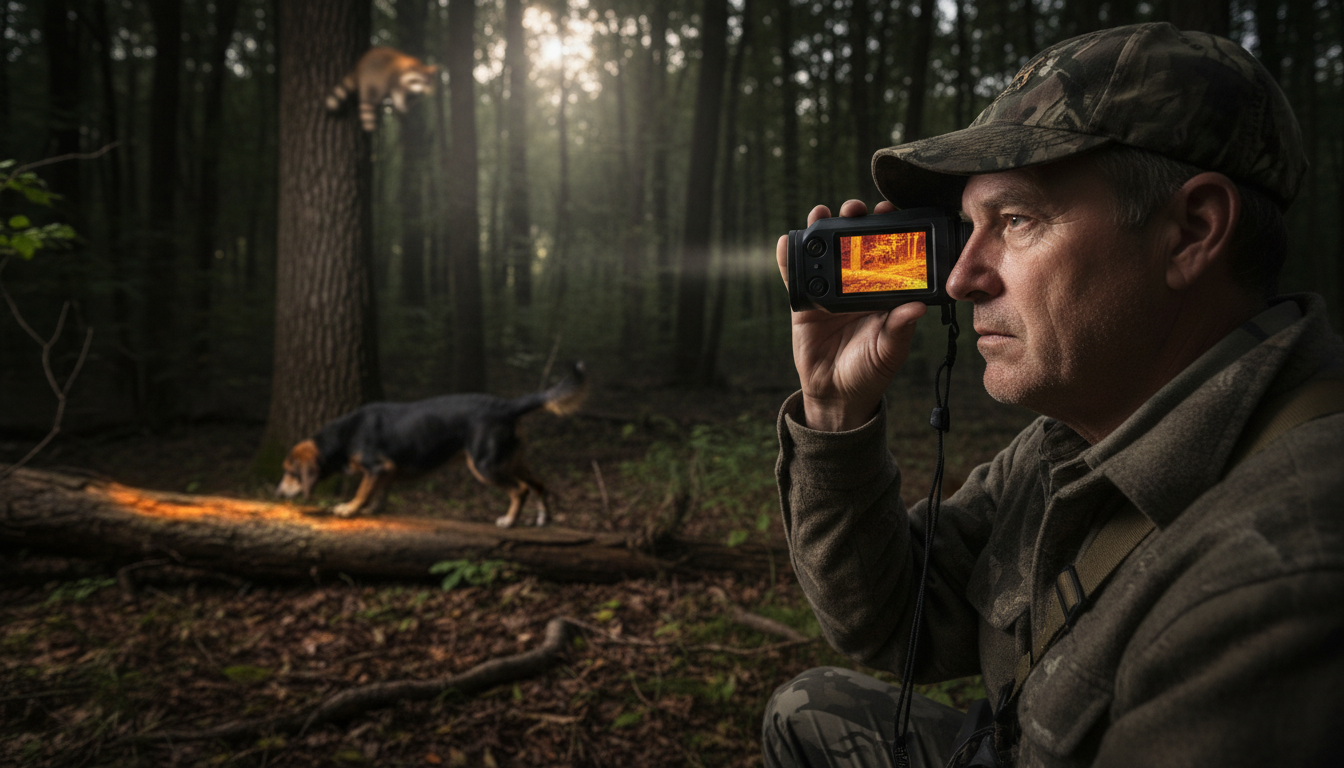
Coon hunting at night brings its own set of challenges. Raccoons are smart, they climb high, and they know how to disappear into thick foliage. We’ve spent countless hours in the field testing thermal monoculars, and we can tell you that the right device makes all the difference between going home empty-handed and filling your tag.
Thermal imaging technology has changed the game for night hunters. Unlike traditional hunting lights that can spook animals or night vision that needs ambient light, thermal monoculars detect heat signatures in complete darkness. You’ll spot that raccoon 30 feet up in an oak tree before your dogs even catch the scent.
But here’s the thing: not every thermal monocular works well for coon hunting. The unit that’s perfect for scanning open hog fields might be terrible in dense timber. We’ll walk you through what actually matters when you’re chasing raccoons through the woods.
Why Thermal Beats Traditional Lights for Coon Hunting
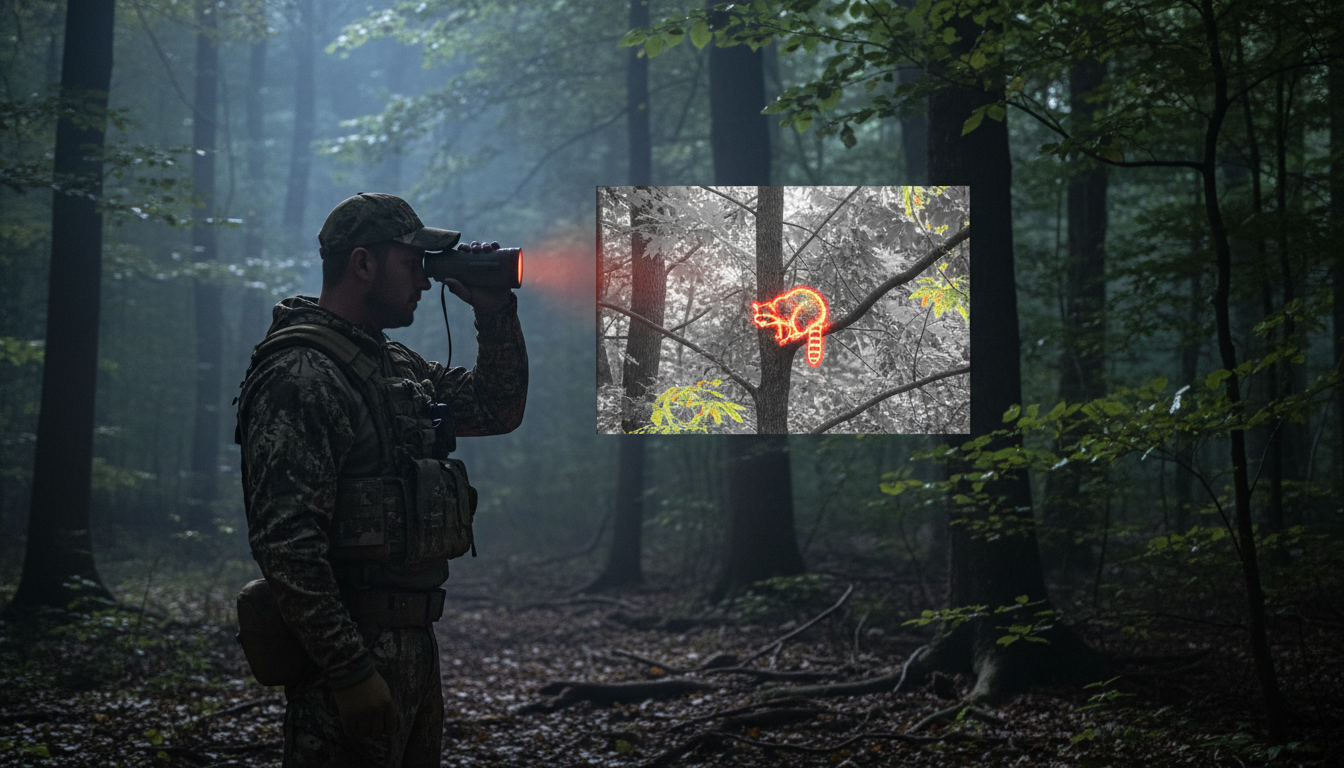
We used to rely on headlamps and spotlights. Those days are behind us. Thermal monoculars see through fog, rain, and heavy dew—conditions that make traditional lights almost useless. The high sensitivity thermal sensors can detect small heat signatures from tree canopies and ground burrows, which is exactly what you need when raccoons are hiding in dense brush or high branches.
The biggest advantage? You can scan without alerting every animal in the area. Thermal imaging technology helps hunters see through the cover of darkness and detect raccoons even in dense cover. And if you’re running dogs, you’ll appreciate keeping your hands free while tracking their movements and watching for incoming raccoons.
For a deeper look at how professional hunters use thermal monoculars, check out our complete guide covering detection ranges, sensor types, and field-tested recommendations.
Key Features That Actually Matter
Detection Range
For coon hunting, look for at least 250-300 meters detection range with 2-4X digital zoom. You don’t need the 1,000+ yard range marketed for open-country hunting. Most of your shots happen inside 150 yards anyway. What you really need is the ability to spot heat signatures in trees at 100-200 yards so you can position yourself and your dogs.
Resolution
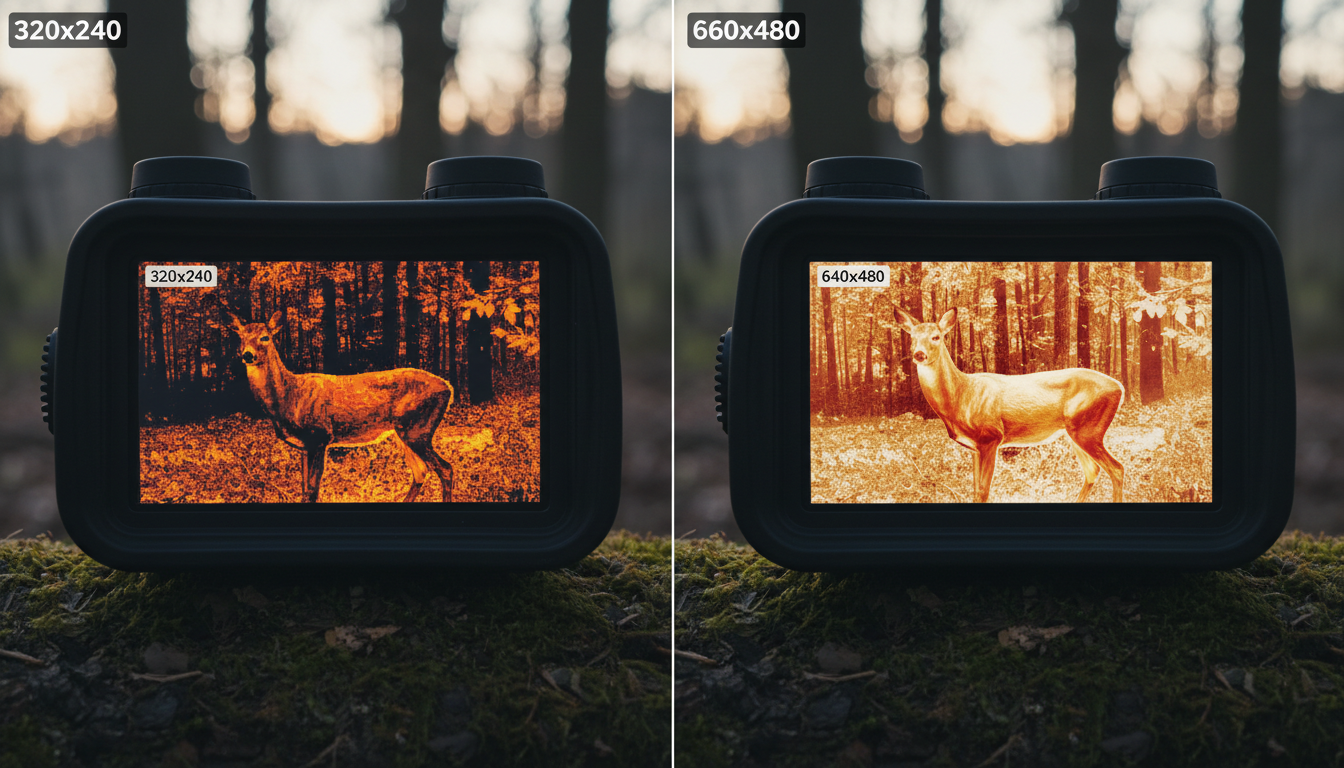
Prioritize 640×480 resolution for identifying small mammals (foxes, raccoons) at 150-300 yards, though a 320×240-384×288 sensor is the sweet spot for most hunting monoculars. We’ve found that 384×288 gives you enough detail to distinguish a raccoon from other critters without breaking the bank.
Battery Life
You need at least 5-6 hours of continuous use for extended night hunts. Nothing’s worse than your thermal dying halfway through a hunt. Look for rechargeable batteries, and always carry a backup.
Field of View
This one’s huge for coon hunting. Field of view is a must in an area that is even somewhat tight. A wide FOV lets you scan quickly and pick up movement in your peripheral vision. Narrow FOV units feel like looking through a straw when you’re in thick timber.
Weight and Design
The monocular should be compact and lightweight enough to easily mount on a helmet or carry in one hand. We prefer units under 1 pound that won’t cause neck strain during 4-hour hunts.
Top Models for Coon Hunters in 2025
AGM Taipan Series
The Taipan TM15-384 runs around $1,200 and includes a Razor Chest Pack, with a wide field-of-view that’s great for tight areas and a 5-year warranty. We’ve pushed these hard in Florida swamps and palmetto thickets. Hunters report it was life-changing for coon hunting, especially in areas with leaves year-round, helping them find many more coons they couldn’t even find with lights.
The step-up model is worth considering. The TM19-384 has two different ways to adjust focus and provides more clarity, with a field of view still fairly wide but more zoomed in, helping reach the top of taller trees. Sound familiar if you hunt southern hardwoods where raccoons like to climb 40+ feet?
AGM Sidewinder TM25-384
Priced at $2,000 and includes a Razor Strap Vest, the Sidewinder has incredible clarity and resolution and has been all the rave among coon hunters over the last year. If your budget allows, this is the unit we grab first.
Budget-Friendly Options
The detection range of the TM15-384 is 708 meters with identification range performance around 200 yards on targets such as hogs and deer with recognition at about 500 yards. For raccoons—which are smaller—expect to identify clearly at 100-150 yards, which covers most hunting scenarios.
Want to see how the Pixfra Sirius HD stacks up? We’ve been testing it alongside these AGM units and the image quality holds its own in dense cover situations.
Handheld vs. Helmet-Mounted: Which Works Better?
We run both depending on the situation. Handheld gives you more control and better scanning—you can quickly sweep an area and adjust your viewing angle. It’s what we use when we’re stationary or moving slowly through open timber.
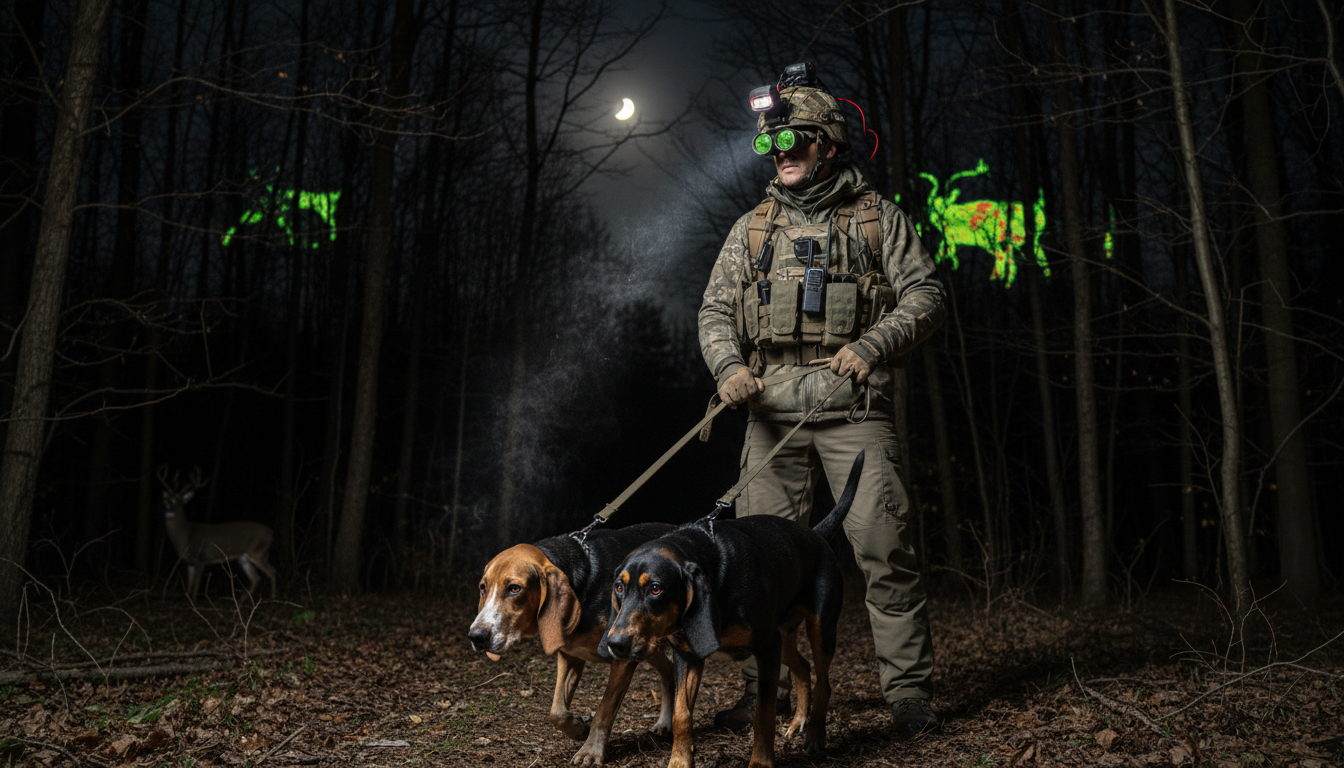
Helmet-mounted keeps your hands free for handling dogs, navigating rough terrain, or carrying your rifle. Some hunters use thermal on a helmet mount to keep their hands free for dog leashes and flashlights. The trade-off is less flexibility in where you’re looking—your thermal points wherever your head points.
Honestly, the best setup is having mounting options for both. Many quality thermal monoculars include chest pack harnesses or helmet mounts. Test both methods and see what fits your hunting style.
Real-World Performance in Different Terrain
Dense Timber and Thick Brush
Wide FOV is non-negotiable here. You need to see what’s happening around you quickly. Thermal monoculars can detect raccoons high up in trees or hiding in dense brush. We’ve spotted raccoons in standing corn, thick honeysuckle, and tangled creek bottoms that we’d never have found with lights.
Mixed Hardwoods
This is where mid-range resolution (384×288) really shines. You get enough clarity to identify a raccoon at 30-40 feet up without spending $3,000+ on a 640×480 unit.
Open Fields and Field Edges
You can get away with narrower FOV here since you’re scanning longer distances. Higher magnification helps spot raccoons traveling between woodlots.
Battery Management and Weather Considerations
Quality thermal monoculars operate smoothly in fog, rain, or heavy dew—exactly the conditions when coon hunting gets interesting. Cold temperatures drain batteries faster, so we always carry a spare. Some hunters keep the backup battery in an inside pocket to keep it warm.
Rechargeable batteries beat disposables for cost and convenience. A rechargeable battery provides 7.5 hours of runtime without WiFi enabled, which is perfect for a night out. Turn off WiFi and video recording features to stretch battery life even further.
What About Lower-Priced Units?
Buying a more expensive thermal doesn’t mean it’s always better, especially for coon hunting—it’s about finding the best thermal for you, and a thermal can be a huge investment where picking the right one the first time matters.
We’ve tested budget units under $600. They work—sort of. You’ll detect heat signatures, but identification is rough. If you really want to identify at that range you need a 384 unit; if you just want to see heat signatures, lower resolution is an option. For serious coon hunters running dogs and hunting multiple nights per week, spend the extra money upfront.
Maintenance and Care Tips
Treat your thermal like the precision instrument it is. Clean the lens with a microfiber cloth—never your shirt. Store it in a protective case. AGM brand thermals offer awesome customer service and great warranties on all their thermals.
Check your local regulations too. Thermal vision devices do not emit IR light, making them a permissible option in some areas, but hunters must always check their local state regulations to ensure compliance.
Making Your Decision
Start by asking yourself three questions: What’s my typical hunting terrain? What’s my realistic budget? How often will I actually use this?
If you hunt thick cover with dogs 2-3 times per week, invest in a quality 384×288 unit with wide FOV. The Taipan TM19-384 is the best of the Taipan models for coon hunting, giving you everything you need to find heat while competition hunting or pleasure hunting.
For occasional hunters or those just getting into thermals, the TM15-384 offers solid performance at a lower price point. You can always upgrade later if you catch the thermal hunting bug—and trust us, you will.
Conclusion
The best thermal monocular for coon hunting balances resolution, field of view, battery life, and price. For most hunters, a 384×288 resolution unit with wide FOV and 5+ hour battery life hits the sweet spot. The AGM Taipan TM19-384 earns our top recommendation for its clarity, versatility, and proven track record in the woods. Budget-conscious hunters will find the TM15-384 delivers excellent value.
Don’t overthink it. Pick a quality thermal in your budget, get out in the woods, and start using it. You’ll learn more in three hunts than reading a dozen reviews. And once you’ve spotted your first raccoon at 150 yards through thick brush in total darkness, you’ll wonder how you ever hunted without one.
For more thermal hunting insights and product recommendations, visit Pixfra’s homepage where we cover everything from entry-level units to professional-grade systems.
FAQs
What resolution thermal monocular do I need for coon hunting?
A 384×288 resolution provides the best balance of performance and price for coon hunting. This resolution gives you clear identification of raccoons at 100-150 yards, which covers most hunting scenarios. Higher 640×480 resolution offers more detail but costs significantly more. Lower 320×240 resolution works for basic detection but makes identification harder, especially at distance or in dense cover.
How far can a thermal monocular detect a raccoon?
Detection and identification are different. Most quality thermal monoculars can detect a raccoon’s heat signature at 300-500 yards, but clear identification happens at shorter ranges. With a 384×288 sensor, expect reliable identification at 100-150 yards. Smaller raccoons produce less heat than deer or hogs, so they appear as smaller thermal signatures. Weather conditions, background temperature, and foliage density also affect detection range.
Can I use a thermal monocular while handling my dogs?
Yes, and many coon hunters prefer helmet-mounted setups for hands-free operation. This lets you manage dog leashes, navigate terrain, and carry your rifle while still scanning for raccoons. Helmet mounts work best when you’re moving or working dogs. For stationary scanning or detailed observation, handheld offers more control. Look for thermal monoculars that include both mounting options so you can switch based on the situation.
Do thermal monoculars work in rain and fog?
Thermal monoculars work well in rain, fog, and heavy dew—conditions that render traditional lights nearly useless. Thermal imaging detects heat signatures rather than reflected light, so moisture in the air doesn’t block the view like it does with spotlights or night vision. However, extremely heavy rain can reduce range slightly. Most quality units carry weather-resistant ratings, but always verify the IP rating before buying.
What’s the minimum battery life I need for coon hunting?
Plan for at least 5-6 hours of continuous runtime. Most coon hunts last 3-4 hours, but battery life decreases in cold weather, and you don’t want to cut a good hunt short. Rechargeable batteries offer the best value long-term. Always carry a fully charged spare battery. Disable features like WiFi, video recording, and excessive screen brightness to maximize runtime in the field.