


Distributors find new thermal suppliers at SHOT Show by building a shortlist before Las Vegas, using booth meetings to test channel fit, then validating samples, warranty terms, landed cost, MAP, and compliance before placing a first order. This SHOT Show sourcing guide gives you the working process, not a booth-walking wish list.
SHOT Show Sourcing Guide Checklist
A distributor should source thermal suppliers at SHOT Show in this order: pre-filter brands by channel fit, meet only suppliers with real inventory plans, compare thermal specs against field use, verify warranty and compliance paperwork, then negotiate terms after sample testing. The best supplier is the one you can sell, service, and reorder.
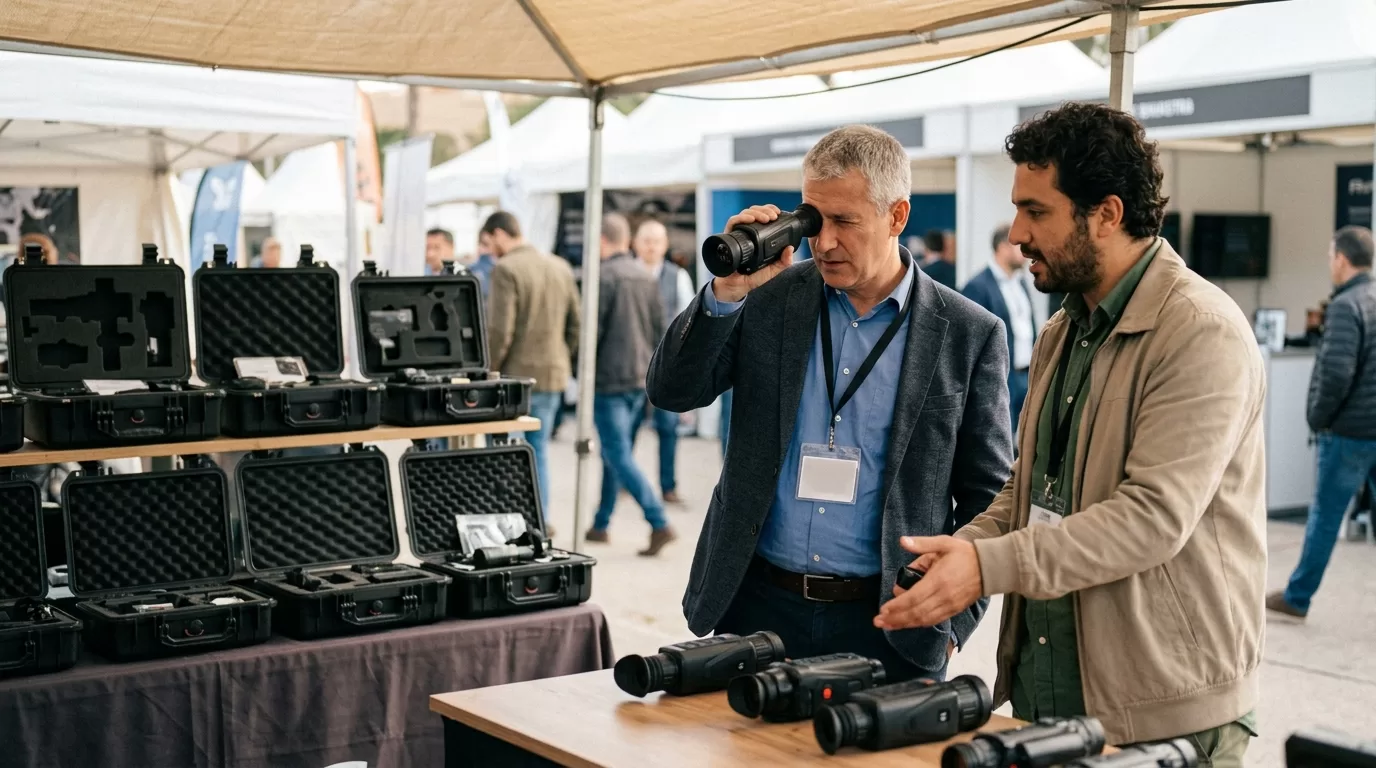
SHOT Show is attractive because the whole trade compresses into one week. NSSF reported the 2026 SHOT Show drew more than 53,000 industry professionals, 2,744 exhibitors, and 834,500-plus net square feet of exhibit space at The Venetian Expo and Caesars Forum. For thermal optics buyers, that scale creates a problem: too much choice.
So you need a filter before you land.
| Sourcing check | What to ask | Walk away if |
|---|---|---|
| Channel fit | Are you built for distributors, dealers, Amazon, or direct-to-consumer? | The supplier wants every channel at once |
| Thermal line depth | Which SKUs cover entry, mid-tier, LRF, and premium buyers? | One hero model carries the whole pitch |
| Service plan | Who handles RMA, firmware, parts, and replacement units? | Warranty answers change by salesperson |
| Margin math | What are MSRP, MAP, dealer cost, MOQ, freight, and payment terms? | Profit depends on perfect sell-through |
| Compliance pack | Can you provide ECCN, manuals, labeling, and battery documents? | Paperwork comes “after the order” |
A distributor walking in cold usually burns two days on attractive booths and leaves with 40 brochures. A better plan is boring on purpose. Before the show, list the price points your dealers already sell: under $1,500 monoculars, $2,000 to $3,500 scopes, 640 sensor LRF units, and premium long-range devices. Then look for gaps. If your dealers already carry Pulsar, AGM, ATN, and iRayUSA, a new supplier has to give you a clean reason to add another brand.
This advice doesn’t apply if you’re buying two demo units for a single retail store. In that case, you can be more opportunistic. For a distributor with 30, 80, or 200 dealer accounts, supplier selection is a systems decision. A thermal optic that looks great for 90 seconds in a booth still has to survive January hog hunts, August humidity, impatient counter staff, and customers who update firmware ten minutes before a weekend trip.
Supplier Fit Beats Booth Buzz
The biggest mistake is treating SHOT Show like a product discovery trip. Discovery matters, but distributors make money from fit: fit with your dealer base, your return policy, your sales cycle, and your state-by-state customer demand. The official SHOT Show page from NSSF describes the event as a trade-only gathering for retailers, wholesalers, distributors, manufacturers, and related industry professionals. That trade-only nature is why serious supplier conversations can happen fast.
Reddit chatter around SHOT Show 2026 was full of questions about which optics brands would attend, which models were being teased, and whether certain products were real launches or dealer rumors. Treat that as directional noise. It tells you buyers are watching thermal optics closely, but it doesn’t tell you which supplier can ship 300 units, hold MAP, or answer a dealer’s warranty call on a Friday afternoon.
Use four fit filters before you care about booth excitement:
| Fit filter | Better signal |
|---|---|
| Dealer type | The supplier can name the exact stores it wants: hunting retailers, tactical dealers, farm supply, or LE distributors |
| SKU ladder | The line moves from entry monocular to 640 LRF without confusing buyers |
| Channel discipline | The supplier has written rules for MAP, marketplace sales, demos, and closeouts |
| Support depth | The supplier can explain RMA flow, firmware release cadence, and spare part availability |
The exclusivity conversation should wait until fit is proven. A supplier may offer “exclusive US distribution” because it sounds valuable; a distributor may ask for it because territory protection feels safe. Neither side should treat it like a handshake prize. If the conversation turns to territory early, use the framework in negotiating exclusive distribution rights for thermal optics and tie exclusivity to measurable sales commitments, inventory coverage, and service duties.
One blunt test works well: ask the supplier which accounts they don’t want. A serious supplier can answer. “We don’t want discount-only marketplace sellers.” “We don’t want dealers with no thermal demo ability.” “We don’t want grey-market export risk.” Those answers reveal discipline. A supplier who says yes to every account will probably say yes to your competitors too.
Thermal Specs Need Field Proof
Thermal specs matter because your dealers have to explain them at the counter. A customer asks, “Why is this 384 model $800 less than that 640 model?” The salesperson has ten seconds to answer before the buyer reaches for a phone and checks another brand. Sensor resolution, NETD, lens size, refresh rate, detection range, battery life, and rangefinder performance all need plain-English selling logic.
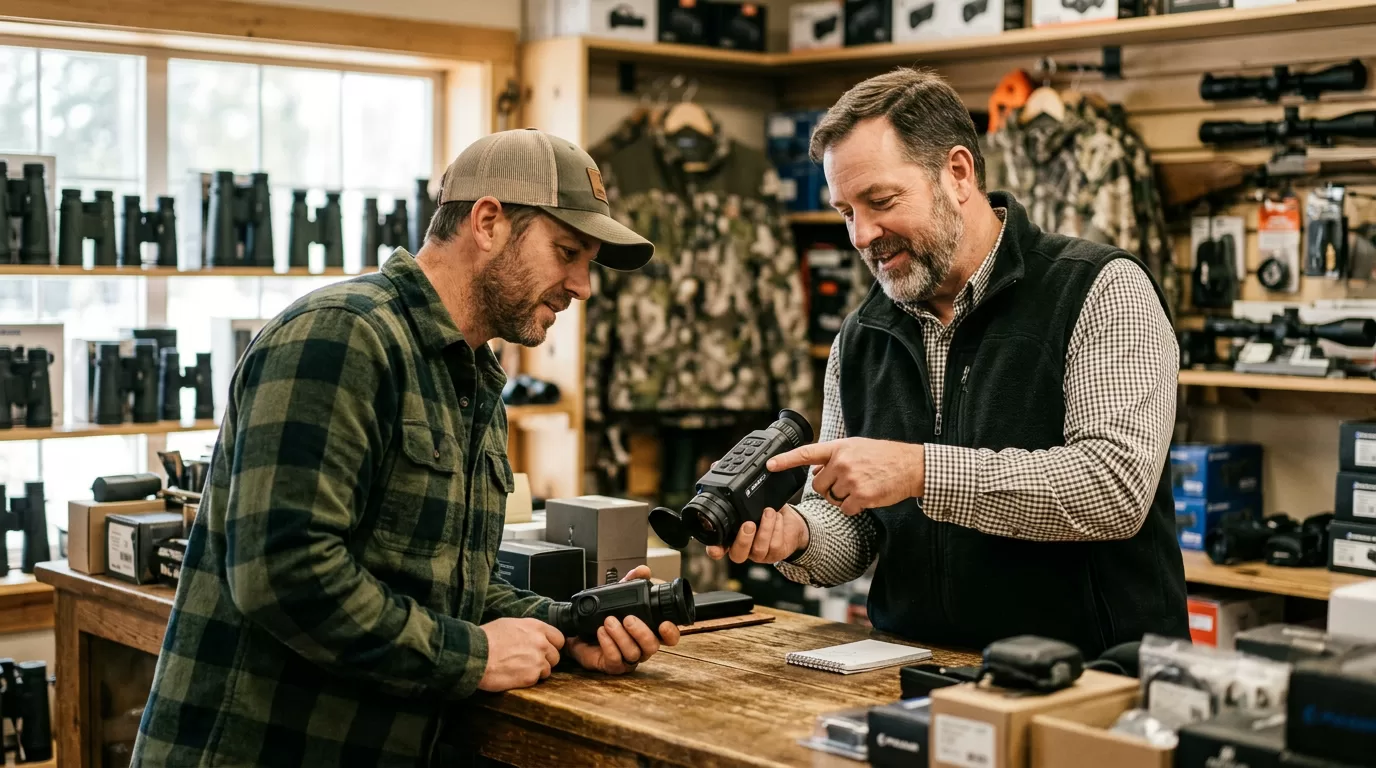
Pixfra’s own outdoor line shows why distributors should compare systems, not just one headline number. Pixfra Arc LRF models include 384×288 and 640×512 sensor options, 12 μm pixel pitch, ≤20 mK NETD at f/1.0, 50 Hz frame rate, and a 1,000 m laser rangefinder. Pixfra Pegasus 2 LRF moves into a 640×512, 15 mK class. Pixfra Sirius units are often evaluated for long-range monocular use with 18 mK sensitivity and an F0.9 lens. Those numbers give a distributor a better conversation than “good image quality.”
Still, the booth image is the easiest image the device will ever produce. Indoor targets are warm, lighting is controlled, and nobody is wearing gloves while scrolling menus.
| Spec | Booth claim | Field proof |
|---|---|---|
| NETD | “Great in low contrast” | Test in fog, rain, wet grass, and humid timber |
| Sensor resolution | “640 is premium” | Compare ID detail at 100, 200, and 300 yards |
| LRF | “1,000 m ranging” | Range dark animals, fence posts, brush edges, and angled targets |
| Battery | “All-night use” | Run video, Wi-Fi, rangefinder, and cold-weather tests |
| Menu design | “Easy controls” | Hand it to a dealer wearing gloves and say nothing |
For US distributors, the sweet spot is usually a clear four-step ladder: budget scanner, serious 384 unit, 640 unit, and 640 LRF or premium long-range unit. Too many SKUs slow dealer training. Too few SKUs leave margin on the table. If your dealers serve Texas hog hunters, Midwest coyote hunters, ranch owners, and law enforcement buyers, the product line has to cover different distances without making the catalog feel like a spreadsheet.
This is where field testing should be harsh. Put a demo unit next to known references: Pulsar Thermion 2, AGM Rattler V2, iRayUSA RICO, ATN ThOR, and any brand already moving through your dealers. Don’t run the comparison only at midnight in perfect conditions. Test at dusk. Test after rain. Test across cut corn, pine edges, and open pasture. Check how fast the device wakes, how often it needs calibration, and whether the app connection makes a salesperson look smart or stuck.
A supplier that gets defensive about field testing is telling you something. A good supplier wants that test because it exposes which buyer the product fits. A 384 monocular with strong sensitivity may be a better ranch tool than a cheap 640 device with weak processing. A heavy LRF scope may be perfect from a tripod and annoying for a mobile hunter. These are not defects. They’re sales boundaries.
Dealer Terms Decide Profit
The best thermal supplier on paper can still lose money for a distributor. Freight, payment terms, warranty swaps, MAP violations, demo discounts, and stale inventory can eat the margin before the first reorder. Ask for the commercial sheet before you ask for a booth demo. If the supplier can’t explain landed cost, you don’t know your real dealer price.

A practical first-order model looks like this: one or two units per key SKU for demo and dealer training, then a controlled reorder after 30 to 45 days of sell-through. That works better than a giant opening buy unless you already have dealer preorders. Thermal optics are too technical for blind inventory confidence. A retailer may love a new 640 LRF model in January, then ask for different lens options after three weekend demos.
Put these terms in writing before the sample invoice:
| Term | Distributor-friendly version |
|---|---|
| MOQ | Low first order with higher reorder targets after sell-through |
| MAP | Written policy, marketplace monitoring, and strike process |
| Warranty | Clear replacement timing, RMA location, and firmware support |
| Demo units | Discounted units with rules for resale after demo period |
| Spare parts | Eyecups, caps, mounts, batteries, chargers, and cables available by SKU |
| Closeouts | Prior notice before price drops or model replacement |
Compliance is part of profit too. Thermal imaging sits close to export-control rules, especially when products move across borders or reach foreign end users. The eCFR entry for 15 CFR § 743.3 on thermal imaging camera reporting requires reporting for certain exports of more than 100 thermal imaging cameras in monocular, biocular, or binocular form when controlled under ECCN 6A003.b.4.b and shipped to specified destinations. A distributor doesn’t need to become a lawyer at the booth, but you do need the supplier’s ECCN, end-use statements, country-of-origin documents, lithium battery documents, and written export guidance.
Ask one awkward question: “What happened during your last warranty spike?” Good suppliers have a story. Maybe a firmware update caused app pairing issues. Maybe a batch of mounts needed replacement. Maybe a battery door seal changed. The details matter less than the response. If the supplier identified the issue, notified dealers, shipped parts, and fixed the next production run, you can work with that. If the answer is “we don’t have warranty issues,” keep walking.
Las Vegas Follow-Up Plan
The real sourcing work starts after SHOT Show. Booth meetings create access; follow-up creates a supplier relationship. By Friday afternoon, every supplier has a stack of business cards, scanned badges, dealer promises, dinner notes, and half-remembered conversations. Your job is to become the distributor with the cleanest next step.

Use a fixed timeline:
1. Within 24 hours: send a short recap with the SKUs, pricing questions, sample request, and account type.
2. Within 7 days: request the dealer price sheet, MAP policy, warranty document, product data, compliance pack, and sample invoice.
3. Within 30 days: test samples with two internal staff and two trusted dealers.
4. Within 45 days: share pass/fail notes, return questions, and forecasted opening order.
5. Within 60 days: place a controlled order or end the conversation cleanly.
Don’t send “great meeting you at SHOT” and wait. Send a buyer-grade note. “We distribute to 120 hunting and outdoor dealers across Texas, Oklahoma, Arkansas, and Louisiana. Our current thermal volume is strongest between $1,800 and $3,500. We’re evaluating one 384 monocular, one 640 scope, and one LRF SKU. Please send dealer cost, MAP, warranty terms, and sample availability by Friday.” That email gets answered because it sounds like money and work.
Your sample scorecard should be simple enough for a dealer to use:
| Test area | Pass condition |
|---|---|
| Image | Dealer can explain the image difference in one minute |
| Controls | New user can change palette, zoom, focus, and record without a manual |
| Sales story | SKU has a clear buyer, distance, and price reason |
| Support | Supplier answers technical questions within one business day |
| Reorder | Supplier confirms lead time before the first PO |
The next question is which supplier deserves deeper commitment. Pick the supplier that makes your dealer stronger. Sometimes that’s the brand with the sharper image. Sometimes it’s the brand with fewer returns, cleaner MAP control, faster RMA swaps, and a product ladder your reps can learn in an afternoon. The show floor rewards flash. Distribution rewards repeatable work.
FAQ
Why source thermal at SHOT Show?
SHOT Show puts thermal optics brands, distributors, retailers, and accessory suppliers in one trade-only setting. You can compare products, terms, warranty answers, and channel strategy in days instead of stretching the same work across months of calls.
How many suppliers should distributors meet?
A serious distributor should pre-book 8 to 12 thermal supplier meetings and leave room for 4 to 6 walk-up discoveries. Fewer meetings limit comparison; too many meetings blur pricing, warranty, and SKU details.
What thermal specs matter most?
For dealer sales, focus on sensor resolution, NETD, lens size, refresh rate, rangefinder performance, battery life, and menu speed. NETD and field image stability often matter more than resolution alone in fog, humidity, and low-contrast terrain.
Should distributors request exclusivity?
Request exclusivity only after sample testing, first sell-through data, and service expectations are clear. A supplier should trade territory protection for measurable distributor commitments, not for enthusiasm after a booth meeting.
When should samples be ordered?
Order samples within one week after SHOT Show while the supplier still remembers the meeting and inventory is visible. Test them for 30 days with staff and trusted dealers before writing a larger purchase order.
Use this SHOT Show sourcing guide as your buying discipline, then bring Pixfra your channel map, target price bands, dealer profile, and preferred thermal categories. We can help you match the right Pixfra outdoor optics products to real accounts instead of guessing from a crowded show floor.