


To vet a thermal optics supplier on Alibaba, verify the company’s legal identity, test a paid sample, inspect product markings, confirm export documents, and check whether the seller can support warranty claims after delivery. Don’t trust badges alone. For thermal scopes, monoculars, and rifle-mounted optics, a weak supplier can cost you chargebacks, seized inventory, or a dealer reputation you can’t repair quickly.
Vet Alibaba Thermal Suppliers
1. Match the Alibaba storefront name to the legal business license.
2. Ask whether the seller is a factory, trading company, or brand reseller.
3. Order a paid sample with serial-number photos before shipment.
4. Search the supplier name plus “scam,” “counterfeit,” and “fake.”
5. Verify manuals, firmware, packaging, warranty terms, and export paperwork before bulk payment.
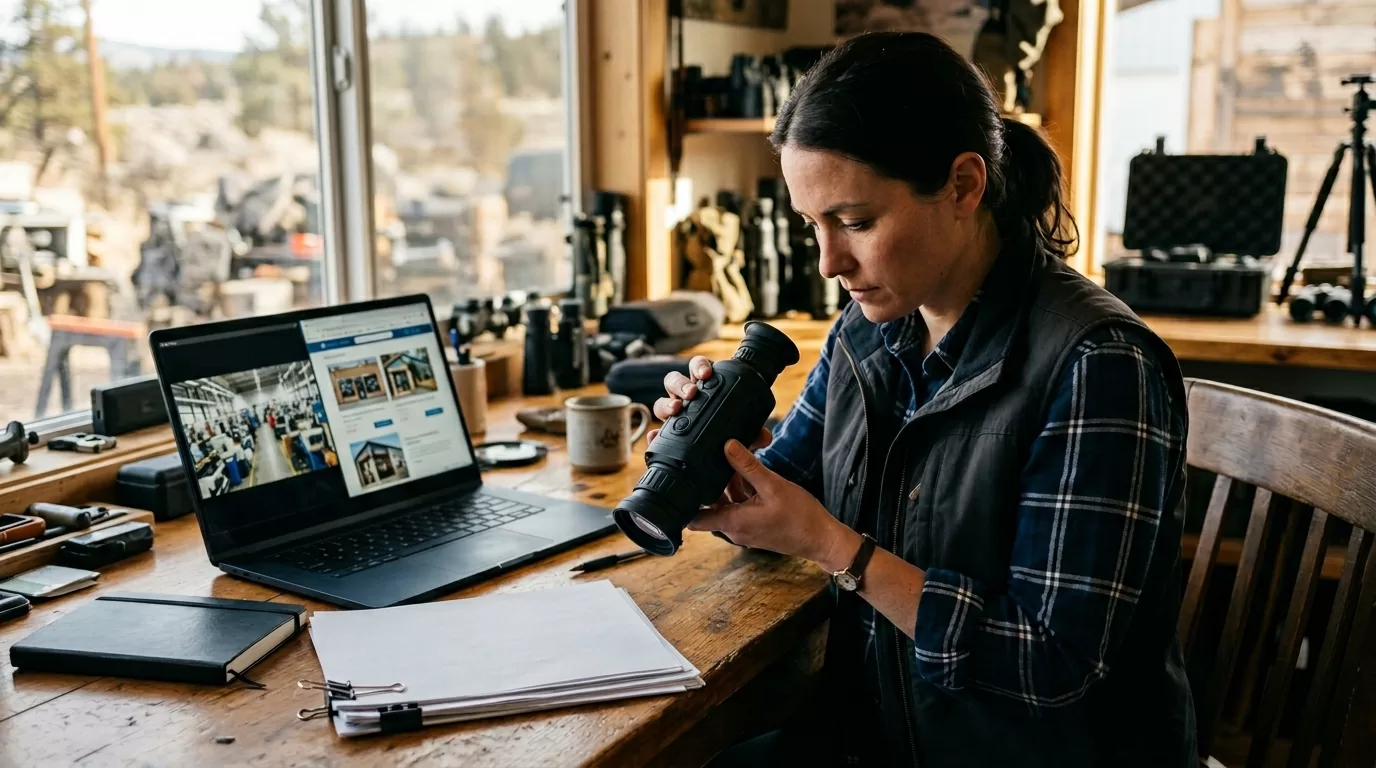
The fastest way to vet a thermal optics supplier on Alibaba is to treat the listing as a starting point, not proof. A thermal monocular page can look professional in 90 seconds: black product render, 384×288 detector claim, “OEM accepted,” five-star reviews, and a factory photo that may belong to someone else.
Bad sourcing usually starts with one lazy assumption: “They have Gold Supplier status, so they’re real.”
Alibaba badges help, but they don’t answer the question dealers actually care about: can this company legally, consistently, and honestly deliver the exact thermal optic you’ll sell under your name or carry in your catalog? For a $39 phone case, a soft answer may be fine. For a thermal scope that might retail from $699 to $2,999, soft answers are expensive.
Use this first-pass screen before you spend time on calls:
| Check | Good Signal | Red Flag |
|---|---|---|
| Business type | License matches storefront and product category | “Factory” claim, but license says trading company |
| Product proof | Real photos with today’s date and serial number | Only renders or cropped catalog images |
| Thermal core | Sensor resolution, NETD, frame rate, lens specs stated clearly | “Military grade” with no detector details |
| Reviews | Mixed but believable feedback | 100% perfect reviews across unrelated products |
| After-sales | Written RMA process and parts timeline | “Don’t worry, quality is best” |
One more point from sourcing forums and Reddit threads: many “manufacturers” are trading companies. That isn’t automatically bad. A strong trading company can consolidate orders and communicate better than a small factory. The problem is pretending. If a supplier lies about being the factory, what else are they editing?
Factory Or Trading Company
Ask this directly: “Are you the manufacturer of this thermal optic, or are you a trading company selling another factory’s product?”
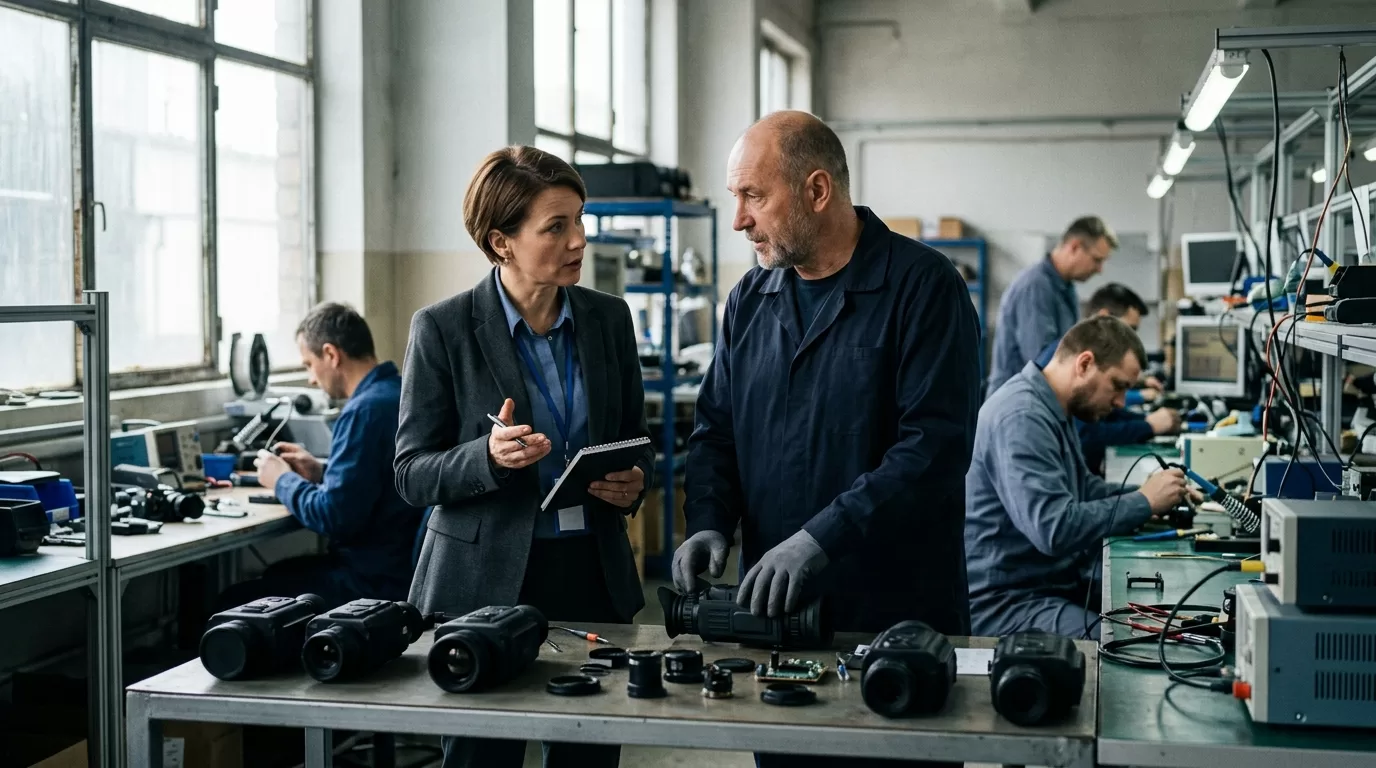
Then stop typing.
Let the supplier answer in their own words. If they dodge with “we have our own production line cooperation factory,” ask for the Chinese legal company name, business license, factory address, and a short video showing your contact walking from the office entrance to the assembly or test area. It doesn’t need cinematic polish. It needs continuity.
For thermal optics, the difference matters because warranty responsibility gets messy. A trading company may not control firmware updates, detector sourcing, lens calibration, recoil testing, packaging changes, or spare eyecups six months later. If you’re buying for a dealer channel, you need to know who owns the product decisions. Before you commit, compare the supplier’s after-sales promises with a real dealer support model such as warranty and rma support for thermal optics dealers, because “one-year warranty” can mean anything until the first failed unit lands on your desk.
A practical script:
> “Please confirm whether your company manufactures this model. If yes, send the business license, factory address, detector supplier category, production capacity for this model, and sample serial-number format. If no, please explain your role in QC, firmware support, warranty replacement, and spare parts.”
Good suppliers won’t panic. They may say, “We are a trading company, but we handle QC and warranty directly.” That can work for small test orders. For private label, regional distribution, or repeat dealer stocking, you’ll want stronger proof: factory audit video, written QC checklist, batch-level test reports, and a named after-sales contact who doesn’t disappear after payment.
| Question | Why It Matters |
|---|---|
| Who designs the firmware? | Firmware bugs create returns that sales reps can’t fix. |
| Who owns the housing mold? | Shared molds make copycat listings harder to control. |
| Who calibrates the lens module? | Thermal image quality depends on calibration, not only resolution. |
| Who handles failed units? | The seller and factory may blame each other. |
This advice doesn’t apply the same way if you’re buying five units for field testing or internal use. For tiny orders, speed may matter more than supplier depth. But if your name, dealer margin, or warranty promise is attached to the product, treat “factory or trader” as a risk question, not a trivia question.
Counterfeit Thermal Optics
Counterfeits in thermal optics don’t always mean a fake logo slapped on a box. Sometimes the copy is quieter: copied product photos, borrowed certifications, cloned housings, inflated detector specs, firmware screenshots from another brand, or a sample that performs well followed by a weaker bulk batch.

That last one hurts.
Picture this: the sample arrives clean. The image looks sharp at 75 yards. The menu language is decent. You approve 100 units. Eight weeks later, customers start complaining that the zero shifts after recoil, the battery door loosens in cold weather, and the “640” model behaves more like a 384 sensor with aggressive upscaling. Now the supplier says the engineer is traveling.
The U.S. Customs and Border Protection page on fake goods and real dangers warns that counterfeit goods can create safety and economic risks. Thermal optics add another layer because buyers may use them for hunting, security, farm work, marine observation, and night search tasks. A false spec isn’t just annoying; it changes what the user believes the device can do.
Use these checks before bulk payment:
- Search the supplier name plus “scam,” “fake,” “counterfeit,” “Reddit,” and “complaint.”
- Reverse image search the hero product photos.
- Ask for uncropped photos of the unit, box, manual, serial label, and boot screen.
- Compare the menu UI against known brands such as Pulsar, AGM Global Vision, ATN, Hikmicro, InfiRay, and Pixfra.
- Ask whether the supplier can provide written brand authorization if they’re selling a branded product.
- Avoid “original brand, no logo” offers. That phrase often means trouble.
The 100% positive review problem deserves its own note. A supplier with 42 perfect reviews, all written in the same tone, across thermal monoculars, baby strollers, and solar cables should make you slow down. Real B2B orders have friction: delayed cartons, misunderstood specs, sample revisions, customs questions. A believable profile may include neutral details.
Also watch for fake urgency. “Only 20 pieces left at this price” doesn’t mean much in a category where the supplier claims monthly output of 3,000 units. When thermal optics listings push countdown pressure before technical clarity, the seller is asking you to act like a retail shopper. You’re sourcing. Different game.
Sample And Spec Checks
Never skip the paid sample. Free samples can bias the exchange: the supplier sends a handpicked unit, then expects bulk commitment. Paying for the sample gives you a cleaner path to demand a normal production unit, normal packaging, normal accessories, and normal serial tracking.
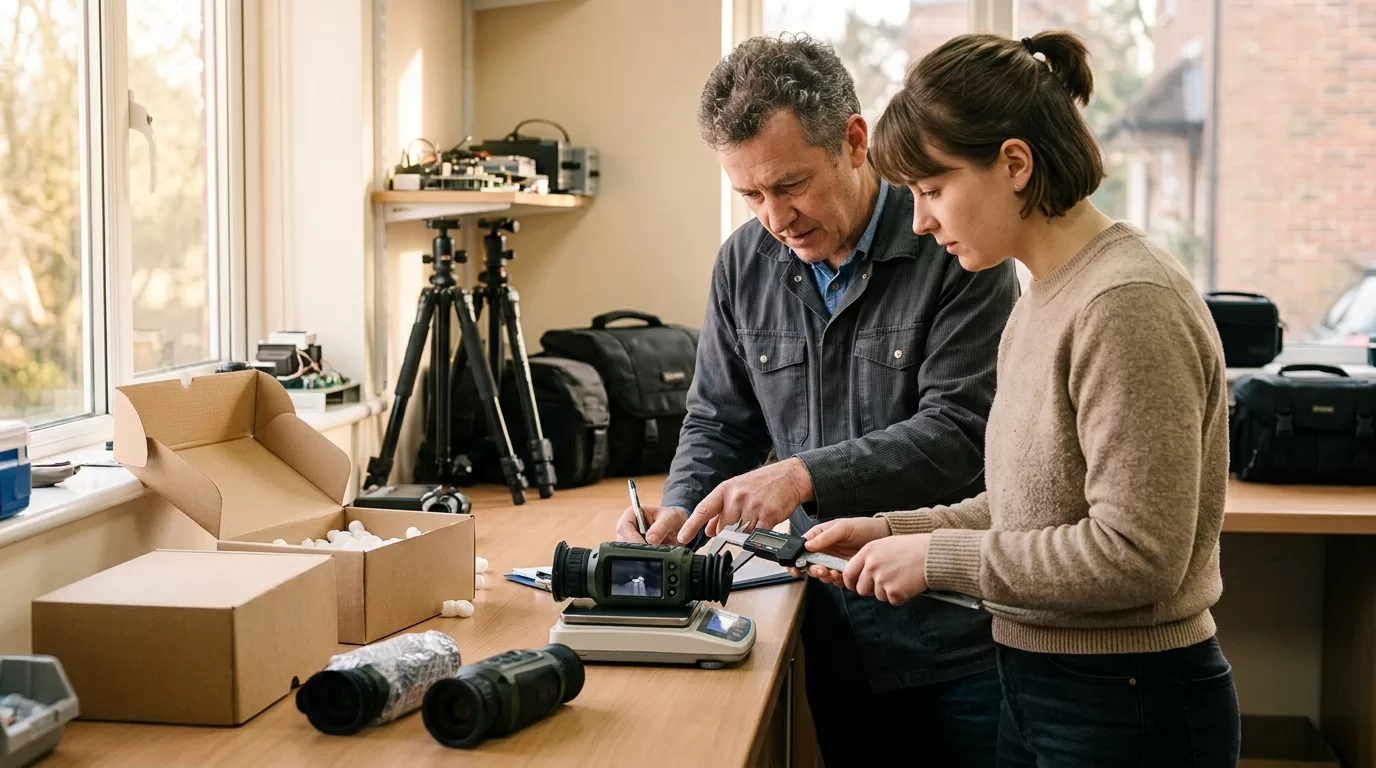
Your sample request should be boringly specific. Ask for the exact SKU, detector resolution, lens focal length, frame rate, NETD rating, display resolution, battery type, firmware version, language pack, reticle options if it’s a scope, and included accessories. If the listing says 384×288, 50 Hz, 35 mm lens, IP67, and 6-hour battery life, your sample invoice should say the same. Vague invoices protect the seller, not you.
Run the sample like a small lab test:
| Test | Simple Method | What To Record |
|---|---|---|
| Boot and UI | Power cycle 20 times | Boot time, freezes, language errors |
| Detection | Test a person at 50, 100, 200 yards | Image clarity, lag, hot-spot handling |
| Battery | Run at room temp and cold condition | Real runtime, charging behavior |
| Recoil claim | Ask for test standard or video proof | Caliber, rounds, mounting method |
| Water resistance | Don’t dunk blindly; request rating evidence | IP claim, seal design, warranty exclusions |
| App pairing | Test iOS and Android | Connection drops, permissions, recording quality |
For a thermal rifle scope, recoil proof is non-negotiable. Ask what caliber and round count the supplier used. “Shockproof” means almost nothing without a test condition. A scope that survives .22 LR plinking may fail on .308 Winchester or 12-gauge slug recoil. For a handheld thermal monocular, prioritize image consistency, startup speed, battery behavior, and focus feel.
Don’t let the supplier control the whole test. Take the sample outside at dusk, at midnight, and before sunrise. Point it at a tree line, a parked vehicle, a dog at 40 yards, a person walking across a field, and a warm engine cooling down. Thermal optics reveal weaknesses in weird places: over-smoothed image processing, lag during panning, mushy edges, or a focus ring that feels fine indoors and awful with gloves.
Ask for the original files, too. If the supplier sends marketing videos only, request raw footage recorded from the unit. Compressed clips can hide image noise. Cropped clips can hide frame drops. A supplier that understands the category won’t be surprised by this.
Alibaba Payment Controls
Alibaba Trade Assurance can reduce payment risk, but it doesn’t replace supplier vetting. The order terms must state what you’re buying in measurable language. “Thermal monocular, good quality, black color” gives you almost no room to argue if the bulk shipment is wrong.

Write the purchase order as if a third party will read it later with no context. Include model number, detector resolution, frame rate, lens size, NETD if promised, display resolution, housing color, logo position, packaging version, accessories, warranty term, inspection standard, carton count, and shipment deadline. If private label packaging is involved, attach the approved artwork and version date.
The Federal Trade Commission guide on online shopping and payment scams tells buyers to be careful with payment methods that offer little recourse. In B2B sourcing, that same principle applies: avoid off-platform payment pressure until you have a tested relationship, and even then, use written contracts, pro forma invoices, and inspection records.
Payment structure matters:
| Order Stage | Lower-Risk Approach | Higher-Risk Approach |
|---|---|---|
| Sample | Pay on platform with exact SKU terms | Accept a “similar model” sample |
| First bulk order | Small MOQ, inspection before balance | Large order based on chat promises |
| Deposit | 20-30% after documents and sample pass | 100% payment before production |
| Final payment | After photos, videos, and inspection | Before seeing finished goods |
| Repeat orders | Same spec sheet and change log | “Same as before” with no paperwork |
Third-party inspection is worth considering for dealer-sized orders. You don’t need an overbuilt audit for every purchase, but a pre-shipment inspection can catch wrong labels, missing accessories, dead units, weak packaging, and mismatched cartons. For thermal optics, ask the inspector to power on a sample set, verify serial labels, confirm menu language, check accessories, and photograph the packaging from all sides.
There’s a tradeoff. Inspection adds cost and time, and inspectors may not understand thermal image quality unless you give them a clear checklist. Still, it’s better than discovering 18 defective units after the cartons reach your warehouse in Texas, Ohio, or Pennsylvania.
Dealer Risk Signals
The clearest sign of a weak supplier is vague confidence. “Quality is guaranteed” means less than a two-line answer explaining how failed units are diagnosed, who pays freight, and how fast replacements ship.
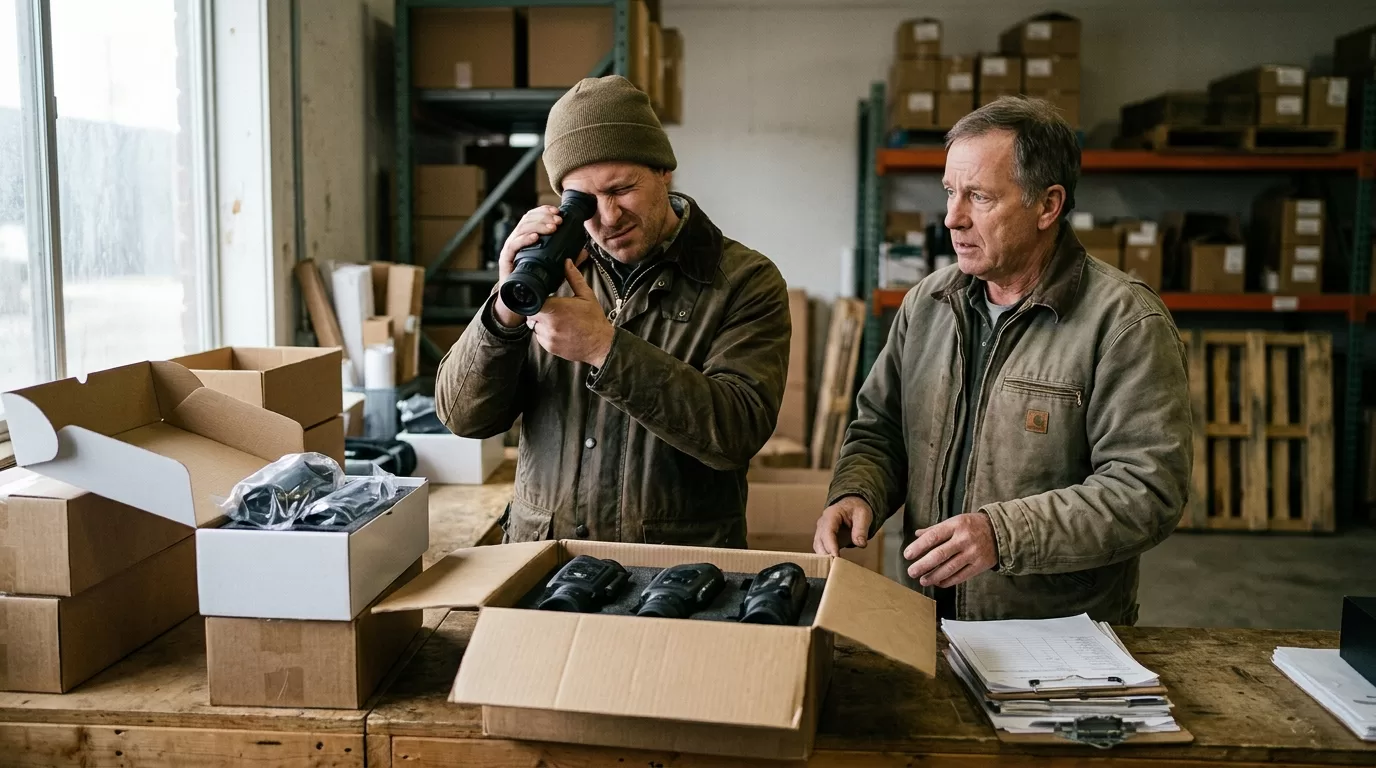
For US-focused dealers, support expectations are different from one-off marketplace sales. Your buyer may ask whether the optic has a firmware update path, whether the battery cap can be replaced, whether the mount fits a common rail setup, or whether the unit can be repaired after the 13th month. If your supplier can’t answer, you become the support department with no tools.
Ask these dealer-specific questions before you scale:
- What is the DOA policy?
- Who pays return freight for confirmed defects?
- Can you provide spare eyecups, mounts, cables, battery caps, and lens covers?
- What is the average repair or replacement time?
- Are serial numbers tracked by production batch?
- Do firmware updates require factory service?
- Can you hold the same spec for 12 months?
A supplier who only wants to discuss unit price is usually a poor fit for dealer distribution. Price matters, of course. A $20 per-unit difference on 200 units is real money. But a bad warranty process can erase that margin in one weekend if customers start returning scopes before deer season.
The strongest suppliers talk in systems. They can explain incoming material checks, detector sourcing tiers, burn-in testing, packaging drop tests, firmware version control, and RMA workflow. They don’t need perfect English. They need specific answers.
This is also where branded sourcing can beat anonymous OEM buying. With a brand like Pixfra, the product, documentation, warranty expectations, and dealer communication are tied together. That’s less flexible than buying a blank housing from a random Alibaba seller, but the tradeoff is accountability. For dealers, accountability usually wins.
Alibaba Vetting Checklist
Before placing a first bulk order, create a one-page supplier file. Keep it simple enough that your purchasing manager, sales manager, and warehouse lead can all understand it. If the deal goes sideways, this file becomes your memory.
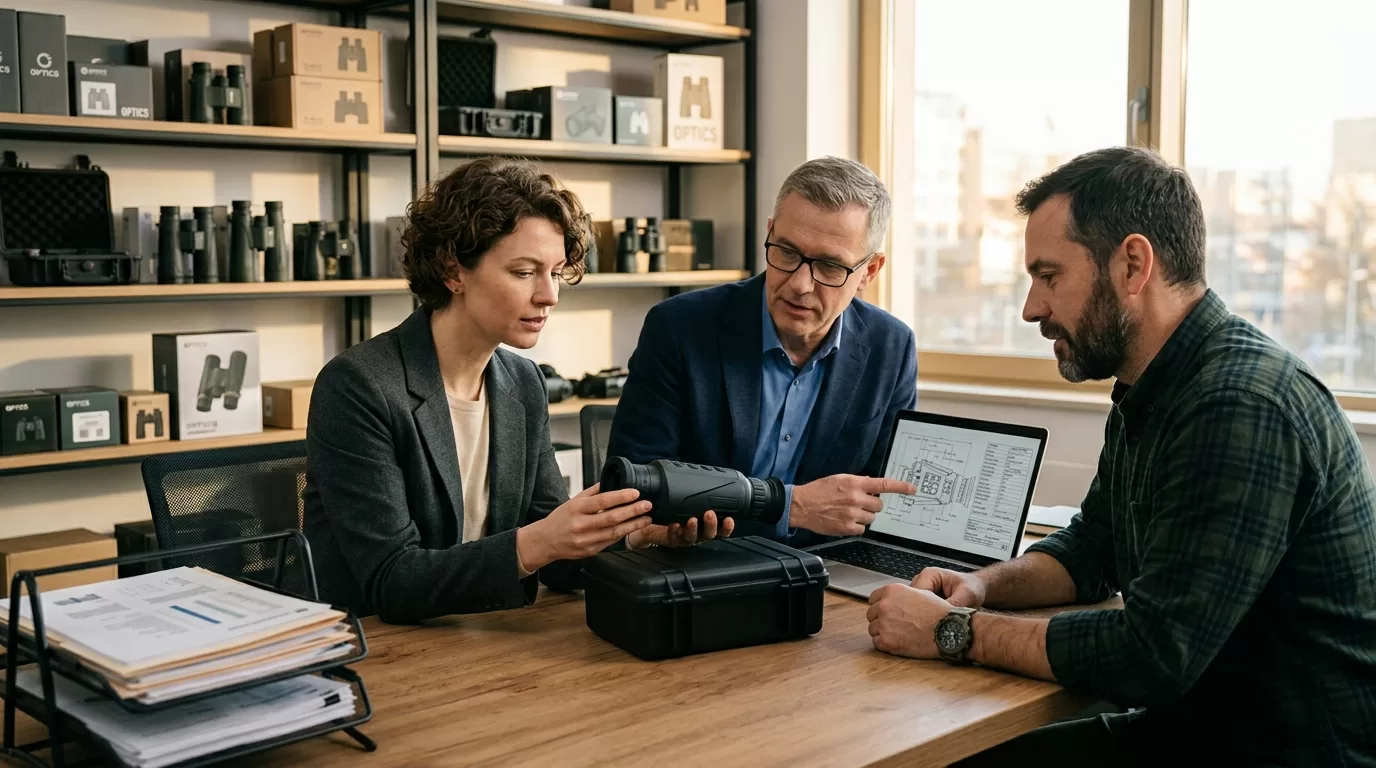
Include the Alibaba profile link, legal company name, business license screenshot, contact names, sample invoice, sample test notes, product photos, packaging photos, serial-number format, promised warranty terms, payment terms, inspection checklist, and chat exports for key promises. Save the boring stuff. Boring paperwork is what protects you.
Use this final screen:
| Pass/Fail Item | Pass Standard |
|---|---|
| Legal identity | Storefront, license, invoice, and payment account align |
| Product authenticity | No copied photos, no fake brand claims, serials make sense |
| Technical proof | Sample matches listed detector, lens, frame rate, and UI |
| Support readiness | Written warranty, RMA path, spare parts answer |
| Payment control | Clear PO terms, staged payment, inspection before balance |
| Reputation check | Search results show no serious unresolved complaints |
If two items fail, pause. If three fail, walk away. There are enough thermal optics suppliers in China, Europe, and North America that you don’t need to rescue a messy deal because the first quote looked cheap.
When does this advice not apply? If you’re sourcing generic accessories like lens cloths, soft cases, or simple mounts, you can use a lighter version of this process. Thermal imaging devices are different because the value sits in the detector, calibration, firmware, lens, and support chain. The outside shell tells you almost nothing.
One last move: call the supplier. A 15-minute video call can reveal more than 40 chat messages. Ask them to show the sample unit, power it on, open the firmware screen, show the serial label, and walk through the menu. If the camera suddenly “can’t work,” reschedule once. If it fails twice, you have your answer.
FAQ
How do I verify Alibaba suppliers?
Match the Alibaba storefront to the legal business license, invoice name, payment account, and product category. Then test a paid sample and search the supplier name with “scam,” “fake,” and “counterfeit.”
Are Alibaba thermal optics safe?
Some Alibaba thermal optics are safe, but listing quality varies widely by seller, factory, and QC process. Treat every unit as unverified until the sample, specs, warranty, and export documents are checked.
Can I buy branded thermal optics on Alibaba?
Only buy branded thermal optics on Alibaba if the seller provides written authorization from the brand owner. “Original without logo” or “same factory as brand” is a red flag.
Is Alibaba Trade Assurance enough?
No. Trade Assurance helps with payment disputes, but weak order terms can still hurt you. Your PO must list exact specs, packaging, warranty terms, inspection rules, and shipment deadlines.
What is the biggest red flag when vetting a supplier?
The biggest red flag is a supplier who claims to be a factory but can’t prove the legal company name, factory address, sample serial tracking, or warranty process. Cheap pricing won’t fix that.
If you’re building a US dealer program, don’t treat thermal optics sourcing like a quick catalog buy. Vet the supplier, test the sample, write the order terms, and protect the customer experience before you chase price. Pixfra supports dealers with thermal imaging products built for repeat sales, clear documentation, and after-sales accountability.