


Warranty and RMA support for thermal optics dealers should be settled before your first purchase order, not after a hunter ships back a dead-on-arrival thermal monocular in November. Dealers need written coverage terms, serial-number rules, freight responsibilities, and a named support path so they can protect margin while giving buyers a straight answer at the counter.
Thermal optics are high-ticket electronics that get mounted on rifles, packed into trucks, used in rain, dropped on frozen ground, and judged at 2 a.m. when hogs or coyotes are moving. A bad warranty answer costs more than one refund. It can cost the next five sales, because buyers compare Pixfra with Pulsar, ATN, iRayUSA, AGM Global Vision, and Bering Optics on trust as much as detector resolution.
Dealer RMA Basics
Warranty and RMA support for thermal optics dealers is the written process for proving coverage, opening a return authorization, inspecting the device, repairing or replacing it, and sending it back with clear status updates. Good dealer programs define who pays freight, which failures qualify, and which serial-number channels are eligible before a sale happens.

An RMA is a permission slip with teeth. It tells the dealer, customer, warehouse, and service team that a specific unit is approved to enter the service process. For thermal optics, that specific unit matters. A Pixfra Ranger thermal monocular, a Taurus thermal front attachment, and an Arc handheld thermal device may all need different checks before anyone promises repair or replacement.
The dealer’s job isn’t to become a repair lab. Your job is to capture the facts fast enough that the manufacturer can make a decision without ten follow-up emails. Model name. Serial number. Firmware version. Purchase invoice. A clear symptom report. If the customer says, “It doesn’t work,” that’s a support ticket. If the customer says, “The display powers on, the menu works, but the image freezes after manual NUC,” that’s an RMA case with a head start.
| Dealer question | Written answer you need |
|---|---|
| Is this serial number from an authorized channel? | Yes, no, or escalation required |
| Is the failure covered? | Covered defect, user damage, wear item, or inspection needed |
| Who pays inbound freight? | Dealer, customer, brand, or case-by-case approval |
| What happens after inspection? | Repair, replacement, credit, or no-fault return |
This matters more with thermal optics than with basic glass. A traditional binocular has lenses, prisms, armor, and adjustment parts. A thermal monocular adds a detector, display, image processor, firmware, battery system, charging board, buttons, seals, and sometimes Wi-Fi or app pairing. The customer only sees one black screen. The RMA team sees eight possible causes.
Set the expectation early. “Bring it in and we’ll look at it” sounds friendly, but it can trap your counter staff into promises the manufacturer never approved. A cleaner phrase is: “We’ll verify purchase channel, collect symptoms, and open a warranty review with the brand.” Less drama. Better paper trail.
Warranty Terms Before PO
Ask for warranty terms before the purchase order because the warranty is part of your landed cost. A dealer buying 40 thermal monoculars at a sharp wholesale price can still lose money if every defective unit requires uninsured outbound freight, overseas inspection, and a 45-day silence gap during peak season.

The warranty sheet should say what’s covered by product category. Thermal detector coverage matters. Display coverage matters. Battery coverage matters too, because removable batteries often have a shorter warranty than the optic body. Don’t accept “standard warranty applies” as an answer unless the standard warranty is attached to the dealer packet and matches the model lines you’re buying.
For US retail sales, warranty disclosure has a legal side. The Federal Trade Commission Businessperson’s Guide to Federal Warranty Law says written warranties on consumer products over $15 must be available before purchase. That means the warranty PDF shouldn’t live only in a rep’s inbox. Your sales team needs access before the customer asks.
A useful dealer PO packet includes four items:
- Current warranty terms by model line, including detector, display, housing, and battery coverage
- RMA form with required fields, photo requirements, and shipping instructions
- DOA policy with the approval window and swap authority
- Freight, insurance, packaging, and lost-shipment rules
A 5-year headline can lose to a 2-year policy with local replacement stock. That sounds backward until you’re holding a customer’s $2,499 thermal scope two days before a coyote tournament. If Brand A promises a long warranty but requires every unit to cross a border, and Brand B gives a shorter written term with domestic triage and dealer swap stock, Brand B may be the better dealer line.
This advice doesn’t apply the same way to every account. A police supply distributor buying thermal handhelds for municipal bids may care more about written service-level language, quote validity, and asset tracking. A farm-and-ranch retailer may care more about fast counter exchanges during calving season. A pure ecommerce seller needs shipment rules tight enough that customers can’t mail back a loose optic in a cereal box and call freight damage a warranty defect.
Cross-Border Warranty Risk
Gray-market inventory is where dealers get burned. A customer finds a cheaper Pixfra, Pulsar, or InfiRay unit from an overseas seller, then walks into a US store when the screen fails. The local dealer may want to help. The manufacturer may still require the customer to return it through the original selling dealer or regional distributor.
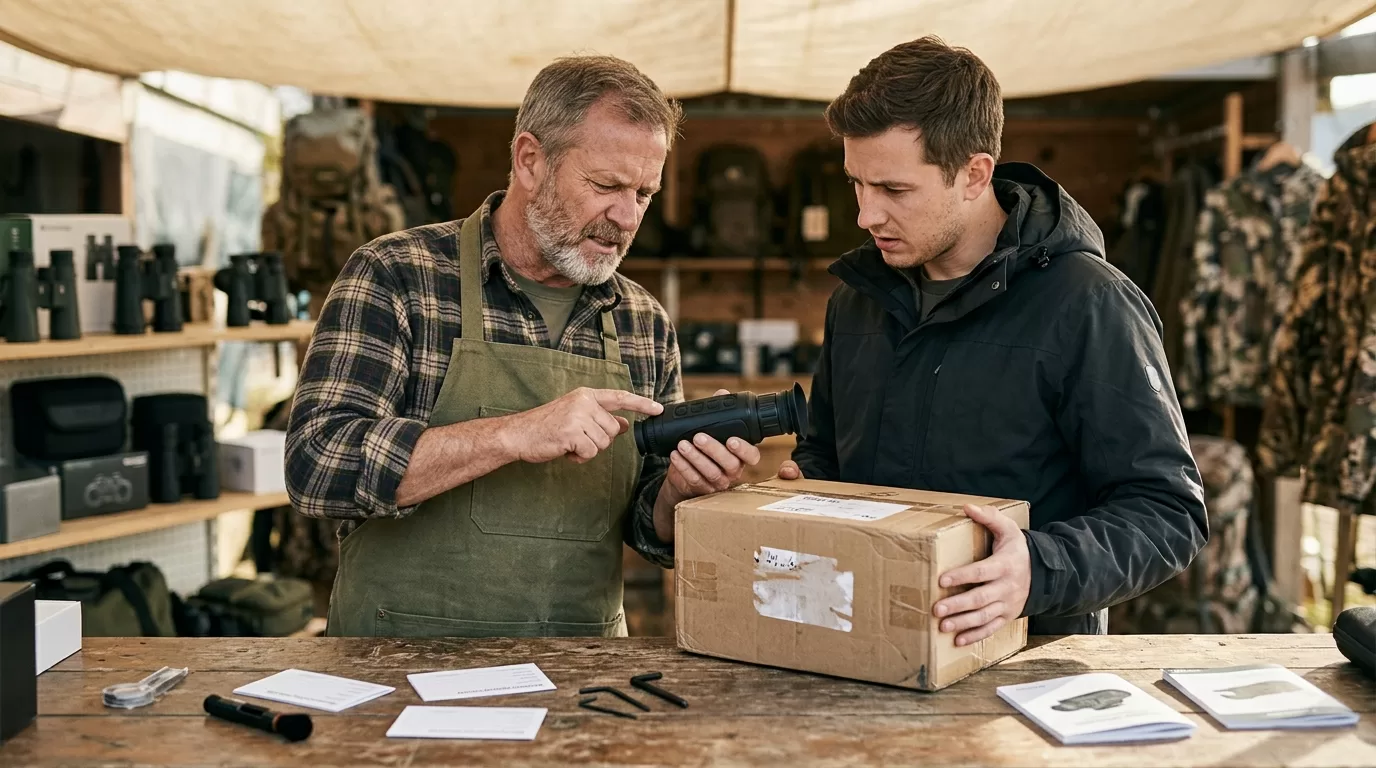
That feels harsh to the buyer, but it’s a real channel issue. Warranty coverage is often tied to the region where the product was sold, the distributor that imported it, and the serial-number batch assigned to that channel. If a dealer can’t explain this before purchase, the customer hears it as an excuse after failure.
Cross-border RMA is also a compliance problem, not just a postage problem. The U.S. Bureau of Industry and Security Export Administration Regulations identify certain thermal imaging cameras under export-control rules, including ECCN references such as 6A003.b.4.b in reporting contexts. A service return can still involve export classification, customs paperwork, and carrier restrictions. Get counsel for regulated shipments; don’t let a warehouse clerk guess.
| Scenario | Dealer stance |
|---|---|
| US customer bought from your authorized stock | Open normal warranty review |
| US customer bought from overseas marketplace | Verify serial channel before promising coverage |
| Canadian or EU customer asks your US shop for repair | Route through approved regional process |
| Unit has no invoice or altered serial label | Escalate before accepting shipment |
The awkward part is the counter conversation. You don’t want staff saying, “That’s not our problem.” You also don’t want staff accepting every thermal optic on earth because the customer found your phone number. Use a script: “We can check the serial number and purchase channel. If it’s outside our channel, the original dealer may need to handle the warranty.”
This is one reason dealer authorization has value. Buyers often focus on price, NETD rating, detection range, and sensor resolution. They rarely ask who owns the RMA when the unit crosses borders twice. Your team should ask for them.
Small accessories are different. Eyecups, lens caps, neck straps, charging cables, and rubber covers can often be handled locally without turning the case into a full RMA. Don’t build a giant process around a $9 part. Save the strict workflow for optics with serial numbers, electronics, and warranty exposure.
RMA Workflow That Works
Clean RMA work feels boring. That’s the point. Nobody should be inventing the process while an angry customer stands at the counter with a frozen display and a receipt from last fall.

Use this workflow as your baseline:
1. Confirm purchase channel, invoice date, model name, and serial number.
2. Record the symptom in plain language, with photos or a short video.
3. Check simple fixes: battery, firmware, lens cover, app pairing, and calibration settings.
4. Issue an RMA number only after the case is accepted for review.
5. Receive the unit with packaging photos, accessory list, and carrier tracking.
6. Inspect for covered defect, impact damage, water entry, or no-fault condition.
7. Decide repair, replacement, credit, or paid service.
8. Close the case with serial-number notes and customer communication history.
Thermal devices create false alarms. A user may call every speck a dead pixel. A low battery can look like a power-board failure. A dirty objective lens can make the image look soft. A firmware update can change menu behavior enough that a customer thinks the optic is broken.
For weapon-mounted thermal scopes and front attachments, capture recoil context. A unit used on .223 Rem, .308 Win, 6.5 Creedmoor, or a 12-gauge slug gun is living a different life than a handheld scanner in a ranch truck. Ask about mount torque, rail type, round count, and whether the optic was moved between rifles. That isn’t blame. It’s diagnosis.
The first response target should be one business day. The diagnosis target should be 3-5 business days after the service center receives the unit. Repair or replacement can reasonably take 10-21 business days when parts are in stock. These are working targets, not magic promises. Put the actual terms in your dealer agreement.
Faster isn’t always better. A blind replacement policy can make customers happy for 30 days, then wreck dealer inventory when half the returns test as no fault found. Better: allow instant swaps for true DOA units inside a defined window, then require inspection for field-used units. Seven to 14 calendar days is a practical DOA range for electronics because charging faults, display failures, and sensor problems usually appear fast.
The RMA form should force useful detail. “Won’t turn on” is too thin. “Won’t turn on with two known-good batteries; charging indicator flashes red; no startup logo; firmware unknown” gives the technician a real path. The form should also ask whether accessories are included. Customers love sending mounts, cables, lens caps, batteries, and cases in the same box. If nobody logs them, someone pays for the argument later.
Dealer Agreement Records
Your dealer agreement should be dull enough that a new counter employee can follow it on a busy Saturday. The document should define authorized territory, eligible sales channels, warranty start date, proof-of-purchase rules, DOA authority, freight approval, credit memo timing, and escalation contacts.

Margin math changes with inventory model, so place warranty terms beside your dropship vs stock inventory for thermal optics retailers decision instead of treating support as an afterthought. If Pixfra or another brand ships directly to your customer, the customer may expect brand-led service. If you stock the unit, the customer will usually expect you to own the first conversation.
Track RMA performance like inventory turns. If you sell 120 thermal units in a season and receive six warranty claims, that’s a 5% claim rate. If four of those six were no-fault cases fixed by firmware, your training needs work. If two were display failures from the same batch, your purchasing team needs to know before the next PO.
| Record | Why it protects dealers |
|---|---|
| Serial number and invoice date | Proves warranty start and channel |
| Customer receipt and dealer PO | Connects retail sale to authorized stock |
| Photos, video, and firmware version | Reduces guesswork during diagnosis |
| Carrier tracking and accessory list | Prevents shipment and missing-part disputes |
Keep the language honest on your product pages. Don’t say “lifetime warranty” unless the written warranty says lifetime and explains what lifetime means. Don’t say “free replacement” when the actual process starts with inspection. Don’t hide exclusions for impact damage, modified housings, water intrusion from opened seals, non-approved batteries, or lost accessories.
This advice shifts for commercial thermal inspection cameras. If your buyer is a utility contractor, HVAC service company, or public safety department, the warranty conversation may include calibration records, asset tags, purchase-order billing, and tax-exempt documentation. A hunting retailer usually doesn’t need calibration certificates. A municipal bid might.
The best dealer record is the one nobody has to remember. Put the RMA checklist in your POS notes, ecommerce help center, staff SOP, and dealer folder. Train staff to say the same sentence every time: “We’ll verify the serial number and open a warranty review with the required photos.” Customers can handle rules. They hate surprises.
FAQ
Who pays RMA shipping?
Usually the dealer or customer pays inbound freight, while the manufacturer pays return freight after an approved warranty repair. Put exceptions in writing for DOA units, no-fault inspections, out-of-warranty service, and lost-in-transit claims.
Can dealers replace DOA units?
Yes, if the dealer agreement grants swap authority and defines the DOA window. For thermal optics, 7-14 calendar days is practical because display faults, charging failures, battery faults, and sensor problems appear quickly.
Are gray-market optics covered?
Often no, or only through the original selling distributor. A customer who bought a thermal monocular outside the US channel may need to return it through that dealer, with proof of purchase and serial-number validation.
How long should RMA take?
After the service center receives the optic, a practical target is 3-5 business days for diagnosis and 10-21 business days for repair or replacement when parts are available. Holiday hunting seasons can stretch timelines.
Which records prove warranty coverage?
Keep the purchase invoice, dealer PO, serial number, model name, customer receipt, and support ticket history. Photos, short videos, firmware version, accessory list, and carrier tracking help settle disputes without a long email chain.
Before your next dealer line review, ask Pixfra for the current warranty sheet, eligible-channel rules, RMA contact path, and model-level service notes for the thermal optics you plan to carry. Bring one real scenario: “Customer bought a Pixfra Ranger from us in Texas, screen fails after 11 months.” The answer should be clear enough to paste into your staff SOP.