

















Importing thermal cameras from China usually means classifying the finished camera under HTSUS 8525.89.50, preparing standard U.S. Customs and Border Protection entry paperwork, and checking dual-use specs before the supplier ships. The hard part is rarely the port form itself; it’s a 30 Hz or 640 × 512 model with vague end-use paperwork, a thermal scope treated like a basic camera, or a “free duty” code that still carries China tariff layers.
If you’re buying for a U.S. dealer catalog, security integrator, hunting retailer, inspection team, or government-adjacent customer, do the compliance work before the purchase order. A box sitting at Long Beach is an expensive place to discover that your invoice says “camera accessory” while the spec sheet says “thermal weapon sight with ballistic reticle.”
Thermal Camera HS Codes
Most finished thermal imaging cameras imported into the United States are commonly reviewed under HTSUS 8525.89.50, but the correct HS code depends on the product’s actual function. A handheld inspection camera, outdoor thermal monocular, weapon-mounted sight, drone payload, and uncooled camera core can land in different classification conversations.
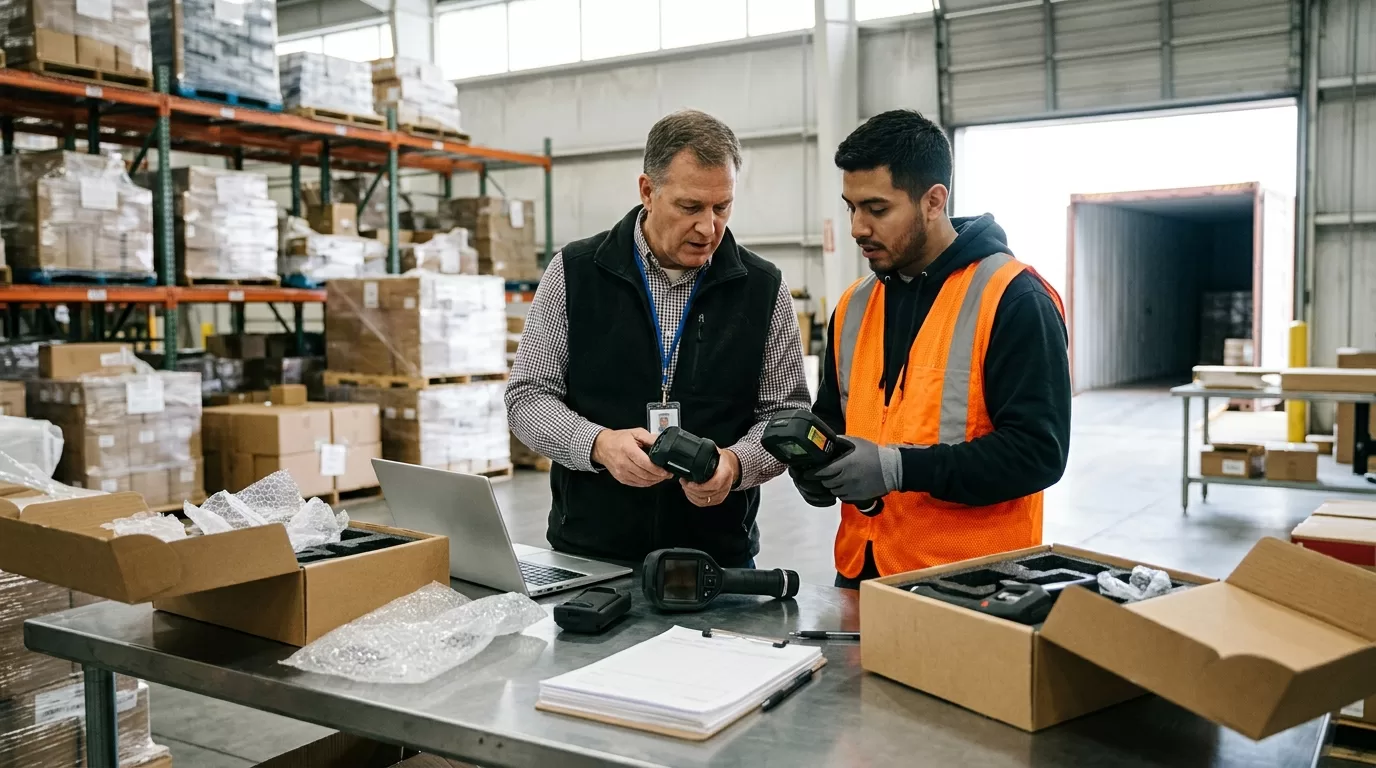
U.S. Customs and Border Protection moved the practical starting point for many finished thermal video cameras toward heading 8525 after the HS 2022 changes. In CBP Headquarters Ruling H331315, dated December 5, 2025, CBP classified the AXIS P1290-E Thermal Network Camera and AXIS Q1951-E Thermal Camera under HTSUS 8525.89.50 and stated that older thermal-camera rulings under heading 9013 were revoked by operation of law.
That ruling matters because importers still repeat old advice from forums, broker templates, and legacy supplier invoices. “Thermal camera equals Chapter 90” used to be a common shortcut. In 2026, it’s a bad shortcut for many finished video cameras.
| Product type | Common classification starting point | What to verify |
|---|---|---|
| Finished thermal network camera | 8525.89.50 | Video output, surveillance function, no sighting function |
| Handheld thermal imaging camera | 8525.89.50 | Finished camera vs measuring instrument |
| Thermal monocular | Often 8525.89.50 review | Civil outdoor use, no weapon mount, no ballistic features |
| Thermal weapon sight or scope | Don’t assume 8525.89.50 | Reticle, mounting system, sighting purpose |
| Thermal drone payload | Needs separate review | Gimbal, UAV integration, stabilizer, laser module |
| Thermal core or sensor module | Don’t use finished-camera logic | Detector-only vs camera output, part vs complete article |
When importing thermal cameras from China, ask the supplier for a spec sheet that names the detector resolution, frame rate, spectral band, output format, lens, mounting hardware, wireless functions, and intended use. “Infrared product” is not enough. Your customs broker can’t classify a product cleanly from a one-line Alibaba invoice.
A clean commercial invoice should say something like “finished handheld thermal imaging camera, uncooled LWIR, 384 × 288 detector, 50 Hz, no weapon mount, no laser rangefinder, country of origin China.” That’s boring. Boring is good at the port.
Customs Clearance Documents
Customs clearance starts with the importer of record. If you’re the U.S. buyer, your company name, EIN, customs bond, broker power of attorney, and entry data need to line up. U.S. Customs and Border Protection uses CBP Form 7501 to record classification, value, origin, duty rate, and related entry data, so don’t treat the 7501 as broker back-office paperwork. Read it.

For ocean freight, your broker or forwarder will also need Importer Security Filing data before the container is loaded. For air freight, the timeline is shorter and the mistakes surface faster. A wrong model number on a carton label can still trigger questions, especially if the shipment contains lithium batteries, Wi-Fi models, or products described as “scope,” “sight,” “target,” or “payload.”
Use this file before shipment:
| Document | Who provides it | What must match |
|---|---|---|
| Commercial invoice | Supplier | Model, unit value, Incoterm, origin, buyer, seller |
| Packing list | Supplier | Carton count, gross weight, serial batches |
| Bill of lading or air waybill | Forwarder | Shipper, consignee, port, pieces |
| Spec sheet | Supplier or brand | Resolution, Hz, lens, battery, wireless functions |
| Country-of-origin marking proof | Supplier | Product label and retail packaging |
| FCC data, if wireless | Supplier | FCC ID, radio module, label location |
| Battery transport documents | Supplier | UN38.3 summary, MSDS, packing method |
DDP is tempting for first-time buyers because the supplier says, “We handle everything.” For thermal imaging products, DDP can hide the very data you’ll need later: HTSUS code, entry number, declared value, importer of record, and any Chapter 99 tariff line. If a marketplace freight agent clears the goods under its own importer number, your landed-cost history becomes foggy.
FOB Shenzhen, FOB Shanghai, or FCA factory usually works better for serious U.S. dealers because your broker controls the entry. EXW looks cheap on the quote sheet, but it pushes China export clearance and pickup risk onto the buyer. Most U.S. importers don’t want to manage a truck appointment in Dongguan just to save a few dollars on paper.
Dual-Use Export Controls
Thermal imaging is a civil technology with military applications. A camera used for hog hunting, electrical inspection, perimeter security, or search and rescue can share detector specs with equipment that export-control agencies care about.

For U.S. importers, the key point is timing. A normal U.S. import entry doesn’t become a BIS import license case just because the device is thermal. Export controls matter when the China supplier exports the goods, when U.S.-origin content or technology is involved, and when you later re-export, resell, or transfer the product outside the United States. If your customer is a defense contractor, police procurement office, drone integrator, or overseas distributor, the file needs more than a customs invoice.
The U.S. Bureau of Industry and Security treats many thermal imaging cameras under ECCN 6A003.b.4.b, with special attention to frame rate, focal plane array size, civil end users, and embedded uses. BIS §742.6 describes license requirements for certain thermal imaging cameras, including thresholds tied to more than 60 Hz and focal plane arrays above or below 111,000 elements. For a deeper split between defense controls and dual-use controls, read Pixfra’s guide to ITAR vs EAR for thermal imaging before you promise a shipment date to a reseller.
The number 111,000 is not abstract. A 384 × 288 detector has 110,592 elements, just under that line. A 640 × 512 detector has 327,680 elements, well above it. A 256 × 192 detector has 49,152 elements. Frame rate matters too: 9 Hz feels choppy when tracking a moving animal or vehicle, while 30 Hz, 50 Hz, or 60 Hz feels much smoother. Better viewing performance can mean more paperwork.
Watch these trigger points:
| Spec or feature | Why buyers should pause |
|---|---|
| 640 × 512 detector | Higher FPA element count raises export-control attention |
| More than 60 Hz | BIS rules call out frame-rate thresholds |
| 30 Hz or 50 Hz consumer models | Smooth image, but still needs classification support |
| Weapon mount or reticle | May change both classification and control analysis |
| Ballistic calculator | Strong sighting-use signal |
| Laser rangefinder | Adds another controlled component question |
| UAV gimbal integration | China export controls and U.S. end-use checks may apply |
| Military, police, border, or overseas buyer | End user screening becomes more serious |
China-side export controls can matter before the shipment leaves Shenzhen, Hangzhou, Wuhan, or Yantai. China has adjusted export controls for UAV-related components, including infrared thermal-imaging devices, and suppliers may ask for end-use statements when products are tied to drones, payloads, or higher-performance optics. If your supplier says “no license needed,” ask for that position in writing, tied to the exact model number.
China Origin Tariff Math
HTSUS 8525.89.50 may show a general duty rate of free, but “free” doesn’t mean your landed cost is zero. China-origin goods can face separate Chapter 99 duties, Merchandise Processing Fee, Harbor Maintenance Fee for ocean freight, broker fees, bond costs, exam charges, and storage if anything goes wrong.

This is where importers get burned. They price a dealer program on the base HTSUS rate, then the broker adds a China tariff line at entry. The invoice margin shrinks overnight. If you quoted 200 thermal monoculars to a retailer at a fixed landed cost, that mistake comes straight out of your margin.
Ask your broker for a landed-cost worksheet before the first production deposit:
| Cost line | Where it comes from | Buyer note |
|---|---|---|
| Product value | Supplier invoice | Must reflect real transaction value |
| International freight | Forwarder | Depends on Incoterm |
| Insurance | Forwarder or buyer | Often small, still part of landed math |
| Base duty | HTSUS line | 8525.89.50 may show free for many entries |
| China tariff line | Chapter 99 review | Check current Section 301 status by entry date |
| MPF | CBP fee | Applies to formal entries |
| HMF | Ocean entries | Doesn’t apply to air freight |
| Broker and bond | Broker | Annual bond usually beats single bonds for repeat shipments |
Valuation is another quiet trap. If you supply free housings, tooling, firmware work, molds, engineering, labels, or packaging to the factory, tell your broker. Some assists and royalties may need to be added to customs value. A $180 camera can become a $194 customs value after additions, and duties follow the adjusted value.
Country-of-origin marking should be in English and visible enough for retail reality. “Made in China” on the master carton alone may not work if the product is repacked into dealer packaging after entry. If you sell through Amazon, Bass Pro-style retail, independent hunting shops, or security distributors, ask for photos of the unit label and retail box before the balance payment.
Broker Questions To Ask
A customs broker doesn’t need to be a thermal engineer, but your broker does need product data. Send the spec sheet, product photos, user manual, battery details, and sales page before the shipment leaves China. If the broker only sees “thermal camera” after arrival, the broker is guessing under pressure.

The best question is plain: “Would you file this entry the same way if CBP opened the carton and read the manual?” If the answer is no, fix the paperwork. Manuals often reveal words that invoices hide: reticle, zeroing, ballistic profile, target tracking, gimbal, drone, law enforcement, weapon mount. Those words don’t always create a problem, but they change the review.
Ask these before the purchase order:
1. Which HTSUS code would you use for this exact model?
2. Do you see any reason to request a CBP binding ruling?
3. Does the product description need to mention “thermal imaging” rather than “digital camera”?
4. Are there any Chapter 99 China tariff lines on the entry date?
5. Does the product have Wi-Fi, Bluetooth, cellular, GPS, or a radio remote?
6. Does the FCC ID belong to the finished device or only to a module?
7. Is the lithium battery packed in equipment, with equipment, or alone?
8. Does the product include a laser rangefinder?
9. Does the model have a reticle, weapon mount, or ballistic calculator?
10. Will the supplier provide an export-control statement by model number?
Some products deserve a CBP binding ruling before volume import. Thermal scopes, clip-on weapon sights, drone payload cameras, fever-screening devices, and camera cores are the usual candidates. A ruling takes more time than a broker email, but it gives you a written position tied to the exact facts you submitted.
Medical claims change the lane. A thermal camera sold for fever screening or diagnosis can bring U.S. Food and Drug Administration medical-device questions into the import file. A thermal monocular sold for outdoor observation usually doesn’t belong in that same medical bucket. Claims on the website, box, manual, and Amazon listing matter.
Dealer Compliance Checklist
For dealers, the practical goal is simple: build a model-level compliance packet once, then reuse it for every shipment until the model changes. Don’t rebuild the entry file from scratch for every carton. Keep the spec sheet, HS rationale, export-control statement, battery documents, FCC data, marking photos, and supplier declaration in a shared folder named by model and revision.

That revision detail matters. A supplier can change a 25 Hz model to 50 Hz, swap a 384 × 288 detector for 640 × 512, add Wi-Fi, or release a “Pro” trim with a laser rangefinder. The sales name may stay almost the same. Customs and export-control facts won’t.
Use this checklist for importing thermal cameras from China at dealer scale:
| Step | Action | Why it matters |
|---|---|---|
| 1 | Lock the exact model and trim | “T50” and “T50 Pro LRF” may not be the same product |
| 2 | Collect detector and frame-rate specs | 384 × 288, 640 × 512, 9 Hz, 50 Hz all matter |
| 3 | Identify the product function | Handheld camera, monocular, scope, payload, core |
| 4 | Get broker HS review in writing | Stops invoice-level guessing |
| 5 | Check Chapter 99 tariff exposure | Base duty isn’t the full landed cost |
| 6 | Confirm FCC status for wireless models | Wi-Fi and Bluetooth can hold up retail sale |
| 7 | Save battery transport documents | Airlines and couriers ask for them often |
| 8 | Screen end users for sensitive deals | Defense, UAV, and overseas resale raise the bar |
| 9 | Review labeling photos | Origin marking must survive repacking |
| 10 | Recheck after model changes | New specs can change the answer |
The biggest tradeoff is performance versus paperwork. A 9 Hz entry-level monocular may be easier to place in low-risk civil retail channels, but it won’t feel as natural when a hunter pans across a tree line or a security guard follows a moving vehicle. A 50 Hz 640 × 512 model gives a better field experience, but the compliance packet needs to be tighter.
If you sell to only U.S. civilian outdoor customers, your workflow can stay lean. If you sell to drone integrators, overseas dealers, public agencies, or defense-adjacent buyers, add end-use screening and export-control review before accepting the order. A fast sale to the wrong buyer is not worth the refund, seizure risk, or follow-up questions.
FAQ
What HS code covers thermal cameras?
Many finished thermal imaging cameras are commonly reviewed under HTSUS 8525.89.50, especially after CBP’s 2025 ruling on thermal network cameras. Thermal scopes, drone payloads, cores, and sensor modules need separate review.
Are thermal cameras dual-use?
Yes. Thermal cameras have civil uses such as hunting, inspection, firefighting, and security, but some specs and end uses are controlled because the same technology can support military, UAV, or surveillance applications.
Do 9Hz thermal cameras need licenses?
Not automatically for U.S. import, but 9 Hz doesn’t erase all export-control issues. End user, destination, model design, U.S.-origin content, and later re-export plans still matter.
Is DDP safe for dealers?
DDP can work for samples, but it’s risky for repeat dealer imports because you may lose visibility into the entry, HTSUS code, declared value, and importer of record. Use your own broker for volume shipments.
What specs should suppliers provide?
Ask for detector resolution, frame rate, spectral range, lens, wireless functions, battery type, laser features, mounts, reticle status, country of origin, FCC data if wireless, and an export-control statement by model number.
Before you issue the first purchase order, ask Pixfra for the model spec sheet, marking details, wireless status, battery packing data, and export-control statement your broker needs. Send the same packet to your customs broker before the shipment leaves China; port problems are cheaper on a spreadsheet than at LAX, JFK, or Long Beach.