














How to use our product

Paikallinen kumppaniohjelmamme (LPP) on suunniteltu huolellisesti tarjoamaan vankkaa tukea arvostetuimmille kumppaneillemme paikallisilla markkinoilla.

Blogit

Stay informed with Pixfra’s latest updates, product stories, and insights into the world of thermal imaging.

Ryhmä 26, varajärjestelmä

6 Best Thermal Devices to Clip On Your Day Scope

You’ve spent years dialing in your day scope. The last thing you want is to swap it out every time the sun goes down. A thermal clip-on fixes that — it mounts right in front of your existing optic and turns your rifle into a night-hunting machine without touching your zero. Here are the 6 best thermal devices to clip on your day scope this year. What Is a Clip-On Thermal and How Does It Work A thermal clip-on — also called a thermal front attachment — is a compact device that mounts directly in front of your daytime riflescope. A clip-on thermal mounts directly in front of your existing daytime scope. It turns your day optic into a thermal rifle scope by projecting a thermal image through your regular reticle, with no need to re-zero. Unlike a dedicated thermal scope that replaces your existing optic entirely, a clip-on works with it. You don’t remove your daytime glass. The clip-on attaches to the objective end, typically with an adapter ring that clamps onto the scope’s objective bell or via a Picatinny rail mount positioned ahead of the day scope. No scope swaps. You go from daytime hunting to thermal detection in seconds. At Pixfra, we build thermal front attachments like our Taurus LRF series for exactly this — giving hunters a fast, reliable way to add thermal to the rifle they already trust. The tech behind it is what makes it tick. A clip-on thermal uses a microbolometer sensor to detect infrared heat radiation from animals, people, and objects. That data gets processed and displayed on a tiny internal OLED screen, which your day scope then magnifies. The result? You see thermal imagery through the same glass you’ve been shooting with all day. A clip-on thermal is a specialized thermal

Importing Thermal Cameras from China: Customs, Compliance & HS Codes

Importing Thermal Cameras from China: Customs, Compliance & HS Codes

Importing thermal cameras from China usually means classifying the finished camera under HTSUS 8525.89.50, preparing standard U.S. Customs and Border Protection entry paperwork, and checking dual-use specs before the supplier ships. The hard part is rarely the port form itself; it’s a 30 Hz or 640 × 512 model with vague end-use paperwork, a thermal scope treated like a basic camera, or a “free duty” code that still carries China tariff layers. If you’re buying for a U.S. dealer catalog, security integrator, hunting retailer, inspection team, or government-adjacent customer, do the compliance work before the purchase order. A box sitting at Long Beach is an expensive place to discover that your invoice says “camera accessory” while the spec sheet says “thermal weapon sight with ballistic reticle.” Thermal Camera HS Codes Most finished thermal imaging cameras imported into the United States are commonly reviewed under HTSUS 8525.89.50, but the correct HS code depends on the product’s actual function. A handheld inspection camera, outdoor thermal monocular, weapon-mounted sight, drone payload, and uncooled camera core can land in different classification conversations. importing thermal cameras from china — thermal camera hs codes U.S. Customs and Border Protection moved the practical starting point for many finished thermal video cameras toward heading 8525 after the HS 2022 changes. In CBP Headquarters Ruling H331315, dated December 5, 2025, CBP classified the AXIS P1290-E Thermal Network Camera and AXIS Q1951-E Thermal Camera under HTSUS 8525.89.50 and stated that older thermal-camera rulings under heading 9013 were revoked by operation of law. That ruling matters because importers still repeat old advice from forums, broker templates, and legacy supplier invoices. “Thermal camera equals Chapter 90” used to be a common shortcut. In 2026, it’s a bad shortcut for many finished video cameras. Product type Common classification starting point What to verify

How to Become a Thermal Optics Dealer: A Step-by-Step Guide

How to Become a Thermal Optics Dealer: A Step-by-Step Guide

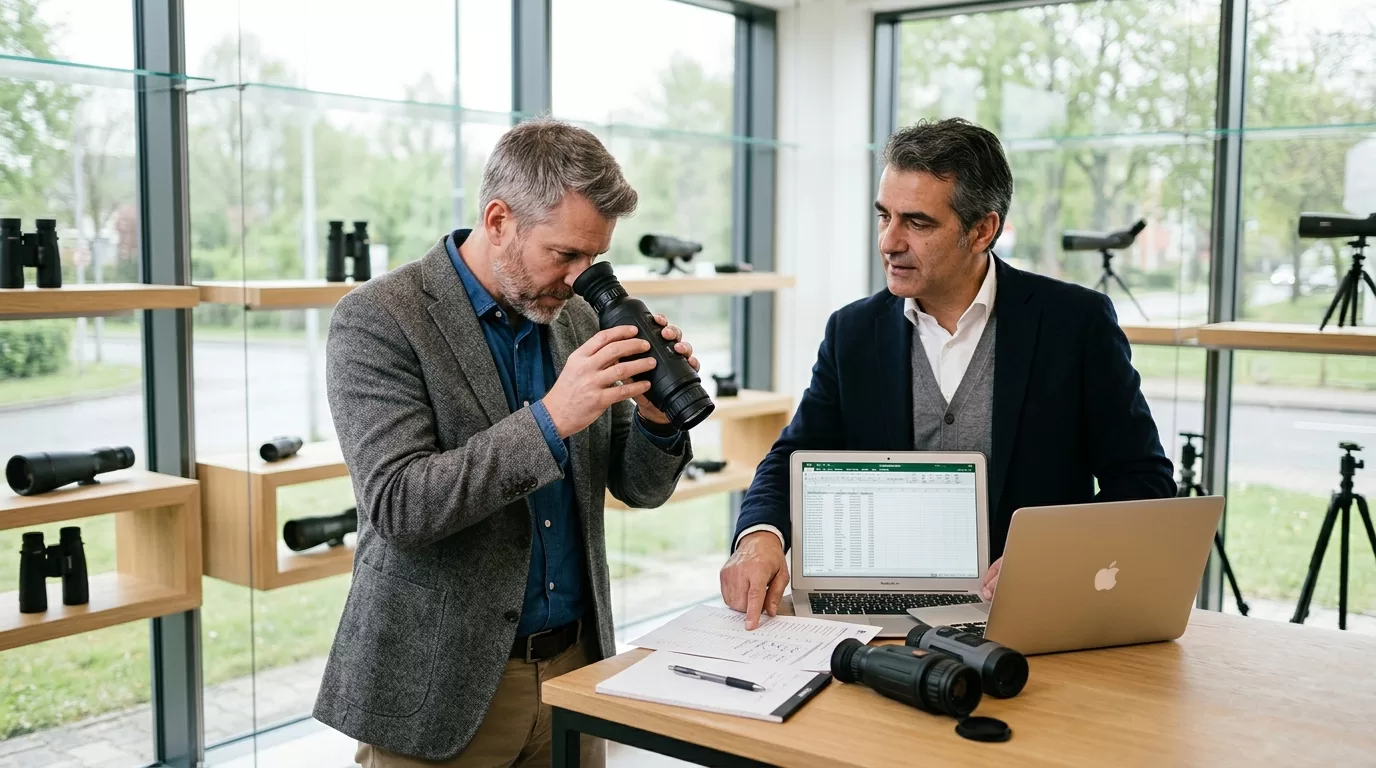
To become a thermal optics dealer, you need a real buyer base, clear resale terms, compliant sales processes, trained staff, and the right starter inventory. The fastest path is to prove you can sell thermal monoculars, thermal scopes, and multispectral optics to specific US buyers without treating every device like a generic outdoor gadget. Become a Thermal Optics Dealer Steps 1. Define your buyer group. 2. Match Pixfra SKUs to that use. 3. Register business and resale tax paperwork. 4. Set export, age, and hunting-rule controls. 5. Build demo inventory. 6. Train staff on sensors and rangefinders. 7. Agree margin, MAP, warranty, and reorder terms. 8. Apply and report sell-through. become a thermal optics dealer — thermal dealer steps A thermal dealer isn’t just a store with a shelf. You’re the person a ranch owner calls before buying a handheld scanner for coyotes at 2 a.m. You’re also the person who explains why a 640×512 thermal scope costs more than a compact entry monocular, and why a built-in laser rangefinder matters when the customer can’t judge distance in a black field. If your real aim is to become a thermal optics dealer, start by narrowing the buyer. Predator hunters, hog hunters, ranch security teams, outdoor retailers, tactical resellers, and property managers do not ask the same questions. A coyote hunter cares about field of view and fast target ID. A ranch manager cares about battery life, warranty handling, and whether an employee can learn the menu in ten minutes. The mistake is ordering inventory first. Don’t. First, write down your top 25 likely buyers by name: local hunting clubs, firearm stores, feed stores, ranches, outfitters, security installers, and night-hunting guides. If you can’t name 25, your dealer application is still a theory. Dealer readiness checklist Area Minimum proof Strong proof

Case Study: Testing 2026’s Best Thermal Device in the Field

Spec sheets tell you what a thermal device should do. The field tells you what it actually does. We took our Pixfra thermal devices — monoculars, scopes, and front attachments — into real hunting and observation conditions across varying terrain, weather, and lighting to see how they held up when it counted. Here’s what we found. Too many thermal device reviews in 2026 rely on manufacturer claims, controlled lab numbers, and best-case scenarios. And while those specs give you a starting point, they don’t tell you how a device handles at 2 AM in a foggy tree line, or whether your battery dies before the hogs show up, or if you can actually tell a coyote from a stump at 400 meters in heavy humidity. That gap between on-paper performance and real-world results is exactly why we ran this field test. We wanted to push our own gear hard — not to prove that every number is perfect, but to show you what our thermal devices do when conditions get ugly. If you’re shopping for a thermal monocular, thermal scope, or thermal front attachment in 2026, this case study gives you field data, not marketing talk. And if you want a breakdown of the specs that matter most before you buy, our guide to the top 6 features needed in the best thermal device in 2026 is worth reading alongside this one. Why Real-World Testing Beats Spec Sheets There’s a reason experienced hunters and wildlife observers focus on field-tested results over spec sheets: the real world doesn’t cooperate with ideal testing conditions. A thermal monocular rated for 2,000-meter detection in a climate-controlled lab may perform very differently across a humid Southern pasture or a cold Rocky Mountain ridge. Temperature swings, fog, rain, ambient heat radiating off the ground — all

8 Best Thermal Devices for Security and Law Enforcement (2026)

From nighttime patrols to perimeter sweeps, thermal devices give security teams and law enforcement a tactical edge that flashlights and standard cameras can’t touch. At Pixfra, we build thermal monoculars, scopes, and front attachments designed for real-world field conditions — and we’ve put together this list of the 8 best thermal devices for security and law enforcement in 2026. Why Security Teams Need Thermal Devices Thermal imaging has gone from a niche military tool to a standard piece of gear for police departments, private security firms, and property patrol teams across the United States. Thermal imaging cameras detect heat, enabling law enforcement professionals to see in complete darkness. Unlike night vision cameras, thermal imaging cameras require no ambient light and retain their clarity in any lighting condition. If someone is hiding behind a bush, under a car, or crouching in a dark alley, their body heat shows up on a thermal display like a glowing outline. Handheld thermal imagers work by creating a virtual display showing the heat signatures of objects in the field of view, and these devices can provide responders with a covert method of surveillance, providing a tactical advantage at night. For law enforcement officers working the late shift or responding to a call in a wooded area, that’s not a nice-to-have — it’s a lifeline that keeps them safer and more effective on every shift. The thermal device market in 2026 looks very different from a few years back. Sensor resolutions have climbed while prices have dropped. What used to be a premium 640×512 resolution is now a mid-range standard, and NETD sensitivity levels below 20mK are available outside of strictly military-grade equipment. These advances mean police departments, security agencies, and private property owners can now access thermal imaging that delivers clear, high-contrast imagery for a

9 Best Thermal Devices for Survival and Outdoor Enthusiasts (2026)

Whether you’re tracking hogs after dark, scanning backcountry trails, or watching wildlife without spooking it, a solid thermal device changes everything. At Pixfra, we build thermal monoculars, thermal scopes, thermal front attachments, and multispectral binoculars — all made for real outdoor conditions. Here are the 9 best thermal devices for survival and outdoor enthusiasts in 2026. Why Every Outdoor Enthusiast Needs a Thermal Device Thermal imaging technology has come a long way. What used to be a military-only tool is now something everyday hunters, hikers, campers, and survivalists can carry in their pockets. These devices detect infrared radiation — heat — instead of visible light. That means they work in complete darkness, through fog, in rain, and even when smoke fills the air. You’re not relying on moonlight or a flashlight to see what’s out there. You’re reading heat signatures, and heat doesn’t hide. A deer in a field, a person on a trail, a hot engine in a parking lot — all of it lights up on a thermal screen even when your eyes see nothing. For anyone who spends time outdoors, that kind of awareness isn’t just nice to have. It’s a game changer for safety, for success on a hunt, and for pure enjoyment of the wilderness. The survival use case alone makes thermal devices worth it. If you’re lost, a thermal camera can help you spot warm structures, vehicles, or other people from a distance. If you’re camping, it lets you scan around your site for animals you’d rather not surprise in the dark. If you’re a search-and-rescue volunteer, thermal imaging cuts search time down drastically because you’re reading body heat through brush, foliage, and low-visibility conditions. Thermal monoculars are the most common entry point for outdoor users because they’re handheld, lightweight, and quick to deploy.

Käyttötapaukset
ulkoilma-seikkailut
Metsästys
Eläinten havainnointi

Designed to increase situational awareness at any time of day, the camera can detect humans, animals, and objects in complete darkness, haze, or through glaring light, equipping law enforcement professionals,  and outdoor enthusiasts with reliable thermal imaging in tough conditions.

Toivon saavani lisätietoja

Ota JavaScript käyttöön selaimessasi, jotta voit täyttää tämän lomakkeen.
=
tietosuojaehdot

Tilaa Pixfran tuoreimmat uutiset

Tilaa Pixfran uutiskirje ja pysy ajan tasalla tuotteisiin liittyvistä uutisista, ulkoiluun liittyvistä vinkkeistä ja eksklusiivisista päivityksistä.

Ota JavaScript käyttöön selaimessasi, jotta voit täyttää tämän lomakkeen.