Thermal imaging can help detect hidden moisture behind drywall because wet materials often appear cooler during evaporation or warmer when fed by an active hot-water leak. For detecting hidden moisture & mold risk behind drywall with thermal, treat the camera as a fast screening tool: it finds suspect areas, then a moisture meter confirms whether the wall is actually wet.
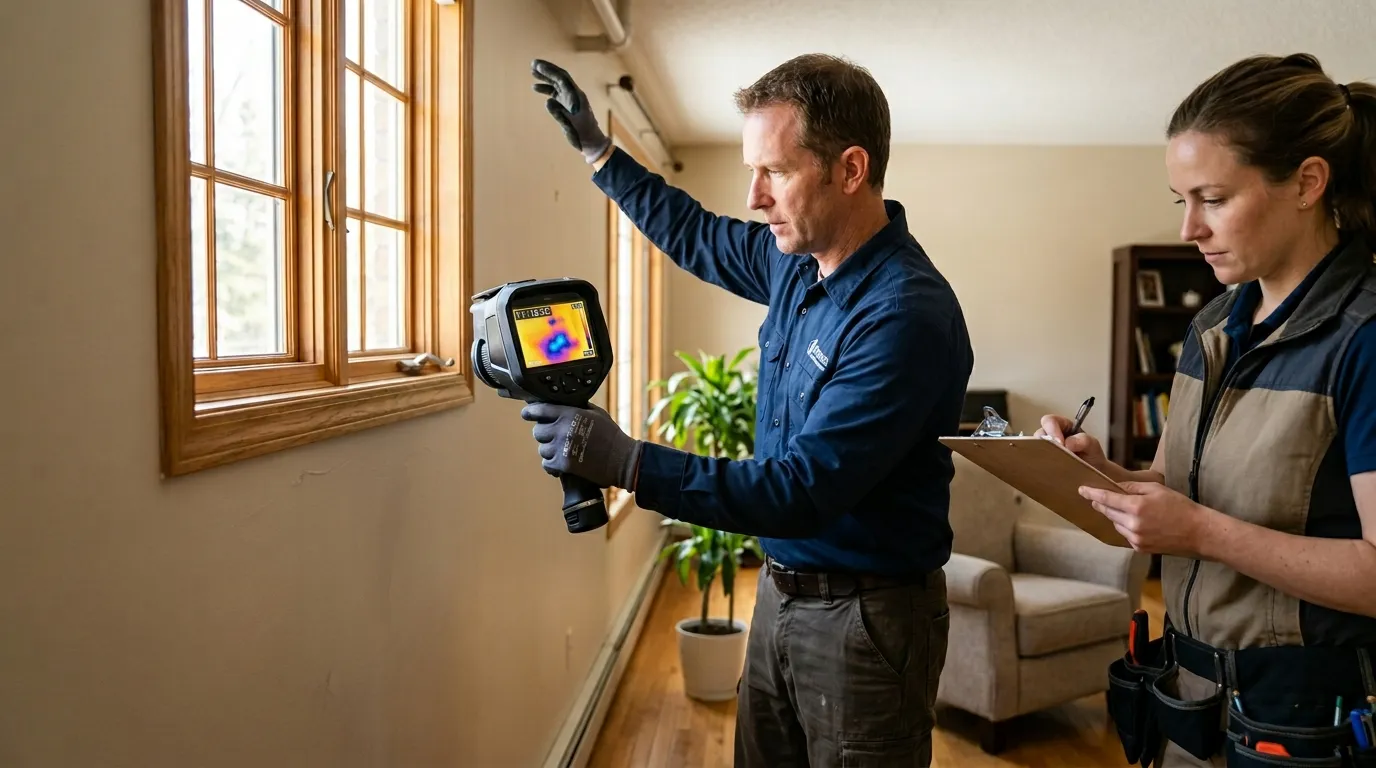
A thermal camera doesn’t see mold spores. It reads surface temperature. That distinction matters because a wet cavity can produce a clean thermal clue hours or days before staining, bubbling paint, or a musty odor becomes obvious. The camera gives you a map of where to test, not a lab result.
The mold part comes from moisture, time, and a food source. Drywall paper is food. A slow supply-line drip, roof leak, window flashing failure, AC condensate problem, or shower valve leak provides the water. The U.S. Environmental Protection Agency’s mold guide says moisture control is the core of mold control and recommends drying water-damaged areas within 24-48 hours to help prevent growth. That time window is why thermal scanning is useful: it can speed up the decision to open, meter, dry, or call a remediation pro.
No. Thermal cameras can’t identify mold species or confirm mold growth behind drywall. They can reveal temperature patterns that often come from wet gypsum, damp insulation, leaking pipes, or evaporation. If the pattern lines up with a water source, confirm it with a moisture meter before calling it mold risk.
The blunt answer to the Reddit version of this question is simple: thermal imaging sees the wet conditions that let mold grow. If someone points a camera at a wall and says, “that’s mold,” they’re skipping the proof step.
Wet drywall often looks cooler than surrounding drywall because evaporation pulls heat from the surface. Picture a bathroom wall behind a shower valve. The tile side looks fine. The hallway side has one soft blue-gray patch on the thermal display, starting at the valve height and feathering downward between studs. You touch it. It feels normal. The pinless meter says 28 percent wood moisture equivalent at the center and 10 percent two feet away. Now you have a target.

Hot-water leaks can flip the pattern. A leaking copper line behind 1/2-inch gypsum may show as a warm vertical stripe for 10 minutes after someone runs the shower. Once the flow stops, the same area can cool as damp materials evaporate. This is why one scan at 2 p.m. rarely tells the whole story. Run the suspected fixture, wait, scan, meter, then scan again.
| Thermal pattern | Common cause | Better next check |
|---|---|---|
| Cool blotch with soft edges | Evaporating wet drywall | Pinless meter grid |
| Warm line near floor | Hot-water pipe or radiant heat | Re-scan after fixture use |
| Cool vertical bay between studs | Wet insulation touching drywall | Pin probe or small inspection opening |
| Sharp straight stripe | Stud, corner bead, duct, or pipe | Compare with framing layout |
| Cool area at exterior corner | Air leak or missing insulation | Smoke pencil and humidity reading |
Wet drywall often looks cold because evaporation absorbs heat from the wall surface. The stronger the evaporation, the stronger the cooling pattern. High indoor humidity, vinyl wallpaper, low airflow, or a wall cavity packed with insulation can weaken that pattern, so thermal scans work best with meter confirmation.
The best readings usually happen when the room is stable and the wall has a temperature difference from its surroundings. In a U.S. home with air conditioning running, damp drywall near a plumbing leak may stand out by 2°F to 5°F. That isn’t a universal pass-fail number. A 2°F patch that repeats from three angles and matches a meter reading matters more than a 10°F reflection from a shiny picture frame.
Start with the story of the building. A one-story ranch in Phoenix with a flat roof fails differently from a 1998 Colonial in Ohio with upstairs bathrooms over a finished basement. Ask what changed: a new roof penetration, a frozen pipe last winter, a shower remodel, a dishwasher overflow, a musty closet after a humid week. Thermal imaging gets sharper when you already have a short suspect list.
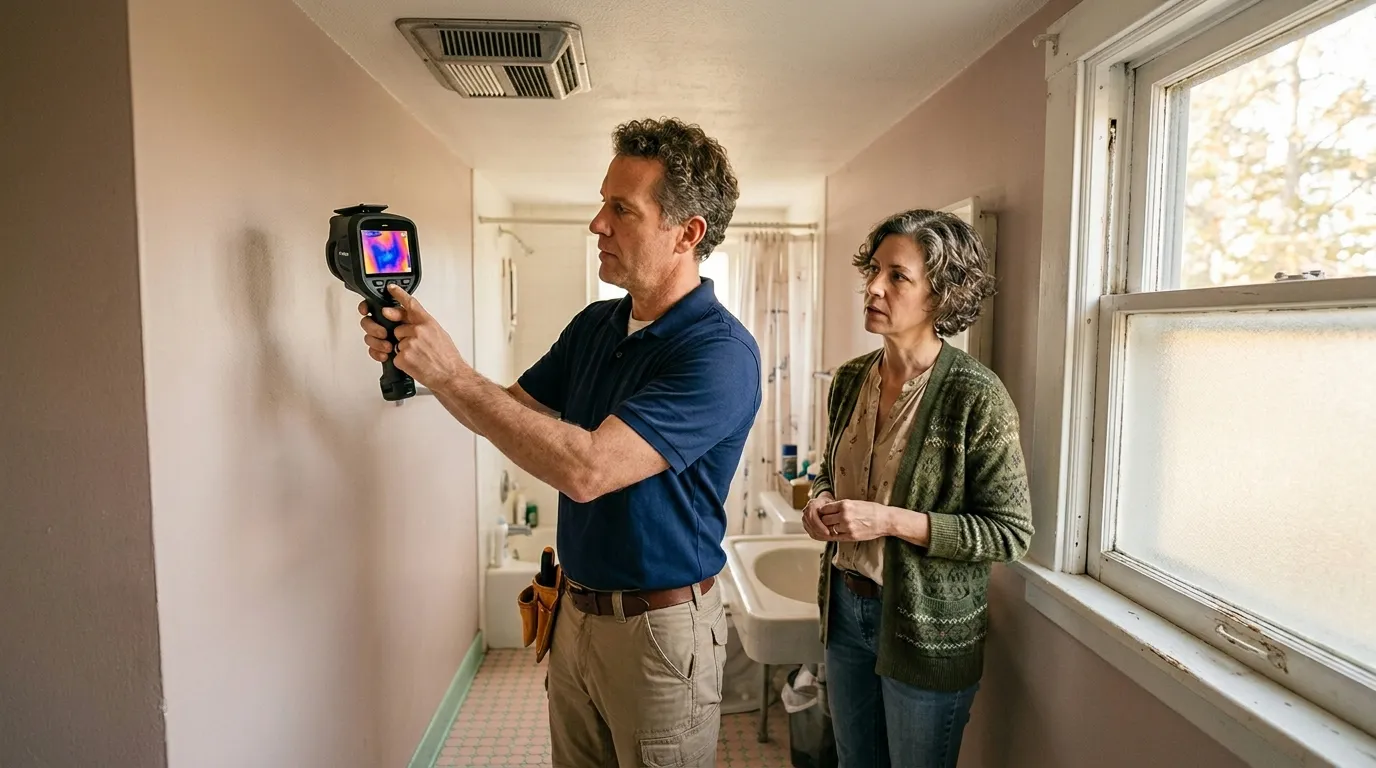
A practical scan works in passes. Stand back first, about 6 to 10 feet from the wall, so you can see the whole pattern. Then move closer for detail. Keep the camera perpendicular to the wall when possible. Avoid scanning across glossy tile, mirrors, stainless appliances, and glass because they reflect heat from your body, lights, and windows. If you’re using a Pixfra thermal device for a quick check, hold the view steady for a few seconds before calling the pattern real.
Use a simple field sequence:
If the cold pattern starts at the floor line or repeats along a hot-water run, the same logic used when plumbers locate slab leaks & radiant heating pipes with thermal applies: trace the heat path, confirm the wet zone, and avoid opening drywall until the pattern and meter reading agree.
Thermal can help trace active hot-water lines, radiant loops, and sometimes cold-water lines when the pipe temperature differs from the wall. It won’t map every pipe through drywall. Plastic PEX, deep cavities, insulation, and equalized wall temperatures can hide the line until water flow changes the temperature.
A moisture meter is still the closer. Pinless meters are faster and cleaner for painted drywall. Pin meters are better when you need depth clues or when the surface material is confusing the reading. For restoration work, a common pairing is a thermal scan plus a Protimeter Surveymaster, Tramex Moisture Encounter ME5, or Delmhorst BD-2100. The brand matters less than repeatable readings and a dry baseline.
False positives are common. Sun on an exterior wall can leave a warm rectangle that looks like a leak path. A supply register can chill a wall bay. A missing insulation batt can look like wet drywall because both create cold areas. Metal corner bead, screws, studs, and ductwork can create crisp thermal lines that don’t behave like moisture.
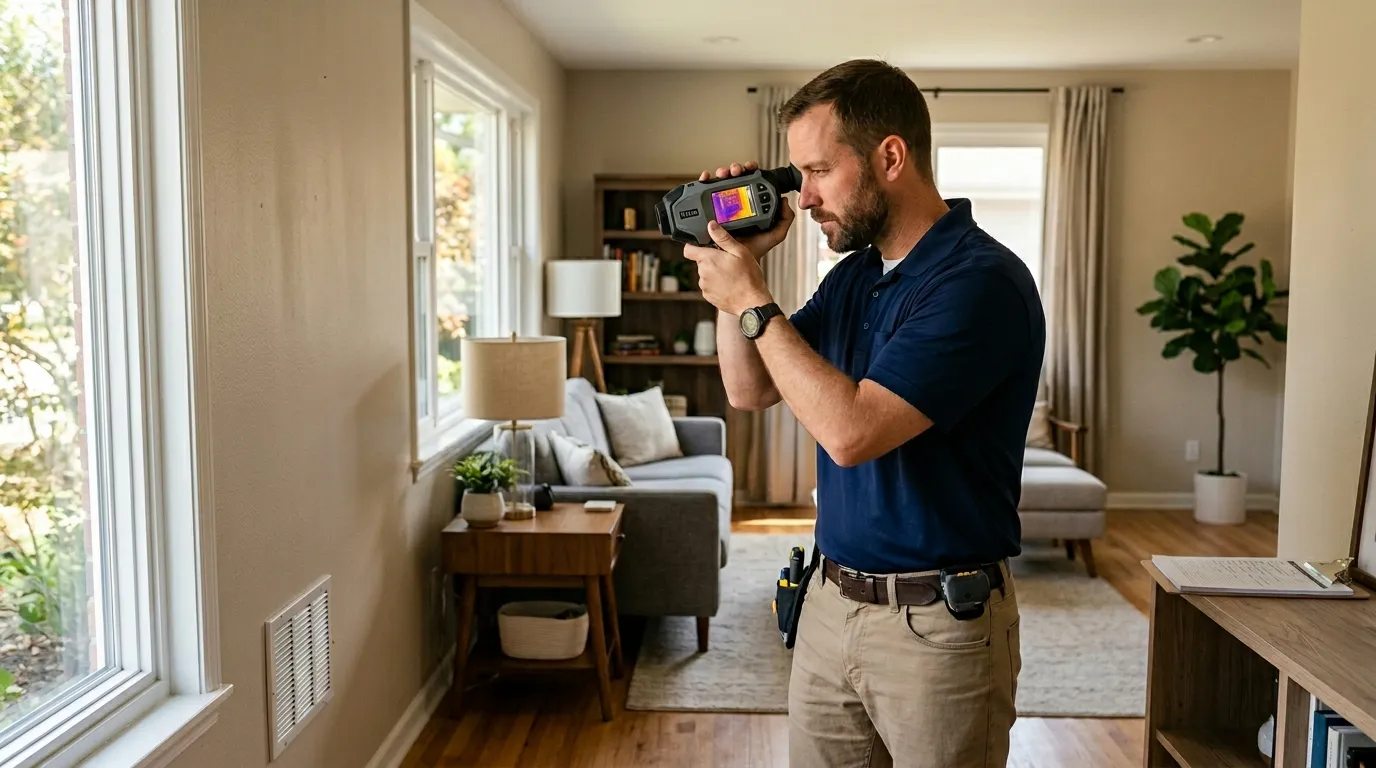
Reflections fool people fastest. A glossy painted wall can bounce the heat signature of your hand, a recessed light, or a sunny window behind you. Move left. Move right. If the “wet spot” moves with you, it’s reflection. Real wet drywall stays fixed to the wall geometry.
Field rule: a suspect moisture pattern should pass at least four checks before you treat it as real.
Thermal work also overlaps with pest inspections; when a warm wall patch moves, contains nesting material, or follows an attic entry point, this is closer to thermal imaging for pest control pros than a moisture call. Moisture patterns spread, wick downward, and follow absorbent materials. Animal heat behaves differently. So does a live electrical load.
Once you confirm moisture, the next question is risk. The Centers for Disease Control and Prevention’s mold page says mold can grow where moisture is present and notes that people with asthma, mold allergies, immune compromise, or chronic lung disease can have stronger health reactions. That doesn’t mean every cold patch is an emergency. It means you should match the response to the size, water source, occupant risk, and time wet.
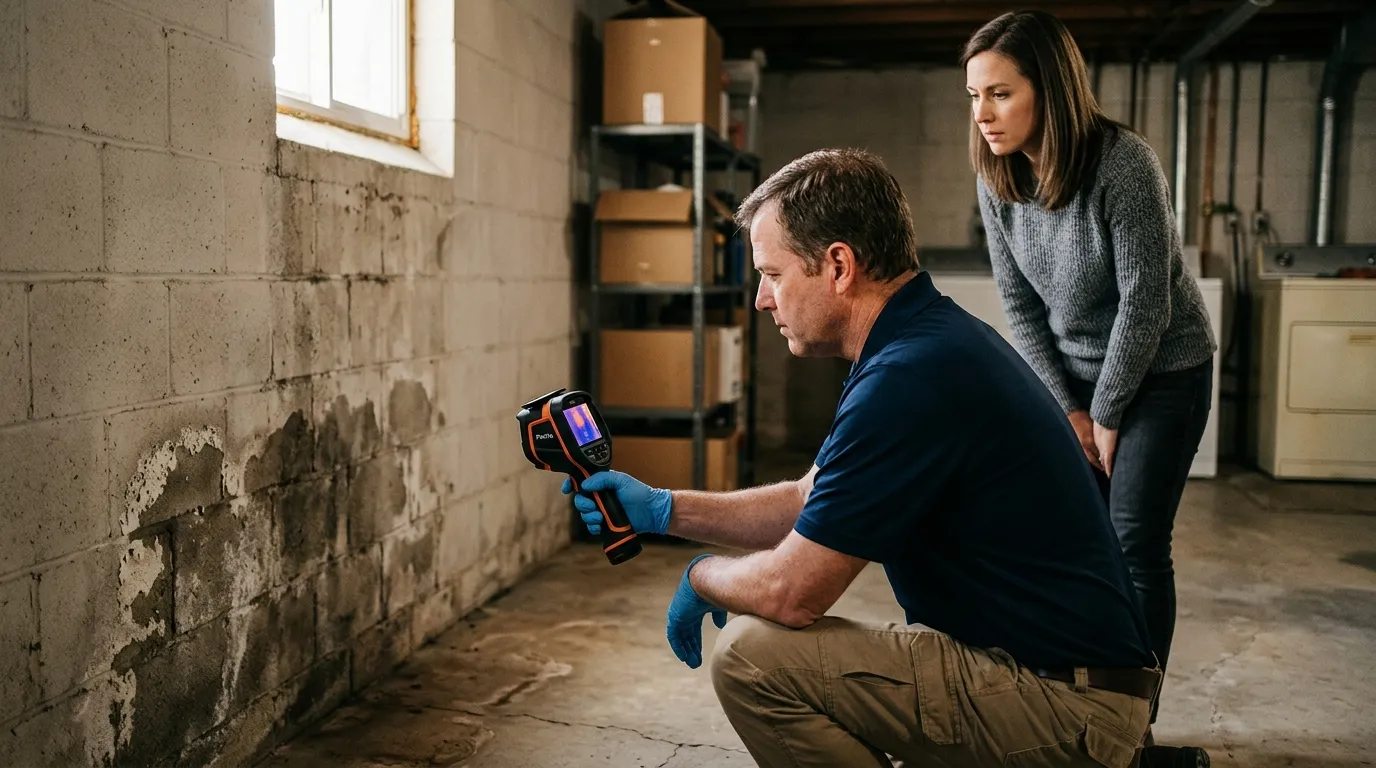
Small, clean-water leaks caught early are usually a drying problem. A toilet overflow from a clean tank is one thing. Sewage, floodwater, long-term wall cavity moisture, or a musty odor with occupant symptoms is a different call. Don’t let a pretty thermal image soften that distinction.
| Situation | Thermal value | Best decision |
|---|---|---|
| Leak less than 24 hours old | Finds wet perimeter fast | Stop water and dry aggressively |
| Leak 2-7 days old | Maps likely mold-risk zone | Meter, open if readings stay high |
| Musty odor, no visible stain | Finds hidden suspect areas | Inspect cavities with care |
| Sewage or floodwater | Limited screening value | Call a qualified remediation pro |
| Mold over about 10 sq. ft. | Helps define spread | Follow professional cleanup guidance |
Open drywall when moisture readings stay high, the water source is confirmed, the wall smells musty, paint is soft, or the cavity contains contaminated water. Don’t open a wall just because a thermal image looks odd. Meter it, compare it, and document why that exact spot is the right cut.
Behind drywall, mold risk climbs when drying can’t reach the wet material. Closed cavities, vinyl wallpaper, wet fiberglass insulation, double drywall, and baseboards with trapped water slow evaporation. A dehumidifier in the room may make the surface look better while the paper backing stays wet. That’s one of the sneaky parts.
For homeowners, the line is usually safety and scale. A 12-inch patch under a small supply leak may be manageable if you stop the water fast and dry the wall. A 6-foot run behind kitchen cabinets with swelling baseboard is contractor territory. If anyone in the home has asthma or immune compromise, move sooner.
Good documentation turns thermal imaging from “I saw something weird” into a defensible moisture map. Take a normal photo and a thermal photo from the same position. Mark the wall. Note the date, room, fixture tested, indoor temperature, relative humidity, and meter readings. Use the same color palette for the job so the photos don’t exaggerate the change from room to room.
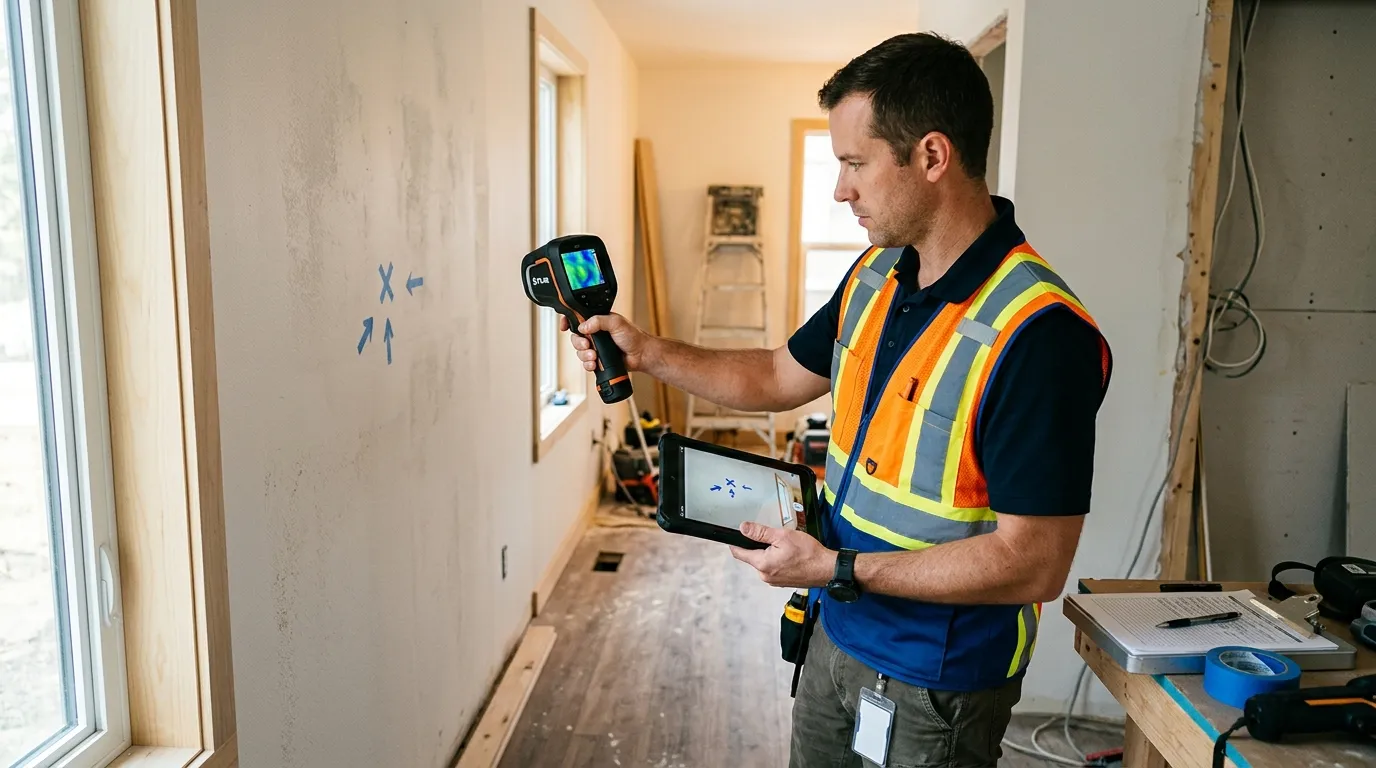
Don’t chase perfect images. Chase repeatable evidence. A slightly blurry thermal photo with a clear tape mark, meter number, and dry control reading beats a dramatic rainbow image with no context. Insurance adjusters, landlords, tenants, and restoration crews all need the same thing: where is wet, how wet is it, and what caused it?
For detecting hidden moisture & mold risk behind drywall with thermal, use this job note format:
Then come back. A drying job without follow-up is a guess. Re-scan after 24 hours and again when the meter reads close to the dry control area. If the thermal pattern shrinks and the meter drops, you’re moving in the right direction. If the surface looks dry but the meter stays high, the wall is still holding water.
No. Thermal imaging marks suspicious surface temperature patterns; a moisture meter, probe, or controlled inspection opening confirms wet drywall.
A 2°F to 5°F difference can matter when it follows a leak-shaped pattern and repeats from several angles. Single pixels or sharp stripes near studs are weak evidence.
Yes, flat or eggshell paint is usually fine. Gloss paint, foil wallpaper, tile, glass, and mirrors can reflect heat and distort results.
Usually no. CDC says if you see or smell mold, remove it and fix the moisture source; testing isn’t needed for most homes.
EPA recommends drying water-damaged areas within 24-48 hours to help prevent mold growth. Wet drywall left closed for days deserves a closer inspection.
Pixfra builds thermal devices for people who need to read heat patterns clearly, whether they’re outdoors at night or checking a suspicious wall inside a property. For detecting hidden moisture & mold risk behind drywall with thermal, the win is disciplined scanning: find the pattern, confirm the moisture, stop the water, and document the dry-out.
Dans le secteur de l'optique, les conditions « net 30 », les acomptes et les modalités de paiement signifient généralement une chose : les revendeurs établis peuvent bénéficier d'un délai de paiement de 30 jours à compter de la date de facturation, tandis que les nouveaux acheteurs doivent souvent verser un acompte ou payer la totalité du montant à l'avance jusqu'à ce que leur fiabilité, leur historique de commandes et leurs références de crédit aient été vérifiées. Dans les domaines de l’imagerie thermique, de la vision nocturne, des lunettes de visée, des jumelles et des télémètres, les conditions de paiement constituent en réalité un accord de trésorerie entre deux entreprises qui gèrent toutes deux des stocks coûteux.
Le délai de paiement « Net 30 » signifie que l'acheteur règle la facture dans les 30 jours calendaires suivant la date de facturation ; les acomptes permettent de réduire le risque pour le fournisseur avant la production ou l'expédition. Dans le secteur de l'optique, les nouveaux revendeurs commencent généralement par verser des acomptes de 30% à 50%, régler leur première commande à l'avance ou payer par carte bancaire, avant de passer au « Net 30 » après plusieurs transactions sans incident.

Un nouveau détaillant souhaite se procurer douze monoculaires thermiques avant l'ouverture de la saison de chasse au cerf. Le fournisseur souhaite protéger son stock, dont chaque unité peut coûter des centaines, voire des milliers de dollars. Les deux parties font preuve de raison. La tension commence lorsque le détaillant exige un délai de paiement de 30 jours nets pour sa première commande, alors que le fournisseur est confronté à un nouveau client dont il ne connaît ni le sérieux ni l'historique de paiement.
Voici un point de référence pratique :
| Situation de l'acheteur | Conditions de paiement courantes | Pourquoi les fournisseurs l'utilisent-ils ? |
|---|---|---|
| Première commande, petit revendeur | Paiement anticipé ou acompte 50% | Aucun historique de transactions pour l'instant |
| Client régulier, casier judiciaire vierge | 15 jours nets ou 30 jours nets | Réduction du risque de recouvrement |
| Grand distributeur | De 30 à 60 jours nets | Le volume compense le risque |
| Optiques OEM sur mesure | Acompte de 30%, 70% avant expédition | Les liquidités liées à la production sont immobilisées dès le début |
| Appareil thermique sous marque de distributeur | Paiements échelonnés | L'outillage, les micrologiciels, le conditionnement et la certification constituent des sources de risque |
Les conditions « Net 60 » et « Net 90 » existent bel et bien, notamment chez les grands distributeurs et dans le cadre d’achats liés au secteur public. Les petits revendeurs d’optique ne devraient pas les considérer comme des conditions de départ habituelles. Un détaillant d’articles de plein air possédant deux magasins qui demande un délai de paiement « Net 90 » pour une première commande de $18 000 de vêtements thermiques revient à demander au fournisseur de se transformer en banque.
C'est justement ce que les acheteurs ne voient pas.
Si votre marge est de 25%, un seul retard de paiement peut anéantir le bénéfice généré par plusieurs commandes sans problème. Le fournisseur a déjà payé les capteurs, les objectifs, les boîtiers, le fret, la main-d’œuvre en entrepôt et parfois même le soutien marketing avant même que votre client ne mette les pieds dans le magasin. Les conditions de paiement “ net 30 ”, les acomptes et les modalités de paiement dans le secteur de l’optique doivent être abordés sous l’angle du fonds de roulement, et non pas simplement comme de la « paperasse standard ».”
Une meilleure question pour commencer serait : “ Quelle structure de premier ordre permet de mettre cela en route tout en progressant vers le paiement à 30 jours ? ” Cette phrase passe mieux que “ Tout le monde nous accorde des délais de paiement. ”
Un acompte ne signifie pas un manque de confiance. C'est un moyen de répartir les risques avant que les marchandises ne soient expédiées.
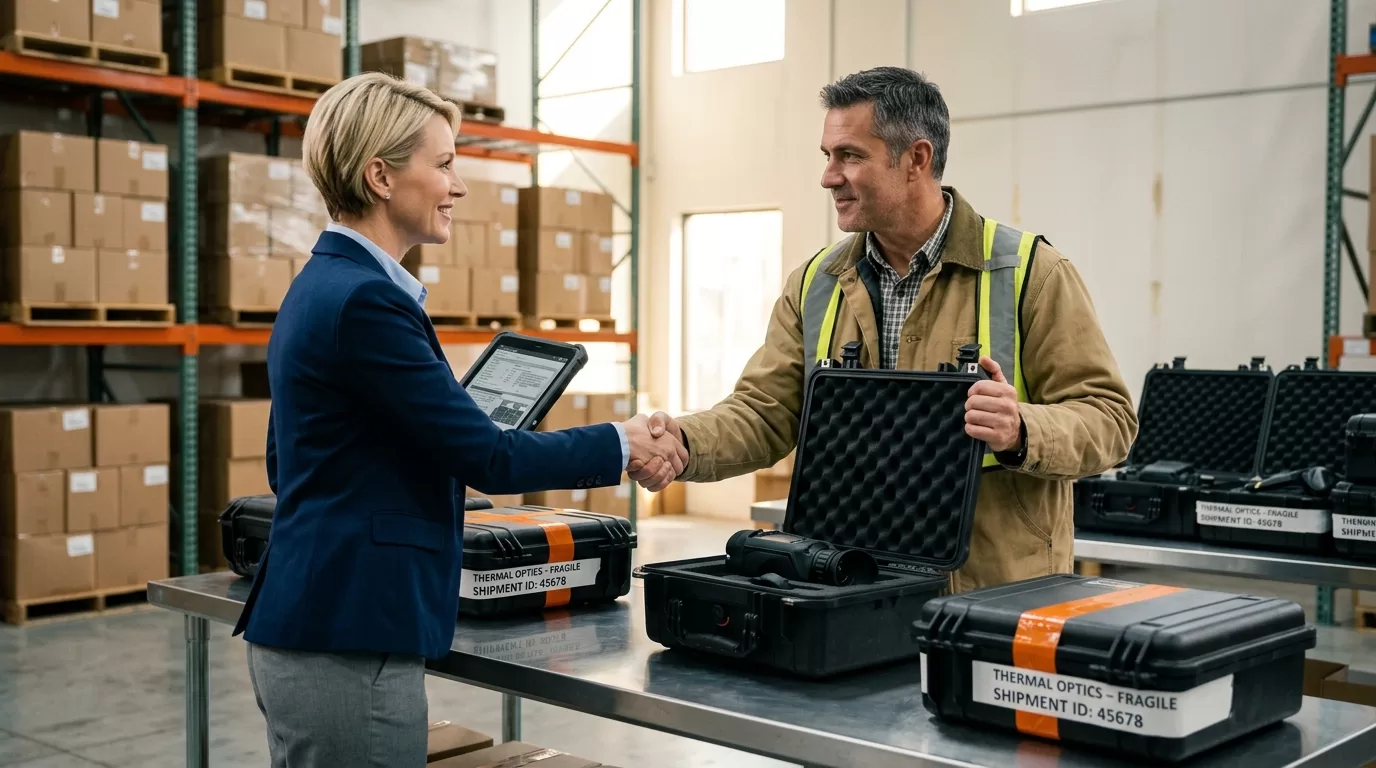
Dans le domaine de l'optique thermique, le risque lié aux stocks est plus important que pour les accessoires à bas prix. Un monoculaire thermique 640×512, un module à clipser 384×288 ou un lot d’appareils portables de marque peuvent immobiliser des capitaux importants. Si l’acheteur annule sa commande à la dernière minute, le fournisseur peut se retrouver avec une configuration qui ne correspond pas au budget, au marché ou à la langue d’emballage du client suivant.
Pour les produits standard du catalogue, un fournisseur peut exiger le paiement intégral avant l'expédition de la première commande. Pour les commandes plus importantes, il est courant de verser 30% d'avance et 70% avant l'expédition. Dans le cadre de projets OEM ou ODM, les acomptes sont généralement versés plus tôt, car la production démarre avant qu'il n'y ait de produit fini à vendre.
Prenons l'exemple d'un projet de caméras thermiques en marque de distributeur. Vous devrez peut-être gérer l'affectation des capteurs, le choix des objectifs, les menus du micrologiciel, la conception graphique des emballages, la documentation relative à la FCC et les tests sur échantillons. Le profil de risque est bien différent de celui lié à la commande de dix paires de jumelles en boîte provenant d'un stock existant. Les acheteurs de Pixfra qui comparent des produits finis à des programmes d'appareils sur mesure devraient considérer intégration du module de refroidissement dans le cadre d'une discussion distincte concernant le paiement, car le temps consacré à l'ingénierie et la planification des composants commencent bien avant l'établissement de la facture finale.
Un simple calendrier de versements peut vous éviter des appels délicats par la suite :
| Type de projet | Modèle de dépôt | Condition de paiement |
|---|---|---|
| Monoculaires thermiques disponibles en stock | 100% : première commande avec paiement anticipé | Avant l'expédition |
| Commande de réapprovisionnement chez le concessionnaire | 30 jours nets après validation | Date de la facture |
| Emballages sur mesure | Dépôt 30% | Avant la conception graphique ou la production |
| Dispositif thermique OEM | 30% / 40% / 30% | Lancement, validation des échantillons, expédition |
| Accord d'exclusivité territoriale | Acompte et montants minimaux trimestriels | Signature du contrat et cycle de renouvellement de commande |
Les acomptes sont mieux acceptés lorsque le fournisseur précise exactement ce qu’ils couvrent. “ Acompte 30% requis ” semble un peu brusque. “ L’acompte 30% permet de réserver le stock et de lancer la production des emballages ” est plus facile à accepter, car l’acheteur en comprend la raison commerciale.
Il existe également un aspect lié à la protection de l’acheteur. Si vous versez un acompte à un nouveau fournisseur d’optiques, demandez-lui une facture pro forma, ses coordonnées bancaires, les conditions d’expédition, les délais de livraison, les références des produits, les conditions de garantie et les règles de remboursement par écrit au cas où le fournisseur ne serait pas en mesure d’effectuer la livraison. La règle de la Commission fédérale du commerce (FTC) relative aux commandes par courrier, Internet ou téléphone impose aux vendeurs de disposer d’une base raisonnable pour les allégations publicitaires concernant l’expédition et de gérer correctement les retards d’expédition. FTC, 2024
Cette règle ne permettra pas de résoudre tous les litiges B2B. Elle offre néanmoins aux acheteurs américains un critère de référence utile : les engagements en matière d'expédition doivent être concrets, datés et documentés.
Un fournisseur accorde rarement un délai de paiement de 30 jours net simplement parce qu'un acheteur le lui demande gentiment. Il accorde ce délai parce que l'acheteur semble solvable.

Qu'est-ce que cela signifie concrètement ? Les informations relatives à votre entreprise correspondent aux registres publics. Vos références commerciales répondent au téléphone. Votre première commande est traitée sans encombre. Le délai de réapprovisionnement que vous proposez est adapté à la catégorie de produits concernée. Votre acheteur ne disparaît pas après vous avoir demandé une facture pro forma.
Pour un nouveau revendeur de produits optiques, le moyen le plus rapide d’obtenir un délai de paiement de 30 jours net consiste à adopter une approche rigoureuse et sans faille. Réglez d’avance la première ou les deux premières commandes. Veillez à ce que le volume des commandes reste raisonnable. Écoulez tout le stock. Passez une nouvelle commande avant la haute saison. Ensuite, négociez les conditions de paiement en présentant des chiffres concrets.
Un fournisseur peut demander :
L'Association nationale de gestion du crédit (National Association of Credit Management) indique que les décisions en matière de crédit commercial doivent tenir compte des antécédents de paiement, de la capacité de crédit, de la situation financière, des garanties et de la réputation. NACM, 2023 Cela peut paraître un peu formel, mais les fournisseurs de matériel optique utilisent la même logique dans leur langage courant : ce client est-il en mesure de payer, va-t-il payer, et que se passera-t-il s'il ne le fait pas ?
La pression sur la trésorerie est bien réelle pour les revendeurs. Un détaillant peut avoir besoin de produits en rayon avant un salon de la chasse, un cycle d’approvisionnement de la police ou une promotion d’automne. Les clients veulent toucher l’appareil, comparer la qualité d’image et s’informer sur la portée de détection. On ne vend pas un rayon vide.
Il n'en reste pas moins que recourir au crédit fournisseur pour financer une demande de vente au détail incertaine comporte des risques. Si vous commandez vingt lunettes de vision thermique avec un délai de paiement de 30 jours nets et que vous n'en vendez que six au cours du premier mois, les unités restantes constituent un stock, et non de la trésorerie. Le loyer est à payer. Les salaires sont à verser. La facture est également à régler.
Une approche plus rationnelle consiste à commencer à plus petite échelle. Commandez huit modèles répartis sur deux gammes de prix, par exemple des appareils thermiques avec une résolution de 384 et d'autres de 640. Suivez les ventes par modèle. Renouvelez la commande des modèles qui se vendent le mieux. Négociez ensuite des conditions de paiement à 30 jours nets en vous basant sur la rotation réelle des stocks plutôt que sur des prévisions optimistes.
Voici une demande plus ferme :
> “ Nous avons réglé d’avance les deux premières factures de Pixfra, pour un montant total de $14 600. Le délai moyen de vente a été de 22 jours. Nous souhaiterions bénéficier d’un délai de paiement de 30 jours nets pour les commandes supplémentaires jusqu’à $20 000, avec un paiement anticipé au-delà de ce seuil jusqu’à la prochaine révision. ”
On dirait bien un dossier commercial. Ça donne au responsable du crédit un élément à approuver.
Un délai de paiement de 30 jours nets peut sembler généreux pour l'acheteur, jusqu'à ce que le calendrier commence à s'écouler.
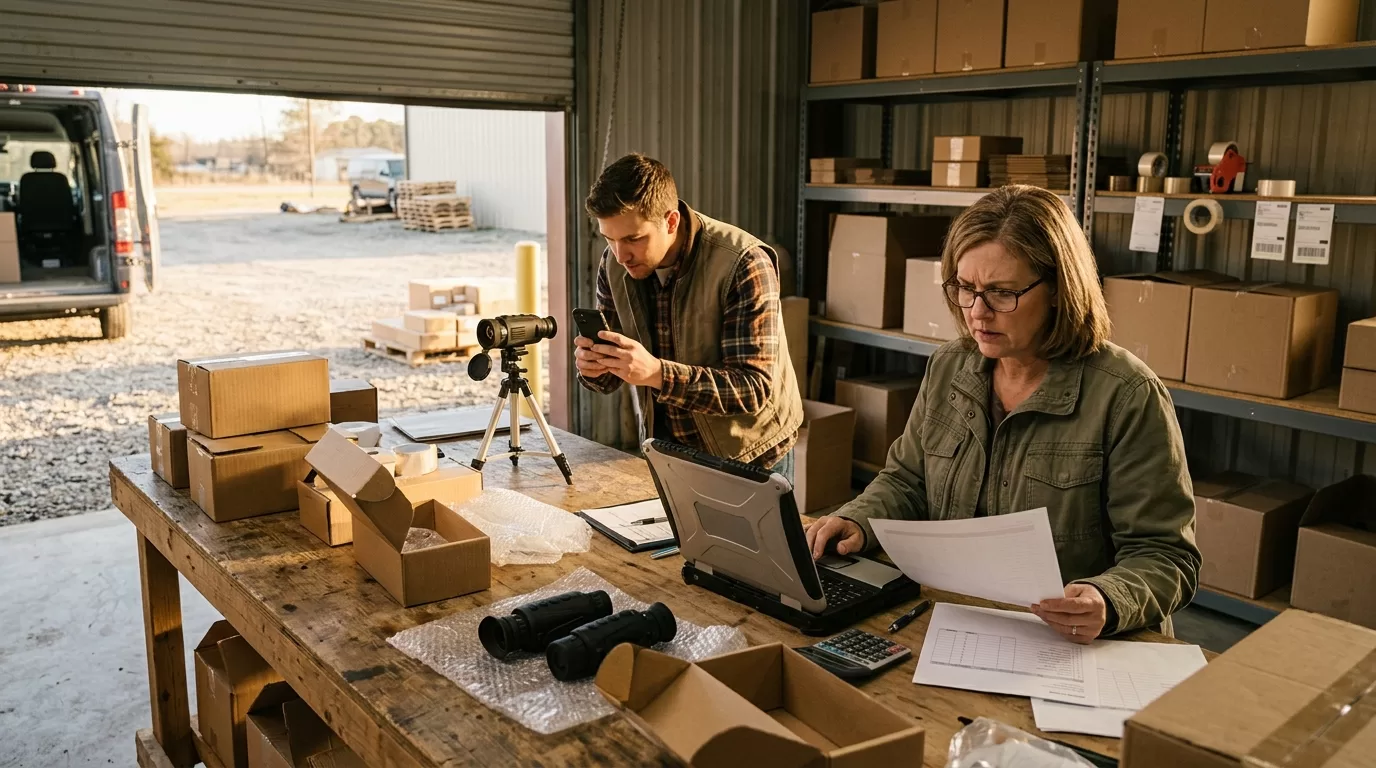
Jour 1 : expédition des appareils. Jour 6 : réception des appareils. Jour 10 : votre équipe met en ligne les annonces, forme le personnel et installe des batteries de démonstration. Jour 18 : le premier client en achète un. Jour 31 : échéance de la facture.
Si les ventes sont plus lentes que prévu, le délai de paiement de 30 jours nets ne génère pas de bénéfice. Il raccourcit le délai. C'est pourquoi les acheteurs du secteur de l'optique devraient établir leurs conditions de paiement en fonction de la rotation des stocks, et pas uniquement de la marge brute.
| Durée | Avantages pour l'acheteur | Risque pour l'acheteur | Risque lié aux fournisseurs |
|---|---|---|---|
| Prépaiement | Une validation souvent plus rapide | Sorties de trésorerie avant la vente | Faible |
| Dépôt 30% | Moins d'apport initial | Le solde doit être réglé avant l'expédition | Moyen-faible |
| 15 jours nets | Une marge de manœuvre réduite | Délai de revente très court | Moyen |
| 30 jours nets | Amélioration du cycle de trésorerie dans le secteur de la distribution | Pénalités de retard en cas de stagnation des ventes | Moyen-élevé |
| 60 jours nets | Plus de temps pour vendre | Peut masquer une faible demande | Élevé |
| 90 jours nets | Un allègement considérable de la trésorerie | Difficile à obtenir sans balance | Très élevé |
Une marge de 25% change la donne. Supposons qu'un revendeur achète pour $12 000 de matériel d'optique thermique et s'attende à les vendre pour $16 000. Cela représente une marge brute de $4 000 avant frais, retours, démonstrations, frais de transport et frais de traitement des cartes bancaires. Si $6 000 de ce stock reste invendu au-delà de la date d’échéance, le revendeur devra peut-être trouver des liquidités ailleurs pour payer le fournisseur.
C'est pourquoi les conditions de paiement « Net 30 », les acomptes et les délais de paiement dans le secteur de l'optique doivent être adaptés au rythme des ventes. Les produits destinés à la saison de chasse peuvent se vendre rapidement d'août à novembre, puis connaître un ralentissement. Les démonstrations destinées aux forces de l'ordre peuvent prendre des mois, car un test au sein d'un service peut impliquer le personnel chargé des achats, les agents de terrain et l'approbation du budget. Le commerce en ligne dédié aux activités de plein air peut connaître un pic après la publication d’une critique sur YouTube, puis se stabiliser pendant plusieurs semaines.
Des conditions de paiement qui conviennent à un canal peuvent nuire à un autre.
Pour les vendeurs en ligne, les conditions de paiement anticipé ou d'acompte peuvent s'avérer plus sûres tant que vous ne connaissez pas les taux de retour et les coûts publicitaires. Pour les revendeurs en magasin, le paiement à 30 jours nets peut permettre de couvrir la période d'essai si la fréquentation est prévisible. Pour les distributeurs, le paiement à 60 jours nets peut convenir, car les commandes sont réparties entre de nombreux sous-revendeurs.
Ne négligez pas non plus les questions de change et de fret. Si vous importez du matériel optique, les fluctuations des taux de change, les droits de douane et le fret aérien peuvent modifier votre coût au dédouanement avant même que le client ne reçoive le produit. Le Service des douanes et de la protection des frontières des États-Unis rappelle aux importateurs que la classification, l'évaluation et la responsabilité en matière de droits de douane incombent à l'importateur officiel. CBP, 2025
Cela a une incidence sur les conditions de paiement. Une “ bonne ” offre à 30 jours nets peut s'avérer peu avantageuse si vous avez oublié les droits de douane, les frais de courtage, les formalités administratives liées aux batteries au lithium ou la provision pour garantie.
La date de facturation n'est pas un détail anodin. Les conditions d'expédition non plus.

Si le délai de paiement de 30 jours nets court à compter de la date de facturation et que la facture est émise trois jours avant l'enlèvement, votre délai de paiement a déjà commencé avant même que les cartons ne quittent l'entrepôt. Si le délai de paiement de 30 jours nets court à compter de la date de livraison, la situation est différente. Précisez-le par écrit.
Il en va de même pour les Incoterms. Les termes EXW, FOB, CIF, DDP et DAP déterminent qui prend en charge les frais de transport, qui assume les risques et à quel moment la responsabilité est transférée. Dans les transactions transfrontalières liées au secteur de l'optique, un seul mot peut faire varier la responsabilité de plusieurs milliers de dollars.
Pour les concessionnaires américains, les clauses essentielles sont généralement les suivantes :
Un fournisseur peut se réserver le droit de suspendre les livraisons en cas de retard de paiement. C'est tout à fait normal. Les acheteurs doivent prendre connaissance de cette clause avant de lancer une promotion. Il n'y a rien de pire que d'écouler son stock de départ, de prévoir une campagne publicitaire pour le week-end, puis d'apprendre que la nouvelle commande est suspendue parce que le paiement de la facture précédente a été effectué avec deux jours de retard.
Les retours méritent une rubrique à part. Les appareils d'imagerie thermique ne sont pas des t-shirts. Un appareil ouvert à des fins de démonstration peut nécessiter une inspection avant d'être remis en vente. Un appareil dont la lentille est rayée, auquel il manque un câble ou dont le micrologiciel a été modifié ne peut pas simplement être remis en stock. Des règles claires en matière de retour (RMA) protègent les deux parties.
Les avoirs au titre de la garantie constituent un autre point de friction courant. Si un client retourne un monoculaire thermique présentant un véritable défaut, le fournisseur doit-il le remplacer, le réparer, émettre un avoir ou expédier des pièces de rechange ? Qui prend en charge les frais de retour ? Que se passe-t-il si les tests du produit s’avèrent normaux ? Ces questions semblent mineures jusqu’à ce qu’un appareil $1 999 se retrouve sur votre comptoir et que le client exige une réponse d’ici vendredi.
Une précision pratique : définissez la notion de “ jour ouvré ”. Un délai de paiement de 30 jours calendaires diffère d’un délai de 30 jours ouvrés. Sauf indication contraire, les fournisseurs font généralement référence aux jours calendaires. Les acheteurs partent parfois du principe qu’il s’agit de jours ouvrés. Cet écart de compréhension est source de ressentiment inutile.
Les coordonnées bancaires doivent également faire l'objet d'une attention particulière. La fraude par virement dans le commerce interentreprises est particulièrement grave et rapide. Vérifiez tout changement de coordonnées bancaires par téléphone auprès d'un interlocuteur de confiance, et non via le fil de discussion par e-mail où ce changement a été signalé. Pour les premiers versements, demandez au fournisseur de vous envoyer ses coordonnées bancaires sur une facture pro forma signée et vérifiez que le nom de la société correspond bien au titulaire du compte.
Demandez les conditions après avoir réduit le risque pour le fournisseur.
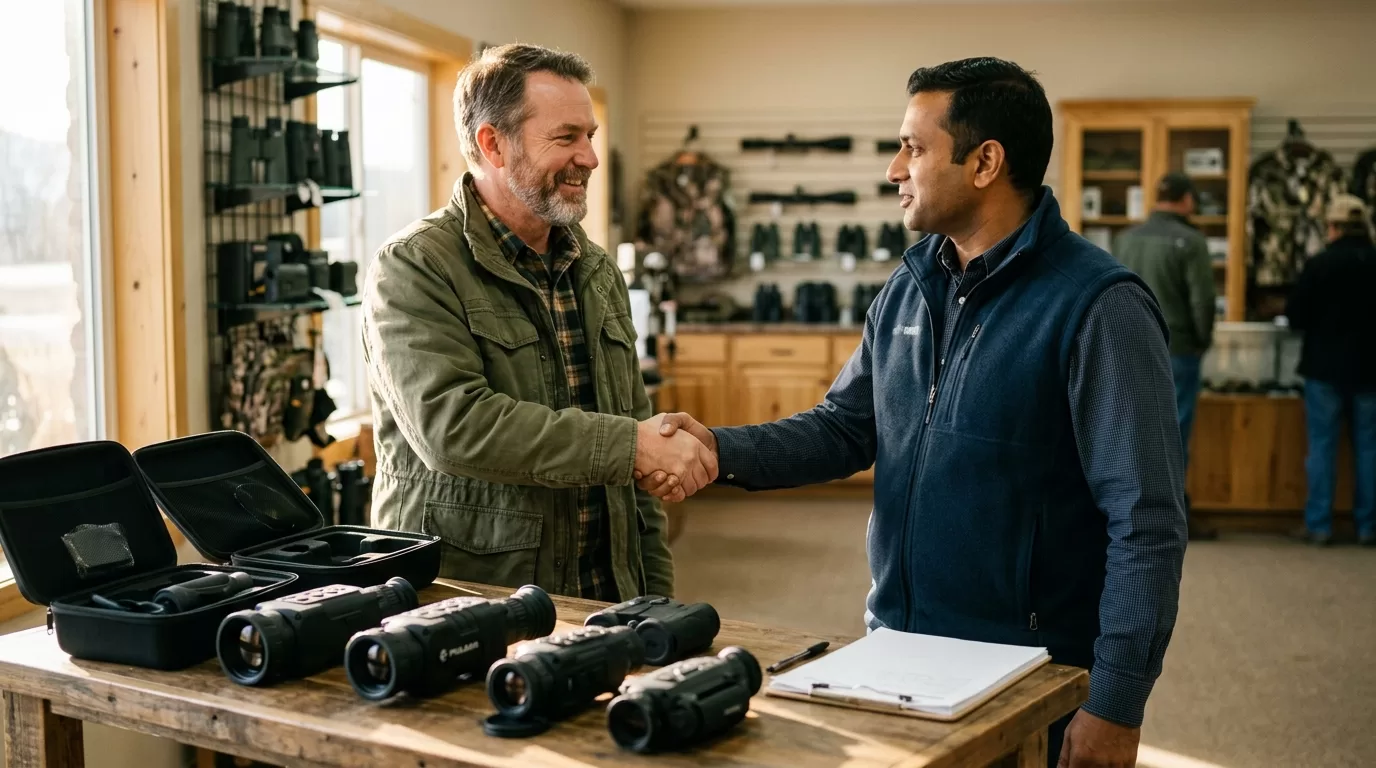
Voilà, c'est toute la négociation.
Si vous êtes un nouveau distributeur, ne commencez pas par demander : “ Pouvons-nous bénéficier d'un délai de paiement de 30 jours nets ? ” Commencez par présenter votre projet : gamme de produits, canal de distribution, date de lancement, cycle de réapprovisionnement prévu et historique de paiement. Proposez ensuite une structure qui permette aux deux parties d'aller de l'avant.
De meilleures phrases d'accroche :
Remarquez la logique. Vous ne demandez pas au fournisseur d'assumer un risque illimité. Vous tracez la voie à suivre.
Les gros acheteurs disposent d'une plus grande marge de manœuvre pour négocier, car ils peuvent proposer des volumes importants, des prévisions, des emplacements en magasin, la production de contenu ou l'accès à un canal de distribution spécifique. Même dans ce cas, les délais de paiement plus longs s'accompagnent généralement de contrats plus contraignants. Un délai de paiement de 60 jours nets peut nécessiter une vérification de solvabilité, une garantie personnelle, des délais de contestation plus courts ou des minimums d'achat stricts.
Même les petits acheteurs peuvent négocier. Le meilleur atout, c’est la précision. Au lieu de dire “ Nous prévoyons une forte demande ”, dites plutôt : “ En octobre dernier, nous avons vendu neuf monoculaires thermiques d’une résolution de 384 en 27 jours, à des prix compris entre $1 299 et $1 699. ” Au lieu de dire “ Nous avons un large public ”, dites “ Notre liste de diffusion compte 8 400 abonnés, et la promotion sur les optiques de l'automne dernier a généré $32 000 de chiffre d'affaires traçable. ”
Les fournisseurs sont sensibles aux chiffres.
Il y a des moments où il vaut mieux se retirer. Si un fournisseur exige un acompte important mais refuse de fournir une facture pro forma, une liste des modèles, les coordonnées de l'entité juridique, la date d'expédition, les conditions de garantie ou les modalités de remboursement, il convient de prendre du recul. Si un acheteur exige un paiement à 90 jours nets pour une première commande et refuse une demande de crédit, le fournisseur devrait lui aussi prendre du recul.
Pour les partenaires de Pixfra, la meilleure approche en matière de paiement est celle de la franchise : il faut adapter les conditions de paiement au type de commande, au canal de vente et aux preuves de vente effective. L'imagerie thermique est une catégorie technique dont les valeurs unitaires sont supérieures à celles des accessoires de plein air courants ; les promesses vagues ne suffisent donc pas. Une première commande sans problème vaut souvent plus qu'une première ligne de crédit trop généreuse.
Oui, le délai de paiement « Net 30 » est courant pour les revendeurs et distributeurs d'optique bien établis, ainsi que pour les acheteurs réguliers ayant un historique de paiement irréprochable. Les nouveaux acheteurs commencent souvent par un paiement anticipé, un acompte ou un délai de paiement « Net 15 » avant de bénéficier du délai « Net 30 ».
Pour les optiques en stock, les premières commandes peuvent nécessiter un paiement intégral à l'avance. Pour les commandes importantes ou sur mesure d'appareils d'imagerie thermique, des acomptes compris entre 30% et 50% sont courants, le solde étant dû avant l'expédition ou à une étape clé du projet.
Ce n'est généralement pas le cas pour la première commande. Un délai de paiement de 60 jours nets est plus réaliste pour les grands distributeurs, les clients de longue date ou les acheteurs disposant de solides références de crédit et dont le volume de commandes est prévisible.
Les factures doivent préciser si le délai de paiement court à compter de la date de facturation, de la date d'expédition ou de la date de livraison. Si le document indique uniquement “ Net 30 ”, il convient de considérer qu'il s'agit de jours calendaires à compter de la date de facturation, sauf indication contraire du fournisseur.
Uniquement si la facture ou le contrat le précise. Les emballages sur mesure, les dispositifs thermiques OEM et les stocks réservés comportent souvent des montants non remboursables, car le fournisseur a déjà engagé des dépenses liées à la production ou à l'allocation.
Que vous envisagiez de passer des commandes auprès de revendeurs, de commercialiser des produits d'imagerie thermique sous marque propre ou d'effectuer votre premier achat en gros, Pixfra peut vous aider à définir votre gamme de produits et vos modalités de paiement en vous basant sur des chiffres de vente réels, et non sur des suppositions. Commencez par définir un volume de commande précis, un plan de distribution réaliste et des conditions que les deux parties peuvent justifier par écrit.
If you run a farm or ranch in the U.S., you already know that losses don’t just happen during the day. Predators, sick livestock, broken fences, and trespassers do their worst after dark. A thermal monocular puts eyes on your entire operation at night — and the return on that one purchase can be staggering. We built this case study at Pixfra to show you the actual numbers.
Let’s start with what’s eating into your bottom line right now. Feral hogs alone are a persistent and costly threat to U.S. crop and livestock production, inflicting over $1.6 billion in damages annually. That’s not some abstract government number — it’s real money disappearing from farms across the South and West every single year. In Texas alone, the cost of feral hog-related agricultural damage exceeded $871 million in a single year. And hogs are just part of the picture. Collectively, predator attacks — led by coyotes — cost ranchers about $232 million per year in lost animals, with coyotes responsible for well over half of all livestock losses to predators nationwide. If you’re running cattle, sheep, or goats, something out there is costing you money every night you can’t see what’s happening on your land.

The damage goes beyond dead animals. Feral hogs caused an estimated $375 million in property damage in 2020 alone across 13 states, including damage to fencing, waterers, feed and hay storage, pasture roads, erosion infrastructure, and working facilities. In 2021, producers spent $474 million and over 17 million labor hours on hog control. That’s time you’re not spending on production, breeding, or anything else that actually grows your revenue. And here’s the kicker: it’s estimated that a single feral hog can cause $500 worth of damage to fields and pastures. Multiply that by a sounder of 15 or 20 hogs, and you’re looking at a five-figure hit from one bad night.
Then there’s the livestock health side. Infrared imaging can identify sick animals early by detecting fever, changes in circulation, or inflammation. Without thermal, a cow running a fever at 2 AM looks the same as every other cow in the pasture — you won’t know until she’s off feed the next morning, and by then, the problem may have spread. Thermal imaging saves farmers between $21,546 and $64,638 annually in mastitis-related costs alone for mid-sized dairy operations. Whether you’re running beef cattle, a dairy herd, or a sheep operation, the losses you can’t see in the dark are the ones that hurt most. Getting ahead of those losses is where a thermal monocular earns its keep. If you want to understand the top 6 features needed in the best thermal device in 2026, we put together a full breakdown that covers sensor specs, battery life, durability, and more — all the stuff that actually matters when you’re picking gear for real farm conditions.
Here’s where the thermal monocular ROI for farmers gets real. The math isn’t complicated. A quality handheld thermal monocular from Pixfra — something like our Arc LRF or Mile 2 series — sits in a mid-range price tier that most working farms can justify in a single season. Our devices deliver NETD values of ≤18mK, which means you can pick out a coyote against a warm field background or spot a feverish calf from across the pasture. You don’t need a $10,000 system to start seeing real savings. With system costs ranging from $500 for basic devices to $25,000+ for advanced setups, ROI is typically achieved within 12-18 months through prevented equipment failures ($5,000-$20,000 saved annually) and improved herd health outcomes. For most farms using a handheld thermal monocular, the payback window is even shorter because the upfront cost is lower.
The USDA’s predation management program data shows that for every dollar spent on predation management, $3 worth of livestock were saved. Think about that ratio applied to your operation. If you lose even two calves a year to coyotes or feral hogs — and at today’s beef prices, each calf is worth $800 to $1,200 — that’s $1,600 to $2,400 gone. A thermal monocular that lets you spot and deal with those predators before they hit your herd can pay for itself with a single saved animal. Farmers and ranchers have dozens of uses for thermal monoculars that save time and prevent losses — check on animals at night without disturbing the herd, spot a cow that’s separated from the group, and identify sick animals by detecting fever, since elevated body temperature shows up instantly on thermal displays. Every one of those use cases has a dollar value attached to it, and they stack up fast.
The indirect savings are just as real. You can cover large pastures quickly without driving out to every corner of your property, and thermal imaging also helps with predator control — coyotes, feral hogs, or other animals threatening livestock show up clearly, even from long distances. That means fewer midnight truck trips burning diesel, less wear on your ATV, and less time physically walking fence lines in the dark. One scan from a hilltop with a Pixfra monocular can cover ground that would take you 45 minutes by truck. Over a season, those hours and fuel costs add up. When you factor in predator deterrence, early health detection, faster head counts, calving-season monitoring, and property security, the ROI from a single thermal monocular covers a lot of ground — literally and financially.
Estimated Annual ROI Breakdown for a Mid-Size Cattle Operation (200 head)
| Loss Category | Estimated Annual Cost Without Thermal | Potential Savings With Thermal |
|---|---|---|
| Calf losses to predators (2-3 head/year) | $2,000 – $3,600 | $1,500 – $3,000 |
| Late disease detection & vet bills | $3,000 – $8,000 | $1,500 – $5,000 |
| Feral hog crop/pasture damage | $2,500 – $10,000 | $1,000 – $6,000 |
| Fence/infrastructure repair (hog damage) | $1,500 – $5,000 | $500 – $2,500 |
| Fuel, labor, and patrol time | $1,200 – $3,000 | $600 – $1,500 |
| Total estimated | $10,200 – $29,600 | $5,100 – $18,000 |
These figures are conservative, built from USDA damage data and typical livestock values. Your mileage will vary depending on your location, herd size, and local predator pressure — but even at the low end, a thermal monocular that costs under $2,000 can pay for itself in the first year.
Let’s put this into a real scenario. Picture a 600-acre cattle operation in east Texas — a region where feral hog damage exceeded $871 million in a single year statewide and coyote pressure is constant. The rancher runs about 150 cow-calf pairs. Before thermal, he was losing an average of three calves per year to predators — two to coyotes, one to hogs. At 2025 calf prices, that’s roughly $3,000 gone. Add in the pasture damage from a recurring hog sounder — torn-up hay meadows, damaged waterers, rutted-out feed roads — and the annual hit was pushing $8,000 to $12,000. He was spending an extra 10 hours a week during peak predator season driving the ranch roads at night with a spotlight, burning diesel and losing sleep.

After picking up a Pixfra thermal monocular, the picture changed fast. With our 12μm pixel pitch sensor and ≤18mK NETD, he could scan his entire calving pasture from one elevated point in under five minutes. Some ranchers use thermal monoculars during calving season to check pregnant cows overnight without spooking them with lights or vehicle noise, and coyotes, feral hogs, or other animals threatening livestock show up clearly, even from long distances. Within the first three months, he’d identified a coyote pair working the south pasture and a sounder of hogs bedding in a creek bottom he’d never checked before. He dealt with both problems before losing a single calf that season. That alone saved $2,000 to $3,000. The hog damage to his hay ground dropped by over 60% because he could now locate and trap them before they tore up acreage, saving another $3,000 to $4,000 in reseeding and repair costs.
He also started using the monocular for nightly health checks. Illness, injury, and infection often manifest as a change in surface temperature — a “hot spot” or “cold spot” — and a thermal monocular can flag a potential issue like mastitis, lameness, or fever in an animal from a distance. He caught a heifer with early respiratory illness on a thermal sweep one night — her head and chest were noticeably warmer than the rest of the group. By treating her the next morning before she went off feed, he avoided what likely would’ve been a $500+ vet bill and potential spread through the pen. His total first-year savings? Conservatively, $7,000 to $10,000 — from a device that cost a fraction of that. The thermal monocular ROI wasn’t a multi-year projection. It was a single-season reality.
Not every thermal monocular on the shelf is built for farm work. You need something that can handle dust, rain, cold mornings, and getting tossed on the truck seat. At Pixfra, we build every device with IP67-rated housing — that means full dust sealing and protection against water submersion. That’s non-negotiable for any device you’ll use outdoors in real conditions. You also need a sensor that can tell a coyote from a fence post at 300 yards on a warm night, and that comes down to NETD and resolution. Our devices hit ≤18mK NETD and pair that with 12μm pixel pitch sensors across the lineup, from the Draco for everyday farm use to the Sirius HD for large-property scanning at ranges out to 3,600 meters.

Battery life is another deal-breaker for farm use. If your thermal monocular dies at midnight and you’re mid-calving season, it’s a very expensive flashlight. Our Pixfra devices range from about 4.5 to 15 hours depending on the model, and many use standard 18650 batteries you can swap in seconds. That’s a deliberate design choice — when you need to pop in a fresh battery at 3 AM, proprietary charging setups are the last thing you want. For all-night predator patrols or multi-day backcountry work, swappable batteries beat built-in rechargeables every time. Cold weather can also slash battery performance by 30-50%, so carry spares in an inside pocket and you’ll never get caught dead in the dark.
Thermal optics are widely used for livestock protection and farm patrol. If you manage cattle, sheep, or poultry, predators like coyotes, hogs, or stray dogs can cause serious losses overnight. Waiting until daylight often means the damage is already done. Thermal devices allow you to detect movement across open land, fence lines, and tree cover without relying on floodlights. If your farm doubles as a place where you need to monitor for trespassers, check equipment sheds, or keep an eye on remote outbuildings, a thermal monocular with Wi-Fi streaming and video recording — like our models with the Pixfra Outdoor App — gives you documentation and real-time awareness in one tool. You’re not buying a gadget. You’re buying a farm management tool that works 24/7, handles rough conditions, and pays you back every time it prevents a loss you’d otherwise never see coming.
How fast will a thermal monocular pay for itself on a farm?
For most livestock operations, a thermal monocular can pay for itself within one season — sometimes in a single event. If you prevent even one calf loss to predators at today’s beef prices ($800-$1,200 per head) or catch a hog sounder before it destroys a hay meadow, you’ve covered the cost of a mid-range device. For operations using thermal imaging more broadly for herd health and equipment monitoring, ROI is typically achieved within 12-18 months. The faster you use the device, the faster it pays back.
Can a thermal monocular really detect sick livestock?
Yes. By monitoring the body temperature of animals, farmers can detect signs of illness, stress, or discomfort early, allowing for timely interventions that improve animal welfare and productivity. Fever, inflammation, and circulation changes all show up as hot spots on a thermal display. You can scan a group of cattle from a distance without disturbing them and flag the animal that looks warmer than the rest — all without getting close enough to stress the herd.
Do I need an expensive thermal monocular for farm use?
No. Most farmers initially think of thermal as a tool for predator control, but with a decent sub-$1,000 thermal, you have an entire spectrum of non-visible light opened up — you can monitor livestock without disturbing them and detect disease and injury earlier. Entry-level devices work well for short-range pasture checks and basic predator scanning. If you need longer detection ranges for larger properties — say, 1,000+ meters — a mid-range model like the Pixfra Arc LRF or Mile 2 hits the sweet spot between performance and price.
Is a thermal monocular better than trail cameras for farm security?
For active monitoring, yes. Trail cameras only capture what walks past them, and they need you to check the footage later. A single thermal device can detect a human-sized heat signature at over a mile, compared to a few hundred feet for a standard security camera. A thermal monocular gives you real-time, full-area scanning — you step outside, power it up, and you know exactly what’s on your property right now. For passive, 24/7 recording, trail cams still have their place, but when it comes to stopping a threat in real time, thermal wins every time.
What’s the best thermal monocular for a working farm or ranch?
It depends on your acreage and primary use. For smaller operations doing nightly livestock checks and close-range predator work, our Pixfra Draco provides solid performance at a reasonable price point. For mid-to-large ranches where you need to scan long distances — and especially if you’re dealing with feral hogs or coyotes — models like the Arc LRF (with a built-in laser rangefinder) or the Mile 2 series give you the detection range, battery life, and durability to handle serious farm use. Every Pixfra device is built to IP67 standards, runs a 50Hz refresh rate for smooth imaging, and works with our Outdoor App for firmware updates and image transfer.
Shooting past 300 yards in total darkness is a different game. You need a thermal scope that can detect, identify, and help you hit targets at distance — not just show you a glowing blob. At Pixfra, we build thermal imaging devices used by hunters across 30+ countries, and we know what separates a real long-range thermal scope from a spec-sheet wonder.
Not every thermal scope can handle long-range work. A scope that performs well at 100 yards might turn into a blurry mess at 400. If you plan to reach out past 300 yards at night — whether you’re hunting coyotes across open fields, running hog eradication on ranch land, or just want confidence at distance — you need to pay attention to a few specific things before you spend a dime.

The first thing to look at is sensor resolution. This is the number of pixels your thermal sensor uses to build the image you see through the eyepiece. If your shots stay within 100–150 meters, a 384×288 sensor will often suffice. If you’re shooting 250+ meters, go for a higher-resolution sensor (640×480 or 1024×768) and better thermal sensitivity (<20 mK NETD). A higher pixel count means the animal you’re looking at is rendered by more pixels on the screen, which lets you see ears, legs, body posture, and movement — all details you need for positive target ID before pulling the trigger. If you look at a coyote at 400 yards through a 256-resolution sensor, the animal might only be rendered by 4 or 5 pixels — it will look like a blurry Lego brick. With a 640×512 sensor, that same coyote is rendered by dozens of pixels. That’s a night-and-day difference when it comes to making an ethical shot.
Second, your long-range thermal scope needs a laser rangefinder (LRF) and a ballistic calculator — period. A laser rangefinder integrated with a ballistic calculator eliminates guesswork on longer shots by automatically adjusting your reticle for range and angle. This is particularly valuable for ethical hunting in low-visibility conditions where distance estimation is difficult. At night, you can’t judge distance by landmarks the way you can during the day. An integrated LRF gives you exact yardage in a fraction of a second, and when that feeds into a ballistic calculator, your reticle adjusts automatically for bullet drop. If you want a deeper look at what features set a great thermal device apart, we put together a guide on the top features needed in the best thermal device in 2026 that covers this in detail. Finally, don’t overlook build quality, refresh rate, and battery life. A scope with a 50Hz refresh rate tracks moving animals smoothly, while anything below 30Hz creates lag that can cost you a clean shot. And a battery that dies four hours into a night hunt is a deal-breaker — look for 7+ hours of runtime or swappable 18650 batteries so you can keep going.
After testing, field feedback, and engineering-level analysis of what performs at distance, here are our top seven picks for long-range thermal shooting in 2026. We’ve pulled from our own Pixfra lineup because we know these devices inside and out — and because they’re built to perform in exactly these conditions. Each model below brings something different to the table depending on your shooting style, terrain, and budget.
1. Pixfra Pegasus 2 LRF — Our flagship thermal scope for long-range precision. The Pegasus 2 LRF is built around the tagline “Make Precision Target Locking Effortless,” and it delivers. It features an integrated laser rangefinder, a high-sensitivity thermal sensor with NETD ≤18mK, and detection range that stretches well past what most hunters will ever need. The LRF feeds distance data directly to the scope, taking the guesswork out of holdovers at 300+ yards. If you want one scope that does everything for long-range thermal hunting, this is the one.

2. Pixfra Chiron LRF — Designed with one purpose: “Lock-On, Readiness, Fire.” The Chiron LRF pairs its integrated laser rangefinder with a built-in ballistic calculator, giving you real-time adjusted aiming points for different ranges and angles. This is the thermal rifle scope you want if you’re running predator control across big open ground. It computes bullet drop, angle compensation, and other ballistic factors so your reticle is already where it needs to be when you’re ready to squeeze the trigger.
3. Pixfra Pegasus Pro Series — When the slogan says “Shoot in a Pro Way,” it’s talking about features that matter to serious shooters. The Pegasus Pro is a thermal scope built for hunters who want a step up in optical performance and target clarity without the added weight and cost of full LRF integration. It offers excellent thermal imaging, smooth magnification, and a sensor that punches above its class for target identification at mid-to-long range.
4. Pixfra Taurus T650 LRF — This is a thermal front attachment, which means it clips onto the front of your existing daytime scope and turns it into a thermal imaging system. Why does that matter for long-range shooters? Because you get to keep using the high-quality glass optic you already trust for daylight work. The T650 LRF adds thermal detection with an integrated laser rangefinder and a ballistic calculator. Its zeroing precision sits at an ultra-fine 0.9cm@100m click value — that’s seriously tight for a thermal front attachment.
5. Pixfra Taurus T450 LRF — Similar DNA to the T650 but in a slightly different configuration, the T450 LRF gives you thermal front attachment capability with LRF and ballistic support. It’s ideal for shooters running mid-range optics on bolt-action rifles or AR platforms who want thermal capability at distance without re-zeroing or swapping their entire scope setup. Both Taurus LRF models are built for fast mounting and solid zero retention — key when you need to switch between day and night shooting.
6. Pixfra Volans Series — “See Beyond Time” isn’t just a marketing line. The Volans is a digital day-and-night vision scope with an adjustable aperture (F1.2–F3.0) that adapts to different lighting conditions. This gives you an all-day scope that handles bright daylight, low light, and total darkness without swapping optics. For hunters who don’t want to carry separate day and night rigs, the Volans solves that problem. LRF-equipped models also include a ballistic calculator for accurate targeting at distance.
7. Pixfra Draco — Lightweight design meets multi-functional performance. The Draco stands out as a thermal front attachment that keeps your rifle balanced and maneuverable, even on long stalks. While it’s not as feature-loaded as the Taurus LRF models, the Draco delivers reliable thermal imaging, solid detection range, and a compact form factor that won’t throw off your shooting position. It’s a smart entry into thermal front-attachment shooting for hunters who want thermal capability without the bulk.
Here’s a quick side-by-side comparison to help you see how these stack up:
| Model | Type | LRF | Ballistic Calculator | Best For |
|---|---|---|---|---|
| Pegasus 2 LRF | Lunette thermique | Oui | Oui | All-around long-range precision |
| Chiron LRF | Lunette thermique | Oui | Oui | Predator control, open terrain |
| Pegasus Pro | Lunette thermique | Non | Non | Mid-to-long range, value |
| Taurus T650 LRF | Front Attachment | Oui | Oui | Pairing with existing optics |
| Taurus T450 LRF | Front Attachment | Oui | Oui | Versatile clip-on thermal |
| Volans | Day/Night Scope | Available | Available | 24-hour all-day shooting |
| Draco | Front Attachment | Non | Non | Lightweight, portable thermal |
Key stat: Detection ranges across the Pixfra lineup run from around 500m on entry-level devices up to 3,600m on premium models like the Sirius HD series. For long-range shooting, our LRF models provide accurate ranging out to 1,000m — which covers virtually every realistic hunting scenario in North America.
This is the single biggest source of confusion in thermal scopes, and it trips up both new buyers and experienced hunters. When shopping for thermal optics, you will often see specs like “Detection Range: 2,500 yards.” Do not mistake detection for identification. Detection means the scope can sense a heat source — at 1,500 yards, a cow and a truck engine might look exactly the same, just a white dot. Identification means you can clearly see the animal’s shape, legs, and gait. This is the absolute maximum range at which you can ethically shoot. This is the point we want to drive home: your detection range is always going to be much farther than the range at which you can positively ID a target and take a responsible shot.

For thermal scopes, anything past 250 yards starts to become “long range.” Hitting a target at 500+ yards with a thermal scope requires a perfect storm of environmental conditions, high-end sensor resolution, and a very large objective lens. That’s why we build our Pixfra thermal scopes and front attachments with high-resolution sensors and wide germanium objective lenses. A larger lens collects more infrared radiation, which directly translates to a cleaner image at distance. When paired with a sensor that has NETD values as low as ≤18mK, you get exceptional target separation in conditions that wash out cheaper thermals — high humidity, fog, or low temperature contrast between animals and their environment. Our Taurus LRF series, for example, offers that ultra-fine 0.9cm@100m click value for zeroing, which gives you the precision to actually use those long identification ranges for shot placement, not just spotting.
If you’re shopping for a thermal scope specifically for long-range shooting, here are the specs you should zero in on. First, sensor resolution — we’ve already covered why 640×480 or higher is the sweet spot for long-range work. A 384×288 sensor works fine for close-to-mid range hog hunting inside 200 yards. If you’re pushing past 300 yards or targeting smaller game like coyotes, step up to a 640×480 or 640×512 sensor for cleaner target ID. If your budget limits you to a 384 sensor, you can still get decent performance at moderate distances, but you’ll hit a ceiling faster when you zoom in digitally.

NETD (Noise Equivalent Temperature Difference) is the second spec to watch. NETD measures how sensitive your thermal sensor is to tiny temperature differences. Lower numbers are better. Our Pixfra devices hit ≤18mK, which means the sensor can pick up extremely subtle heat variations — like the difference between a coyote’s warm body and the cooling ground around it on a mild evening. Premium models from top-tier brands typically range from 15mK to 25mK. Anything above 30mK is going to struggle in low-contrast conditions, and those are exactly the conditions where long-range shots are hardest. Temperature differentials shrink as the night goes on, and a sensitive sensor is what keeps your image sharp when conditions get tough.
Grossissement is where a lot of buyers get tricked. Digital zoom simply enlarges the pixels you already have. If you want to shoot at 400 yards, you need a scope with a higher optical base magnification (like 3x or 4x), so you don’t have to rely heavily on digital zoom. A scope advertising 16x magnification sounds impressive, but if that’s achieved through 2x base mag and 8x digital zoom, your image quality at high zoom will be soft. For long-range thermal work, look for a base optical magnification of at least 3x to 5x, and treat digital zoom as a bonus — not the foundation of your long-range plan. Our Pegasus 2 LRF and Chiron LRF are engineered with this philosophy: strong base magnification so you get real optical clarity where it counts.
Choosing a thermal rifle scope for long-range shooting comes down to three things: where you hunt, what you hunt, and how you hunt. Open fields or farmland require a scope with a long detection and identification range, typically a 50–60mm lens and 640+ resolution sensor. Woodland or brush calls for wide field of view, compact form, and fast handling — 35mm lenses and lighter builds are ideal. Mixed terrain means a balanced scope with a mid-range lens (50mm), moderate magnification, and decent FOV. If you’re sitting in a blind over a Texas grain field waiting for hogs, the Pegasus 2 LRF gives you maximum detection and precision. If you’re walking fence lines looking for coyotes, the lighter Draco front attachment keeps your rifle from wearing you out over miles.
Budget matters too. Thermal units range in price from around $1,000 for basic thermal viewers to over $7,000 for the most sophisticated rangefinding scopes. Thermal scopes depend on a rare-earth element called germanium, which supplies temperature-sensitive glass for thermal units. Generally speaking, the best combination of attributes, capability, and overall utility of thermal units will set you back around $3,000. Don’t chase the highest-specced scope if your shots never go past 200 yards. A mid-range Pixfra thermal scope or front attachment will serve you better than an overbuilt unit that’s too heavy for your style. On the flip side, if you’re seriously working open country at 400+ yards, invest in LRF integration and a ballistic calculator — those features pay for themselves in first-round hits and ethical shots. Our Chiron LRF and Taurus LRF both include ballistic calculators that compute factors like bullet drop and angle for accurate targeting at different distances, making them a solid pick for anyone who wants long-range confidence without external accessories.
How far can you actually shoot with a thermal scope?
It depends on the scope and the target, but here’s the honest answer: most thermal scopes let you detect heat signatures well beyond 1,000 yards. However, your actual shooting range — the distance at which you can positively identify the target and make an ethical shot — is usually limited to 400–600 yards with a high-end 640-class sensor and a 50mm+ lens. Our Pixfra thermal scopes with NETD ≤18mK push that identification range further by delivering sharper thermal contrast, but we always recommend knowing your identification limits before taking any shot.
Is a 640 sensor worth the extra money over 384?
If you’re shooting past 200 yards regularly, yes — it’s absolutely worth it. A 640×480 or 640×512 sensor puts significantly more pixels on your target at distance, which translates directly into better target identification. At 400 yards, the difference between a 384 and a 640 sensor is the difference between guessing and knowing what you’re aiming at. For close-range work under 200 yards, a 384 sensor handles the job, but for long-range thermal shooting, the 640 is the baseline we recommend.
Do I need a built-in laser rangefinder on my thermal scope?
For long-range shooting — yes. At night, your ability to judge distance drops off a cliff compared to daylight. An integrated LRF gives you accurate yardage in under a second, and when it’s paired with a ballistic calculator (like on our Chiron LRF and Taurus LRF), it adjusts your aiming point automatically. You range, you aim, you shoot. No fumbling for a separate rangefinder, no breaking your eye from the scope. If you mostly shoot under 150 yards from a fixed position where you already know the distances, you can skip the LRF. But for anything past 200 yards in unfamiliar terrain, it’s a game-changer.
Can I use a thermal scope during the day?
Yes. Thermal scopes detect heat, not light, so they work in daylight, total darkness, fog, smoke, and glaring light. Our Pixfra Volans Series takes this a step further with an adjustable aperture (F1.2–F3.0) that adapts to different lighting conditions, giving you true all-day vision capability. You won’t get the same color image as a traditional daylight optic, but you’ll see heat signatures that you’d miss with regular glass — like a bedded deer in tall grass or a coyote tucked into a shady tree line.
What NETD rating should I look for in a long-range thermal scope?
Lower is better. NETD stands for Noise Equivalent Temperature Difference, and it measures how small of a temperature change the sensor can detect. For long-range work, look for anything ≤25mK. Premium scopes sit around 15–18mK, which is where our Pixfra lineup lands. At ≤18mK, you get clear thermal contrast even in tough conditions like high humidity or when ambient temperatures are close to your target’s body temperature. Anything above 35mK will struggle at distance and in challenging weather.
If you need to negotiate MOQ with a thermal optics manufacturer, start by reducing the manufacturer’s production risk, then trade something concrete: deposit, forecast, standard packaging, or a dated reorder. MOQ changes when you ask for a 640×512 detector, a 35 mm lens, app changes, reticle presets, private-label packaging, or compliance paperwork for a U.S. sales channel. The first job is to find which part of your request is setting the floor.
A new buyer often asks the wrong question: “Can you do 20 units?” A stronger question is: “Which requirement makes the MOQ 300, and what changes would make a 50-unit pilot workable?”
1. Ask which cost sets the MOQ: sensor, lens, tooling, packaging, or compliance.
2. Keep first order on standard hardware, firmware, and carton.
3. Pay for samples, engineering, and inspection instead of asking the factory to absorb them.
4. Split commitment into pilot order plus dated reorder.
5. Trade lower MOQ for deposit, shared packaging, simple SKU mix, and clear forecast.
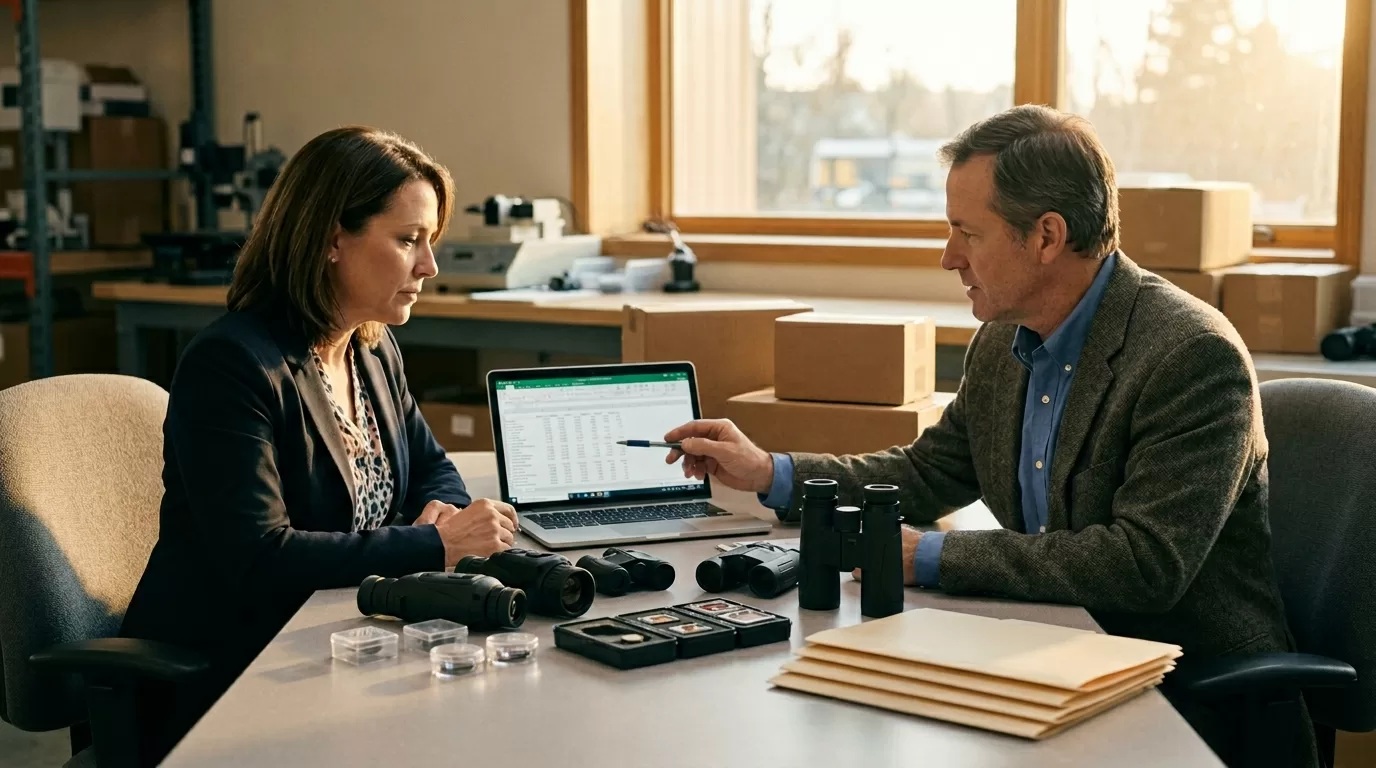
Thermal optics MOQs are built from setup costs. Detector purchasing, lens assembly, waterproof housing checks, firmware loading, image calibration, and packaging print runs all create small minimums inside the bigger MOQ. A 384×288 thermal monocular in a standard housing might hit one factory threshold; the same unit with a branded startup screen, U.S. carton, custom manual, and changed Wi-Fi app can hit four.
The best way to negotiate MOQ with a thermal optics manufacturer is to turn “small order” into a low-risk production plan. Say what you’ll keep standard. Say what you’ll pay for. Give the supplier a real reorder window, such as “80 units now, 220 units within 90 days if field testing passes.”
| Factory answer | Better buyer question | Possible path |
|---|---|---|
| MOQ is 300 units | Which part requires 300? | Reduce branding or split into pilot plus reorder |
| Custom carton needs MOQ | Can we use standard carton with a label? | Lower first order, brand later |
| 640 sensor supply is tight | Can we start with one 384 SKU? | Prove demand before higher trim |
| Firmware change adds MOQ | Can logo stay on packaging only? | Avoid engineering work |
| Tooling is required | Can we pay tooling separately? | Separate unit MOQ from tooling cost |
Don’t negotiate only on quantity. Negotiate the order shape.
An 80-unit order of one thermal monocular SKU is cleaner than 20 units each across four trims. The warehouse picks one carton. Production loads one firmware version. QC checks one optical setup. Your sales team also learns faster because every dealer demo, return, and customer question points to the same model.
A factory MOQ is rarely one fixed number. It moves with customization. For thermal optics, the biggest cost drivers are detector resolution, focal length, housing changes, firmware requests, app work, private-label packaging, accessories, and certifications. The low-friction items are usually labels, outer cartons, quick-start inserts, and batch timing. The hard items are sensor changes, new molds, new lens assemblies, and model-specific test reports.

Detector choices matter because a 256×192, 384×288, and 640×512 device may sit on different purchasing plans. Pixfra’s Mile 2 range, for example, includes 256×192, 384×288, and 640×512 options across different model trims. That doesn’t mean a buyer can freely mix all detector levels in one tiny pilot. From a production view, those are different builds with different cost stacks.
Before you trade MOQ for a private-label carton, confirm the compliance packet, because Pixfra’s guide to thermal optics certifications buyers should demand explains why CE, FCC, and RoHS paperwork has to match the actual model, charger, battery, wireless module, and sales market. A PDF from a similar model isn’t enough for a serious U.S. dealer program.
| Usually negotiable | Usually harder |
|---|---|
| Logo sticker on standard carton | New molded housing |
| Standard manual plus insert | Full manual rewrite in multiple languages |
| One SKU pilot | Mixed detector resolutions |
| Standard accessories | New mount, case, or battery pack |
| Paid sample order | Free engineering on first order |
Here’s the blunt version: custom branding is cheap until it touches production. A logo on a carton is simple. A logo molded into the housing means tooling, color matching, material testing, and a longer approval loop. That’s why “same product, just my brand” can still raise MOQ if the request reaches beyond packaging.
A one-SKU pilot works better than a mixed trial pack. If you’re entering the U.S. hunting, wildlife, farm security, or outdoor retail channel, pick the product level that matches your first customer. A store selling entry thermal monoculars may test a 256×192 or 384×288 unit first. A dealer selling long-range scanning may need a 640×512 model with a 25 mm or 35 mm lens. Mixing all of them in the first PO slows learning.
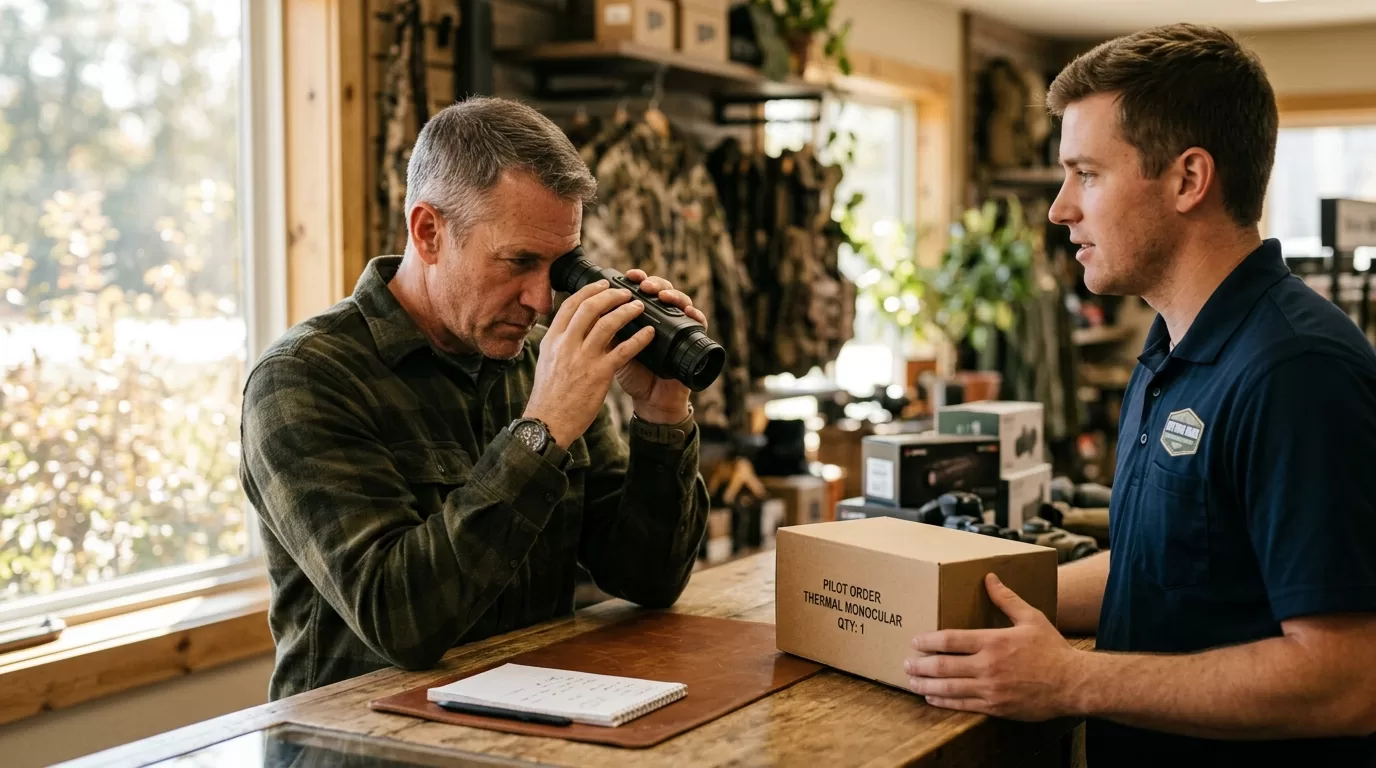
The strongest MOQ levers are the ones that remove doubt for the manufacturer. A signed forecast beats vague optimism. A 50% deposit beats a request for net 30. A standard carton beats a new print run. A dated reorder beats “we’ll buy more if it sells.” Suppliers hear that line every week.
| Buyer lever | Why it helps MOQ talks |
|---|---|
| 50% deposit | Reduces factory cash risk |
| Standard packaging | Avoids carton print minimums |
| One SKU | Cuts setup and QC changes |
| Paid sample fee | Covers engineering time |
| 90-day reorder plan | Gives production a reason to reserve parts |
| Third-party inspection | Reduces dispute risk before shipment |
Try this structure: “We can accept your standard packaging and standard firmware for the first 80 units. If the pilot passes U.S. dealer testing, we’ll place 220 units within 90 days with private-label carton artwork.” That’s a deal a production manager can discuss.
What doesn’t work? Asking for the lowest MOQ, lowest price, custom box, custom startup logo, free samples, net 60 payment, and DDP delivery to Ohio in the same email. That reads like risk from every angle. Pick your battle. For a first order, MOQ matters more than a perfect carton.
Payment terms can move MOQ because they change who carries the risk. The U.S. International Trade Administration says cash-in-advance reduces exporter credit risk because the seller receives payment before shipment, while full prepayment is less attractive for the buyer. That tension is useful. If you want a smaller first order, offer payment terms that make the smaller run easier to approve.

For a new buyer, asking for 30 units and open-account payment is a weak position. Asking for 50 or 80 units with 50% deposit and 50% before shipment is much stronger. If you need extra protection, add pre-shipment inspection instead of pushing the supplier to finance your inventory.
| Order type | Practical term |
|---|---|
| 2-5 samples | 100% prepaid |
| 50-unit pilot | 50% deposit, 50% before shipment |
| 100-200 units | 30/70 or 40/60 after relationship starts |
| 300+ units | Better unit price, stronger delivery slot |
| Annual forecast | Quarterly releases tied to reorder dates |
Incoterms also affect the conversation. EXW gives the buyer more logistics work. FOB gives a cleaner handoff at port. DDP to a U.S. warehouse may sound convenient, but it pushes customs, duties, delivery issues, and paperwork onto the seller. If MOQ is your main concern, keep logistics simple for the first order.
There’s a tradeoff. Better payment terms can lower MOQ, but they shift cash-flow pressure onto you. A 50% deposit on 80 units of thermal scopes is real money. Use that lever when you have dealer demand, not when you’re still guessing.
Some MOQ requests should be rejected, even if the supplier agrees. Thermal optics aren’t generic plastic accessories. Image quality depends on detector grade, lens focus, calibration, firmware behavior, screen quality, and waterproof assembly. A cheap 30-unit batch with inconsistent sensors can burn a new dealer faster than a higher MOQ with stable quality.
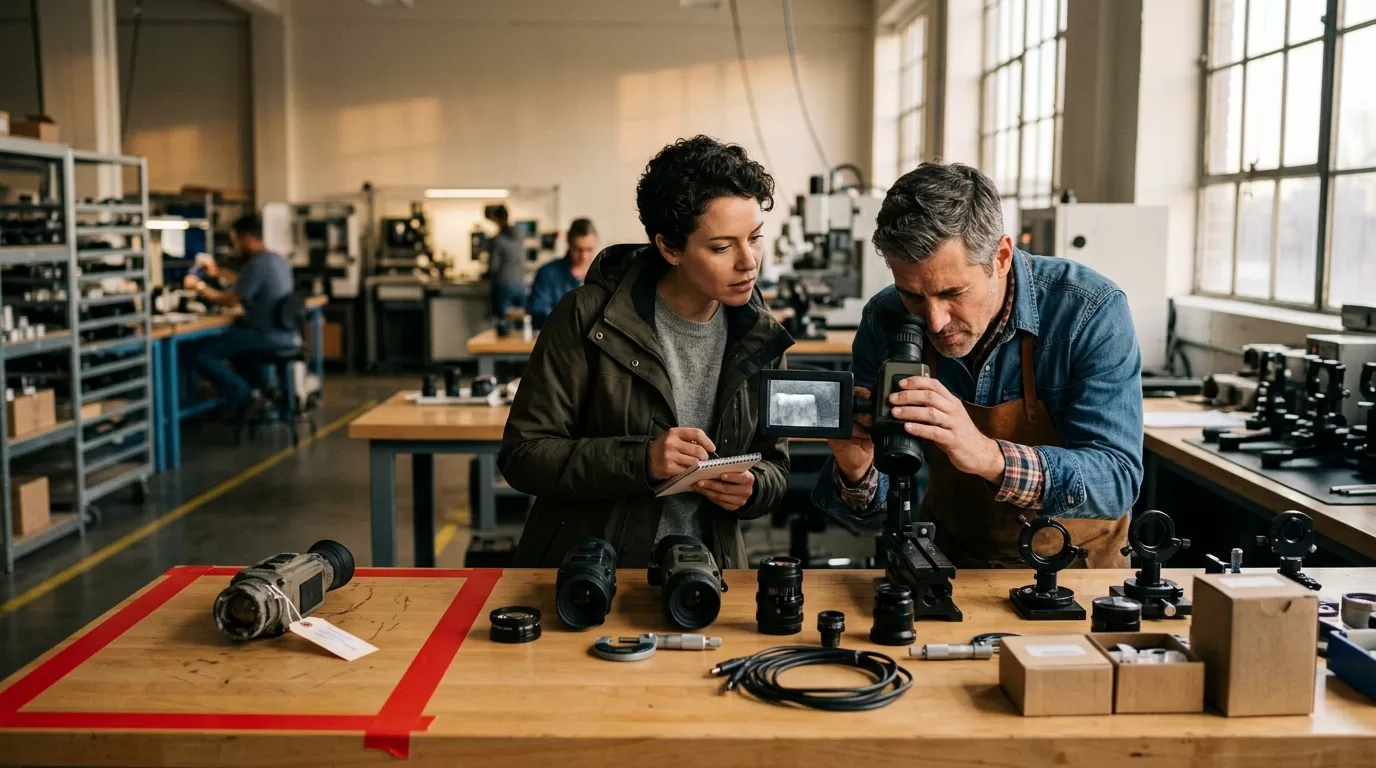
Compliance is another red line. The U.S. Bureau of Industry and Security’s Commerce Control List Category 6 includes controls for some thermal imaging cameras under ECCN 6A003, so classification and destination checks matter. This is especially sensitive if products include thermal imaging, laser rangefinding, wireless functions, or military-adjacent use cases.
Don’t negotiate these away:
Les conseils contenus dans ce guide ne s'appliquent pas à tous les achats. Si vous achetez des stocks de fin de série provenant d’un ancien lot, la quantité minimale de commande (MOQ) peut être inférieure, car l’usine souhaite libérer de l’espace. Cela peut convenir à un détaillant discount, mais vérifiez l’ancienneté du micrologiciel, l’état des batteries, la présence de tous les accessoires et les modalités de garantie. Un prix bas avec des batteries hors d’usage et aucune pièce de rechange n’est pas une bonne affaire.
Be careful with “same as branded model” claims too. Two thermal monoculars can share a detector resolution and still perform differently because of lens quality, NETD, image processing, display, housing seal, and calibration. A 640×512 badge alone doesn’t tell you enough.
Send the MOQ email after you know the product category, detector level, lens size, target price band, and sales channel. “Thermal monocular for hunting” is too broad. “384×288 thermal monocular, 19 mm lens, standard housing, U.S. dealer pilot, 80 units” gives the manufacturer something real to quote.

Use this version as a starting point:
> Subject: Pilot order request for standard thermal monocular SKU
>
> Hi [Name],
>
> We’re preparing a U.S. dealer pilot for one thermal monocular SKU: 384×288 detector, standard housing, standard firmware, and standard accessories.
>
> Your quoted MOQ is 300 units. For the first order, can you quote these two options?
>
> Option A: 80 units, standard packaging, 50% deposit, 50% before shipment.
> Option B: 80 units now plus 220 units within 90 days after field testing, same SKU.
>
> Please also tell us which requirement sets the 300-unit MOQ: detector purchase, lens setup, carton printing, firmware, certification, or another cost.
>
> We can delay private-label packaging until the second order if that helps.
That last sentence does a lot. It tells the supplier you’re serious about volume, but you’re also realistic about factory costs. It gives them room to say yes without eating setup expense.
If you’re comparing two manufacturers, send both the same format. Then compare answers, not only price. The better partner will explain the MOQ driver, offer a workable pilot structure, and flag any compliance limits early. The weaker partner will answer only with “MOQ 300, best price attached.”
Yes. MOQ is negotiable when your order reduces setup risk or pays for the setup cost directly. A buyer asking for 30 private-label 640×512 scopes with new firmware has little room; a buyer ordering 80 standard 384×288 monoculars has much more.
For standard thermal monoculars, a 50-100 unit pilot can be realistic when the model, carton, manual, and firmware stay standard. Custom housing, molded accessories, new app features, or special detector procurement can push the first order toward 300, 500, or more.
Yes, if private labeling includes custom cartons, manuals, molded logos, startup screens, or app changes. If branding stays on a removable label or carton sleeve, the first-order MOQ may stay closer to the standard product minimum.
Often, yes. A higher deposit, prepaid sample fee, or 50/50 payment split can make a smaller pilot easier for the manufacturer to approve. Don’t ask for low MOQ and buyer-friendly credit terms in the same first order.
Yes, if the SKU, firmware language, warranty path, and compliance files match your market. Avoid odd lots with missing accessories, old batteries, EU-only chargers, or unclear FCC files, because the savings disappear when returns start.
For a first U.S. dealer order, send Pixfra your target category, detector level, lens size, branding needs, forecast, and compliance market. We’ll help you separate the pieces worth negotiating from the pieces that protect image quality, safety, and after-sales support.
Thermal optics certifications buyers should demand are FCC for US radio-frequency compliance, CE for EEA market access, and RoHS for hazardous-substance control in electronic parts. Ask for model-specific certificates, declarations, test reports, label artwork, and manual text before you place an order, because a logo on a catalog page won’t protect a dealer when customs, Amazon, a distributor, or a retailer asks for evidence.
The thermal optics certifications buyers should demand are FCC authorization evidence for United States sales, a CE Declaration of Conformity for EEA sales, and RoHS substance-control evidence for electronic parts. Match every document to the exact SKU, firmware/radio configuration, label, and manual before deposit.

Start with the sales market, then work backward. A US dealer selling a Pixfra Mile 2 PFI-M625 to hunters needs FCC evidence. A German distributor will ask for CE and RoHS files. A marketplace seller may ask for both sets because one listing can end up serving buyers in several countries.
This is where low-price thermal optics get expensive. A $60 discount per unit looks good until 200 units sit in a warehouse because the FCC ID doesn’t match the product label, or the CE Declaration lists a generic “thermal camera” with no model codes. Buyers notice. Dealers notice faster.
| Evidence | Demand it when | Ask for | Red flag |
|---|---|---|---|
| FCC authorization | Selling or marketing in the United States | FCC ID or Supplier’s Declaration of Conformity, Part 15 report, manual statement | “FCC pending” or a report for another camera |
| CE Declaration | Selling in the European Economic Area | EU Declaration of Conformity, applicable directives, standards, model list | CE logo only, no signed declaration |
| RoHS evidence | Selling electronics into EU-linked channels | Déclaration RoHS, justificatifs relatifs aux matériaux, couverture des accessoires | Report covers only one cable or old PCB |
| Label and manual package | Any B2B resale channel | Rating label, carton mark, manual compliance pages | Label says one model, invoice says another |
One file can cover several variants, but only when the report says so. Pixfra Mile 2 PFI-M619 and PFI-M625 are both 640 x 512 thermal monocular variants with different optics; if one compliance file covers both, the model list or technical rationale should make that clear. Silence is not proof.
A buying team should treat certification like payment terms. No matching file, no clean order.
FCC proof is the sales gate for the United States. The FCC doesn’t judge thermal image quality, NETD, detection range, or recoil resistance. It cares whether the product’s radio-frequency behavior fits US rules so the device doesn’t cause harmful interference.
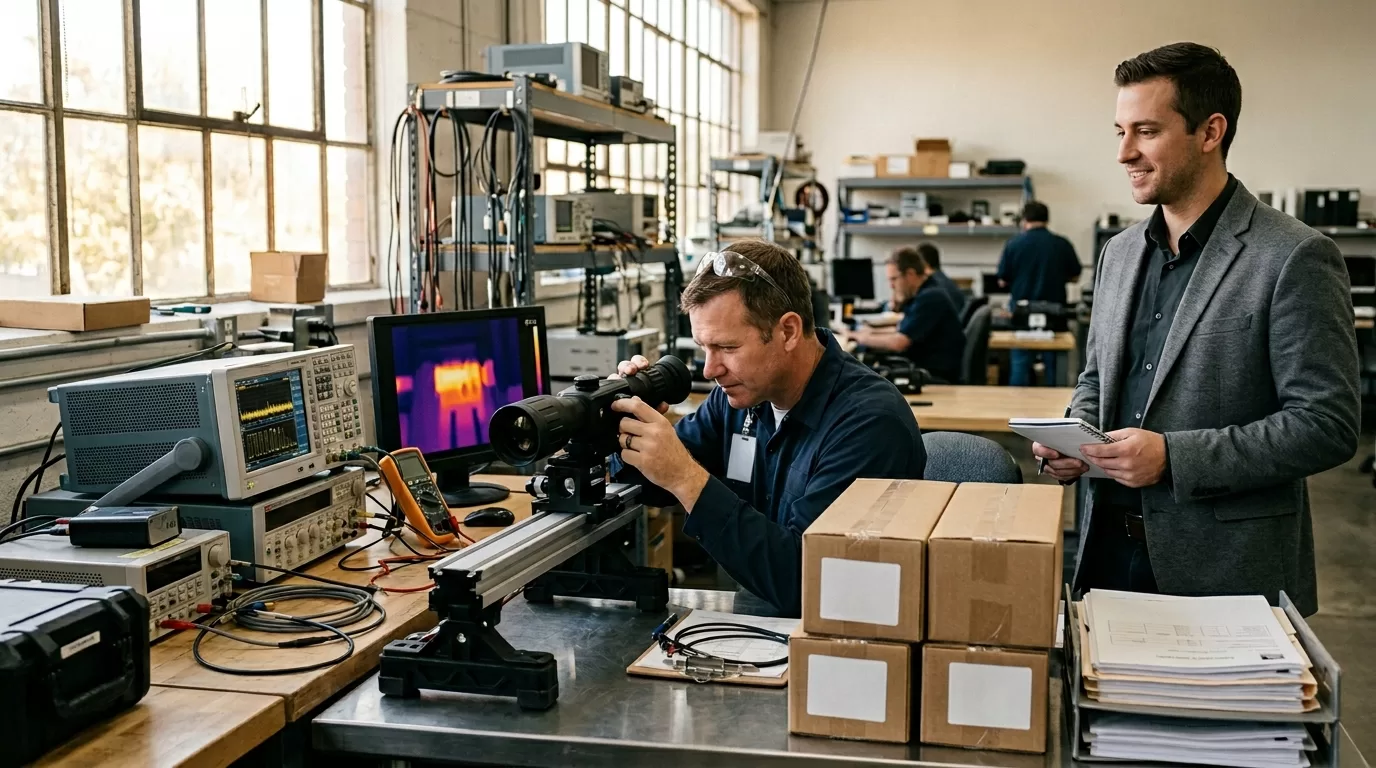
Le Federal Communications Commission equipment marketing rules state that radio-frequency devices must meet authorization, labeling, and technical requirements before they’re marketed in the United States, with the route depending on device type. For thermal optics, that usually means asking whether the product is an intentional radiator or an unintentional radiator.
A thermal monocular with Wi-Fi or Bluetooth app pairing usually needs FCC Certification and an FCC ID. A no-radio digital device may use Supplier’s Declaration of Conformity, often called SDoC. The difference matters because SDoC puts real responsibility on the US responsible party. “The lab passed FCC” is not enough by itself.
Ask the supplier for:
La liste des variantes est l'endroit où s'affichent les raccourcis. Si un monoculaire thermique Ranger est équipé de la même carte processeur mais d'un objectif différent, le dossier FCC peut tout de même être valable. Si une nouvelle référence intègre le Wi-Fi, modifie le module radio ou est livrée avec un accessoire alimenté différent, vous devez fournir de nouvelles preuves ou une justification technique claire.
For US dealers, FCC proof also builds buyer trust. A customer may never read the manual, but a retail platform can. So can a distributor’s compliance desk. If the FCC ID on the label doesn’t match the listing file, the conversation gets slow and awkward.
CE marking is easy to print and hard to defend without the file behind it. For the European Economic Area, CE is the manufacturer’s declaration that the product meets the applicable EU requirements. It is not an EU agency approval stamp.

Le European Commission CE marking guidance explains that manufacturers must carry out conformity assessment, prepare technical documentation, issue an EU Declaration of Conformity, and affix the CE mark where CE legislation applies. For buyers, the practical move is simple: ask for the declaration and the evidence behind it.
Thermal optics can touch several EU rule sets. EMC is common for electronic emissions and immunity. RED applies when the optic includes wireless communication. RoHS applies to electrical and electronic equipment. Laser rangefinder models can require extra attention to laser-related standards. Battery, packaging, and local language duties may sit outside the CE file, depending on the channel.
| CE file item | What to check |
|---|---|
| EU Declaration of Conformity | Legal manufacturer name, address, model codes, directives, standards, signature, date |
| Test reports | EMC, RED if wireless, RoHS where listed, and any product-specific standards |
| Technical file index | Photos, circuit diagrams, risk assessment, labels, manual pages |
| Importer or EU contact | Needed when the channel requires an EU economic operator |
| Manual and label set | CE mark placement, warnings, language versions, model consistency |
This advice doesn’t apply the same way to a US-only resale plan. CE is useful as a quality screen, but it doesn’t replace FCC authorization for US marketing. Don’t pay extra for “CE certified” if the supplier can only send a logo screenshot. The document is the value.
A strong CE file should name the exact product family. “Thermal imaging device” is too broad for a distributor buying Arc LRF units with app connection and laser rangefinding. You want model codes, applicable standards, and a signed declaration from the real legal manufacturer.
RoHS is the quiet file that often gets checked late. Too late, usually. A distributor approves pricing, sales sends samples, the product page is ready, then someone asks whether the PCB solder, cable jacket, charger, and plastic components meet restricted-substance limits.

As of June 2026, the European Commission describes RoHS as EU rules restricting hazardous substances in electrical and electronic equipment. The restricted list includes lead, cadmium, mercury, hexavalent chromium, PBB, PBDE, DEHP, BBP, DBP, and DIBP. Those names are not decoration. They map to real materials in electronics.
For thermal optics, RoHS evidence should cover the device and the shipped bundle. A handheld thermal monocular may include a battery, USB-C cable, charger, wrist strap with metal parts, and packaging inserts. A front attachment or thermal scope may ship with mounts, caps, tools, and powered accessories. The buyer’s risk follows the box, not just the optic body.
Good RoHS evidence usually includes:
Don’t demand fresh chemical testing for every screw in every reorder. That burns time and money without improving the file much. For a stable bill of materials, annual declarations plus component-level evidence may be enough. For a new charger supplier, new cable jacket, new PCB finish, or new molded housing, ask again.
RoHS also matters outside Europe. US retailers, distributors, and government-adjacent buyers often use RoHS as a screen for electronics risk. It’s not the same as FCC. It’s not a performance badge. It answers a narrower question: does this electrical product avoid restricted hazardous substances at the levels the rule demands?
Ask for the file before the deposit. Once a factory has your money and production is moving, every missing document becomes a schedule problem, not a paperwork problem.

For the import side, especially HS codes, duties, customs broker files, and product descriptions, pair this certification review with our guide to importing thermal cameras from China so the PO, invoice, packing list, and compliance folder tell the same story. A broker reading “thermal camera” and a certificate reading “digital night vision device” will ask questions.
Use this pre-PO checklist:
The boring part saves the order. If the quote says Pixfra Mile 2 Series, the invoice says PFI-M625, the label says PFI-M619, and the FCC file says “Model A,” someone in the chain has to explain the mismatch. That person may be you.
A practical buyer also asks for sample photos. Get a photo of the rating label on the actual production sample, not a clean PDF label template. Get a photo of the manual compliance page. Get the carton mark. Small mismatches are easier to fix before 500 units are sealed.
Certifications reduce channel risk, but they don’t answer every legal question. FCC, CE, and RoHS don’t decide whether a thermal scope can be used for hunting in a specific US state. They don’t replace export-control review. They don’t prove a laser rangefinder is safe for every use case.
Channel risk changes by sales route. A field-service company buying five thermal monoculars for internal use has a different risk profile than a distributor listing 1,000 units across Amazon US, Amazon Germany, and a dealer portal. Same product. Different file pressure.
| Channel | Extra pressure point |
|---|---|
| Amazon or Walmart Marketplace | FCC ID, label photo, manual statement, invoice match |
| EU distributor | CE Declaration, RoHS evidence, local language manual, importer details |
| Government or utility buyer | Supplier traceability, warranty terms, data/security questions |
| Hunting or shooting dealer | Product classification, state rules, mounting use, return policy |
| OEM or private label buyer | Brand owner responsibility, label control, retesting after changes |
SDoC is cheaper and faster than FCC Certification for eligible no-radio devices, but it puts more burden on the responsible party. FCC Certification costs more, yet an FCC ID gives marketplace reviewers and distributors a cleaner lookup path. For a US reseller, that clarity is often worth the extra lab time.
CE has a similar tradeoff. A supplier may offer one global package with CE, RoHS, FCC, multilingual manuals, and stricter label control. The unit price may be higher. The cheaper package may work for a narrow domestic order, but it can trap you later when a dealer asks for EU files or a marketplace listing expands.
A clean buying file keeps thermal optics certifications buyers should demand from turning into a launch delay. Ask early, match every model, and write change control into the PO.
FCC authorization is usually needed before a radio-frequency device is marketed or imported for sale in the United States. Thermal optics with Wi-Fi or Bluetooth often need FCC Certification; no-radio digital models may use Supplier’s Declaration of Conformity.
Le marquage CE peut inclure la conformité à la directive RoHS lorsque celle-ci fait partie des exigences européennes applicables, mais il convient de demander séparément les justificatifs de conformité à la directive RoHS. La présence du logo CE sur le boîtier ne prouve pas que les matériaux utilisés pour le circuit imprimé, le câble, la batterie, les accessoires et le chargeur ont été contrôlés.
Yes, if the variants are listed or the report explains why they are electrically identical. A different radio module, charging board, display driver, or wireless firmware version can force a new authorization or extra test evidence.
No. Amazon, Walmart, and EU marketplace teams may ask for the certificate, test report, label photo, manual statement, responsible party details, and invoice match. Keep the files ready before the listing goes live.
Demand CE if you sell into the EEA, support EU dealers, or use one global product file. For US-only resale, FCC evidence matters more, while RoHS still helps retail buyers screen electronics risk.
For distributor, OEM, or agency purchasing, ask Pixfra for model-level FCC, CE, and RoHS evidence before the PO locks. Send the target market, exact SKU, quantity, channel, and bundle contents; the Pixfra team can help match the right thermal optic to the file package your buyer will ask for later.