Your AR-15 deserves a thermal scope that actually works in the field. This guide covers thermal optics for AR platforms—budget picks, mid-range workhorses, and premium units. The market in 2026 is packed. Here are the six best thermal scopes for AR-15 that we’d put our own money on.
The AR-15’s lightweight aluminum construction and modular design make it adaptable for a wide range of purposes, from hunting to tactical applications.Its standard Picatinny rail gives you a plug-and-play platform for just about any optic, and thermal scopes are no exception. Whether you’re running predator control at night, wiping out feral hogs on your property, or scanning for coyotes across open fields, a thermal scope turns your AR into a true 24/7 hunting machine. And with the right thermal scope accessories like quick-detach mounts and extended battery solutions, you can squeeze even more performance out of your setup.
Thermal riflescopes detect thermal infrared radiation rather than relying on visible light. They work in total darkness and may retain an advantage in light fog, light rain or smoke, although these conditions can reduce image contrast and range. Pair that with the AR-15’s semi-automatic action and fast follow-up shots, and you’ve got a night hunting rig that’s hard to beat. Thermal scopes are a must if you’re hunting nocturnal game like coyotes, hogs, and other varmints and predators during nighttime and low-light conditions.
Thermal scope performance varies with temperature, weather and terrain, so specifications need to be considered in context. Data from Pixfra’s thermal device lineup provides context for sensor sensitivity and detection range across product tiers.
Not every thermal scope fits an AR-15 well. A few specs separate a good match from a bad one, and we want to save you from learning that the hard way.
Sensor resolution is the first thing to check. Resolution is a measure of how much detail your image will have, so the higher the resolution of your sensor, the more finely rendered your image will be. A 384×288 sensor can provide useful image detail, while a 640×480 or 640×512 sensor generally provides more detail under comparable optical and viewing conditions. Reliable target identification also depends on the lens, target size, weather and contrast, not resolution alone. NETD rating tells you how sensitive the thermal sensor is to small temperature differences—lower numbers generally indicate better sensitivity under comparable test conditions. Scopes under 20mK can help reveal subtle temperature differences, especially when target and background temperatures are similar, but NETD alone does not guarantee detection.
Refresh rate affects how smooth your image looks when you’re tracking a moving target. A 60Hz refresh rate can make motion appear smoother, but does not by itself guarantee a clear image of a moving target. Anything below 30Hz can look choppy, especially on running hogs. Magnification range should match your typical engagement distances. For AR-15 use, a 1x–8x or 2x–16x range covers most hunting scenarios without piling on extra weight. High magnification looks appealing on paper, but thermal image quality drops quickly if you over-zoom. Many hunters spend most of their time between 2x and 6x, even on scopes capable of much more.
Finally, make sure the scope is rated for semi-auto recoil and mounts cleanly to a Picatinny rail. Quality night vision and thermal scopes should hold zero on a semi-auto rifle. Problems can arise from unsuitable mounts, loose fasteners, or scopes used outside their recoil rating. QD mounts are a bonus if you swap between day glass and thermal on the same rifle.
Here’s a quick comparison of the top thermal rifle scope tiers we recommend for AR-15 platforms this year. We’ve organized them by performance level so you can match your budget to your hunting style:
| Spec | Entry-Level | Mid-Range | Premium |
|---|---|---|---|
| Sensor Resolution | 256×192 | 384×288 | 640×480 / 640×512 |
| NETD | ≤25mK | ≤20mK | ≤18mK |
| Refresh Rate | 25–50Hz | 50–60Hz | 60Hz |
| Distanță de detecție | ~800m | ~1,500m | ~2,500m+ |
| Autonomie | 4–6 hrs | 6–10 hrs | 8–15 hrs |
| Laser Rangefinder | Rare | Sometimes | Often Included |
| Ballistic Calculator | No | Sometimes | Da |
| Typical Price | $1,000–$2,000 | $2,000–$4,000 | $4,000–$8,000+ |
These are illustrative ranges, not fixed industry standards. Actual specifications, features, battery life and prices vary by model, test conditions and market.
Key stat: USDA APHIS has estimated annual U.S. feral swine damage and control costs at $2.5 billion. This provides context for the importance of feral swine management.
The sweet spot for most AR-15 owners in 2026 sits in that mid-range tier. A 384×288 sensor with a 50Hz or 60Hz refresh rate, 6+ hours of battery life, and a built-in ballistic calculator can provide a useful feature set, but image quality and reliable target identification depend on the specific model and conditions. Thermal optics are usually mounted on AR-15, a bolt-action rifle, or rifles chambered in .300 Winchester Magnum, .308 Winchester, 6.5 Creedmoor, or the .243 Winchester for coyote. Recoil suitability must be confirmed for the specific scope and firearm.
Premium 640-class sensors, integrated laser rangefinders and onboard video recording are available, with features varying by model. Low NETD values and long detection ranges do not by themselves establish a reliable target identification distance; detection, recognition and identification are different measures.
Mounting requirements, mount height and eye relief depend on the specific scope and rifle. Follow the manufacturers’ instructions rather than treating a single mount-height range as suitable for every setup.
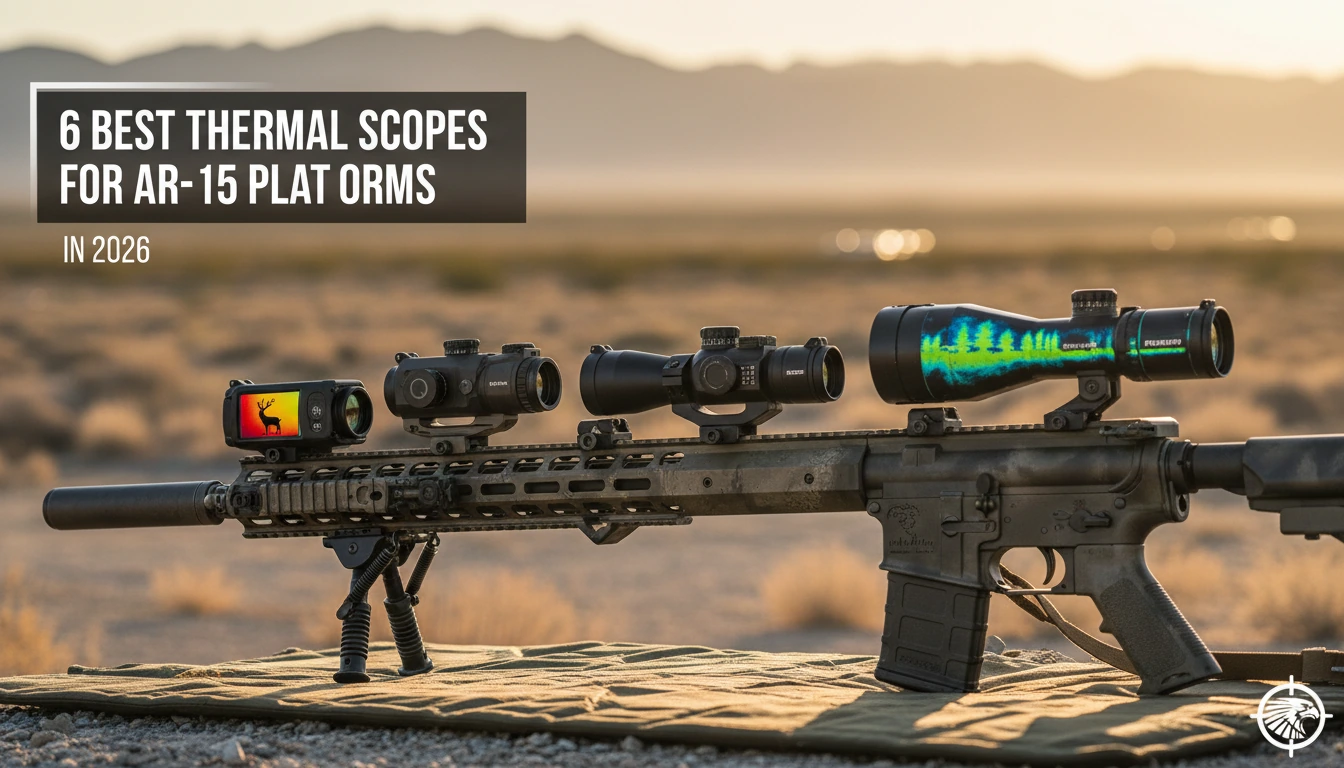
Use a quality mount—preferably a QD mount if you plan to swap between day and thermal optics. Torque your rings to spec and double-check that everything is level before zeroing. Most modern thermal scopes feature one-shot zero or digital zeroing, which speeds up the process. Fire a shot, move the digital reticle to your point of impact, confirm with a follow-up, and you’re done.
Battery life can end your hunt early if you don’t plan ahead. Thermal scope battery life varies by model and operating conditions; 4–8 hours is an illustrative range, not a universal average. For all-night hog eradication or multi-stand predator sessions, carry spare batteries of the type specified by the manufacturer; some models use 18650 cells, while others require proprietary packs. A compatible external power bank can extend runtime on models that support USB-C power; duration depends on the scope’s power consumption, temperature and the bank’s usable capacity.
Cold weather kills battery performance faster than you’d expect. Keep your spares in an inside jacket pocket where body heat keeps them warm. Using the manufacturer’s standby or power-off options between sessions can conserve power; the benefit varies with usage.
Yes. Thermal scopes detect thermal infrared radiation rather than relying on visible light, so they can operate in daylight, shade and complete darkness. This does not require the visible-light exposure controls used by digital day/night scopes.
A compatible thermal scope can retain zero when used within its recoil rating. Zero retention also depends on the mounting system and correct installation; check the scope manufacturer’s specifications.
In the $1,000–$2,000 range, scopes with 256×192 sensors deliver solid performance for close-range hog and varmint hunting. Capabilities vary by lens and model; sensor resolution and price alone do not establish a reliable identification distance.
For most hunting—especially hog and predator control—thermal wins. Thermal and night vision solve different problems. Thermal excels at detection and tracking, while night vision can be better for navigation and detail in some environments. Thermal works in complete darkness and can reveal partially exposed heat sources through gaps in brush, but it cannot see through solid vegetation. Fog can reduce both image contrast and range.
Hunting rules vary by state, species, season and time of day. Legal ownership does not mean every hunting use is permitted. California generally prohibits heat-sensing devices while taking or attempting to take big game, subject to applicable exceptions. Always check current state and local regulations before heading out.