





How to use our product

Нашата програма за местни партньори (LPP) е създадена, за да осигури стабилна подкрепа на ценните ни партньори на местните пазари.

Company News & Blogs

Stay informed with Pixfra’s latest updates, product stories, and insights into the world of thermal imaging.

编组 26备份

Thermal Monocular ROI for Farmers: A Case Study

If you run a farm or ranch in the U.S., you already know that losses don’t just happen during the day. Predators, sick livestock, broken fences, and trespassers do their worst after dark. A thermal monocular puts eyes on your entire operation at night — and the return on that one purchase can be staggering. We built this case study at Pixfra to show you the actual numbers. What Farmers Lose Without Thermal Imaging Let’s start with what’s eating into your bottom line right now. Feral hogs alone are a persistent and costly threat to U.S. crop and livestock production, inflicting over $1.6 billion in damages annually. That’s not some abstract government number — it’s real money disappearing from farms across the South and West every single year. In Texas alone, the cost of feral hog-related agricultural damage exceeded $871 million in a single year. And hogs are just part of the picture. Collectively, predator attacks — led by coyotes — cost ranchers about $232 million per year in lost animals, with coyotes responsible for well over half of all livestock losses to predators nationwide. If you’re running cattle, sheep, or goats, something out there is costing you money every night you can’t see what’s happening on your land. The damage goes beyond dead animals. Feral hogs caused an estimated $375 million in property damage in 2020 alone across 13 states, including damage to fencing, waterers, feed and hay storage, pasture roads, erosion infrastructure, and working facilities. In 2021, producers spent $474 million and over 17 million labor hours on hog control. That’s time you’re not spending on production, breeding, or anything else that actually grows your revenue. And here’s the kicker: it’s estimated that a single feral hog can cause $500 worth of damage to fields and pastures. Multiply

Top 7 Thermal Scopes for Long-Range Shooting in 2026

Shooting past 300 yards in total darkness is a different game. You need a thermal scope that can detect, identify, and help you hit targets at distance — not just show you a glowing blob. At Pixfra, we build thermal imaging devices used by hunters across 30+ countries, and we know what separates a real long-range thermal scope from a spec-sheet wonder. What Makes a Thermal Scope Good for Long-Range Shooting Not every thermal scope can handle long-range work. A scope that performs well at 100 yards might turn into a blurry mess at 400. If you plan to reach out past 300 yards at night — whether you’re hunting coyotes across open fields, running hog eradication on ranch land, or just want confidence at distance — you need to pay attention to a few specific things before you spend a dime. The first thing to look at is sensor resolution. This is the number of pixels your thermal sensor uses to build the image you see through the eyepiece. If your shots stay within 100–150 meters, a 384×288 sensor will often suffice. If you’re shooting 250+ meters, go for a higher-resolution sensor (640×480 or 1024×768) and better thermal sensitivity (<20 mK NETD). A higher pixel count means the animal you’re looking at is rendered by more pixels on the screen, which lets you see ears, legs, body posture, and movement — all details you need for positive target ID before pulling the trigger. If you look at a coyote at 400 yards through a 256-resolution sensor, the animal might only be rendered by 4 or 5 pixels — it will look like a blurry Lego brick. With a 640×512 sensor, that same coyote is rendered by dozens of pixels. That’s a night-and-day difference when it comes to making an

How to Negotiate MOQ with a Thermal Optics Manufacturer

How to Negotiate MOQ with a Thermal Optics Manufacturer

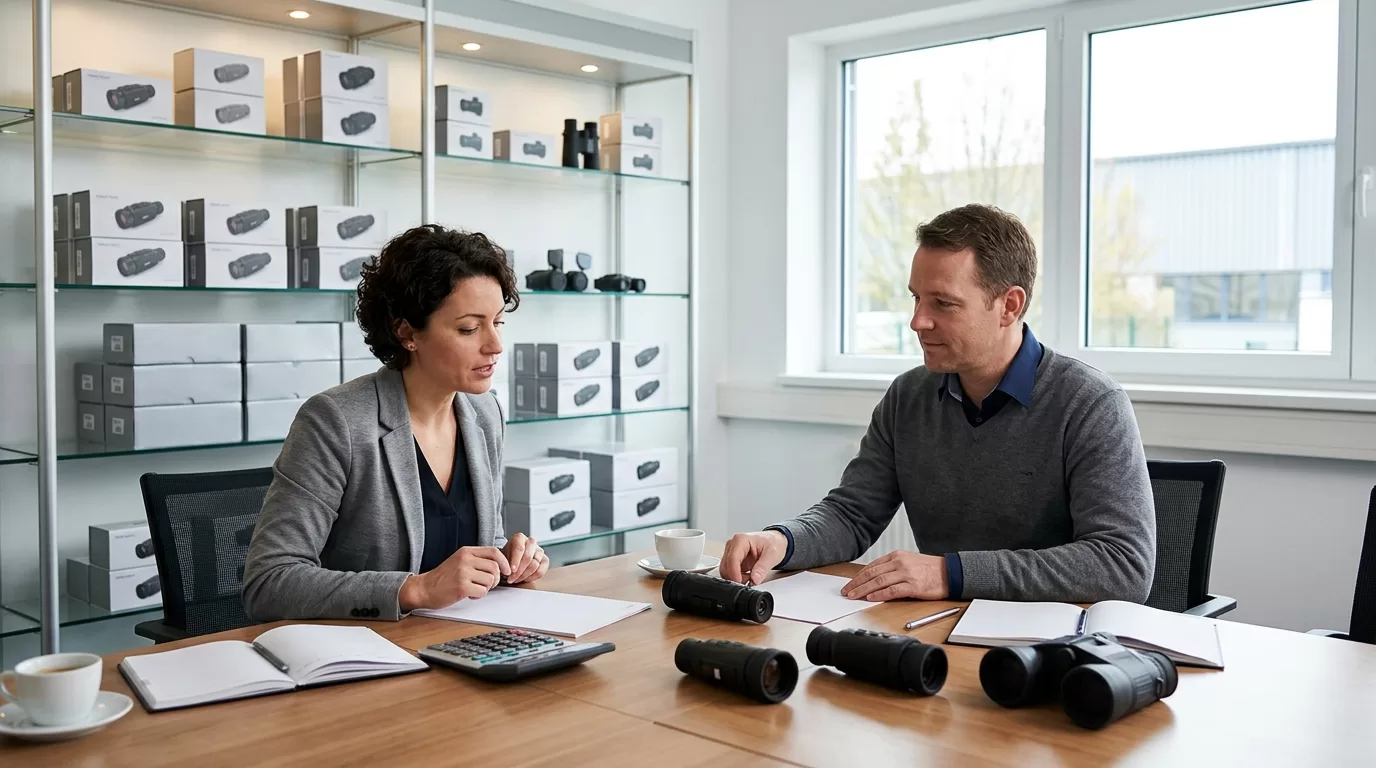
If you need to negotiate MOQ with a thermal optics manufacturer, start by reducing the manufacturer’s production risk, then trade something concrete: deposit, forecast, standard packaging, or a dated reorder. MOQ changes when you ask for a 640×512 detector, a 35 mm lens, app changes, reticle presets, private-label packaging, or compliance paperwork for a U.S. sales channel. The first job is to find which part of your request is setting the floor. A new buyer often asks the wrong question: “Can you do 20 units?” A stronger question is: “Which requirement makes the MOQ 300, and what changes would make a 50-unit pilot workable?” MOQ Negotiation Steps 1. Ask which cost sets the MOQ: sensor, lens, tooling, packaging, or compliance. 2. Keep first order on standard hardware, firmware, and carton. 3. Pay for samples, engineering, and inspection instead of asking the factory to absorb them. 4. Split commitment into pilot order plus dated reorder. 5. Trade lower MOQ for deposit, shared packaging, simple SKU mix, and clear forecast. negotiate moq with a thermal optics manu — moq negotiation steps Thermal optics MOQs are built from setup costs. Detector purchasing, lens assembly, waterproof housing checks, firmware loading, image calibration, and packaging print runs all create small minimums inside the bigger MOQ. A 384×288 thermal monocular in a standard housing might hit one factory threshold; the same unit with a branded startup screen, U.S. carton, custom manual, and changed Wi-Fi app can hit four. The best way to negotiate MOQ with a thermal optics manufacturer is to turn “small order” into a low-risk production plan. Say what you’ll keep standard. Say what you’ll pay for. Give the supplier a real reorder window, such as “80 units now, 220 units within 90 days if field testing passes.” Factory answer Better buyer question Possible

Thermal Optics Certifications Buyers Should Demand: CE, FCC, RoHS

Thermal Optics Certifications Buyers Should Demand: CE, FCC, RoHS

Thermal optics certifications buyers should demand are FCC for US radio-frequency compliance, CE for EEA market access, and RoHS for hazardous-substance control in electronic parts. Ask for model-specific certificates, declarations, test reports, label artwork, and manual text before you place an order, because a logo on a catalog page won’t protect a dealer when customs, Amazon, a distributor, or a retailer asks for evidence. Certifications Buyers Should Demand The thermal optics certifications buyers should demand are FCC authorization evidence for United States sales, a CE Declaration of Conformity for EEA sales, and RoHS substance-control evidence for electronic parts. Match every document to the exact SKU, firmware/radio configuration, label, and manual before deposit. thermal optics certifications buyers sho — certifications buyers should demand Start with the sales market, then work backward. A US dealer selling a Pixfra Mile 2 PFI-M625 to hunters needs FCC evidence. A German distributor will ask for CE and RoHS files. A marketplace seller may ask for both sets because one listing can end up serving buyers in several countries. This is where low-price thermal optics get expensive. A $60 discount per unit looks good until 200 units sit in a warehouse because the FCC ID doesn’t match the product label, or the CE Declaration lists a generic “thermal camera” with no model codes. Buyers notice. Dealers notice faster. Evidence Demand it when Ask for Red flag FCC authorization Selling or marketing in the United States FCC ID or Supplier’s Declaration of Conformity, Part 15 report, manual statement “FCC pending” or a report for another camera CE Declaration Selling in the European Economic Area EU Declaration of Conformity, applicable directives, standards, model list CE logo only, no signed declaration RoHS evidence Selling electronics into EU-linked channels RoHS declaration, material evidence, accessory coverage Report covers only one cable

6 Best Thermal Devices to Clip On Your Day Scope

You’ve spent years dialing in your day scope. The last thing you want is to swap it out every time the sun goes down. A thermal clip-on fixes that — it mounts right in front of your existing optic and turns your rifle into a night-hunting machine without touching your zero. Here are the 6 best thermal devices to clip on your day scope this year. What Is a Clip-On Thermal and How Does It Work A thermal clip-on — also called a thermal front attachment — is a compact device that mounts directly in front of your daytime riflescope. A clip-on thermal mounts directly in front of your existing daytime scope. It turns your day optic into a thermal rifle scope by projecting a thermal image through your regular reticle, with no need to re-zero. Unlike a dedicated thermal scope that replaces your existing optic entirely, a clip-on works with it. You don’t remove your daytime glass. The clip-on attaches to the objective end, typically with an adapter ring that clamps onto the scope’s objective bell or via a Picatinny rail mount positioned ahead of the day scope. No scope swaps. You go from daytime hunting to thermal detection in seconds. At Pixfra, we build thermal front attachments like our Taurus LRF series for exactly this — giving hunters a fast, reliable way to add thermal to the rifle they already trust. The tech behind it is what makes it tick. A clip-on thermal uses a microbolometer sensor to detect infrared heat radiation from animals, people, and objects. That data gets processed and displayed on a tiny internal OLED screen, which your day scope then magnifies. The result? You see thermal imagery through the same glass you’ve been shooting with all day. A clip-on thermal is a specialized thermal

Importing Thermal Cameras from China: Customs, Compliance & HS Codes

Importing Thermal Cameras from China: Customs, Compliance & HS Codes

Importing thermal cameras from China usually means classifying the finished camera under HTSUS 8525.89.50, preparing standard U.S. Customs and Border Protection entry paperwork, and checking dual-use specs before the supplier ships. The hard part is rarely the port form itself; it’s a 30 Hz or 640 × 512 model with vague end-use paperwork, a thermal scope treated like a basic camera, or a “free duty” code that still carries China tariff layers. If you’re buying for a U.S. dealer catalog, security integrator, hunting retailer, inspection team, or government-adjacent customer, do the compliance work before the purchase order. A box sitting at Long Beach is an expensive place to discover that your invoice says “camera accessory” while the spec sheet says “thermal weapon sight with ballistic reticle.” Thermal Camera HS Codes Most finished thermal imaging cameras imported into the United States are commonly reviewed under HTSUS 8525.89.50, but the correct HS code depends on the product’s actual function. A handheld inspection camera, outdoor thermal monocular, weapon-mounted sight, drone payload, and uncooled camera core can land in different classification conversations. importing thermal cameras from china — thermal camera hs codes U.S. Customs and Border Protection moved the practical starting point for many finished thermal video cameras toward heading 8525 after the HS 2022 changes. In CBP Headquarters Ruling H331315, dated December 5, 2025, CBP classified the AXIS P1290-E Thermal Network Camera and AXIS Q1951-E Thermal Camera under HTSUS 8525.89.50 and stated that older thermal-camera rulings under heading 9013 were revoked by operation of law. That ruling matters because importers still repeat old advice from forums, broker templates, and legacy supplier invoices. “Thermal camera equals Chapter 90” used to be a common shortcut. In 2026, it’s a bad shortcut for many finished video cameras. Product type Common classification starting point What to verify

How to use our product

Нашата програма за местни партньори (LPP) е създадена, за да осигури стабилна подкрепа на ценните ни партньори на местните пазари.

Company News & Blogs

Stay informed with Pixfra’s latest updates, product stories, and insights into the world of thermal imaging.

编组 26备份

Thermal Monocular ROI for Farmers: A Case Study

If you run a farm or ranch in the U.S., you already know that losses don’t just happen during the day. Predators, sick livestock, broken fences, and trespassers do their worst after dark. A thermal monocular puts eyes on your entire operation at night — and the return on that one purchase can be staggering. We built this case study at Pixfra to show you the actual numbers. What Farmers Lose Without Thermal Imaging Let’s start with what’s eating into your bottom line right now. Feral hogs alone are a persistent and costly threat to U.S. crop and livestock production, inflicting over $1.6 billion in damages annually. That’s not some abstract government number — it’s real money disappearing from farms across the South and West every single year. In Texas alone, the cost of feral hog-related agricultural damage exceeded $871 million in a single year. And hogs are just part of the picture. Collectively, predator attacks — led by coyotes — cost ranchers about $232 million per year in lost animals, with coyotes responsible for well over half of all livestock losses to predators nationwide. If you’re running cattle, sheep, or goats, something out there is costing you money every night you can’t see what’s happening on your land. The damage goes beyond dead animals. Feral hogs caused an estimated $375 million in property damage in 2020 alone across 13 states, including damage to fencing, waterers, feed and hay storage, pasture roads, erosion infrastructure, and working facilities. In 2021, producers spent $474 million and over 17 million labor hours on hog control. That’s time you’re not spending on production, breeding, or anything else that actually grows your revenue. And here’s the kicker: it’s estimated that a single feral hog can cause $500 worth of damage to fields and pastures. Multiply

Top 7 Thermal Scopes for Long-Range Shooting in 2026

Shooting past 300 yards in total darkness is a different game. You need a thermal scope that can detect, identify, and help you hit targets at distance — not just show you a glowing blob. At Pixfra, we build thermal imaging devices used by hunters across 30+ countries, and we know what separates a real long-range thermal scope from a spec-sheet wonder. What Makes a Thermal Scope Good for Long-Range Shooting Not every thermal scope can handle long-range work. A scope that performs well at 100 yards might turn into a blurry mess at 400. If you plan to reach out past 300 yards at night — whether you’re hunting coyotes across open fields, running hog eradication on ranch land, or just want confidence at distance — you need to pay attention to a few specific things before you spend a dime. The first thing to look at is sensor resolution. This is the number of pixels your thermal sensor uses to build the image you see through the eyepiece. If your shots stay within 100–150 meters, a 384×288 sensor will often suffice. If you’re shooting 250+ meters, go for a higher-resolution sensor (640×480 or 1024×768) and better thermal sensitivity (<20 mK NETD). A higher pixel count means the animal you’re looking at is rendered by more pixels on the screen, which lets you see ears, legs, body posture, and movement — all details you need for positive target ID before pulling the trigger. If you look at a coyote at 400 yards through a 256-resolution sensor, the animal might only be rendered by 4 or 5 pixels — it will look like a blurry Lego brick. With a 640×512 sensor, that same coyote is rendered by dozens of pixels. That’s a night-and-day difference when it comes to making an

How to Negotiate MOQ with a Thermal Optics Manufacturer

How to Negotiate MOQ with a Thermal Optics Manufacturer

If you need to negotiate MOQ with a thermal optics manufacturer, start by reducing the manufacturer’s production risk, then trade something concrete: deposit, forecast, standard packaging, or a dated reorder. MOQ changes when you ask for a 640×512 detector, a 35 mm lens, app changes, reticle presets, private-label packaging, or compliance paperwork for a U.S. sales channel. The first job is to find which part of your request is setting the floor. A new buyer often asks the wrong question: “Can you do 20 units?” A stronger question is: “Which requirement makes the MOQ 300, and what changes would make a 50-unit pilot workable?” MOQ Negotiation Steps 1. Ask which cost sets the MOQ: sensor, lens, tooling, packaging, or compliance. 2. Keep first order on standard hardware, firmware, and carton. 3. Pay for samples, engineering, and inspection instead of asking the factory to absorb them. 4. Split commitment into pilot order plus dated reorder. 5. Trade lower MOQ for deposit, shared packaging, simple SKU mix, and clear forecast. negotiate moq with a thermal optics manu — moq negotiation steps Thermal optics MOQs are built from setup costs. Detector purchasing, lens assembly, waterproof housing checks, firmware loading, image calibration, and packaging print runs all create small minimums inside the bigger MOQ. A 384×288 thermal monocular in a standard housing might hit one factory threshold; the same unit with a branded startup screen, U.S. carton, custom manual, and changed Wi-Fi app can hit four. The best way to negotiate MOQ with a thermal optics manufacturer is to turn “small order” into a low-risk production plan. Say what you’ll keep standard. Say what you’ll pay for. Give the supplier a real reorder window, such as “80 units now, 220 units within 90 days if field testing passes.” Factory answer Better buyer question Possible

Thermal Optics Certifications Buyers Should Demand: CE, FCC, RoHS

Thermal Optics Certifications Buyers Should Demand: CE, FCC, RoHS

Thermal optics certifications buyers should demand are FCC for US radio-frequency compliance, CE for EEA market access, and RoHS for hazardous-substance control in electronic parts. Ask for model-specific certificates, declarations, test reports, label artwork, and manual text before you place an order, because a logo on a catalog page won’t protect a dealer when customs, Amazon, a distributor, or a retailer asks for evidence. Certifications Buyers Should Demand The thermal optics certifications buyers should demand are FCC authorization evidence for United States sales, a CE Declaration of Conformity for EEA sales, and RoHS substance-control evidence for electronic parts. Match every document to the exact SKU, firmware/radio configuration, label, and manual before deposit. thermal optics certifications buyers sho — certifications buyers should demand Start with the sales market, then work backward. A US dealer selling a Pixfra Mile 2 PFI-M625 to hunters needs FCC evidence. A German distributor will ask for CE and RoHS files. A marketplace seller may ask for both sets because one listing can end up serving buyers in several countries. This is where low-price thermal optics get expensive. A $60 discount per unit looks good until 200 units sit in a warehouse because the FCC ID doesn’t match the product label, or the CE Declaration lists a generic “thermal camera” with no model codes. Buyers notice. Dealers notice faster. Evidence Demand it when Ask for Red flag FCC authorization Selling or marketing in the United States FCC ID or Supplier’s Declaration of Conformity, Part 15 report, manual statement “FCC pending” or a report for another camera CE Declaration Selling in the European Economic Area EU Declaration of Conformity, applicable directives, standards, model list CE logo only, no signed declaration RoHS evidence Selling electronics into EU-linked channels RoHS declaration, material evidence, accessory coverage Report covers only one cable

6 Best Thermal Devices to Clip On Your Day Scope

You’ve spent years dialing in your day scope. The last thing you want is to swap it out every time the sun goes down. A thermal clip-on fixes that — it mounts right in front of your existing optic and turns your rifle into a night-hunting machine without touching your zero. Here are the 6 best thermal devices to clip on your day scope this year. What Is a Clip-On Thermal and How Does It Work A thermal clip-on — also called a thermal front attachment — is a compact device that mounts directly in front of your daytime riflescope. A clip-on thermal mounts directly in front of your existing daytime scope. It turns your day optic into a thermal rifle scope by projecting a thermal image through your regular reticle, with no need to re-zero. Unlike a dedicated thermal scope that replaces your existing optic entirely, a clip-on works with it. You don’t remove your daytime glass. The clip-on attaches to the objective end, typically with an adapter ring that clamps onto the scope’s objective bell or via a Picatinny rail mount positioned ahead of the day scope. No scope swaps. You go from daytime hunting to thermal detection in seconds. At Pixfra, we build thermal front attachments like our Taurus LRF series for exactly this — giving hunters a fast, reliable way to add thermal to the rifle they already trust. The tech behind it is what makes it tick. A clip-on thermal uses a microbolometer sensor to detect infrared heat radiation from animals, people, and objects. That data gets processed and displayed on a tiny internal OLED screen, which your day scope then magnifies. The result? You see thermal imagery through the same glass you’ve been shooting with all day. A clip-on thermal is a specialized thermal

Importing Thermal Cameras from China: Customs, Compliance & HS Codes

Importing Thermal Cameras from China: Customs, Compliance & HS Codes

Importing thermal cameras from China usually means classifying the finished camera under HTSUS 8525.89.50, preparing standard U.S. Customs and Border Protection entry paperwork, and checking dual-use specs before the supplier ships. The hard part is rarely the port form itself; it’s a 30 Hz or 640 × 512 model with vague end-use paperwork, a thermal scope treated like a basic camera, or a “free duty” code that still carries China tariff layers. If you’re buying for a U.S. dealer catalog, security integrator, hunting retailer, inspection team, or government-adjacent customer, do the compliance work before the purchase order. A box sitting at Long Beach is an expensive place to discover that your invoice says “camera accessory” while the spec sheet says “thermal weapon sight with ballistic reticle.” Thermal Camera HS Codes Most finished thermal imaging cameras imported into the United States are commonly reviewed under HTSUS 8525.89.50, but the correct HS code depends on the product’s actual function. A handheld inspection camera, outdoor thermal monocular, weapon-mounted sight, drone payload, and uncooled camera core can land in different classification conversations. importing thermal cameras from china — thermal camera hs codes U.S. Customs and Border Protection moved the practical starting point for many finished thermal video cameras toward heading 8525 after the HS 2022 changes. In CBP Headquarters Ruling H331315, dated December 5, 2025, CBP classified the AXIS P1290-E Thermal Network Camera and AXIS Q1951-E Thermal Camera under HTSUS 8525.89.50 and stated that older thermal-camera rulings under heading 9013 were revoked by operation of law. That ruling matters because importers still repeat old advice from forums, broker templates, and legacy supplier invoices. “Thermal camera equals Chapter 90” used to be a common shortcut. In 2026, it’s a bad shortcut for many finished video cameras. Product type Common classification starting point What to verify

Приложения
Приключения на открито
Лов
Наблюдение на животни

Създаден за по-добра ориентация по всяко време на денонощието, уредът открива хора, животни и обекти в пълен мрак, лека мъгла или при заслепяваща светлина. Той осигурява надеждно термовизионно наблюдение в трудни условия за служители на реда и любители на природата.

Желаете повече информация?

Моля, активирайте JavaScript в браузъра си, за да попълните формуляра.
=
Условия за поверителност

Sirius & Sirius HD User Manual

Please choose your preferred language.

Draco User Manual

Please choose your preferred language.

Pegasus 2 LRF User Manual

Please choose your preferred language.

Pegasus User Manual

Please choose your preferred language.

Chiron LRF User Manual

Please choose your preferred language.

Chiron – ръководство за употреба

Please choose your preferred language.

Cetus User Manual

Please choose your preferred language.

Taurus & Taurus LRF User Manual

Please choose your preferred language.

Ranger Series User Manual

Please choose your preferred language.

Mile 2 Series User Manual

Please choose your preferred language.

Mile 3 Series User Manual

Please choose your preferred language.

Subscribe to the Latest News from Pixfra

Subscribe to the Pixfra newsletter and keep up with first-hand product news, outdoor insights and exclusive updates.

Моля, активирайте JavaScript в браузъра си, за да попълните формуляра.