Du har brukt flere år på å finjustere dagskikket ditt. Det siste du ønsker, er å måtte bytte det ut hver gang solen går ned. Et termisk påklippbar kikkertsikte løser det problemet – det monteres rett foran det eksisterende kikkertsiktet ditt og forvandler riflen din til et nattjaktvåpen uten at du trenger å justere nullpunktet. Her er de 6 beste termiske enhetene du kan feste på dagkikkertsiktet ditt i år.
Et termisk påsett – også kalt et termisk frontpåsett – er en kompakt enhet som monteres rett foran ditt vanlige riflesikte. Et termisk påsett monteres direkte foran ditt eksisterende dagslys-sikte. Det forvandler ditt dagslys-sikte til et termisk riflesikte ved å projisere et termisk bilde gjennom det vanlige siktemerkets, uten at du trenger å nullstille det på nytt. I motsetning til et dedikert termisk sikt som erstatter din eksisterende optikk fullstendig, fungerer et påsett med Det. Du trenger ikke å ta av dagslyssiktet. Påsatsen festes på objektivenden, vanligvis med en adapterring som klemmes fast på kikkarsiktets objektivkrage eller via et Picatinny-skinnemonteringsfeste plassert foran dagslyssiktet. Ingen bytte av kikkarsikt. Du går fra jakt i dagslys til termisk deteksjon på få sekunder. Ved Pixfra, vi utvikler termiske frontmonterte tilbehør som vår Taurus LRF-serie nettopp for dette formålet – for å gi jegere en rask og pålitelig måte å utstyre riflen de allerede stoler på med termisk funksjonalitet.

Det er teknologien bak som får det til å fungere. Et påklippbart termisk kikkertsikte bruker en mikrobolometersensor til å registrere infrarød varmestråling fra dyr, mennesker og gjenstander. Disse dataene blir behandlet og vist på en liten innebygd OLED-skjerm, som ditt vanlige kikkertsikte deretter forstørrer. Resultatet? Du ser termiske bilder gjennom det samme glasset du har skutt med hele dagen. Et påklippbart termisk kikkertsikte er et spesialisert termisk avbildningsapparat designet for å passe perfekt i forlengelsen av et tradisjonelt dagtidskikkertsikte. I motsetning til et dedikert termisk kikkertsikte – som har sitt eget siktemerk og må innstilles uavhengig av riflens løp – samler et påklippbart kikkertsikte ganske enkelt det termiske bildet og projiserer det bakover inn i objektivlinsen til dagtidskikkertsiktet ditt. Den viktigste fordelen her er hastighet og allsidighet – du beholder ditt førsteklasses dagsiktesikte og legger til termisk bilde når forholdene krever det. Hvis du vil lære mer om spesifikasjonene som skiller et godt termisk bildeapparat fra et gjennomsnittlig, har vi brutt ned De 6 viktigste funksjonene alle som skal kjøpe et termisk apparat trenger i 2026.
Med så mange alternativer som oversvømmer markedet, kan det føles som en kjedelig oppgave å velge riktig termisk klipsenhet. Vi har sett på hva jegere over hele USA faktisk bruker i felten – fra nattlig villsvinjakt i Texas til rovdyrjakt i Midtvesten – og har snevret det inn til seks kategorier av termiske clip-on-enheter som leverer der det teller. Prioriter disse faktorene når du vurderer et termisk påklippbart kikkertsikte: sensoroppløsning (jo høyere, jo bedre), NETD-følsomhet (jo lavere, jo bedre), oppdateringsfrekvens (50 Hz er standarden), kompatibilitet med kikkerter, IP-værklassifisering, batterilevetid og – spesielt i 2026 – smarte funksjoner som app-tilkobling, innebygd opptak og AI-forbedret bildebehandling. Her er vår oversikt.
1. Beste produkt totalt sett: Høyoppløselig klipsmodell med innebygd avstandsmåler. For jegere som ønsker hele pakken i én og samme enhet, er et påklippbart termisk kamera med oppløsning på 640×512 og innebygd laseravstandsmåler den gjeldende gullstandarden. Dette oppsettet gir deg det skarpeste termiske bildet i klassen for påklippbare kameraer, i tillegg til øyeblikkelige avstandsmålinger uten at du trenger å lete etter en separat enhet. Vår Pixfra Taurus T650 LRF passer inn i denne kategorien – den kombinerer en sensor med høy oppløsning med en NETD-følsomhet på ≤18 mK, 12 μm pikselavstand og en integrert laseravstandsmåler med 1 000 meters rekkevidde. Når du skanner åpne beitemarker klokka 02.00 om natten og et villsvin dukker opp 300 yards unna, sparer den innebygde LRF-en deg tid og gjør at du kan plassere skuddet ditt med langt større sikkerhet. Den ultrafine klikkverdien på 0,9 cm@100m gir deg en innstillingspresisjon som kan måle seg med dedikerte termiske kikkerter.

2. Best egnet for jakt på mellomstore rovdyr: 384×288 påsatt kikkert med LRF. Ikke alle trenger sensoren med den høyeste oppløsningen på markedet. Hvis du jakter på prærieulver, villsvin eller andre rovdyr på avstander under 500 yards – noe som dekker det aller meste av nattjakten i USA – gir en påklippbar sensor på 384×288 med laseravstandsmåler deg et klart og detaljert bilde uten prislappen til en enhet i 640-klassen. Vår Taurus T450 LRF er laget nettopp for denne typen oppgaver. Sensoren gir sterk kontrast på typiske jaktavstander, og den integrerte avstandsmåleren gjør det enkelt å estimere avstanden om natten. Kombinert med en NETD på ≤18 mK gir den klare bilder selv når temperaturforskjellen mellom dyret og bakgrunnen er liten – for eksempel på varme sommernætter når alt avgir varme på omtrent samme nivå.
3. Det mest prisgunstige termiske frontmonterte tilbehøret med avstandsmåler. Budsjettet spiller en rolle, og et godt termisk påsatt kamera trenger ikke å tømme bankkontoen din. Det optimale valget for de fleste jegere som ser etter sitt første termiske påsatte kamera, er en solid sensor med middels oppløsning kombinert med funksjonene som gjør den største forskjellen i praksis: en laseravstandsmåler, flere fargepaletter og et slitesterkt, værbestandig hus. Pixfra Taurus T425 LRF oppfyller alle disse kravene. Den gir deg integrert laseravstandsmåler til en pris som gjør termisk teknologi tilgjengelig uten å gå på akkord med det som virkelig teller i felten. Siden den fortsatt har en pikselavstand på 12 μm og en NETD på ≤18 mK, får du en bildekvalitet som ligger langt over det man kan forvente i denne prisklassen. For deg som kjøper et termisk påmonterbart kamera for første gang, er dette det innstegsproduktet vi anbefaler.
4. Den beste lette klipsmodellen for lengre jaktturer. Vekten er en viktig faktor når du fester et termisk kamera foran dagskikket. Festet legger til ekstra vekt foran på riflen, noe som endrer balansen litt. En tung enhet gjør riflen munnstykketung, forstyrrer balansen din og sliter deg ut under lange jaktsesjoner. De beste lette termiske klipsenhetene holder vekten nede samtidig som de leverer solid sensorytelse og batterilevetid. Hos Pixfra har vi designet Draco-serien med en lett konstruksjon for jegere som trenger multifunksjonell ytelse uten ekstra vekt. Når du sitter i timevis på utkikk etter rovdyr eller går milevis langs ranchgjerder om natten, teller hver ekstra ounce. Se etter påklippbare termiske siktemidler med hus i aluminiumslegering – de er robuste nok til å tåle rekyl og fall, samtidig som de holder den totale vekten lav og riflen i balanse.
5. Beste clip-on-modell med batterilevetid som varer hele natten. Batterilevetiden ødelegger flere jakter enn dårlig vær. En enhet med utrolig bildekvalitet og et batteri som varer i to timer, er i praksis bare en veldig dyr papirvekt ved midnatt. De beste termiskameraene med klips som holder hele natten, gir deg 8 timer eller mer med kontinuerlig driftstid og bruker utskiftbare batterier, slik at du kan sette inn et nytt batteri midt i jakten. Standard 18650-batterier er det beste valget – de er billige, lett tilgjengelige, og du kan ha med deg ekstra i jakkelommen. I hele Pixfra-serien varierer batterilevetiden fra omtrent 4,5 til 15 timer, avhengig av modell og bruksforhold. Mange av modellene våre bruker standard 18650-batterier som kan byttes ut på få sekunder. Det er et bevisst designvalg. Et profftips fra våre egne feltforsøk: Kaldt vær kan redusere batteriets ytelse med 30–50%. Ha alltid med ekstra batterier i en innerlomme der kroppsvarmen din holder dem varme.
6. Den beste klipsmodellen med smarte funksjoner og ballistikkalkulator. I 2026 har smarte funksjoner gått fra å være en luksus til å bli fullverdige verktøy i felten. De beste termiske påklippbare enhetene viser ikke bare varme – de tar opp video, kobler seg til telefonen din via Wi-Fi, strømmer liveopptak og oppdaterer fastvaren trådløst. Våre Taurus LRF-modeller går et skritt videre med innebygde ballistikkalkulatorer som beregner kulens fall og gir deg et justert siktemål på farten. Sammen med Pixfra Outdoor-appen – som støtter alle våre nåværende modeller, inkludert Taurus- og Taurus LRF-seriene – kan du justere innstillinger, overføre opptak og oppdatere enheten direkte fra smarttelefonen din. Å ta opp et vellykket skudd og dele det med jaktkameratene dine neste morgen, eller registrere dyrelivets aktivitet for eiendomsforvaltning, er den typen praktisk verdi som skiller en førsteklasses påklippbar enhet fra resten.
Her er en rask sammenligning av hva du bør fokusere på i ulike bruksområder for clip-on-enheter:
| Bruksscenario | Min. sensoroppløsning | NETD (mK) | Trenger du LRF? | Min. batterilevetid |
|---|---|---|---|---|
| Korte kveldsjakter (2–3 timer) | 256×192 | ≤25 | Valgfritt | 4–5 timer |
| Bekjempelse av villsvin og rovdyr gjennom hele natten | 384×288 | ≤20 | Ja | 8–10 timer |
| ID-registrering på lang avstand i åpent terreng | 640×512 | ≤18 | Ja | 6–8 timer |
| Bruk i lettvektig terreng | 384×288 | ≤20 | Valgfritt | 10–15 timer |
| Eiendomssikkerhet/overvåking | 384×288 | ≤20 | Valgfritt | 6–8 timer |
Når du skal kjøpe et termisk kamera som kan festes på ditt dagskikkert, er det tre spesifikasjoner du bør legge mest vekt på: NETD, sensoroppløsning og oppdateringsfrekvens. NETD – Noise Equivalent Temperature Difference – måler termisk følsomhet. Jo lavere tallet er, desto bedre fanger enheten opp små temperaturforskjeller mellom målet og bakgrunnen. I 2026 ligger de beste påklippbare termiske enhetene på ≤18 mK NETD eller lavere. I 2026 er ≤20 mK et rimelig referansepunkt for en god enhet; ≤18 mK representerer ytelsesgrensen i denne prisklassen. Våre Pixfra-enheter oppnår ≤18 mK på tvers av hele serien, noe som betyr at du ser tydelige konturer i stedet for uskarpe flekker – selv på fuktige sommernætter når alt avgir varme på omtrent samme nivå. Sensoroppløsningen angir hvor mange termiske piksler detektoren har. De to vanligste oppløsningene er 384×288 og 640×512. En 640×512-sensor har nesten tre ganger så mange piksler som en 384×288, og den ekstra pikseltettheten gjør en stor forskjell når du zoomer inn gjennom dagkikkerten eller prøver å identifisere et mål på over 200 yards avstand.
Oppdateringsfrekvensen er en av de spesifikasjonene som virker tekniske, men som har stor betydning i praksis. Varmebildesensorer opererer vanligvis ved enten 25 Hz eller 50 Hz. Ved 50 Hz oppdateres bildet jevnt med minimal forsinkelse – noe som er avgjørende for å spore en coyote i full fart eller et villsvin som beveger seg gjennom kratt. Alle toppvalgene i denne guiden opererer ved 50 Hz. Alt under 30 Hz gir et hakkende bilde som gjør det vanskelig å følge mål i rask bevegelse. Og ikke overse pikselavstanden – en mindre pikselavstand, som 12 μm-teknologien vi bruker i hele Pixfra-produktserien, gir mer detalj i hvert bilde og leverer skarpere bilder på alle avstander. En lavere pikselavstand kombinert med en sensor med høy oppløsning er det som gir deg det skarpe bildet med høy kontrast som gjør identifiseringen av målet rask og sikker.

I tillegg til sensoren gir værklassifiseringen til klipsen din en indikasjon på hvor mye den tåler i felten. IP67 er for tiden gullstandarden for termiske enheter. Det betyr at enheten er fullstendig forseglet mot støv og tåler midlertidig nedsenking i vann – noe som inkluderer regn, kryssing av bekker, snø, gjørme og utilsiktede fall i vannpytter. I motsetning til dedikerte termiske kikkerter som erstatter den vanlige optikken din fullstendig, beholder påsatsene kikkertens nullstilling og det kjente siktemerkets, noe som muliggjør raske overganger mellom bruk om dagen og om natten uten å måtte nullstille på nytt. Kvalitets termiske påmonterbare enheter koster vanligvis mellom $2 000 og $7 000, avhengig av oppløsning og funksjoner. Hos Pixfra utvikler vi våre termiske frontmonterte tilbehør for de samme forholdene som vi tester dem under. Taurus LRF-serien tåler kraftig rekyl, er korrosjonsbestandig og fungerer i regn og støv. Hvis du tar nattjakt på alvor, bør du ikke nøye deg med noe mindre enn et hus med IP67-klassifisering.
Dette er debatten som dukker opp i alle jaktfora: bør man kjøpe et påklippbart termisk sikte eller et dedikert termisk sikte? Det korte svaret er – det kommer an på utstyret ditt og hvordan du jakter. Påklippbare sikter gjør det mulig å raskt bytte mellom natt- og dagjakt uten at det påvirker nullstillingen til dagsiktet. Du slipper å bytte kikkert, nullstille på nytt eller ha et ekstra gevær kun for nattjakt. Du kan gå fra hjortejakt kl. 17.00 til rovdyrjakt kl. 21.00 med samme gevær, samme kikkert og uten nedetid. Påsatt termisk kikkert fungerer også på flere rifler hvis du har passende adaptere, og mange modeller kan også brukes som håndholdte termiske monokularer for å skanne og speide før du gjør deg klar til å skyte.
Spesialiserte termiske kikkerter bytter denne fleksibiliteten mot ren ytelse. Siden termisk sensor, skjerm og optikk er utformet som ett samlet system, gir en spesialisert kikkert vanligvis skarpere bilder og flere innebygde funksjoner. Våre Pixfra Pegasus 2 LRF- og Chiron LRF-serier har for eksempel integrerte laseravstandsmålere med en rekkevidde på 1 000 m, flere nullstillingsprofiler og innebygde ballistikkalkulatorer – alt inne i selve kikkerten. Men påsatte kikkerter har reelle ulemper. Den største ulempen med et påklippbart kikkertsikte er at det ikke har samme optiske oppløsning som en dedikert enhet, så du vil kanskje ikke være like presis eller nøyaktig når du skyter. Forstørrelsen på dagskikkertsiktet ditt påvirker det termiske bildet direkte – går du over ca. 6x–8x, zoomer du inn på en digital skjerm der pikslene blir tydelige og detaljene blir uskarpe. Hvis du bare har ett gevær og trenger det til både dag- og nattbruk, er et påklippbart kikkertsikte det smarteste kjøpet. Hvis du har et dedikert nattjaktoppsett og ønsker et så skarpt termisk bilde som mulig, er et dedikert kikkertsikte det beste valget.
Det er enklere å montere et påklippbart termisk sikte enn de fleste tror, men det er viktig å gjøre det riktig. De fleste påklippbare termiske sikter monteres enten på en Picatinny-skinne foran kikkerten eller direkte på kikkertens frontlinse ved hjelp av en adapter. Før du kjøper, må du kontrollere at enhetens monteringssystem er kompatibelt med øyeobjektivets diameter på dagtidssiktet ditt og skinnesystemet på riflen din. Skinnefestede påsatser er vanligere på rifler av AR-typen og i taktiske oppsett, mens adapterfestede systemer fungerer godt med boltaksjonsrifler som bruker tradisjonelle kikkerter. Uansett hvilken monteringsmetode du velger, må du sørge for at påsatsen sitter rett og sentrert foran dagkikkerten din. En skjev eller løs montering vil føre til justeringsproblemer som ødelegger hele poenget med å opprettholde nullstillingen. Velg et solid, middels tungt sikte for å balansere den ekstra vekten fra det frontmonterte modulen. Kaliber med høy rekyl krever sikker adapterlåsing for en stabil nullstilling.
Før din første jakt bør du alltid prøvemontere og justere fokuset på påsatt termisk enhet i dagslys. Før din første jakt bør du prøve å montere påsettet i dagslys. Dette sikrer riktig fokusavstand, stabil innretting og full synlighet av siktemerkene før du i det hele tatt slår på termikkenheten. Justering er prosessen med å innrette påsettets termiske bilde med siktemerkene på dagkikkerten din, slik at de stemmer overens på skuddavstanden din. De fleste clip-on-enheter av høy kvalitet gjør dette til en rask prosess, men hvis du hopper over den, går det ut over nøyaktigheten. Vær også oppmerksom på forstørrelsen på dagskikket ditt – det ideelle området er 2x til 6x. Høyere forstørrelser reduserer bildeoppløsningen og innsnevrer synsfeltet ditt. Hvis du skruer opp forstørrelsen på dagsiktet til over 8x, zoomer du bare inn på det påsatte termiske kameraets interne skjerm, noe som gir synlige piksler og uskarpe detaljer. Hold forstørrelsen på et rimelig nivå, så forblir det termiske bildet klart og skarpt.
Vil en termisk påsatt optikk endre nullstillingen på dagskikket mitt?
De fleste termiske påmonterbare kikkerter av høy kvalitet medfører minimal eller ingen forskyvning av treffpunktet når de er riktig montert. Noen modeller er spesielt utviklet for å opprettholde nullpunktet når de er festet. Noen rimeligere modeller kan forårsake små forskyvninger, men vanligvis mindre enn 1 MOA. Kontroller alltid nullpunktet etter montering av et påmonterbart termisk sikte, spesielt før jakt. Det er hele poenget med et påmonterbart termisk sikte – ditt dagssikte forblir innstilt på nullpunktet og klart for bruk i dagslys, mens det termiske sikte gir deg nattfunksjonalitet uten å forstyrre treffpunktet.
Hvilken forstørrelse fungerer best med et påklippbart termisk kamera?
Hold deg til lavere innstillinger – mellom 2x og 6x for å få de klareste resultatene. Et påklippbart termisk kamera viser bildet på en liten innebygd OLED-skjerm, og dagskikkerten din forstørrer denne skjermen. Hvis du setter forstørrelsen for høyt, vil du se enkeltpiksler, og bildet blir uskarpt. Lavere forstørrelse gir deg et bredere synsfelt og et mye skarpere termisk bilde. Påklippbare termiske skop fungerer vanligvis best med variabel forstørrelse i lav til middels ytelse (1–6x, 2–10x, 3–15x). For høy forstørrelse ødelegger bildekvaliteten.
Hvor langt unna kan en termisk påsatt enhet oppdage mål?
Deteksjonsrekkevidden avhenger av sensoroppløsningen, objektivstørrelsen og NETD-følsomheten til påsatt termisk kamera. Påsatte termiske kameraer i innstegssegmentet oppdager vanligvis varmesignaturer ut til rundt 500 meter, mens premium-modeller med 640×512-sensorer kan nå godt over 2 000 meter. I hele Pixfra-serien spenner deteksjonsrekkevidden fra 500 meter for innstegsmodellene til 3 600 meter for vår premium-serie Sirius HD. For de fleste nattjakter i USA vil en påsatt termisk kamera med en detekteringsrekkevidde på 1 000–1 500 meter dekke de aller fleste praktiske situasjoner.
Kan jeg bruke et termisk påsatt objektiv som et håndholdt monokulær?
Ja. Mange termiske påmonterbare kikkerter kan også brukes som frittstående, håndholdte termiske monokulære kikkerter når du tar dem av riflen. Ingenting hindrer deg i å bruke det termiske påmonterbare siktet som en vanlig monokulær kikkert. Det er fortsatt en pålitelig enhet med ett rør. Derfor er den lett og tar liten plass. Denne doble funksjonaliteten er en av de største praktiske fordelene med et påmonterbart kikkertsikte – du får to verktøy i ett uten å måtte kjøpe separate enheter.
Er det verdt å ha en innebygd laseravstandsmåler på et påklippbart termisk kamera?
Ved jakt om natten på avstander over 150 yards er en innebygd laseravstandsmåler en stor fordel. Den gir deg den nøyaktige avstanden til målet med et enkelt trykk på en knapp, slik at du kan plassere skuddet uten å måtte bære med deg et separat avstandsmåleapparat. Våre Pixfra Taurus LRF-modeller har integrerte laseravstandsmålere med en rekkevidde på 1 000 meter. Kombinert med en ballistisk kalkulator beregner disse modellene kulens fall og gir deg et justert siktpunkt – forskjellen mellom et rent, etisk skudd og et bomskudd på lang avstand.
Importing thermal cameras from China usually means classifying the finished camera under HTSUS 8525.89.50, preparing standard U.S. Customs and Border Protection entry paperwork, and checking dual-use specs before the supplier ships. The hard part is rarely the port form itself; it’s a 30 Hz or 640 × 512 model with vague end-use paperwork, a thermal scope treated like a basic camera, or a “free duty” code that still carries China tariff layers.
If you’re buying for a U.S. dealer catalog, security integrator, hunting retailer, inspection team, or government-adjacent customer, do the compliance work before the purchase order. A box sitting at Long Beach is an expensive place to discover that your invoice says “camera accessory” while the spec sheet says “thermal weapon sight with ballistic reticle.”
Most finished thermal imaging cameras imported into the United States are commonly reviewed under HTSUS 8525.89.50, but the correct HS code depends on the product’s actual function. A handheld inspection camera, outdoor thermal monocular, weapon-mounted sight, drone payload, and uncooled camera core can land in different classification conversations.
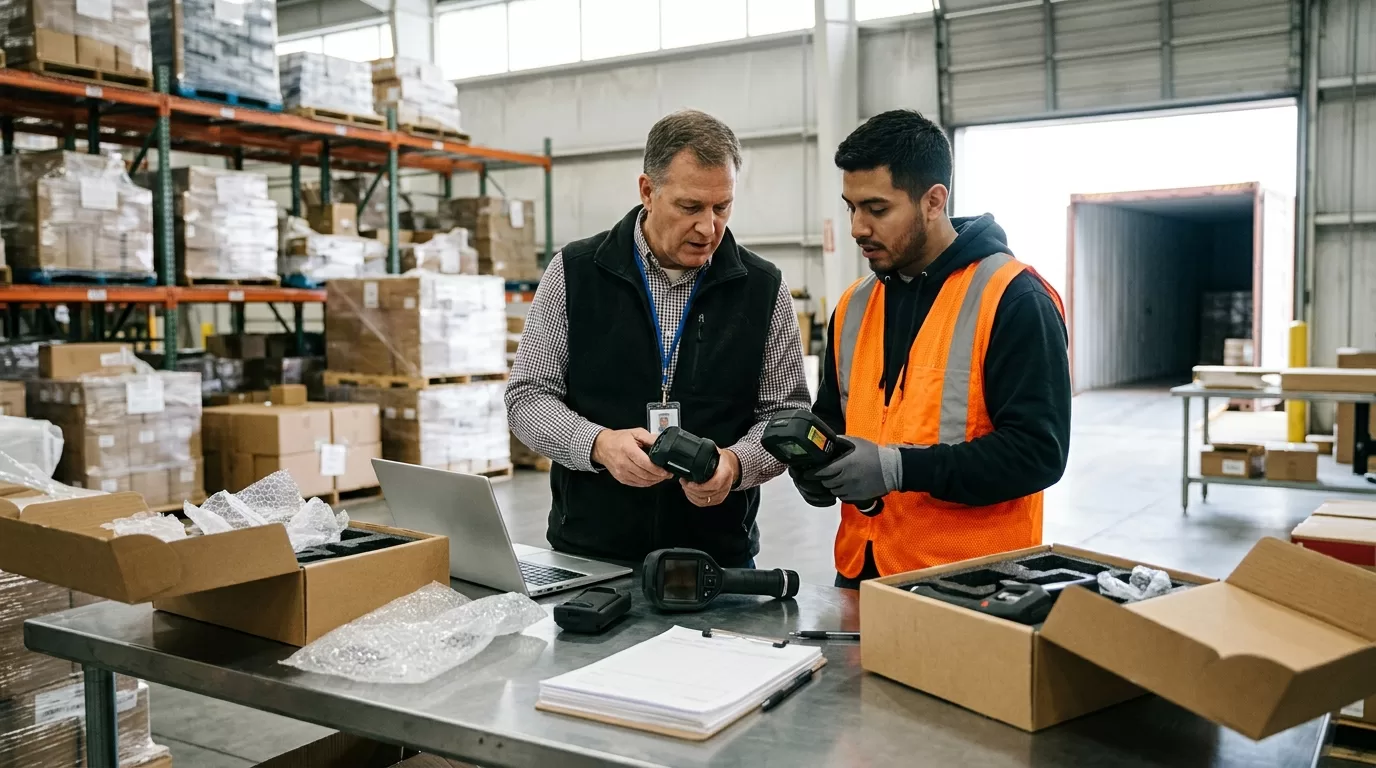
U.S. Customs and Border Protection moved the practical starting point for many finished thermal video cameras toward heading 8525 after the HS 2022 changes. In CBP Headquarters Ruling H331315, dated December 5, 2025, CBP classified the AXIS P1290-E Thermal Network Camera and AXIS Q1951-E Thermal Camera under HTSUS 8525.89.50 and stated that older thermal-camera rulings under heading 9013 were revoked by operation of law.
That ruling matters because importers still repeat old advice from forums, broker templates, and legacy supplier invoices. “Thermal camera equals Chapter 90” used to be a common shortcut. In 2026, it’s a bad shortcut for many finished video cameras.
| Product type | Common classification starting point | What to verify |
|---|---|---|
| Finished thermal network camera | 8525.89.50 | Video output, surveillance function, no sighting function |
| Handheld thermal imaging camera | 8525.89.50 | Finished camera vs measuring instrument |
| Thermal monocular | Often 8525.89.50 review | Civil outdoor use, no weapon mount, no ballistic features |
| Thermal weapon sight or scope | Don’t assume 8525.89.50 | Reticle, mounting system, sighting purpose |
| Thermal drone payload | Needs separate review | Gimbal, UAV integration, stabilizer, laser module |
| Thermal core or sensor module | Don’t use finished-camera logic | Detector-only vs camera output, part vs complete article |
When importing thermal cameras from China, ask the supplier for a spec sheet that names the detector resolution, frame rate, spectral band, output format, lens, mounting hardware, wireless functions, and intended use. “Infrared product” is not enough. Your customs broker can’t classify a product cleanly from a one-line Alibaba invoice.
A clean commercial invoice should say something like “finished handheld thermal imaging camera, uncooled LWIR, 384 × 288 detector, 50 Hz, no weapon mount, no laser rangefinder, country of origin China.” That’s boring. Boring is good at the port.
Customs clearance starts with the importer of record. If you’re the U.S. buyer, your company name, EIN, customs bond, broker power of attorney, and entry data need to line up. U.S. Customs and Border Protection uses CBP Form 7501 to record classification, value, origin, duty rate, and related entry data, so don’t treat the 7501 as broker back-office paperwork. Read it.

For ocean freight, your broker or forwarder will also need Importer Security Filing data before the container is loaded. For air freight, the timeline is shorter and the mistakes surface faster. A wrong model number on a carton label can still trigger questions, especially if the shipment contains lithium batteries, Wi-Fi models, or products described as “scope,” “sight,” “target,” or “payload.”
Use this file before shipment:
| Document | Who provides it | What must match |
|---|---|---|
| Commercial invoice | Supplier | Model, unit value, Incoterm, origin, buyer, seller |
| Packing list | Supplier | Carton count, gross weight, serial batches |
| Bill of lading or air waybill | Forwarder | Shipper, consignee, port, pieces |
| Spec sheet | Supplier or brand | Resolution, Hz, lens, battery, wireless functions |
| Country-of-origin marking proof | Supplier | Product label and retail packaging |
| FCC data, if wireless | Supplier | FCC ID, radio module, label location |
| Battery transport documents | Supplier | UN38.3 summary, MSDS, packing method |
DDP is tempting for first-time buyers because the supplier says, “We handle everything.” For thermal imaging products, DDP can hide the very data you’ll need later: HTSUS code, entry number, declared value, importer of record, and any Chapter 99 tariff line. If a marketplace freight agent clears the goods under its own importer number, your landed-cost history becomes foggy.
FOB Shenzhen, FOB Shanghai, or FCA factory usually works better for serious U.S. dealers because your broker controls the entry. EXW looks cheap on the quote sheet, but it pushes China export clearance and pickup risk onto the buyer. Most U.S. importers don’t want to manage a truck appointment in Dongguan just to save a few dollars on paper.
Thermal imaging is a civil technology with military applications. A camera used for hog hunting, electrical inspection, perimeter security, or search and rescue can share detector specs with equipment that export-control agencies care about.

For U.S. importers, the key point is timing. A normal U.S. import entry doesn’t become a BIS import license case just because the device is thermal. Export controls matter when the China supplier exports the goods, when U.S.-origin content or technology is involved, and when you later re-export, resell, or transfer the product outside the United States. If your customer is a defense contractor, police procurement office, drone integrator, or overseas distributor, the file needs more than a customs invoice.
The U.S. Bureau of Industry and Security treats many thermal imaging cameras under ECCN 6A003.b.4.b, with special attention to frame rate, focal plane array size, civil end users, and embedded uses. BIS §742.6 describes license requirements for certain thermal imaging cameras, including thresholds tied to more than 60 Hz and focal plane arrays above or below 111,000 elements. For a deeper split between defense controls and dual-use controls, read Pixfra’s guide to ITAR vs EAR for thermal imaging before you promise a shipment date to a reseller.
The number 111,000 is not abstract. A 384 × 288 detector has 110,592 elements, just under that line. A 640 × 512 detector has 327,680 elements, well above it. A 256 × 192 detector has 49,152 elements. Frame rate matters too: 9 Hz feels choppy when tracking a moving animal or vehicle, while 30 Hz, 50 Hz, or 60 Hz feels much smoother. Better viewing performance can mean more paperwork.
Watch these trigger points:
| Spec or feature | Why buyers should pause |
|---|---|
| 640 × 512 detector | Higher FPA element count raises export-control attention |
| More than 60 Hz | BIS rules call out frame-rate thresholds |
| 30 Hz or 50 Hz consumer models | Smooth image, but still needs classification support |
| Weapon mount or reticle | May change both classification and control analysis |
| Ballistic calculator | Strong sighting-use signal |
| Laser rangefinder | Adds another controlled component question |
| UAV gimbal integration | China export controls and U.S. end-use checks may apply |
| Military, police, border, or overseas buyer | End user screening becomes more serious |
China-side export controls can matter before the shipment leaves Shenzhen, Hangzhou, Wuhan, or Yantai. China has adjusted export controls for UAV-related components, including infrared thermal-imaging devices, and suppliers may ask for end-use statements when products are tied to drones, payloads, or higher-performance optics. If your supplier says “no license needed,” ask for that position in writing, tied to the exact model number.
HTSUS 8525.89.50 may show a general duty rate of free, but “free” doesn’t mean your landed cost is zero. China-origin goods can face separate Chapter 99 duties, Merchandise Processing Fee, Harbor Maintenance Fee for ocean freight, broker fees, bond costs, exam charges, and storage if anything goes wrong.

This is where importers get burned. They price a dealer program on the base HTSUS rate, then the broker adds a China tariff line at entry. The invoice margin shrinks overnight. If you quoted 200 thermal monoculars to a retailer at a fixed landed cost, that mistake comes straight out of your margin.
Ask your broker for a landed-cost worksheet before the first production deposit:
| Cost line | Where it comes from | Buyer note |
|---|---|---|
| Product value | Supplier invoice | Must reflect real transaction value |
| International freight | Forwarder | Depends on Incoterm |
| Insurance | Forwarder or buyer | Often small, still part of landed math |
| Base duty | HTSUS line | 8525.89.50 may show free for many entries |
| China tariff line | Chapter 99 review | Check current Section 301 status by entry date |
| MPF | CBP fee | Applies to formal entries |
| HMF | Ocean entries | Doesn’t apply to air freight |
| Broker and bond | Broker | Annual bond usually beats single bonds for repeat shipments |
Valuation is another quiet trap. If you supply free housings, tooling, firmware work, molds, engineering, labels, or packaging to the factory, tell your broker. Some assists and royalties may need to be added to customs value. A $180 camera can become a $194 customs value after additions, and duties follow the adjusted value.
Country-of-origin marking should be in English and visible enough for retail reality. “Made in China” on the master carton alone may not work if the product is repacked into dealer packaging after entry. If you sell through Amazon, Bass Pro-style retail, independent hunting shops, or security distributors, ask for photos of the unit label and retail box before the balance payment.
A customs broker doesn’t need to be a thermal engineer, but your broker does need product data. Send the spec sheet, product photos, user manual, battery details, and sales page before the shipment leaves China. If the broker only sees “thermal camera” after arrival, the broker is guessing under pressure.

The best question is plain: “Would you file this entry the same way if CBP opened the carton and read the manual?” If the answer is no, fix the paperwork. Manuals often reveal words that invoices hide: reticle, zeroing, ballistic profile, target tracking, gimbal, drone, law enforcement, weapon mount. Those words don’t always create a problem, but they change the review.
Ask these before the purchase order:
1. Which HTSUS code would you use for this exact model?
2. Do you see any reason to request a CBP binding ruling?
3. Does the product description need to mention “thermal imaging” rather than “digital camera”?
4. Are there any Chapter 99 China tariff lines on the entry date?
5. Does the product have Wi-Fi, Bluetooth, cellular, GPS, or a radio remote?
6. Does the FCC ID belong to the finished device or only to a module?
7. Is the lithium battery packed in equipment, with equipment, or alone?
8. Does the product include a laser rangefinder?
9. Does the model have a reticle, weapon mount, or ballistic calculator?
10. Will the supplier provide an export-control statement by model number?
Some products deserve a CBP binding ruling before volume import. Thermal scopes, clip-on weapon sights, drone payload cameras, fever-screening devices, and camera cores are the usual candidates. A ruling takes more time than a broker email, but it gives you a written position tied to the exact facts you submitted.
Medical claims change the lane. A thermal camera sold for fever screening or diagnosis can bring U.S. Food and Drug Administration medical-device questions into the import file. A thermal monocular sold for outdoor observation usually doesn’t belong in that same medical bucket. Claims on the website, box, manual, and Amazon listing matter.
For dealers, the practical goal is simple: build a model-level compliance packet once, then reuse it for every shipment until the model changes. Don’t rebuild the entry file from scratch for every carton. Keep the spec sheet, HS rationale, export-control statement, battery documents, FCC data, marking photos, and supplier declaration in a shared folder named by model and revision.

That revision detail matters. A supplier can change a 25 Hz model to 50 Hz, swap a 384 × 288 detector for 640 × 512, add Wi-Fi, or release a “Pro” trim with a laser rangefinder. The sales name may stay almost the same. Customs and export-control facts won’t.
Use this checklist for importing thermal cameras from China at dealer scale:
| Step | Action | Hvorfor dette er viktig |
|---|---|---|
| 1 | Lock the exact model and trim | “T50” and “T50 Pro LRF” may not be the same product |
| 2 | Collect detector and frame-rate specs | 384 × 288, 640 × 512, 9 Hz, 50 Hz all matter |
| 3 | Identify the product function | Handheld camera, monocular, scope, payload, core |
| 4 | Get broker HS review in writing | Stops invoice-level guessing |
| 5 | Check Chapter 99 tariff exposure | Base duty isn’t the full landed cost |
| 6 | Confirm FCC status for wireless models | Wi-Fi and Bluetooth can hold up retail sale |
| 7 | Save battery transport documents | Airlines and couriers ask for them often |
| 8 | Screen end users for sensitive deals | Defense, UAV, and overseas resale raise the bar |
| 9 | Review labeling photos | Origin marking must survive repacking |
| 10 | Recheck after model changes | New specs can change the answer |
The biggest tradeoff is performance versus paperwork. A 9 Hz entry-level monocular may be easier to place in low-risk civil retail channels, but it won’t feel as natural when a hunter pans across a tree line or a security guard follows a moving vehicle. A 50 Hz 640 × 512 model gives a better field experience, but the compliance packet needs to be tighter.
If you sell to only U.S. civilian outdoor customers, your workflow can stay lean. If you sell to drone integrators, overseas dealers, public agencies, or defense-adjacent buyers, add end-use screening and export-control review before accepting the order. A fast sale to the wrong buyer is not worth the refund, seizure risk, or follow-up questions.
Many finished thermal imaging cameras are commonly reviewed under HTSUS 8525.89.50, especially after CBP’s 2025 ruling on thermal network cameras. Thermal scopes, drone payloads, cores, and sensor modules need separate review.
Yes. Thermal cameras have civil uses such as hunting, inspection, firefighting, and security, but some specs and end uses are controlled because the same technology can support military, UAV, or surveillance applications.
Not automatically for U.S. import, but 9 Hz doesn’t erase all export-control issues. End user, destination, model design, U.S.-origin content, and later re-export plans still matter.
DDP can work for samples, but it’s risky for repeat dealer imports because you may lose visibility into the entry, HTSUS code, declared value, and importer of record. Use your own broker for volume shipments.
Ask for detector resolution, frame rate, spectral range, lens, wireless functions, battery type, laser features, mounts, reticle status, country of origin, FCC data if wireless, and an export-control statement by model number.
Before you issue the first purchase order, ask Pixfra for the model spec sheet, marking details, wireless status, battery packing data, and export-control statement your broker needs. Send the same packet to your customs broker before the shipment leaves China; port problems are cheaper on a spreadsheet than at LAX, JFK, or Long Beach.
For å bli forhandler av termisk optikk trenger du en reell kundebase, klare vilkår for videresalg, salgsprosesser som oppfyller gjeldende regelverk, opplært personale og det riktige startlageret. Den raskeste veien er å bevise at du kan selge termiske monokularer, termiske kikkerter og multispektral optikk til bestemte kjøpere i USA, uten å behandle hvert enkelt produkt som en generisk friluftsutstyrsartikkel.
1. Definer målgruppen din.
2. Tilordne Pixfra-SKU-er til den aktuelle bruken.
3. Registrer dokumentasjon knyttet til virksomhets- og omsetningsavgift.
4. Angi begrensninger for eksport, alder og jaktbestemmelser.
5. Opprett en demo-varebeholdning.
6. Gi personalet opplæring i bruk av sensorer og avstandsmålere.
7. Avtal vilkår for margin, MAP, garanti og etterbestilling.
8. Gjennomfør salget og rapporter om hvor mye som er solgt.
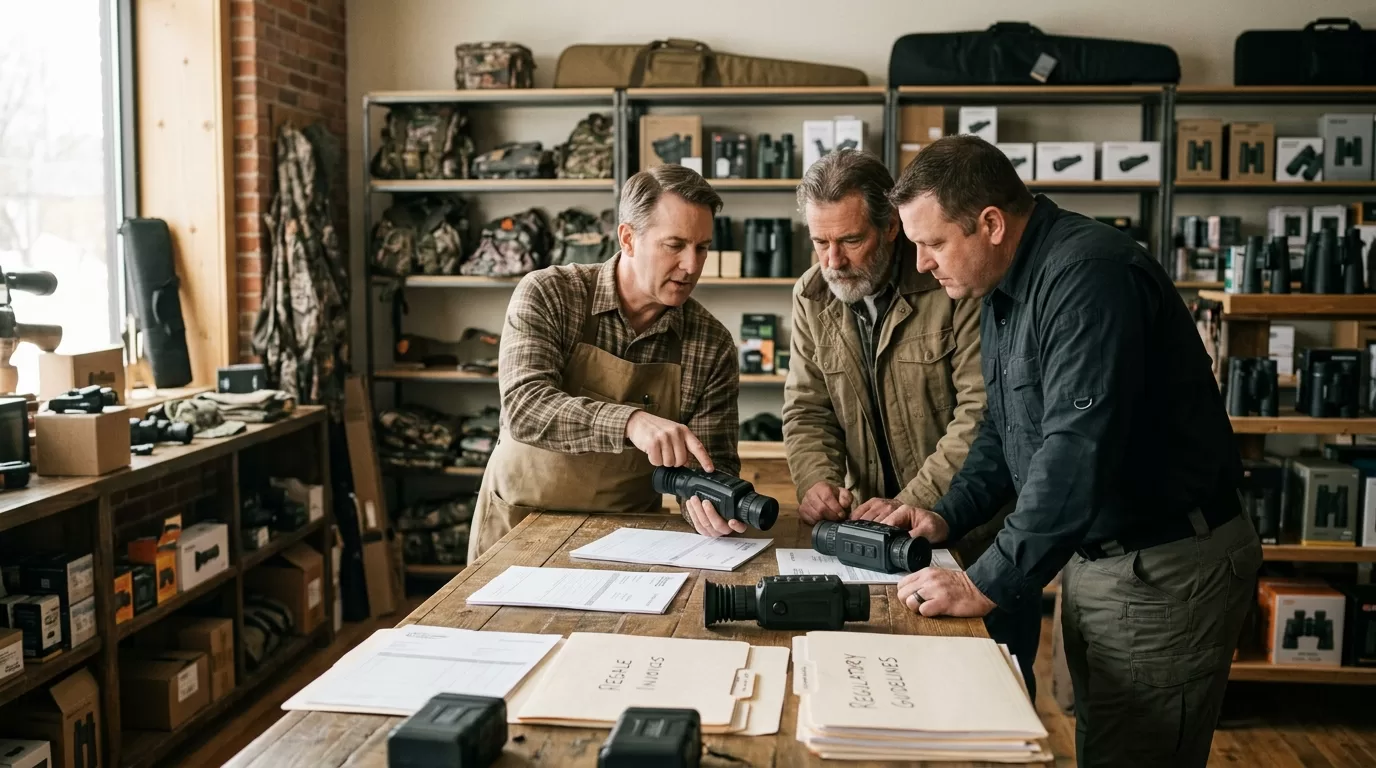
En forhandler av termiske produkter er ikke bare en butikk med en hylle. Du er den personen en ranch-eier ringer til før han kjøper en håndholdt skanner for å oppdage prærieulver klokka 02.00 om natten. Du er også den som forklarer hvorfor et termisk sikt med oppløsning på 640×512 koster mer enn et kompakt monokulært sikt for nybegynnere, og hvorfor en innebygd laseravstandsmåler er viktig når kunden ikke kan bedømme avstanden i et mørkt landskap.
Hvis ditt egentlige mål er å bli forhandler av termisk optikk, bør du begynne med å avgrense målgruppen. Rovdyrjegere, villsvinjegere, sikkerhetsteam på rancher, friluftsbutikker, forhandlere av taktisk utstyr og eiendomsforvaltere stiller ikke de samme spørsmålene. En coyotejeger er opptatt av synsfelt og rask målidentifisering. En ranchforvalter er opptatt av batterilevetid, garantihåndtering og om en ansatt kan lære seg menyen på ti minutter.
Feilen er å bestille varelager først. Ikke gjør det. Begynn med å skrive ned navnene på de 25 mest sannsynlige kjøperne: lokale jaktforeninger, våpenbutikker, fôrbutikker, rancher, jaktutstyrsforhandlere, sikkerhetsinstallatører og guider for nattjakt. Hvis du ikke klarer å nevne 25, er forhandlersøknaden din fortsatt bare en teori.
Sjekkliste for forhandlerens forberedelser
| Område | Minimumsbevis | Sterke bevis |
|---|---|---|
| Tilgang for kjøpere | 25 utvalgte talenter | Over 100 kjøpere som har meldt seg på, eller besøkende i butikken |
| Produktkunnskap | Grunnleggende termiske begreper | De ansatte kan sammenligne NETD, oppløsning, synsfelt og avstandsmåler |
| Salgskanal | Nettside eller butikk | Butikk, netthandel, demonstrasjoner, lokale arrangementer |
| Overholdelse | Lenker til statlige jaktnettsteder | Skriftlig arbeidsflyt for eksport- og bruksretningslinjer |
| Tjeneste | E-postsupport | Innmeldingsskjema, serienummeroppfølging, garantibehandling |
De beste forhandlerne av termiske produkter velger først én hovedkundegruppe. “Friluftsfolk” er et for bredt begrep. En butikk som allerede selger elektroniske lokkekaller, stativer, våpenskap og lys til rovdyrjakt, kan legge til Pixfra termisk optikk for utendørs bruk uten å måtte lære kundene en ny kjøpsvaner. En kamerahandler eller sikkerhetsinstallatør kan fortsatt selge termiske enheter, men salgsprosessen er annerledes: færre impulskjøp, flere forespørsler om tilbud og mer opplæring.
Når det gjelder friluftsoptikk i USA, kommer den sterkeste B2B-passformen vanligvis fra fire kjøpergrupper. Rovdyr- og villsvinjegere ønsker rask oppdagelse. Brukere på rancher og gårder ønsker oversikt over området. Friluftsforhandlere ønsker pålitelig omsetning. Sikkerhetsinstallatører ønsker konsistente spesifikasjoner og støtte. Velg én. Bygg deretter tilbudet rundt det konkrete nattproblemet til den aktuelle kjøperen.
| Kjøpertype | Hva de spør om først | En bedre vinkel på et innstegsprodukt |
|---|---|---|
| Rovdyrjeger | “Hvor langt kan jeg oppdage noe?” | Termisk monokulær samt termisk siktelinje |
| Vildsvinejeger | “Kan jeg identifisere målet før jeg skyter?” | Høyere oppløsning, stabilt bilde, hjelp til rekkevidde |
| Rancheier | “Vil de ansatte bruke det?” | Enkel betjening, garanti, robust bæreveske |
| Butikk | “Vil den bevege seg?” | Demomodell, MAP-klarhet, opplæring av personale |
| Sikkerhetsinstallatør | “Kan vi dokumentere spesifikasjonene?” | Datablad, standardisert modellbetegnelse |
Her er et virkelig scenario. En kunde kommer inn i en butikk etter å ha sett fem videoer om termiske siktemidler på nettet. Han spør etter “den med lang rekkevidde”. Hvis personalet bare gjentar deteksjonsrekkevidden, kan det hende han går derfra med feil utstyr. Hvis personalet spør hvor han jakter, hva som er vanlig skuddavstand, terrenget, hvilke arter han jakter på, og om han trenger opptak eller en laseravstandsmåler, blir salget et annet. Det er forhandlerens merverdi.
Dette rådet gjelder ikke hvis du bare ønsker å selge noen få enheter på en markedsplass. Kunder som kjøper termisk optikk stiller kostbare spørsmål. De forventer kundestøtte etter kjøpet. Hvis du ikke kan gi støtte når det gjelder spørsmål om fastvare, problemer med app-tilkobling, valg av monteringsutstyr eller håndtering av garantisaker, bør du holde deg unna denne kategorien inntil du kan det.
En produsent eller distributør vil vanligvis be om bevis på at du driver en ekte virksomhet. Du må regne med å oppgi det juridiske firmanavnet, videresalgssertifikatet, opplysninger om nettstedet eller butikken, kontaktperson, leveringsadresse, salgskanaler og produktkategorien du ønsker å føre. Noen merker kan be om opplysninger om forventet månedlig omsetning eller ditt nåværende utvalg av utendørsoptikk. Det er helt vanlig.

Økonomien krever enkel matematikk. La oss si at innkjøpsprisen din på en termisk optikk er $1 200 og den laveste annonserte prisen er $1 599. Bruttomarginen din er $399 før kortgebyrer, frakt, personalutgifter, demonstrasjoner, returer og skattehåndtering. Det utgjør 24,9%. Hvis du gir rabatt til $1 450 for å sikre en rask ordre, faller marginen til $250, eller 17,2%. Én retur med omfattende garantikrav kan utligne hele dette beløpet.
For en forhandler er det viktigere å overholde MAP-reglene enn å jage etter hvert eneste salg. En butikk som holder prisene, opplærer personalet og selger tilbehør, oppnår ofte en sunnere fortjenestemargin enn en selger som kutter prisene på nettet og sender ut pakker uten kundestøtte. Termiske optiske produkter er produkter som krever forklaring. Slike produkter belønner forhandlere som kan formidle kunnskap.
Forhandlerens kostnadsmodell
| Kostnadspost | Hvorfor dette er viktig | Praktisk mål |
|---|---|---|
| Demomodell | Kundene ønsker å se gjennom termisk | 1 enhet per hovedproduktnivå |
| Opplæring av ansatte | Dårlige forklaringer fører til returer | Minst 2 utdannede ansatte |
| Frakt og forsikring | Enheter med høyere verdi krever sikrere frakt | Finn prisen før du gir et tilbud |
| Kortbehandling | En økning fra 2,51 TP3T til 3,51 TP3T kan gå ut over marginen | Innregne det i prisberegningen |
| Garantihåndtering | Serienumre og bilder sparer tid | Bruk skriftlig form |
| Tilbehør | Holder, etuier, batterier, stativer | Festingsgrad over 20% |
Ikke lov noe som retningslinjene dine ikke kan støtte. Hvis du tilbyr “gratis retur” på monterte varmesikter etter bruk i felten, vil du måtte betale for det. Strengere retningslinjer fungerer bedre: la kundene prøve produktet før kjøp, sjekk det ved levering, dokumenter serienumrene og håndter garantikrav gjennom den godkjente prosessen.
Startlageret bør dekke ulike bruksområder, ikke hver eneste SKU. En god første bestilling kan for eksempel omfatte én kompakt termisk monokular for nybegynnere, én monokular i 640-klassen for seriøs deteksjon, én serie med termiske kikkerter for jegere som er klare til å montere dem, og én multispektral- eller avstandsmåler-modell for kunder som ønsker mer enn grunnleggende varmesøk. Det er nok til å undervise, demonstrere og selge uten å binde opp kapital i varianter som selger dårlig.
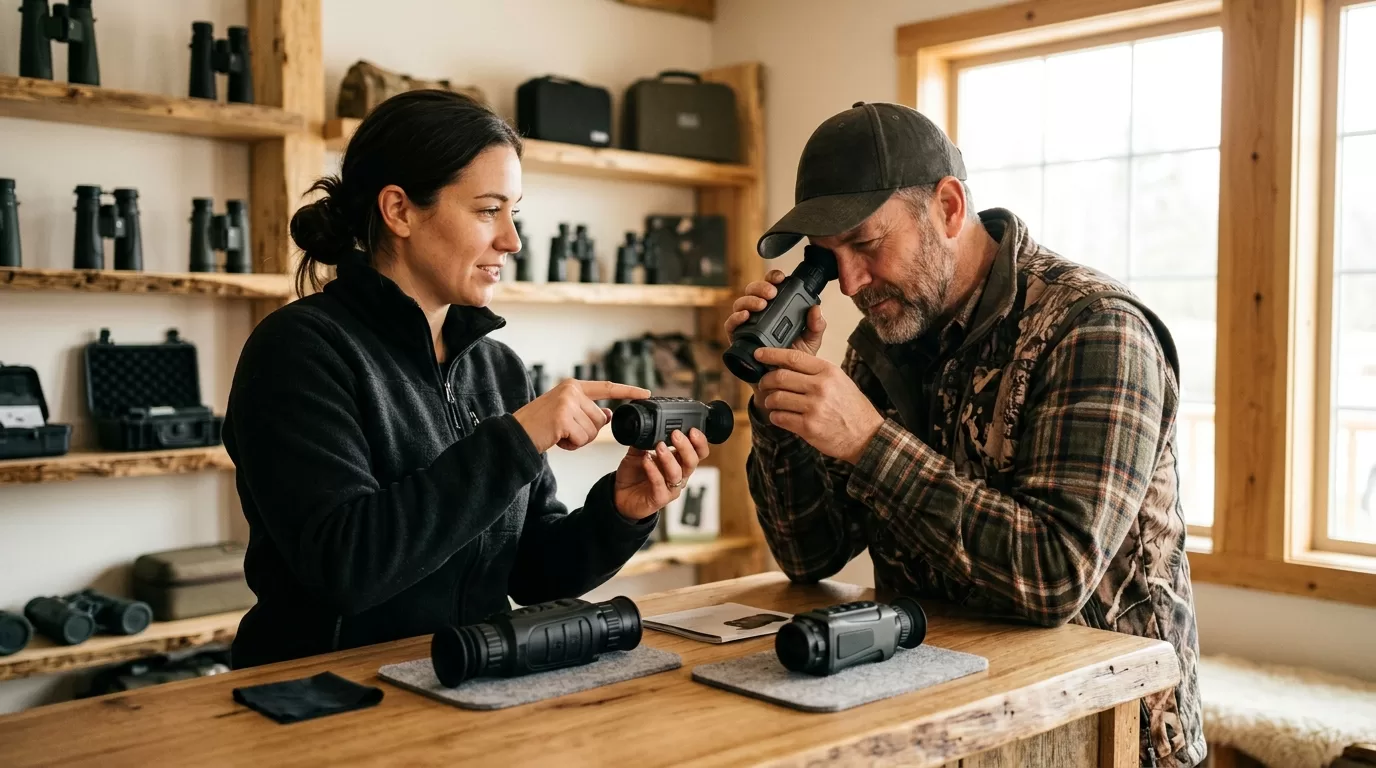
Pixfra tilbyr forhandlerne et nyttig utvalg. Sirius 640 er posisjonert som et termisk monokulær med lang rekkevidde, med en deteksjonsrekkevidde på opptil 2600 m, 18 mK NETD og et F0,9-objektiv. Arc LRF har i tillegg en innebygd laseravstandsmåler, med en oppgitt rekkevidde på 1000 m på Pixfras produktside. Draco kombinerer termisk bildebehandling, 4K digitalt nattesyn, laseravstandsmåler og infrarød belysning. Mile 2 passer for de som ønsker et kompakt produkt. Taurus passer for kunder som ønsker et termisk kikkert med opptil 640×512 detektoroppløsning og 18 mK NETD eller lavere.
| Startrolle | Eksempel på Pixfra | Beste kjøpermatch |
|---|---|---|
| Kompakt skanner | Mile 2-serien | Første kjøper av termoklær, bruker av ryggsekk |
| Håndholdt med lang rekkevidde | Sirius 640 | Ranch, rovdyr, overvåking av åpne områder |
| Håndholdt avstandsmåler | Arc LRF | Jegere som trenger trygghet på lang avstand |
| Multimodusoptikk | Draco | Buyers comparing thermal and night vision |
| Thermal scope | Taurus-serien | Mounted hunting setup |
A dealer should demo at dusk, not at noon in a parking lot. Thermal sells when a buyer sees heat contrast: tree lines, parked trucks, dogs at distance, warm rocks cooling after sunset. A daytime demo can still explain ergonomics, menus, and screen quality, but it won’t close as well.
If your team needs brand context before choosing models, the Pixfra thermal imaging optics site is a practical place to compare current outdoor lines before building a stocking plan. Keep the product story simple: what the customer sees, how far the customer can detect, how easy the device is to carry, and what problem the device solves at night.
Thermal optics sales touch export control, hunting law, platform rules, and customer safety. The Electronic Code of Federal Regulations, 2026, publishes the Export Administration Regulations Commerce Control List under 15 CFR Part 774, including Category 6 for sensors and lasers. The Bureau of Industry and Security regulations are the source dealers should check before export, reexport, or international shipment.
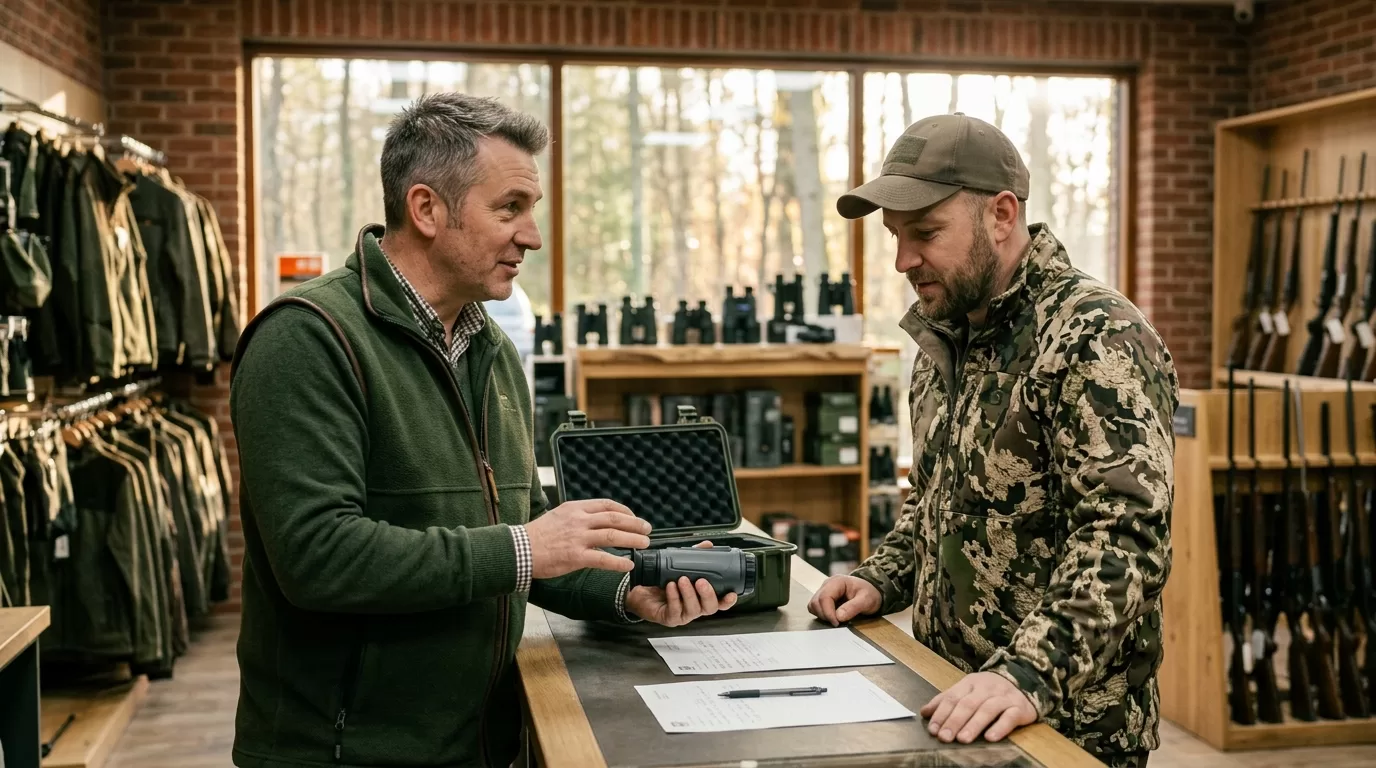
Domestic hunting use is a separate issue. Thermal devices may be legal for scouting, predator control, or certain night hunts in one state and restricted in another. The U.S. Fish and Wildlife Service says refuge hunting can be limited by federal, refuge-specific, and state law, according to its General Hunting Laws. Train staff to say, “Check your state wildlife agency before using thermal equipment to hunt.” That sentence prevents bad advice.
Dealer rule: sell the device, document the buyer, explain lawful-use limits, and avoid giving legal advice beyond official links.
Online sales need their own controls. If you sell through your website, block international checkout until export classification and destination rules are reviewed. If you sell through marketplaces, read the platform’s weapon accessory and optics policies before listing. If you sell in-store, keep a short written script near the counter. Staff turnover is real; the script keeps answers consistent.
This is where expert dealers separate themselves from box movers. A buyer may ask, “Can I take this to Mexico for a hunt?” The answer isn’t a shrug. It’s a process: identify the exact model, classify the item, check export rules, check destination rules, then decide whether the sale or shipment is allowed. Fast answers can be expensive.
Before you contact Pixfra or a distributor, build a one-page dealer profile. Keep it factual. Include your company name, state, business type, current product categories, website, monthly foot traffic or online traffic, target customer group, requested Pixfra product lines, and who will manage service. If you’re a new business, say that. A clear new dealer is better than a vague established one.

Add a 90-day launch plan. For example: two staff training sessions in week one, one evening demo event in week three, 20 outreach calls to ranches or hunting guides, five short product videos, and a reorder review after the first 10 units sold. You don’t need a giant plan. You need a believable one.
Dealer application packet
| Document | Why it helps |
|---|---|
| Business license or registration | Confirms legal business identity |
| Resale certificate | Supports wholesale purchasing |
| Website or storefront photos | Shows sales channel quality |
| Product-line list | Shows related category fit |
| Buyer segment plan | Proves you know who will buy |
| Service contact | Gives warranty and support ownership |
| Compliance workflow | Shows responsible thermal optics sales |
When you apply, ask direct commercial questions. What are the opening order requirements? Which SKUs are best for US outdoor dealers? Is MAP enforced? What is the warranty process? Are demo units available? Who handles replacement parts or firmware questions? How long do reorders take? What marketing assets can dealers use?
The strongest dealer applications sound like operators wrote them. “We sell to predator hunters in Texas and Oklahoma through a retail store and two night-hunting demo events per month” beats “we want to expand into thermal.” Specific wins.
Yes, thermal optics resale can be profitable when margin, MAP, freight, card fees, and warranty time are priced correctly. A dealer chasing discounts can lose money even on high-ticket products.
A normal US resale business may not need a special optics license for domestic sales, but export control and hunting-use rules still matter. Check BIS rules and state wildlife agency rules before shipping or advising buyers.
Compact monoculars often sell first because the price is easier for new thermal buyers. Serious hunters usually move toward Sirius, Arc LRF, Draco, or Taurus once they understand range, resolution, and use case.
Yes, dealers can sell thermal scopes online if manufacturer terms, platform rules, tax setup, shipping limits, and export controls are handled. Block international orders until classification and destination checks are complete.
Dealer approval time varies by brand, paperwork quality, and territory review. A complete application with resale documents, sales channels, buyer plan, and compliance workflow will usually move faster than a casual inquiry.
If you’re ready to build a serious thermal category, start with one demo kit for hunters, one kit for ranch or property use, and a written staff script for compliance questions. Pixfra can support dealers who treat thermal optics as a specialist category, not a side shelf.
Spec sheets tell you what a thermal device should do. The field tells you what it actually does. We took our Pixfra thermal devices — monoculars, scopes, and front attachments — into real hunting and observation conditions across varying terrain, weather, and lighting to see how they held up when it counted. Here’s what we found.
Too many thermal device reviews in 2026 rely on manufacturer claims, controlled lab numbers, and best-case scenarios. And while those specs give you a starting point, they don’t tell you how a device handles at 2 AM in a foggy tree line, or whether your battery dies before the hogs show up, or if you can actually tell a coyote from a stump at 400 meters in heavy humidity. That gap between on-paper performance and real-world results is exactly why we ran this field test. We wanted to push our own gear hard — not to prove that every number is perfect, but to show you what our thermal devices do when conditions get ugly. If you’re shopping for a thermal monocular, thermal scope, or thermal front attachment in 2026, this case study gives you field data, not marketing talk. And if you want a breakdown of the specs that matter most before you buy, our guide to the De 6 viktigste funksjonene som må finnes i den beste termiske enheten i 2026 is worth reading alongside this one.
There’s a reason experienced hunters and wildlife observers focus on field-tested results over spec sheets: the real world doesn’t cooperate with ideal testing conditions. A thermal monocular rated for 2,000-meter detection in a climate-controlled lab may perform very differently across a humid Southern pasture or a cold Rocky Mountain ridge. Temperature swings, fog, rain, ambient heat radiating off the ground — all of these mess with thermal imaging in ways that a product page never mentions.

We built this case study around that reality. Instead of running bench tests in a controlled room, we took our Pixfra lineup — including models from the Sirius HD, Mile 2, Arc LRF, Chiron LRF, Taurus LRF, and Volans series — and used them in conditions that match how real buyers actually use them. Night hunts for hogs and predators. Pre-dawn wildlife observation in dense tree cover. Property scans in rain and fog. Extended sessions where battery life and ergonomics become the deciding factors. We logged detection distances, image clarity ratings, battery drain rates, and usability notes across every outing.
The approach mirrors what field testers across the thermal optics industry are doing in 2026. Hands-on testing under real conditions — not lab environments — is how you separate the thermal devices that work from the ones that frustrate you by the third outing. And that’s exactly where our Pixfra devices had to prove themselves.
We ran our tests over a three-week stretch across two distinct environments: open ranch land in the South (flat, warm, humid) and mixed woodland-field terrain in the mid-Atlantic (rolling hills, dense vegetation, cooler nights). This gave us a spread of conditions that cover most hunting and outdoor scenarios you’d run into across the U.S.

Each device went through a standardized set of evaluations: detection range at measured distances using human-sized and deer-sized heat targets, image clarity at various magnifications, battery life under continuous use, ergonomic handling with and without gloves, and performance under adverse weather including light rain, heavy fog, and temperature drops below 35°F. We tested during full darkness, twilight, and — for our Volans series — broad daylight to evaluate its all-day vision capability with the adjustable aperture (F1.2 to F3.0).
Here’s a snapshot of our testing conditions and protocols:
| Test Parameter | Conditions/Method |
|---|---|
| Deteksjonsområde | Measured targets at 200m, 500m, 1,000m, 1,500m, and 2,500m+ |
| Image clarity | Rated 1–10 at each distance under clear, fog, and rain conditions |
| Batterilevetid | Continuous use, screen brightness at 70%, Wi-Fi off, ambient 40–75°F |
| Cold weather battery drain | Same protocol at 28–35°F to measure cold-induced performance drop |
| Gloved operation | Full menu navigation with insulated hunting gloves |
| LRF accuracy | Verified rangefinder readings against known-distance markers |
| Holdbarhet | Exposure to rain, drops onto packed dirt, sustained use in dusty terrain |
| Startup time | Cold boot to usable thermal image |
Every Pixfra model we tested uses our proprietary heat-detection technology paired with 12μm pixel pitch sensors. NETD ratings across our lineup sit at ≤18mK, which places them at the high end of thermal sensitivity for hunting-grade optics. That sensitivity became a key differentiator in our fog and humidity tests, where devices with higher NETD values tend to wash out and lose contrast between targets and background heat.
This is where the rubber met the road. On clear nights with big temperature differentials between targets and the background, most thermal devices on the market look decent. The real test comes when conditions compress that temperature gap — warm summer nights, fog, rain, or when ground heat lingers after a hot day. That’s where NETD separates a sharp, usable image from a blurry mess.

Our Pixfra devices, with NETD values of ≤18mK, delivered defined target outlines even in the toughest sessions. During one fog-heavy evening on the ranch, we spotted a group of hogs at roughly 600 meters using the Sirius HD — not just as heat blobs, but with enough definition to count individual animals and see their direction of movement. The Sirius HD series pushes detection out to 3,600 meters under ideal conditions, and during our clear-night tests, we consistently picked up heat signatures beyond 2,500 meters. At that distance, identification wasn’t possible, but detection was reliable and repeatable.
The Mile 2 series, aimed at everyday hunters and outdoor enthusiasts, hit its sweet spot between 200 and 600 meters. Image quality at 3x and 4x base magnification stayed clean and high-contrast. Pushing the digital zoom past 8x softened the image, as expected, but targets remained usable for detection out to about 1,000 meters. For most recreational hunters working inside 300–600 meters — which covers the majority of whitetail, hog, and predator hunting in the U.S. — the Mile 2 delivered more than enough image quality to make clean target IDs.
One standout finding: sensor resolution alone doesn’t tell the full story. We paired our 384×288 and 640×512 sensor models against each other in identical conditions, and while the 640×512 models produced sharper images at distance, the 384×288 models with strong NETD and well-tuned image processing still gave usable identification at practical hunting ranges. The takeaway? Resolution matters, but thermal sensitivity and pixel pitch matter just as much — if not more — when conditions turn against you.
Battery life is the feature nobody talks about until it fails. And in our testing, it became one of the clearest performance separators between a device that lasts through a full hunt and one that leaves you in the dark — literally.
Our Pixfra devices range from approximately 4.5 hours to 15 hours of battery life depending on the model and usage. We tested each at 70% screen brightness with Wi-Fi off, which represents realistic hunting use. The models running standard 18650 batteries — including the Arc LRF, Mile 2, and Chiron LRF — gave us the most flexibility. When a battery started dipping toward the end of a session, we swapped in a fresh 18650 from a jacket pocket in under 10 seconds. That swap-and-go design is a deliberate choice on our part, and it proved its value on every all-night session we ran. Proprietary sealed batteries might shave a few grams off the weight, but when you’re deep in a hunt and the power drops, having a spare 18650 ready is worth every gram.
Cold weather tested our batteries hard. At temperatures around 30°F, we measured roughly a 30–40% drop in effective battery life compared to our warm-weather sessions. That tracks with industry-wide data on lithium battery performance in cold conditions. Our field tip: keep your spare batteries in an inside jacket pocket where body heat keeps them warm. We did this throughout testing and never ran out of power during a single outing.
On the build quality side, all of our tested models survived the full three-week test period without a single failure. We exposed every device to rain, dust, accidental drops onto packed dirt, and the kind of rough pack-and-carry treatment that comes with real fieldwork. Our IP67-rated housings handled full water exposure without issue — one unit took a direct dunk into a shallow creek crossing and came out working perfectly. The controls stayed responsive even when wet or operated with heavy insulated gloves, which matters a lot more than you’d think when you’re scanning a tree line at 3 AM in freezing drizzle.
The Draco series earned special mention for its lightweight design. During extended 4+ hour observation sessions, we noticed significantly less arm fatigue compared to heavier units. That weight difference sounds minor on paper, but after a few hours of repeated scanning, your muscles notice.
A thermal device in 2026 isn’t just a sensor with a screen — it’s a connected field tool. And during our testing, the smart features on our Pixfra lineup didn’t just check a box; they made real differences in how efficiently we worked in the field.

The integrated laser rangefinders on our LRF models — Arc LRF, Chiron LRF, and Taurus LRF — gave us instant, accurate distance readings out to 1,000 meters. We verified LRF accuracy against known-distance markers and found the readings consistently landed within ±1 meter. For hunters taking shots beyond 150 yards at night, that kind of precision removes guesswork and directly improves shot confidence. Paired with the built-in ballistic calculators on the Chiron LRF and Taurus LRF, we had computed bullet drop and adjusted aiming points available on-screen without switching devices or pulling out a separate rangefinder. That integration saved us time and kept our workflow smooth during fast-paced hog encounters.
The Pixfra Outdoor App, which supports all our current models including the Sirius, Arc LRF, Mile 2, Pegasus Pro, Chiron LRF, Taurus, and Taurus LRF series, handled firmware updates, settings adjustments, and image transfers without issues during our test period. We transferred hunt footage to smartphones for quick review between sessions and shared scouting data with other team members in real time. The color palette options — White Hot, Black Hot, Red Hot, Iron Bow, and Rainbow — let us adapt display modes to different conditions and personal preferences. Black Hot became our team favorite for predator hunts, giving us better body detail on animals against mixed-temperature backgrounds.
Our Volans series stood out with its all-day vision capability. We ran it in broad daylight, through twilight, and into total darkness, adjusting the aperture between F1.2 and F3.0 as lighting changed. The result was one device that handled every lighting condition we threw at it — no need to carry a separate optic for daytime use. The 50Hz refresh rate across our lineup also delivered the smooth, fluid imaging we needed to track fast-moving targets without the blur or stutter that lower refresh rates produce.
The Taurus and Taurus LRF thermal front attachments also proved their value as a flexible option for hunters who don’t want to replace their existing daylight scope. With ultra-fine 0.9cm@100m click value for zeroing, we achieved precise alignment that held through repeated sessions without drift. For hunters already running a quality daylight optic, the Taurus clips on and adds thermal capability without changing your primary setup — a practical approach that’s popular with European hunters and gaining ground fast in the U.S.
We didn’t run this test to claim perfection. We ran it to show you, with real data from real conditions, what our Pixfra thermal devices actually deliver in the field. The ≤18mK NETD sensitivity, 12μm pixel pitch sensors, swappable 18650 batteries, IP67-rated builds, integrated LRFs and ballistic calculators, companion app connectivity, and all-day vision on the Volans series — these aren’t just features on a spec sheet. They’re tools that performed when conditions got tough, sessions ran long, and weather turned ugly.
Whether you’re a hog hunter in Texas, a predator hunter in the Midwest, a wildlife observer on the East Coast, or a property owner keeping an eye on your land after dark, the results from this case study give you a clear picture of what you’re getting. Thermal imaging technology has reached a point in 2026 where mid-range devices deliver performance that was premium-only just two years ago. Our lineup at Pixfra reflects that shift — from the entry-accessible Mile 2 series all the way to the professional-grade Sirius HD.
If you want to dig deeper into the specific features that define a great thermal device this year, head over to our breakdown of the De 6 viktigste funksjonene som må finnes i den beste termiske enheten i 2026. And when you’re ready to choose the right model for how you hunt, explore, or observe, you’ll find every product in our lineup at Pixfra.com.
What is the real detection range vs. identification range on a thermal device?
Detection range tells you how far the sensor can pick up a heat signature. Identification range — where you can confirm what you’re looking at — is always shorter. In our field tests, real-world identification range typically ran about 30–40% of the stated detection range. Our Pixfra models range from around 500 meters for entry-level devices up to 3,600 meters for the Sirius HD series, but we always recommend checking identification range for your specific use case, not just the headline detection number.
How does cold weather affect thermal device battery life?
Cold temperatures hit lithium battery performance hard. During our testing at around 30°F, we saw a 30–40% drop in effective battery life compared to warm conditions. The solution: use models with swappable 18650 batteries and carry spares in an inside pocket where body heat keeps them warm. Many of our Pixfra models use 18650s specifically for this reason — you can swap a fresh battery in seconds without downtime.
Can you use a thermal device during the day?
Yes. Thermal devices detect heat, not visible light, so they work in full daylight just as well as total darkness. Our Pixfra Volans series goes a step further with an adjustable aperture (F1.2 to F3.0) designed for all-day vision, making it one of the few thermal devices that adapts smoothly across every lighting condition from noon sun to midnight.
Is a built-in laser rangefinder worth it on a thermal monocular or scope?
For hunters shooting beyond 150 yards at night, absolutely. A built-in LRF removes the need for a separate ranging device and gives you exact distance data with the press of a button. Our Pixfra Arc LRF, Chiron LRF, and Taurus LRF models all include integrated laser rangefinders with 1,000-meter range. Paired with onboard ballistic calculators, they deliver a complete targeting solution in one unit.
What IP rating do I need for a thermal device used outdoors?
For any real outdoor use — hunting, hiking, wildlife observation, property monitoring — you want at least an IP67 rating. IP67 means the device is fully sealed against dust and can handle temporary water submersion, covering rain, stream crossings, snow, and accidental drops into puddles. Our Pixfra devices are built to handle these conditions, and our IP67-rated models survived direct water exposure during our field tests without any issues.
From nighttime patrols to perimeter sweeps, thermal devices give security teams and law enforcement a tactical edge that flashlights and standard cameras can’t touch. At Pixfra, we build thermal monoculars, scopes, and front attachments designed for real-world field conditions — and we’ve put together this list of the 8 best thermal devices for security and law enforcement in 2026.
Thermal imaging has gone from a niche military tool to a standard piece of gear for police departments, private security firms, and property patrol teams across the United States. Thermal imaging cameras detect heat, enabling law enforcement professionals to see in complete darkness. Unlike night vision cameras, thermal imaging cameras require no ambient light and retain their clarity in any lighting condition. If someone is hiding behind a bush, under a car, or crouching in a dark alley, their body heat shows up on a thermal display like a glowing outline. Handheld thermal imagers work by creating a virtual display showing the heat signatures of objects in the field of view, and these devices can provide responders with a covert method of surveillance, providing a tactical advantage at night. For law enforcement officers working the late shift or responding to a call in a wooded area, that’s not a nice-to-have — it’s a lifeline that keeps them safer and more effective on every shift.

The thermal device market in 2026 looks very different from a few years back. Sensor resolutions have climbed while prices have dropped. What used to be a premium 640×512 resolution is now a mid-range standard, and NETD sensitivity levels below 20mK are available outside of strictly military-grade equipment. These advances mean police departments, security agencies, and private property owners can now access thermal imaging that delivers clear, high-contrast imagery for a fraction of what it cost just three or four years ago. If you want a deeper look at what separates a great thermal device from a forgettable one, check out our breakdown of the De 6 viktigste funksjonene som må finnes i den beste termiske enheten i 2026.
Whether you’re a patrol officer scanning a parking lot, a SWAT team member clearing a building, a border security agent watching a fence line, or a private guard patrolling a warehouse district, the right thermal device changes how you operate at every level. You spot threats earlier. You make faster, better decisions. You stay safer while doing it. In today’s rapidly evolving security landscape, law enforcement thermal imaging technology has become an indispensable tool for police departments, SWAT teams, and security professionals worldwide. And with features like built-in laser rangefinders, Wi-Fi streaming to smartphones, onboard video recording, and rugged IP67 weatherproofing now standard on serious devices, today’s thermal imaging equipment is a complete field toolkit — not just a fancy scope.
We built this list based on what actually matters for security and law enforcement work: detection range, sensor sensitivity, durability, battery life, and the kind of smart connectivity features that keep you efficient during a 10-hour shift. Every device on this list comes from our Pixfra lineup, and each one is built for real outdoor conditions — from freezing winter nights to dusty summer patrols. Our proprietary heat-detection technology powers every model with NETD values of ≤18mK, placing them at the top end of thermal sensitivity for tactical-grade optics. Here’s how our 8 picks stack up side by side:
| # | Enhet | Type | Deteksjonsområde | LRF | Best egnet for |
|---|---|---|---|---|---|
| 1 | Sirius HD | termisk monokular | Opp til 3 600 m | — | Long-range surveillance & border patrol |
| 2 | Arc LRF | termisk monokular | ~500m+ | Yes (1,000m) | Patrol & perimeter checks |
| 3 | Mile 2 | termisk monokular | ~500m+ | — | Everyday patrol & scouting |
| 4 | Chiron LRF | Termisk sigte | Mid-long range | Yes (1,000m) | Tactical ops & SWAT |
| 5 | Pegasus 2 LRF | Termisk sigte | Mid-long range | Ja | Precision target locking |
| 6 | Taurus LRF | Termisk forsats | Mid-long range | Yes (1,000m) | Weapon-mounted thermal |
| 7 | Draco | Termisk forsats | Mid range | — | Lightweight tactical use |
| 8 | Volans | Day & Night Vision Scope | Mid range | Tilgjengelig | 24-hour all-day operations |
Den Sirius HD is our heavy hitter for agencies that need to cover massive areas. With a detection range stretching out to 3,600 meters, it’s built for border patrol operations, large property surveillance, and any scenario where you need to scan wide-open ground from a fixed position. At the other end of the spectrum, the Arc LRF and Mile 2 series are your best options if you need a compact, pocketable thermal monocular for nightly patrol. The Arc LRF packs an integrated laser rangefinder with 1,000-meter capability, so you can get instant distance-to-target data with a single button press — no fumbling for a separate device in the dark. The Mile 2 keeps things simple and reliable for officers who need thermal imaging every shift without extra complexity. Both models deliver ≤18mK NETD sensitivity, so you’ll see crisp outlines of people and objects even on warm nights when the temperature difference between a suspect and the background is small.

For tactical teams and officers who need thermal imaging mounted on their rifle, the Chiron LRF and Pegasus 2 LRF are our top thermal scopes. The Chiron LRF comes with an integrated laser rangefinder and a built-in ballistic calculator that computes bullet drop and adjusts your aiming point on the fly — a full targeting solution in one device for SWAT teams and tactical units operating in zero-visibility conditions. The Taurus LRF and Draco series work as thermal front attachments, mounting in front of your existing daytime scope to convert it into a thermal optic without changing your zero. The Taurus LRF features ultra-fine zeroing precision with a 0.9cm@100m click value, which matters when every shot counts. The Draco stands out for its lightweight design, built for officers who need multi-functional performance without adding weight to their gear. And if your team pulls shifts that span daylight and darkness, the Volans series delivers all-day vision with an adjustable aperture from F1.2 to F3.0, adapting to any lighting condition you’ll encounter — making it one of the few thermal devices that performs just as well at noon as it does at midnight.
Two specs will make or break your thermal device in the field: NETD and sensor resolution. NETD — Noise Equivalent Temperature Difference — measures how sensitive the thermal sensor is to small temperature changes. Lower numbers equal clearer, more detailed images. For law enforcement and security operations, you want ≤25mK at a bare minimum, and ≤18mK if you’re doing any serious nighttime or tactical work. All of our Pixfra devices hit ≤18mK, which means you’re seeing defined, high-contrast outlines of people and vehicles — not washed-out blobs. Pair that with 12μm pixel pitch technology and you get sharp imagery across sensor resolutions from 256×192 (good for close-range patrol) up to 640×512 (the go-to for professional security and law enforcement use). Resolution alone isn’t the whole story, though. A 50Hz refresh rate is the baseline for any thermal device worth carrying on duty in 2026 — it delivers smooth, fluid imaging that lets you track moving targets like fleeing suspects without blur or chop. Anything below 30Hz will give you stuttering video that makes fast-moving targets hard to follow.
According to a 2024 IACP survey, 78% of police departments using thermal cameras reported a 40% reduction in nighttime accidents, 35% faster suspect apprehension, and 60% improvement in search-and-rescue success. Numbers like that don’t come from spec sheets — they come from image quality, sensor sensitivity, battery reliability, and overall toughness. Our Pixfra devices range from approximately 4.5 to 15 hours of battery life depending on the model, and many use standard 18650 batteries that swap in seconds when power runs low. For durability, IP67 is the gold standard — fully sealed against dust and rated for temporary water submersion, which handles rain, stream crossings, snow, and accidental drops into puddles. Our Pixfra Outdoor App connects to every current model (Sirius, Arc LRF, Mile 2, Pegasus Pro, Chiron LRF, Taurus, and Taurus LRF) for firmware updates, settings control, and image transfer directly to your phone. Wi-Fi streaming, onboard video recording, and multiple color palettes — White Hot, Black Hot, Red Hot, Iron Bow — round out the feature set that field professionals rely on daily.
On a typical night patrol, a handheld thermal monocular turns a routine area scan into a real security sweep. Officers can use thermal imaging devices to spot a recently pursued car — a dark, parked car in a lot full of them, or alone in the middle of an open field, can be difficult to spot, but seen through an IR scope, the hot car stands out as if lit by a spotlight. Beyond vehicle pursuits, officers can detect people hiding in tree lines, spot discarded evidence like a warm firearm tossed into bushes, or sweep a wide perimeter from a single vantage point using a device with 500+ meter detection range. Thermal imagers have the capability to display the difference in temperature between objects, as well as an object’s heat signature and residual heat signature, and these devices are used by responders for search and rescue operations, for investigations, and to increase visibility through fog, smoke, dust, rain, and excessive glare. That kind of all-conditions performance means an officer with a thermal monocular like our Arc LRF or Mile 2 never has to rely on ambient light, street lamps, or a flashlight beam that gives away their position.

For SWAT and tactical teams, thermal scopes and front attachments allow target engagement in zero-visibility scenarios — smoke-filled buildings, blacked-out warehouses, or outdoor operations in dead-of-night conditions. SWAT thermal imaging gear provides specialized tactical teams with enhanced capabilities during high-risk operations, enabling teams to conduct reconnaissance, track suspects through complex environments, and maintain situational awareness during dynamic entries. Thermal front attachments like our Taurus LRF mount to existing optics, so officers don’t need to re-zero or retrain on a new sighting system — they just clip it on and gain full thermal capability. For search and rescue, a thermal monocular can locate a lost person in a wooded area in minutes instead of hours. And for covert surveillance, thermal imaging gives you a passive, no-light-required view that doesn’t reveal the observer’s position. Prosecutors increasingly use thermal imaging recordings to secure convictions, and onboard recording features in devices like our Chiron LRF make it simple to document everything in real time.
Private security firms are adopting thermal devices at a growing rate, too. Warehouse patrols, industrial facility sweeps, and residential estate monitoring all benefit from handheld thermal monoculars that can cover large areas fast. Handheld thermal cameras are increasingly used for personal security applications, and these portable devices allow security personnel to perform quick heat detection in any environment — whether you’re patrolling a large area, monitoring a crowd, or looking for intruders in a remote location. Our Volans series is especially practical for security teams pulling 12-hour shifts that span daylight and darkness. Instead of switching between daytime optics and night gear, your team carries one device that handles both — all-day vision through an adjustable aperture means no more mid-shift equipment swaps.
If you’re deciding between thermal imaging and traditional night vision for security or law enforcement work, here’s the straight answer: thermal wins in almost every real-world scenario. Thermal imaging in security uses cameras that detect infrared radiation — heat — rather than visible light, producing images based on temperature differences between objects and their surroundings. Unlike standard optical cameras, thermal cameras work in complete darkness, through light fog, and are unaffected by shadows, glare, or deliberate lighting changes. Night vision amplifies available light — moonlight, starlight, street lamps — and produces a visible image. It works OK in low-light conditions with some ambient illumination, but it goes blind in total darkness, heavy fog, or smoke. Thermal imaging detects heat, not light, so it performs in pitch-black environments, through fog, light rain, dust, and even partial foliage cover. For any security team or law enforcement agency operating at night, that gap is the difference between spotting a suspect and walking right past them.

The one area where night vision holds an edge is producing high-resolution, color-accurate images in very low light — useful for facial identification or reading license plates. But for detection, tracking, and situational awareness, thermal is the better tool. For security applications, thermal imaging excels at detection — confirming that something is there — while optical cameras and AI analytics handle classification. With devices like our Volans series offering all-day vision through an adjustable aperture (F1.2 to F3.0), you don’t even have to choose between day and night capability. You get both in one device — and one fewer piece of gear to carry, charge, or worry about breaking. For most security and law enforcement professionals, a quality thermal device will outperform night vision on every patrol, every shift, every time conditions get ugly.
Can police use thermal imaging without a warrant?
This is one of the most debated legal questions around thermal imaging in law enforcement. In the landmark Kyllo v. United States case, the Supreme Court held that thermal imaging of a home constitutes a “search” under the Fourth Amendment. That means using a thermal device to scan the inside of someone’s home from outside generally requires a warrant. However, using thermal imaging in open outdoor areas — during a foot pursuit, a perimeter search, or a patrol sweep of public spaces — is a different situation and is widely practiced by law enforcement agencies across the country. Officers should always check their department’s policies and consult legal counsel for specific scenarios.
How far can a thermal device detect a person?
Detection range depends on the device’s sensor resolution, lens size, and NETD sensitivity. Entry-level thermal monoculars typically detect human-sized heat signatures at around 300 to 500 meters. Mid-range models with 384×288 or 640×512 sensors push that out to 1,000–1,500 meters. Our Pixfra Sirius HD series reaches up to 3,600 meters, which covers wide-area surveillance and border patrol applications. Keep in mind that detection range — where you can tell “something is there” — is always longer than identification range, where you can confirm exactly what you’re looking at. For security work, always ask about both numbers before you buy.
Kan varmekameraer se gjennom vegger?
No. Thermal cameras detect surface-level heat radiation — they don’t see through solid walls, glass, or metal. However, if someone is standing against a thin wall or door and transferring body heat to the surface, a thermal device can sometimes pick up that heat signature on the surface itself. This makes thermal imaging useful for detecting the presence of people near walls, doors, or windows, even though it can’t produce an image of what’s behind them. For law enforcement, this is a helpful detection tool during building searches, but it’s not X-ray vision.
What’s the best NETD for a law enforcement thermal device?
For most law enforcement, security, and outdoor patrol work, you want a thermal device with NETD of ≤25mK or lower. A device with ≤18mK — like every model in our Pixfra lineup — picks up extremely small temperature differences, producing sharp, detailed images even in challenging conditions like fog, humidity, or warm summer nights when everything radiates heat at similar levels. Lower NETD numbers translate directly to better image contrast, which means you can distinguish a person from their background faster and at greater distances.
Is thermal better than night vision for security?
For most security applications, yes. Thermal imaging works in total darkness, through fog, smoke, and light rain, and it detects heat signatures that are completely invisible to night vision. Night vision needs at least some ambient light to function and can be blinded by bright light sources like headlights or flashlights. Thermal devices are also passive — they don’t emit any light or signal, so they won’t reveal your position during covert operations. The only edge night vision holds is higher-resolution color imagery in low-light scenes with some available illumination, which helps with facial identification. For detection, tracking, and all-conditions awareness, thermal imaging is the stronger tool.
Whether you’re tracking hogs after dark, scanning backcountry trails, or watching wildlife without spooking it, a solid thermal device changes everything. At Pixfra, we build thermal monoculars, thermal scopes, thermal front attachments, and multispectral binoculars — all made for real outdoor conditions. Here are the 9 best thermal devices for survival and outdoor enthusiasts in 2026.
Thermal imaging technology has come a long way. What used to be a military-only tool is now something everyday hunters, hikers, campers, and survivalists can carry in their pockets. These devices detect infrared radiation — heat — instead of visible light. That means they work in complete darkness, through fog, in rain, and even when smoke fills the air. You’re not relying on moonlight or a flashlight to see what’s out there. You’re reading heat signatures, and heat doesn’t hide. A deer in a field, a person on a trail, a hot engine in a parking lot — all of it lights up on a thermal screen even when your eyes see nothing. For anyone who spends time outdoors, that kind of awareness isn’t just nice to have. It’s a game changer for safety, for success on a hunt, and for pure enjoyment of the wilderness.

The survival use case alone makes thermal devices worth it. If you’re lost, a thermal camera can help you spot warm structures, vehicles, or other people from a distance. If you’re camping, it lets you scan around your site for animals you’d rather not surprise in the dark. If you’re a search-and-rescue volunteer, thermal imaging cuts search time down drastically because you’re reading body heat through brush, foliage, and low-visibility conditions. Thermal monoculars are the most common entry point for outdoor users because they’re handheld, lightweight, and quick to deploy. You can sweep fields, tree lines, and brush edges to spot animals or people before deciding your next move. And since they don’t emit any visible light, you stay hidden while getting a full picture of your surroundings.
For hunters specifically, thermal devices have become a go-to tool for predator control, hog management, and scouting. Night hunting for coyotes and feral hogs is legal in many U.S. states — including Texas, Florida, Georgia, Louisiana, and Oklahoma — and thermal makes it safer and more effective. But even outside of night hunting, thermal monoculars are used for pre-dawn scouting, post-shot blood trailing, and property surveillance. If you’ve been curious about what features actually separate a great thermal device from a mediocre one, we wrote an in-depth guide on the De 6 viktigste funksjonene som må finnes i den beste termiske enheten i 2026 — it covers NETD, detection range, battery life, durability, and smart connectivity in detail.
We’ve picked nine devices from our Pixfra lineup that cover every use case, from everyday carry to long-range professional detection. Each one is built with our proprietary heat-detection technology, 12μm pixel pitch sensors, and rugged construction made for the field — not the shelf. Here’s the breakdown.
1. Sirius HD — The Long-Range Powerhouse. If you need to scan massive areas without moving a step, the Sirius HD is the device to reach for. It pushes out to a 3,600-meter detection range, making it the farthest-reaching thermal monocular in our lineup. It’s built for law enforcement, wildlife managers, and serious hunters who need to see what’s happening at distances most people can’t even imagine covering with a thermal device. The Sirius HD sits at the premium end, but the level of detail and reach it delivers is unmatched. This is the kind of device where every dollar goes straight into performance — high-resolution sensors, top-tier NETD sensitivity at ≤18mK, and rock-solid build quality.
2. Sirius Series — More Than the Perception of Sight. The standard Sirius Series delivers the same core imaging DNA as the HD version, with a focus on versatility. It’s a well-rounded thermal monocular that handles everything from nighttime wildlife observation to property security sweeps. The image quality is sharp enough to distinguish between targets at distance, and the ergonomics are designed so you can use it for hours without fatigue. For outdoor enthusiasts who want pro-level performance in a manageable package, the Sirius Series hits that sweet spot.
3. Mile 2 — New Miles to Go. The Mile 2 is our everyday thermal monocular — the one you toss in your pack and reach for first. It pairs a high-resolution sensor with 12μm pixel pitch technology for sharp, high-contrast images in any condition. It’s compact, straightforward to operate, and delivers the kind of thermal clarity that makes spotting animals or scanning trails easy even in complete darkness. For most recreational hunters and outdoor enthusiasts, the Mile 2 gives you everything you need without overcomplicating it. Think of this as your no-excuses field companion: reliable, clear, and always ready to go.
4. Arc LRF — Performance and Precision in Your Hand. Here’s where things get dialed in. The Arc LRF adds an integrated laser rangefinder with 1,000-meter range capability to the mix. You get exact distance to your target with the press of a button — no fumbling for a separate device. For hunters taking shots beyond 150 yards at night, a built-in LRF makes a real difference in shot placement confidence. The Arc LRF sits in our mid-range tier, meaning it balances detection performance with a price point that doesn’t make your wallet weep. If you want one device that covers scanning, detection, and ranging, this is the one.
5. Pegasus 2 LRF — Make Precision Target Locking Effortless. The Pegasus 2 LRF is a thermal scope designed for shooters who need to acquire targets fast and lock on with confidence. It combines our thermal imaging sensor with an integrated laser rangefinder so you’re getting distance data and a clear thermal image at the same time. This is a weapon-mounted optic built for hog and predator hunting where speed and precision both matter. It handles heavy recoil, rough handling, and the kind of weather that sends most gear running home.
6. Pegasus Pro Series — Shoot in a Pro Way. The Pegasus Pro takes our thermal scope platform and pushes it further for experienced shooters. It offers multiple reticle options, smooth thermal imaging at a 50Hz refresh rate, and the kind of sensor resolution that lets you tell the difference between a target and a stump at distance. The Pro series is made for hunters who already know what they’re doing and want a scope that keeps up with their skill level. If you’re running thermal hunts on a regular basis, this is the setup that stays locked in season after season.
7. Chiron LRF — Lock-On, Readiness, Fire. The Chiron LRF is our fully loaded thermal scope. It has an integrated laser rangefinder and a built-in ballistic calculator that computes bullet drop and gives you an adjusted aiming point in real time. That’s not a gimmick — it’s the difference between a clean shot and a miss. The Chiron LRF takes the guesswork out of night shooting, especially at extended distances where manual holdover gets dicey. For predator hunters working coyotes across open pasture or managing feral hogs on large properties, this scope does the math for you.
8. Taurus LRF — LRF Locked, Ballistics at the Trigger. The Taurus LRF is a thermal front attachment — meaning it clips onto your existing daytime optic and turns it into a thermal-capable system. It features high-definition zeroing with an ultra-fine 0.9cm@100m click value, a built-in laser rangefinder, and a ballistic calculator. The Taurus LRF comes in multiple configurations (T425 LRF, T450 LRF, T650 LRF), so you can match the model to your specific setup. If you’ve already invested in a quality daytime scope and don’t want to buy a whole separate thermal scope, the Taurus front attachment gives you the best of both worlds.
9. Volans Series — See Beyond Time. The Volans is different from everything else on this list. It’s a digital day-and-night vision scope with an adjustable aperture from F1.2 to F3.0 — one of the few devices on the market that works just as well in broad daylight as in total darkness. It also includes a built-in ballistic calculator for distance-adjusted shot placement. The Volans is the “carry one device instead of two” answer for hunters and wildlife observers who need all-day coverage. If you’re in the field from pre-dawn to well past midnight, this is the device that stays on the whole time.
With so many models and brands flooding the market, it’s easy to get distracted by flashy numbers that don’t mean much in real conditions. So let’s cut through the noise and talk about the specs that make or break your experience. NETD — Noise Equivalent Temperature Difference — is the single most telling spec on any thermal device. It measures how sensitive the sensor is to small changes in temperature. A lower number means better sensitivity. For context, our Pixfra devices achieve NETD values of ≤18mK, which places them at the high end of sensitivity for hunting-grade thermal optics. That kind of sensitivity means you’re not squinting at blurry blobs — you’re seeing defined outlines of animals even when the ground, air, and foliage are all radiating heat at similar levels. If the device you’re looking at has an NETD above 30mK, you’re going to notice the difference on warm nights.

Sensor resolution is the other half of image quality. The most common options are 256×192 (entry-level), 384×288 (mid-tier), and 640×512 (premium). Higher resolution means sharper images and better target identification at distance — but resolution alone isn’t the whole story. Pixel pitch matters too. A 12μm pixel pitch, which we use across our Pixfra product lines, gives you sharper thermal images because each pixel is smaller, resulting in finer detail. Pair that with a 50Hz refresh rate and you get smooth, fluid thermal imaging that lets you track moving targets — running coyotes, sprinting hogs — without blur or chop. Anything below 30Hz creates a stuttering image that makes fast-moving animals hard to follow.
Here’s a quick reference table to compare how these specs stack up for different use cases:
| Spesifikasjoner | Entry-Level | Mid-Range | Premium |
|---|---|---|---|
| Sensoroppløsning | 256×192 | 384×288 | 640×512 |
| NETD (Thermal Sensitivity) | ≤40mK | ≤25mK | ≤18mK |
| Pikselavstand | 17μm | 12μm | 12μm |
| Deteksjonsområde | ~500m | ~1,500m | ~3,600m |
| Refresh Rate | 30Hz | 50Hz | 50Hz |
| Laseravstandsmåler | Rare | Common | Standard |
| Batterilevetid | 4–6 hrs | 6–10 hrs | 8–15 hrs |
| IP Rating | IP54 | IP67 | IP67/IP68 |
This table reflects the general landscape in 2026. Our Pixfra lineup covers every tier shown above — from the Mile 2 for everyday use to the Sirius HD for premium, long-range detection.
Having a great thermal device is one thing. Knowing how to use it well is another. One of the most overlooked factors is battery management. Our Pixfra devices range from about 4.5 to 15 hours of battery life depending on the model and settings. Many of our models use standard 18650 batteries that you can swap out in seconds — a design choice we made on purpose. When you’re deep in a hunt at 2 AM and the power dies, popping in a fresh battery from your pocket beats packing up and going home. Here’s a pro tip from our field experience: cold weather can slash battery performance by 30–50%. Always carry spares in an inside pocket where your body heat keeps them warm. If you’re planning an all-night predator hunt or a multi-day backcountry trip, pack at least two spare batteries and keep one warming against your body at all times.
Color palettes are another tool that experienced users rely on heavily. White Hot is the most common mode — heat sources show up white against a darker background — and it works great for general scanning. Black Hot, where heat sources appear black, is preferred by many professional hunters for reading animal body detail more clearly. Red Hot highlights the warmest areas in red and helps you pick out a target fast in busy environments. Iron Bow and Rainbow modes display a full spectrum of temperatures, which is helpful for reading environmental heat patterns. You can switch between these palettes on the fly without changing the device’s detection ability — it’s purely a display preference that helps you adapt to different terrain, weather, and lighting. Don’t just stick with the default. Experiment with palettes during different conditions and you’ll quickly find which ones click for you.
Your choice should start with one question: what will you use it for most? If you’re a recreational hunter who runs a few night hunts per season and wants to scan fields before dark, a monocular like the Mile 2 or Arc LRF is your best bet. These models deliver sharp thermal images, reliable detection range, and the portability to toss in a pack or jacket pocket. If you’re a dedicated predator or hog hunter who shoots at night, step up to a weapon-mounted thermal scope like the Pegasus 2 LRF or Chiron LRF — these are built to handle recoil, zero in tight, and give you distance data when it counts.

For those who already own a quality daytime scope and don’t want to replace it, our Taurus LRF thermal front attachments are the play. They clip onto your existing optic and add thermal capability without forcing you to swap out your whole setup. And if you need all-day coverage — dawn to midnight — the Volans series is the one device that does it all with its adjustable aperture system. Budget matters, obviously. But don’t just chase the cheapest price tag. A thermal device that looks great on paper but dies after two hours, fogs up in the rain, or gives you washed-out images on warm nights isn’t saving you money — it’s wasting your time. Match your expected use to the right device and you’ll end up with gear that pays for itself season after season. Firmware updates for all our Pixfra devices can be performed through the Pixfra Outdoor App, which supports the Sirius, Arc LRF, Mile 2, Pegasus Pro, Chiron LRF, Taurus, and Taurus LRF series — so your device keeps getting better even after you buy it.
Can you use a thermal device during the day?
Yes. Thermal devices detect heat, not light, so they work just as well in daylight as they do at night. Our Pixfra Volans series goes a step further with all-day vision capability and an adjustable aperture (F1.2–F3.0) that adapts to changing light conditions. That makes it one of the few thermal devices on the market that performs equally well in bright sun and total darkness.
What is the best thermal device for survival situations?
For general survival and outdoor use, a compact thermal monocular gives you the most versatility. It lets you scan for people, animals, and warm structures in any visibility condition — darkness, fog, smoke, or heavy rain. Our Mile 2 series is a great pick for this because it’s lightweight, easy to operate, and delivers clear thermal images with ≤18mK sensitivity. If you need more range for search-and-rescue-style scenarios, the Sirius HD pushes detection out to 3,600 meters.
How far can a thermal monocular detect an animal?
Detection range depends on the model. Entry-level devices detect heat signatures at around 500 meters, while premium models like our Sirius HD series reach up to 3,600 meters. Keep in mind that detection range and identification range are different — you can detect a heat source at one distance, but identifying what it is (deer vs. coyote vs. stump) happens at a shorter range. Always ask about both numbers before you buy.
Is a thermal monocular better than night vision for hunting?
For most hunting scenarios, yes. Night vision amplifies available light, which means it needs at least some ambient light (moonlight, starlight) to work. Thermal imaging reads heat signatures and works in absolute darkness — plus it sees through fog, light rain, and brush that blocks visible light. Thermal also makes animals stand out sharply against their backgrounds, even when they’re camouflaged in natural cover. That’s why thermal monoculars have become the go-to handheld optic for hog, predator, and nighttime wildlife work.
What IP rating do I need for an outdoor thermal device?
For any serious outdoor use — hunting, hiking, survival, property security — you want at least an IP67 rating. IP67 means the device is fully sealed against dust and can survive temporary water submersion, which covers rain, snow, stream crossings, and accidental drops into puddles. Devices with an IP54 rating handle light splashes but won’t hold up if you dunk them or use them in heavy downpours. All Pixfra thermal devices are built to handle real-world field conditions, including heavy recoil on our scopes and corrosion resistance over years of use.