Spędziłeś lata na precyzyjnym ustawianiu swojej lunety dziennej. Ostatnią rzeczą, na jaką masz ochotę, jest jej wymiana za każdym razem, gdy zachodzi słońce. Rozwiązaniem tego problemu jest termowizyjny moduł nakładkowy — montuje się go bezpośrednio przed istniejącą optyką i zamienia karabin w narzędzie do nocnego polowania bez konieczności zmiany zerowania. Oto 6 najlepszych urządzeń termowizyjnych, które w tym roku warto zamontować na lunecie dziennej.
Termowizyjny moduł nakładkowy — zwany również przednim modułem termowizyjnym — to kompaktowe urządzenie, które montuje się bezpośrednio przed lunetą dzienną. Termowizyjny moduł nakładkowy montuje się bezpośrednio przed istniejącą lunetą dzienną. Przekształca on optykę dzienną w lunetę termowizyjną, wyświetlając obraz termowizyjny przez standardową siatkę celowniczą, bez konieczności ponownego zerowania. W przeciwieństwie do dedykowanej lunety termowizyjnej, która całkowicie zastępuje istniejącą optykę, moduł nakładkowy działa z To właśnie to. Nie trzeba zdejmować lunety dziennej. Nakładka termowizyjna mocowana jest po stronie obiektywu, zazwyczaj za pomocą pierścienia adapterowego, który zaciska się na tulei obiektywu lunety, lub poprzez uchwyt na szynie Picatinny umieszczony przed lunetą dzienną. Nie trzeba wymieniać lunet. W ciągu kilku sekund można przejść od polowania w świetle dziennym do wykrywania termicznego. W Pixfra, produkujemy właśnie z tego powodu przednie modułowe urządzenia termowizyjne, takie jak nasza seria Taurus LRF — aby zapewnić myśliwym szybki i niezawodny sposób na wyposażenie karabinu, do którego już mają zaufanie, w funkcję termowizyjną.

To właśnie technologia stanowi o jego działaniu. Termowizor nakładkowy wykorzystuje czujnik mikrobolometryczny do wykrywania promieniowania cieplnego w podczerwieni emitowanego przez zwierzęta, ludzi i przedmioty. Dane te są przetwarzane i wyświetlane na niewielkim, wbudowanym ekranie OLED, a następnie powiększane przez lunetę dzienną. Efekt? Obraz termowizyjny widzisz przez tę samą soczewkę, z której strzelałeś przez cały dzień. Termowizor nakładkowy to specjalistyczne urządzenie termowizyjne zaprojektowane tak, by idealnie pasowało do tradycyjnej lunety dziennej. W przeciwieństwie do dedykowanej lunety termowizyjnej — która ma własną siatkę celowniczą i musi być niezależnie wyzerowana względem lufy karabinu — termowizor nakładkowy po prostu zbiera obraz termiczny i rzutuje go do tyłu, do soczewki obiektywowej lunety dziennej. Kluczową zaletą jest tutaj szybkość i wszechstronność – zachowujesz swoją wysokiej jakości lunetę dzienną i dodajesz funkcję termowizyjną, gdy wymagają tego warunki. Jeśli chcesz dowiedzieć się więcej o parametrach, które odróżniają doskonałe urządzenie termowizyjne od przeciętnego, przeanalizowaliśmy 6 najważniejszych funkcji, których każdy nabywca urządzeń termowizyjnych powinien szukać w 2026 roku.
Przy tak ogromnej liczbie opcji zalewających rynek wybór odpowiedniego termowizora nakładanego może wydawać się uciążliwym zadaniem. Przyjrzeliśmy się temu, z czego faktycznie korzystają myśliwi w całych Stanach Zjednoczonych w terenie — od nocnych polowań na dziki w Teksasie po polowania na drapieżniki na Środkowym Zachodzie — i zawęziliśmy wybór do sześciu kategorii termowizorów nakładkowych, które sprawdzają się tam, gdzie jest to najważniejsze. Oceniając dowolną termowizję typu clip-on, należy zwrócić uwagę przede wszystkim na następujące czynniki: rozdzielczość czujnika (im wyższa, tym lepiej), czułość NETD (im niższa, tym lepiej), częstotliwość odświeżania (standardowo 50 Hz), kompatybilność z lunetą, stopień ochrony IP, żywotność baterii oraz — szczególnie w 2026 roku — inteligentne funkcje, takie jak łączność z aplikacją, wbudowana funkcja nagrywania i obrazowanie wzbogacone o sztuczną inteligencję. Oto nasze zestawienie.
1. Najlepszy produkt w kategorii ogólnej: klipsowy dalmierz o wysokiej rozdzielczości z wbudowanym dalmierzem laserowym. Dla myśliwych, którzy oczekują kompletnego zestawu w jednym urządzeniu, nakładka o rozdzielczości 640×512 z wbudowanym dalmierzem laserowym stanowi obecnie złoty standard. Takie rozwiązanie zapewnia najostrzejszy obraz termowizyjny w klasie nakładek, a także natychmiastowe odczyty odległości bez konieczności szukania osobnego urządzenia. Nasz model Pixfra Taurus T650 LRF idealnie wpisuje się w tę kategorię — łączy w sobie czujnik o wysokiej rozdzielczości z czułością NETD ≤18 mK, rozmiarem piksela 12 μm oraz zintegrowanym dalmierzem laserowym o zasięgu 1000 metrów. Kiedy o 2 w nocy skanujesz otwarte pastwiska i w odległości 300 jardów pojawia się dzik, ten wbudowany dalmierz laserowy pozwala zaoszczędzić czas i sprawia, że celowanie staje się znacznie pewniejsze. Bardzo precyzyjna wartość kliknięcia wynosząca 0,9 cm na 100 m zapewnia precyzję zerowania dorównującą dedykowanym lunetom termowizyjnym.

2. Najlepszy do polowań na drapieżniki średniej wielkości: model 384×288 z mocowaniem klipsowym i dalmierzem laserowym (LRF). Nie każdy potrzebuje czujnika o najwyższej rozdzielczości dostępnego na rynku. Jeśli polujesz na kojoty, dzikich świń lub innych drapieżników z odległości poniżej 500 jardów — co obejmuje zdecydowaną większość nocnych polowań w Stanach Zjednoczonych — nakładany czujnik o rozdzielczości 384×288 z dalmierzem laserowym zapewni Ci wyraźny, szczegółowy obraz bez konieczności ponoszenia kosztów związanych z zakupem urządzenia klasy 640. Nasz Taurus T450 LRF został stworzony właśnie z myślą o tego rodzaju zastosowaniach. Czujnik zapewnia wysoki kontrast w typowych odległościach łowieckich, a wbudowany dalmierz laserowy eliminuje konieczność zgadywania podczas szacowania odległości w nocy. W połączeniu z wartością NETD ≤18 mK zapewnia wyraźny obraz nawet wtedy, gdy różnica temperatur między zwierzęciem a tłem jest niewielka — na przykład podczas ciepłych letnich nocy, kiedy wszystko emituje ciepło na podobnym poziomie.
3. Najbardziej opłacalny przedni moduł termowizyjny z dalmierzem. Budżet ma znaczenie, a dobry termowizor montowany na lufie nie musi ogołocić Twojego konta bankowego. Idealnym rozwiązaniem dla większości myśliwych rozważających zakup swojego pierwszego termowizora montowanego na lufie jest solidny czujnik o średniej rozdzielczości w połączeniu z funkcjami, które w praktyce mają największe znaczenie: dalmierz laserowy, wiele palet kolorów oraz wytrzymała, odporna na warunki atmosferyczne obudowa. Model Pixfra Taurus T425 LRF spełnia wszystkie te wymagania. Oferuje zintegrowany dalmierz laserowy w cenie, która sprawia, że termowizja staje się dostępna, nie rezygnując przy tym z funkcji, które mają znaczenie w terenie. Ponieważ nadal charakteryzuje się rozmiarem piksela 12 μm i NETD ≤18 mK, otrzymujesz jakość obrazu znacznie przewyższającą poziom typowy dla tej klasy cenowej. Dla osób kupujących termowizję typu clip-on po raz pierwszy jest to model, który polecamy jako punkt wyjścia.
4. Najlepszy lekki model z zatrzaskiem na dłuższe polowania. Waga ma realne znaczenie, gdy mocujesz urządzenie termowizyjne przed lunetą dzienną. Takie mocowanie zwiększa masę w przedniej części karabinu, nieznacznie zmieniając jego wyważenie. Ciężkie urządzenie powoduje, że karabin jest przeładowany w lufie, co zaburza równowagę i powoduje zmęczenie podczas długich sesji. Najlepsze lekkie termowizory mocowane na klipsie charakteryzują się niską masą, a jednocześnie zapewniają solidną wydajność czujnika i długi czas pracy na baterii. W firmie Pixfra zaprojektowaliśmy serię Draco o lekkiej konstrukcji z myślą o myśliwych, którzy potrzebują wielofunkcyjnego sprzętu bez zbędnego obciążenia. Kiedy spędzasz wiele godzin na czatowaniu na drapieżniki lub nocą przemierzasz mile wzdłuż ogrodzenia rancza, każda dodatkowa uncja ma znaczenie. Warto szukać modeli montowanych na klipsie z obudową ze stopu aluminium — są one wystarczająco wytrzymałe, by wytrzymać odrzut i upadki, a jednocześnie sprawiają, że całość pozostaje lekka i dobrze wyważona na karabinie.
5. Najlepszy model z zatrzaskiem zapewniający wydajność baterii na całą noc. Żywotność baterii psuje więcej polowań niż zła pogoda. Urządzenie o niesamowitej jakości obrazu, ale z baterią wystarczającą na dwie godziny, po północy staje się po prostu bardzo drogim przyciskiem do papieru. Najlepsze termowizory z klipsem, przeznaczone do pracy przez całą noc, zapewniają 8 lub więcej godzin ciągłej pracy i są wyposażone w wymienne baterie, dzięki czemu w trakcie polowania można włożyć nową. Standardowe baterie 18650 to najlepszy wybór — są tanie, powszechnie dostępne, a zapasowe można nosić w kieszeni kurtki. W całej ofercie Pixfra żywotność baterii waha się od około 4,5 do 15 godzin, w zależności od modelu i warunków użytkowania. Wiele naszych modeli wykorzystuje standardowe baterie 18650, które można wymienić w ciągu kilku sekund. Jest to celowy wybór projektowy. Porada od naszych testerów terenowych: niskie temperatury mogą obniżyć wydajność baterii o 30–50%. Zawsze noś zapasowe baterie w wewnętrznej kieszeni, gdzie ciepło ciała zapewni im odpowiednią temperaturę.
6. Najlepszy model z zatrzaskiem, wyposażony w inteligentne funkcje i kalkulator balistyczny. W 2026 roku inteligentne funkcje przestały być luksusem, stając się pełnoprawnymi narzędziami terenowymi. Najlepsze termowizyjne urządzenia typu „clip-on” nie tylko pokazują źródła ciepła — rejestrują również wideo, łączą się z telefonem przez Wi-Fi, transmitują obraz na żywo oraz aktualizują oprogramowanie bezprzewodowo. Nasze modele Taurus LRF idą o krok dalej, oferując wbudowane kalkulatory balistyczne, które obliczają spadek pocisku i na bieżąco podają skorygowany punkt celowania. W połączeniu z aplikacją Pixfra Outdoor — która obsługuje wszystkie nasze aktualne modele, w tym serie Taurus i Taurus LRF — możesz dostosowywać ustawienia, przesyłać nagrania i aktualizować urządzenie bezpośrednio ze smartfona. Nagranie udanego strzału i udostępnienie go partnerom myśliwskim następnego ranka lub rejestrowanie aktywności dzikich zwierząt na potrzeby zarządzania terenem to właśnie te praktyczne zalety, które wyróżniają najwyższej klasy urządzenia typu clip-on.
Oto krótkie zestawienie, na co warto zwrócić uwagę w różnych sytuacjach, w których stosuje się nakładki:
| Przypadek użycia | Minimalna rozdzielczość czujnika | NETD (mK) | Potrzebujesz LRF? | Minimalny czas pracy na baterii |
|---|---|---|---|---|
| Krótkie wieczorne polowania (2–3 godz.) | 256×192 | ≤25 | Opcjonalnie | 4–5 godzin |
| Całonocne zwalczanie dzików i drapieżników | 384×288 | ≤20 | Tak | 8–10 godzin |
| Identyfikacja na otwartym terenie z dużej odległości | 640×512 | ≤18 | Tak | 6–8 godzin |
| Lekkie zastosowanie w terenie | 384×288 | ≤20 | Opcjonalnie | 10–15 godzin |
| Ochrona mienia/monitoring | 384×288 | ≤20 | Opcjonalnie | 6–8 godzin |
Kupując urządzenie termowizyjne do zamocowania na lornetce dziennej, należy zwrócić szczególną uwagę na trzy parametry: NETD, rozdzielczość czujnika oraz częstotliwość odświeżania. NETD (Noise Equivalent Temperature Difference – różnica temperatur równoważna szumowi) mierzy czułość termiczną. Im niższa wartość, tym lepiej urządzenie wykrywa niewielkie różnice temperatur między celem a tłem. W 2026 r. najlepsze termowizory nakładkowe charakteryzują się wartością NETD ≤18 mK lub niższą. W 2026 r. wartość ≤20 mK stanowi rozsądny punkt odniesienia dla wydajnego urządzenia; wartość ≤18 mK reprezentuje najwyższy poziom wydajności w tym przedziale cenowym. Nasze urządzenia Pixfra osiągają wartość ≤18 mK we wszystkich modelach, co oznacza, że widzisz wyraźne kontury zamiast rozmazanych plam — nawet w wilgotne letnie noce, kiedy wszystko emituje ciepło na podobnym poziomie. Rozdzielczość czujnika określa, ile pikseli termowizyjnych zapewnia detektor. Dwa popularne poziomy to 384×288 i 640×512. Czujnik o rozdzielczości 640×512 zawiera prawie trzy razy więcej pikseli niż czujnik 384×288, a ta dodatkowa gęstość pikseli ma ogromne znaczenie podczas powiększania obrazu w lunecie dziennej lub próby zidentyfikowania celu znajdującego się w odległości ponad 200 jardów.
Częstotliwość odświeżania to jedna z tych specyfikacji, które wydają się techniczne, ale mają ogromny wpływ w praktyce. Czujniki termowizyjne zazwyczaj działają z częstotliwością 25 Hz lub 50 Hz. Przy 50 Hz obraz odświeża się płynnie z minimalnym opóźnieniem — co jest niezbędne do śledzenia pędzącego kojota lub dzika poruszającego się w zaroślach. Wszystkie najlepsze modele przedstawione w tym przewodniku działają z częstotliwością 50 Hz. Częstotliwość poniżej 30 Hz powoduje zacinanie się obrazu, co utrudnia śledzenie szybko poruszających się celów. Nie należy też zapominać o rozmiarze piksela — mniejszy rozmiar piksela, taki jak technologia 12 μm stosowana w całej linii produktów Pixfra, pozwala na uchwycenie większej ilości szczegółów w każdej klatce i zapewnia ostrzejszy obraz na wszystkich odległościach. Mniejszy rozstaw pikseli w połączeniu z czujnikiem o wysokiej rozdzielczości zapewnia ostry obraz o wysokim kontraście, który pozwala na szybką i pewną identyfikację celu.

Oprócz czujnika, klasa odporności na warunki atmosferyczne Twojego urządzenia typu clip-on wskazuje, jak trudnym warunkom w terenie jest ono w stanie sprostać. IP67 to obecnie złoty standard wśród urządzeń termowizyjnych. Oznacza to, że urządzenie jest całkowicie szczelne i odporne na kurz oraz wytrzymuje chwilowe zanurzenie w wodzie — co obejmuje deszcz, przekraczanie strumieni, śnieg, błoto i przypadkowe upadki do kałuż. W przeciwieństwie do dedykowanych celowników termowizyjnych, które całkowicie zastępują zwykłą optykę, nakładki zachowują zerowanie celownika i znaną siatkę celowniczą, umożliwiając szybkie przechodzenie między trybem dziennym a nocnym bez konieczności ponownego zerowania. Ceny wysokiej jakości nakładek termowizyjnych zazwyczaj wahają się od $2 000 do $7 000, w zależności od rozdzielczości i funkcji. W firmie Pixfra produkujemy nasze przednie nakładki termowizyjne z myślą o tych samych warunkach, w jakich je testujemy. Seria Taurus LRF wytrzymuje silny odrzut, jest odporna na korozję i działa bez zarzutu w deszczu i kurzu. Jeśli poważnie podchodzisz do polowań nocnych, nie zadowalaj się niczym innym niż obudową o stopniu ochrony IP67.
To dyskusja, która pojawia się na każdym forum myśliwskim: czy lepiej kupić lunetę termowizyjną typu „clip-on”, czy dedykowaną lunetę termowizyjną? Krótka odpowiedź brzmi: to zależy od Twojego wyposażenia i sposobu polowania. Lunety typu „clip-on” umożliwiają szybkie przełączanie się między polowaniem nocnym a dziennym bez wpływu na zerowanie optyki dziennej. Nie ma potrzeby wymiany lunety, ponownego zerowania ani posiadania drugiej strzelby przeznaczonej wyłącznie do polowań nocnych. Możesz przejść od polowania na jelenie o 17:00 do zwalczania drapieżników o 21:00, używając tej samej broni, tej samej lunety i bez żadnych przestojów. Lunety termowizyjne typu „clip-on” działają również z wieloma różnymi karabinami, jeśli masz odpowiednie adaptery, a wiele modeli pełni podwójną funkcję jako ręczne monokularowe lunety termowizyjne do skanowania i rozpoznania terenu przed zajęciem pozycji do strzału.
Specjalistyczne celowniki termowizyjne poświęcają tę elastyczność na rzecz czystej wydajności. Ponieważ czujnik termiczny, wyświetlacz i układ optyczny są zaprojektowane jako jeden system, specjalistyczny celownik zazwyczaj zapewnia ostrzejszy obraz i więcej wbudowanych funkcji. Na przykład nasze serie Pixfra Pegasus 2 LRF i Chiron LRF są wyposażone w zintegrowane dalmierze laserowe o zasięgu 1 000 m, wiele profili zerowania oraz wbudowane kalkulatory balistyczne — a wszystko to w obudowie lunety. Jednak lunety nakładane wiążą się z pewnymi kompromisami. Główną wadą lunety nakładanej jest to, że nie ma ona takiej samej rozdzielczości optycznej jak urządzenie dedykowane, więc strzelanie może nie być tak precyzyjne ani celne. Powiększenie lunety dziennej ma bezpośredni wpływ na obraz termowizyjny — przy powiększeniu powyżej około 6x–8x powiększasz obraz na wyświetlaczu cyfrowym, gdzie piksele stają się widoczne, a szczegóły tracą ostrość. Jeśli posiadasz tylko jedną strzelbę i potrzebujesz jej zarówno do pracy w dzień, jak i w nocy, luneta nakładkowa jest rozsądniejszym wyborem. Jeśli dysponujesz dedykowanym zestawem do polowań nocnych i zależy Ci na możliwie najostrzejszym obrazie termowizyjnym, lepszym wyborem będzie dedykowana luneta.
Montaż termowizora typu „clip-on” jest prostszy, niż większość osób się spodziewa, ale ważne jest, aby zrobić to prawidłowo. Większość celowników termowizyjnych typu clip-on montuje się albo na szynie Picatinny przed lunetą, albo bezpośrednio na przedniej soczewce lunety za pomocą adaptera. Przed zakupem sprawdź, czy system mocowania urządzenia jest kompatybilny ze średnicą okularu Twojej lunety dziennej oraz z konfiguracją szyn w Twojej broni. Moduły montowane na szynie są bardziej powszechne w karabinach opartych na platformie AR i zestawach taktycznych, natomiast systemy montowane za pomocą adaptera sprawdzają się dobrze w karabinach myśliwskich z zamkiem śrubowym, wyposażonych w tradycyjne lunety. Niezależnie od wybranej metody montażu upewnij się, że moduł jest ustawiony prostopadle i wyśrodkowany przed lunetą dzienną. Krzywe lub luźne mocowanie spowoduje problemy z wyrównaniem, co zniweczy cały sens utrzymania zerowania. Wybierz solidną optykę o średniej wadze, aby zrównoważyć dodatkowy ciężar modułu zamontowanego z przodu. Kalibry o dużym odrzucie wymagają pewnego blokowania adaptera, aby zapewnić stałe zerowanie.
Przed pierwszym polowaniem zawsze należy sprawdzić dopasowanie i wyregulować kolimację nakładki termowizyjnej w świetle dziennym. Przed pierwszym polowaniem sprawdź dopasowanie nakładki w świetle dziennym. Zapewni to prawidłową odległość ogniskowania, stabilne wyrównanie i pełną widoczność siatki celowniczej jeszcze przed włączeniem kamery termowizyjnej. Kolimacja to proces dopasowania obrazu termowizyjnego nakładki do siatki celowniczej lunety dziennej tak, aby pokrywały się one w odległości strzału. W przypadku większości wysokiej jakości modułów nakładkowych jest to szybki proces, ale pominięcie go obniży celność. Zwróć również uwagę na powiększenie lunety dziennej — idealny zakres wynosi od 2x do 6x. Wyższe powiększenia zmniejszają rozdzielczość obrazu i zawężają pole widzenia. Jeśli zwiększysz powiększenie lunety dziennej powyżej 8x, po prostu powiększasz wewnętrzny wyświetlacz modułowego urządzenia termowizyjnego, co oznacza widoczne piksele i niewyraźne szczegóły. Utrzymuj rozsądne powiększenie, a obraz termowizyjny pozostanie czysty i ostry.
Czy zamontowanie termowizyjnego modułu nakładkowego wpłynie na zerowanie mojej lunety dziennej?
Większość wysokiej jakości termowizyjnych nakładek powoduje minimalne lub zerowe przesunięcie punktu celowania, gdy są prawidłowo zamontowane. Niektóre modele zostały specjalnie zaprojektowane tak, aby zachować zerowanie po zamontowaniu. Niektóre modele z niższej półki cenowej mogą powodować niewielkie przesunięcia, ale zazwyczaj nie przekraczają one 1 MOA. Zawsze należy sprawdzić zerowanie po zamontowaniu dowolnego celownika termicznego, zwłaszcza przed polowaniem. Na tym właśnie polega sens stosowania celowników termicznych – celownik dzienny pozostaje wyzerowany i gotowy do pracy w świetle dziennym, a celownik termiczny zapewnia widoczność w nocy bez zakłócania punktu trafienia.
Jakie powiększenie najlepiej sprawdza się w przypadku termowizora nakładanego?
Trzymaj się niższych ustawień — od 2x do 6x, aby uzyskać najczystszy obraz. Termowizor nakładkowy wyświetla obraz na niewielkim wewnętrznym ekranie OLED, a luneta dzienna powiększa ten obraz. Jeśli ustawisz zbyt duże powiększenie, zobaczysz pojedyncze piksele, a obraz stanie się rozmyty. Niższe powiększenie zapewnia szersze pole widzenia i znacznie ostrzejszy obraz termowizyjny. Moduły nakładkowe zazwyczaj najlepiej sprawdzają się przy zmiennych powiększeniach o niskiej lub średniej mocy (1–6x, 2–10x, 3–15x). Zbyt duże powiększenie obniża jakość obrazu.
Z jakiej odległości czujnik termiczny typu „clip-on” może wykrywać cele?
Zasięg wykrywania zależy od rozdzielczości czujnika modułu nakładanego, rozmiaru obiektywu oraz czułości NETD. Moduły nakładane klasy podstawowej zazwyczaj wykrywają sygnatury cieplne w odległości do około 500 metrów, podczas gdy modele z wyższej półki, wyposażone w czujniki o rozdzielczości 640×512, mogą wykrywać obiekty znacznie dalej niż 2 000 metrów. W całej ofercie Pixfra zasięgi wykrywania obejmują zakres od 500 m w modelach podstawowych do 3 600 m w naszej serii premium Sirius HD. W przypadku większości nocnych polowań w Stanach Zjednoczonych urządzenie nakładkowe o zasięgu wykrywania wynoszącym 1 000–1 500 m sprawdza się w zdecydowanej większości rzeczywistych sytuacji.
Czy mogę używać termowizyjnego modułu nakładanego jako monokular ręczny?
Tak. Wiele termowizyjnych nakładek może pełnić rolę samodzielnych, ręcznych monokularów termowizyjnych po odłączeniu ich od karabinu. Nic nie stoi na przeszkodzie, aby używać termowizyjnej nakładki tak jak zwykłego monokularu. Nadal jest to niezawodne urządzenie z jedną tubusem. Dzięki temu jest lekki i zajmuje niewiele miejsca. Ta dwufunkcyjna konstrukcja stanowi jedną z największych praktycznych zalet celownika nakładanego — otrzymujesz dwa narzędzia w jednym, bez konieczności kupowania oddzielnych urządzeń.
Czy wbudowany dalmierz laserowy jest przydatny w termowizorze montowanym na klipsie?
W przypadku polowań nocnych na odległość powyżej 150 jardów wbudowany dalmierz laserowy stanowi prawdziwą zaletę. Jednym naciśnięciem przycisku pozwala uzyskać dokładną odległość do celu, dzięki czemu można wycelować bez konieczności noszenia osobnego dalmierza. Nasze modele Pixfra Taurus LRF są wyposażone w zintegrowane dalmierze laserowe o zasięgu 1 000 metrów. W połączeniu z kalkulatorem balistycznym modele te obliczają spadek pocisku i wskazują skorygowany punkt celowania — to właśnie ta różnica decyduje o tym, czy strzał z dużej odległości będzie czysty i zgodny z zasadami etyki, czy też zakończy się chybieniem.
Importing thermal cameras from China usually means classifying the finished camera under HTSUS 8525.89.50, preparing standard U.S. Customs and Border Protection entry paperwork, and checking dual-use specs before the supplier ships. The hard part is rarely the port form itself; it’s a 30 Hz or 640 × 512 model with vague end-use paperwork, a thermal scope treated like a basic camera, or a “free duty” code that still carries China tariff layers.
Jeśli dokonujesz zakupu na potrzeby katalogu amerykańskiego dystrybutora, firmy zajmującej się integracją systemów bezpieczeństwa, sklepu myśliwskiego, zespołu kontrolnego lub klienta powiązanego z sektorem rządowym, zadbaj o zgodność z przepisami przed złożeniem zamówienia. Paczka zalegająca w Long Beach to kosztowne miejsce, by odkryć, że na fakturze widnieje pozycja “akcesoria do kamer”, podczas gdy w specyfikacji technicznej jest mowa o “termowizyjnym celowniku do broni z siatką balistyczną”.”
Most finished thermal imaging cameras imported into the United States are commonly reviewed under HTSUS 8525.89.50, but the correct HS code depends on the product’s actual function. A handheld inspection camera, outdoor thermal monocular, weapon-mounted sight, drone payload, and uncooled camera core can land in different classification conversations.
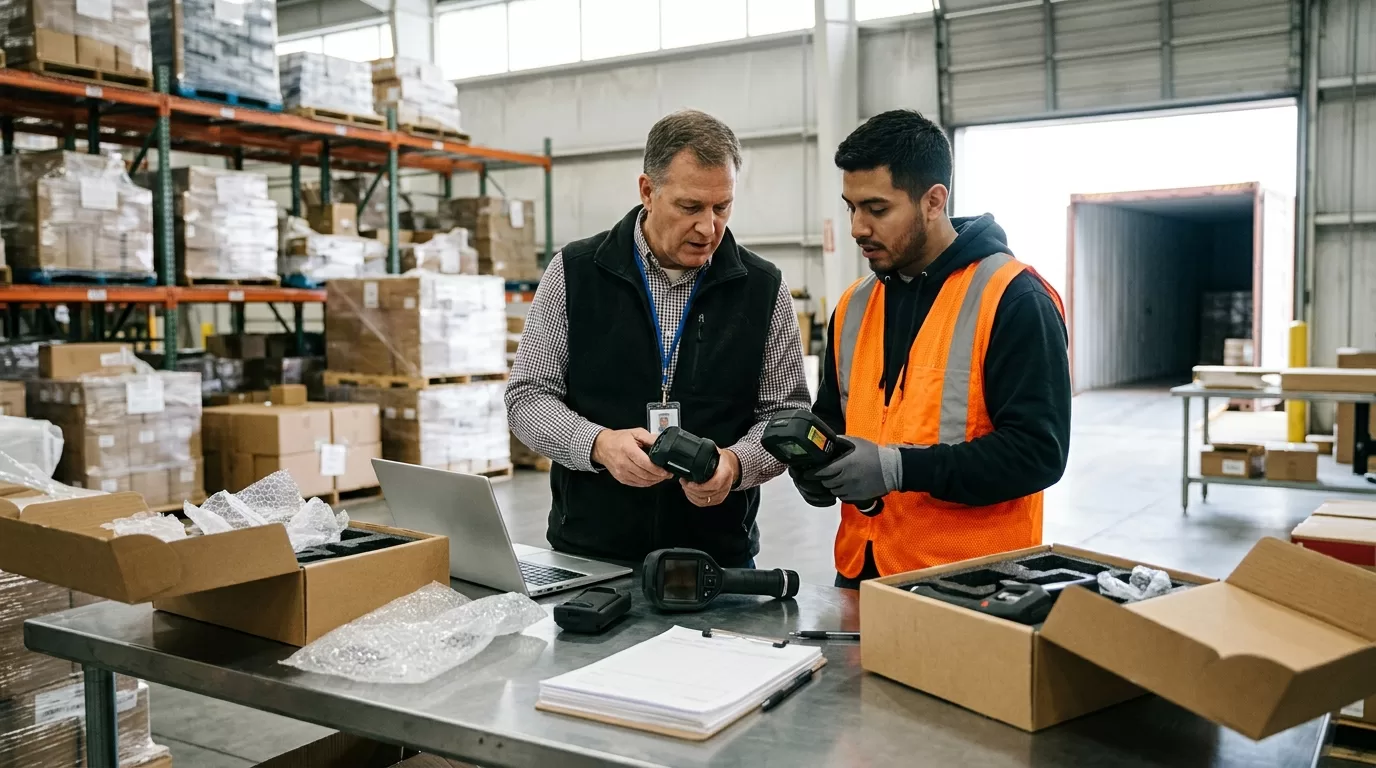
U.S. Customs and Border Protection moved the practical starting point for many finished thermal video cameras toward heading 8525 after the HS 2022 changes. In CBP Headquarters Ruling H331315, dated December 5, 2025, CBP classified the AXIS P1290-E Thermal Network Camera and AXIS Q1951-E Thermal Camera under HTSUS 8525.89.50 and stated that older thermal-camera rulings under heading 9013 were revoked by operation of law.
That ruling matters because importers still repeat old advice from forums, broker templates, and legacy supplier invoices. “Thermal camera equals Chapter 90” used to be a common shortcut. In 2026, it’s a bad shortcut for many finished video cameras.
| Product type | Common classification starting point | What to verify |
|---|---|---|
| Finished thermal network camera | 8525.89.50 | Video output, surveillance function, no sighting function |
| Handheld thermal imaging camera | 8525.89.50 | Finished camera vs measuring instrument |
| Thermal monocular | Often 8525.89.50 review | Civil outdoor use, no weapon mount, no ballistic features |
| Thermal weapon sight or scope | Don’t assume 8525.89.50 | Reticle, mounting system, sighting purpose |
| Thermal drone payload | Needs separate review | Gimbal, UAV integration, stabilizer, laser module |
| Thermal core or sensor module | Don’t use finished-camera logic | Detector-only vs camera output, part vs complete article |
When importing thermal cameras from China, ask the supplier for a spec sheet that names the detector resolution, frame rate, spectral band, output format, lens, mounting hardware, wireless functions, and intended use. “Infrared product” is not enough. Your customs broker can’t classify a product cleanly from a one-line Alibaba invoice.
A clean commercial invoice should say something like “finished handheld thermal imaging camera, uncooled LWIR, 384 × 288 detector, 50 Hz, no weapon mount, no laser rangefinder, country of origin China.” That’s boring. Boring is good at the port.
Customs clearance starts with the importer of record. If you’re the U.S. buyer, your company name, EIN, customs bond, broker power of attorney, and entry data need to line up. U.S. Customs and Border Protection uses CBP Form 7501 to record classification, value, origin, duty rate, and related entry data, so don’t treat the 7501 as broker back-office paperwork. Read it.

For ocean freight, your broker or forwarder will also need Importer Security Filing data before the container is loaded. For air freight, the timeline is shorter and the mistakes surface faster. A wrong model number on a carton label can still trigger questions, especially if the shipment contains lithium batteries, Wi-Fi models, or products described as “scope,” “sight,” “target,” or “payload.”
Use this file before shipment:
| Document | Who provides it | What must match |
|---|---|---|
| Commercial invoice | Supplier | Model, unit value, Incoterm, origin, buyer, seller |
| Packing list | Supplier | Carton count, gross weight, serial batches |
| Bill of lading or air waybill | Forwarder | Shipper, consignee, port, pieces |
| Spec sheet | Supplier or brand | Resolution, Hz, lens, battery, wireless functions |
| Country-of-origin marking proof | Supplier | Product label and retail packaging |
| FCC data, if wireless | Supplier | FCC ID, radio module, label location |
| Battery transport documents | Supplier | UN38.3 summary, MSDS, packing method |
DDP is tempting for first-time buyers because the supplier says, “We handle everything.” For thermal imaging products, DDP can hide the very data you’ll need later: HTSUS code, entry number, declared value, importer of record, and any Chapter 99 tariff line. If a marketplace freight agent clears the goods under its own importer number, your landed-cost history becomes foggy.
FOB Shenzhen, FOB Shanghai, or FCA factory usually works better for serious U.S. dealers because your broker controls the entry. EXW looks cheap on the quote sheet, but it pushes China export clearance and pickup risk onto the buyer. Most U.S. importers don’t want to manage a truck appointment in Dongguan just to save a few dollars on paper.
Thermal imaging is a civil technology with military applications. A camera used for hog hunting, electrical inspection, perimeter security, or search and rescue can share detector specs with equipment that export-control agencies care about.

For U.S. importers, the key point is timing. A normal U.S. import entry doesn’t become a BIS import license case just because the device is thermal. Export controls matter when the China supplier exports the goods, when U.S.-origin content or technology is involved, and when you later re-export, resell, or transfer the product outside the United States. If your customer is a defense contractor, police procurement office, drone integrator, or overseas distributor, the file needs more than a customs invoice.
The U.S. Bureau of Industry and Security treats many thermal imaging cameras under ECCN 6A003.b.4.b, with special attention to frame rate, focal plane array size, civil end users, and embedded uses. BIS §742.6 describes license requirements for certain thermal imaging cameras, including thresholds tied to more than 60 Hz and focal plane arrays above or below 111,000 elements. For a deeper split between defense controls and dual-use controls, read Pixfra’s guide to ITAR vs EAR for thermal imaging before you promise a shipment date to a reseller.
The number 111,000 is not abstract. A 384 × 288 detector has 110,592 elements, just under that line. A 640 × 512 detector has 327,680 elements, well above it. A 256 × 192 detector has 49,152 elements. Frame rate matters too: 9 Hz feels choppy when tracking a moving animal or vehicle, while 30 Hz, 50 Hz, or 60 Hz feels much smoother. Better viewing performance can mean more paperwork.
Watch these trigger points:
| Spec or feature | Why buyers should pause |
|---|---|
| 640 × 512 detector | Higher FPA element count raises export-control attention |
| More than 60 Hz | BIS rules call out frame-rate thresholds |
| 30 Hz or 50 Hz consumer models | Smooth image, but still needs classification support |
| Weapon mount or reticle | May change both classification and control analysis |
| Ballistic calculator | Strong sighting-use signal |
| Laser rangefinder | Adds another controlled component question |
| UAV gimbal integration | China export controls and U.S. end-use checks may apply |
| Military, police, border, or overseas buyer | End user screening becomes more serious |
China-side export controls can matter before the shipment leaves Shenzhen, Hangzhou, Wuhan, or Yantai. China has adjusted export controls for UAV-related components, including infrared thermal-imaging devices, and suppliers may ask for end-use statements when products are tied to drones, payloads, or higher-performance optics. If your supplier says “no license needed,” ask for that position in writing, tied to the exact model number.
HTSUS 8525.89.50 may show a general duty rate of free, but “free” doesn’t mean your landed cost is zero. China-origin goods can face separate Chapter 99 duties, Merchandise Processing Fee, Harbor Maintenance Fee for ocean freight, broker fees, bond costs, exam charges, and storage if anything goes wrong.

This is where importers get burned. They price a dealer program on the base HTSUS rate, then the broker adds a China tariff line at entry. The invoice margin shrinks overnight. If you quoted 200 thermal monoculars to a retailer at a fixed landed cost, that mistake comes straight out of your margin.
Ask your broker for a landed-cost worksheet before the first production deposit:
| Cost line | Where it comes from | Buyer note |
|---|---|---|
| Product value | Supplier invoice | Must reflect real transaction value |
| International freight | Forwarder | Depends on Incoterm |
| Insurance | Forwarder or buyer | Often small, still part of landed math |
| Base duty | HTSUS line | 8525.89.50 may show free for many entries |
| China tariff line | Chapter 99 review | Check current Section 301 status by entry date |
| MPF | CBP fee | Applies to formal entries |
| HMF | Ocean entries | Doesn’t apply to air freight |
| Broker and bond | Broker | Annual bond usually beats single bonds for repeat shipments |
Valuation is another quiet trap. If you supply free housings, tooling, firmware work, molds, engineering, labels, or packaging to the factory, tell your broker. Some assists and royalties may need to be added to customs value. A $180 camera can become a $194 customs value after additions, and duties follow the adjusted value.
Country-of-origin marking should be in English and visible enough for retail reality. “Made in China” on the master carton alone may not work if the product is repacked into dealer packaging after entry. If you sell through Amazon, Bass Pro-style retail, independent hunting shops, or security distributors, ask for photos of the unit label and retail box before the balance payment.
A customs broker doesn’t need to be a thermal engineer, but your broker does need product data. Send the spec sheet, product photos, user manual, battery details, and sales page before the shipment leaves China. If the broker only sees “thermal camera” after arrival, the broker is guessing under pressure.

The best question is plain: “Would you file this entry the same way if CBP opened the carton and read the manual?” If the answer is no, fix the paperwork. Manuals often reveal words that invoices hide: reticle, zeroing, ballistic profile, target tracking, gimbal, drone, law enforcement, weapon mount. Those words don’t always create a problem, but they change the review.
Ask these before the purchase order:
1. Which HTSUS code would you use for this exact model?
2. Do you see any reason to request a CBP binding ruling?
3. Does the product description need to mention “thermal imaging” rather than “digital camera”?
4. Are there any Chapter 99 China tariff lines on the entry date?
5. Does the product have Wi-Fi, Bluetooth, cellular, GPS, or a radio remote?
6. Does the FCC ID belong to the finished device or only to a module?
7. Is the lithium battery packed in equipment, with equipment, or alone?
8. Does the product include a laser rangefinder?
9. Does the model have a reticle, weapon mount, or ballistic calculator?
10. Will the supplier provide an export-control statement by model number?
Some products deserve a CBP binding ruling before volume import. Thermal scopes, clip-on weapon sights, drone payload cameras, fever-screening devices, and camera cores are the usual candidates. A ruling takes more time than a broker email, but it gives you a written position tied to the exact facts you submitted.
Medical claims change the lane. A thermal camera sold for fever screening or diagnosis can bring U.S. Food and Drug Administration medical-device questions into the import file. A thermal monocular sold for outdoor observation usually doesn’t belong in that same medical bucket. Claims on the website, box, manual, and Amazon listing matter.
For dealers, the practical goal is simple: build a model-level compliance packet once, then reuse it for every shipment until the model changes. Don’t rebuild the entry file from scratch for every carton. Keep the spec sheet, HS rationale, export-control statement, battery documents, FCC data, marking photos, and supplier declaration in a shared folder named by model and revision.

That revision detail matters. A supplier can change a 25 Hz model to 50 Hz, swap a 384 × 288 detector for 640 × 512, add Wi-Fi, or release a “Pro” trim with a laser rangefinder. The sales name may stay almost the same. Customs and export-control facts won’t.
Use this checklist for importing thermal cameras from China at dealer scale:
| Step | Action | Why it matters |
|---|---|---|
| 1 | Lock the exact model and trim | “T50” and “T50 Pro LRF” may not be the same product |
| 2 | Collect detector and frame-rate specs | 384 × 288, 640 × 512, 9 Hz, 50 Hz all matter |
| 3 | Identify the product function | Handheld camera, monocular, scope, payload, core |
| 4 | Get broker HS review in writing | Stops invoice-level guessing |
| 5 | Check Chapter 99 tariff exposure | Base duty isn’t the full landed cost |
| 6 | Confirm FCC status for wireless models | Wi-Fi and Bluetooth can hold up retail sale |
| 7 | Save battery transport documents | Airlines and couriers ask for them often |
| 8 | Screen end users for sensitive deals | Defense, UAV, and overseas resale raise the bar |
| 9 | Review labeling photos | Origin marking must survive repacking |
| 10 | Recheck after model changes | New specs can change the answer |
The biggest tradeoff is performance versus paperwork. A 9 Hz entry-level monocular may be easier to place in low-risk civil retail channels, but it won’t feel as natural when a hunter pans across a tree line or a security guard follows a moving vehicle. A 50 Hz 640 × 512 model gives a better field experience, but the compliance packet needs to be tighter.
If you sell to only U.S. civilian outdoor customers, your workflow can stay lean. If you sell to drone integrators, overseas dealers, public agencies, or defense-adjacent buyers, add end-use screening and export-control review before accepting the order. A fast sale to the wrong buyer is not worth the refund, seizure risk, or follow-up questions.
Many finished thermal imaging cameras are commonly reviewed under HTSUS 8525.89.50, especially after CBP’s 2025 ruling on thermal network cameras. Thermal scopes, drone payloads, cores, and sensor modules need separate review.
Yes. Thermal cameras have civil uses such as hunting, inspection, firefighting, and security, but some specs and end uses are controlled because the same technology can support military, UAV, or surveillance applications.
Not automatically for U.S. import, but 9 Hz doesn’t erase all export-control issues. End user, destination, model design, U.S.-origin content, and later re-export plans still matter.
DDP can work for samples, but it’s risky for repeat dealer imports because you may lose visibility into the entry, HTSUS code, declared value, and importer of record. Use your own broker for volume shipments.
Ask for detector resolution, frame rate, spectral range, lens, wireless functions, battery type, laser features, mounts, reticle status, country of origin, FCC data if wireless, and an export-control statement by model number.
Before you issue the first purchase order, ask Pixfra for the model spec sheet, marking details, wireless status, battery packing data, and export-control statement your broker needs. Send the same packet to your customs broker before the shipment leaves China; port problems are cheaper on a spreadsheet than at LAX, JFK, or Long Beach.
To become a thermal optics dealer, you need a real buyer base, clear resale terms, compliant sales processes, trained staff, and the right starter inventory. The fastest path is to prove you can sell thermal monoculars, thermal scopes, and multispectral optics to specific US buyers without treating every device like a generic outdoor gadget.
1. Define your buyer group.
2. Match Pixfra SKUs to that use.
3. Register business and resale tax paperwork.
4. Set export, age, and hunting-rule controls.
5. Build demo inventory.
6. Train staff on sensors and rangefinders.
7. Agree margin, MAP, warranty, and reorder terms.
8. Apply and report sell-through.
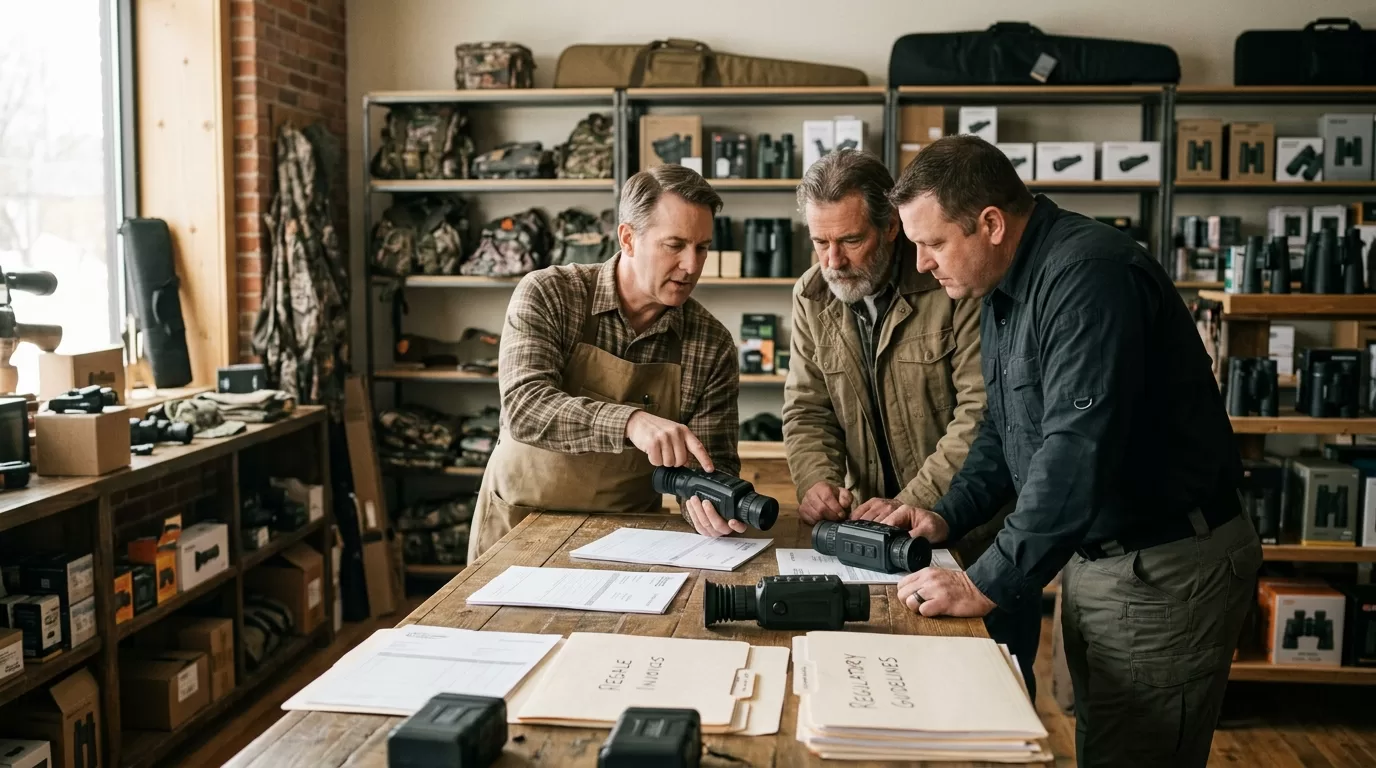
A thermal dealer isn’t just a store with a shelf. You’re the person a ranch owner calls before buying a handheld scanner for coyotes at 2 a.m. You’re also the person who explains why a 640×512 thermal scope costs more than a compact entry monocular, and why a built-in laser rangefinder matters when the customer can’t judge distance in a black field.
If your real aim is to become a thermal optics dealer, start by narrowing the buyer. Predator hunters, hog hunters, ranch security teams, outdoor retailers, tactical resellers, and property managers do not ask the same questions. A coyote hunter cares about field of view and fast target ID. A ranch manager cares about battery life, warranty handling, and whether an employee can learn the menu in ten minutes.
The mistake is ordering inventory first. Don’t. First, write down your top 25 likely buyers by name: local hunting clubs, firearm stores, feed stores, ranches, outfitters, security installers, and night-hunting guides. If you can’t name 25, your dealer application is still a theory.
Dealer readiness checklist
| Area | Minimum proof | Strong proof |
|---|---|---|
| Buyer access | 25 named prospects | 100+ opt-in buyers or retail foot traffic |
| Product knowledge | Basic thermal terms | Staff can compare NETD, resolution, FOV, LRF |
| Sales channel | Website or store | Store, e-commerce, demos, local events |
| Compliance | State hunting links | Written export and use-policy workflow |
| Service | Email support | Intake form, serial tracking, warranty process |
The best thermal dealers pick one primary customer first. “Outdoor people” is too broad. A store that already sells e-callers, tripods, gun safes, and predator hunting lights can add Pixfra outdoor thermal optics without teaching customers a new buying habit. A camera dealer or security installer may still sell thermal devices, but the sales motion is different: fewer impulse buys, more quote requests, more training.
For US outdoor optics, the strongest B2B fit usually comes from four buyer groups. Predator and hog hunters want fast detection. Ranch and farm users want perimeter awareness. Outdoor retailers want reliable turn. Security installers want repeatable specs and support. Pick one. Then build the offer around that buyer’s real night problem.
| Buyer type | What they ask first | Better starter product angle |
|---|---|---|
| Predator hunter | “How far can I detect?” | Thermal monocular plus thermal scope path |
| Hog hunter | “Can I identify before I shoot?” | Higher resolution, stable image, range help |
| Ranch owner | “Will my staff use it?” | Simple controls, warranty, rugged carry setup |
| Retail store | “Will it move?” | Demo unit, MAP clarity, staff training |
| Security installer | “Can we document specs?” | Data sheets, repeatable model naming |
Here’s a real scenario. A customer walks into a shop after watching five thermal videos online. He asks for “the long-range one.” If your staff only repeats detection range, he may leave with the wrong device. If your staff asks where he hunts, typical shot distance, terrain, target species, and whether he needs recording or a laser rangefinder, the sale changes. That’s dealer value.
This advice doesn’t apply if you’re only trying to flip a few units on a marketplace. Thermal optics customers ask expensive questions. They expect after-sale help. If you can’t support firmware questions, app connection issues, mount selection, or warranty routing, stay out of the category until you can.
A manufacturer or distributor will usually want proof that you’re a real business. Expect to provide legal business name, resale certificate, website or storefront details, contact person, shipping address, sales channels, and the product category you want to carry. Some brands may ask for projected monthly volume or current outdoor optics lines. That’s normal.

The money needs plain math. Suppose your wholesale cost on a thermal optic is $1,200 and the minimum advertised price is $1,599. Your gross margin is $399 before card fees, freight, staff time, demos, returns, and tax handling. That’s 24.9%. If you discount to $1,450 to win a quick order, the margin drops to $250, or 17.2%. One warranty-heavy return can erase that.
For a dealer, MAP discipline beats chasing every sale. A store that protects price, trains staff, and sells accessories often keeps healthier margin than a seller who cuts price online and ships boxes with no support. Thermal optics are explanation products. Explanation products reward dealers who can teach.
Dealer cost model
| Cost item | Why it matters | Practical target |
|---|---|---|
| Demo unit | Customers want to look through thermal | 1 unit per key product tier |
| Staff training | Bad explanations cause returns | 2 trained staff minimum |
| Freight and insurance | Higher-value devices need safer shipping | Price it before quoting |
| Card processing | 2.5% to 3.5% can hurt margin | Build it into price math |
| Warranty intake | Serial numbers and photos save time | Use a written form |
| Akcesoria | Mounts, cases, batteries, tripods | Attach rate above 20% |
Don’t promise what your policy can’t support. If you offer “free returns” on mounted thermal scopes after field use, you’ll pay for it. A tighter policy works better: demo before purchase, inspect on delivery, document serial numbers, and handle warranty claims through the approved process.
Starter inventory should cover use cases, not every SKU. A good first order might include one compact thermal monocular for entry buyers, one 640-class monocular for serious detection, one thermal scope line for hunters ready to mount, and one multispectral or rangefinder option for customers who want more than basic heat detection. That’s enough to teach, demo, and sell without tying up cash in slow-moving variants.
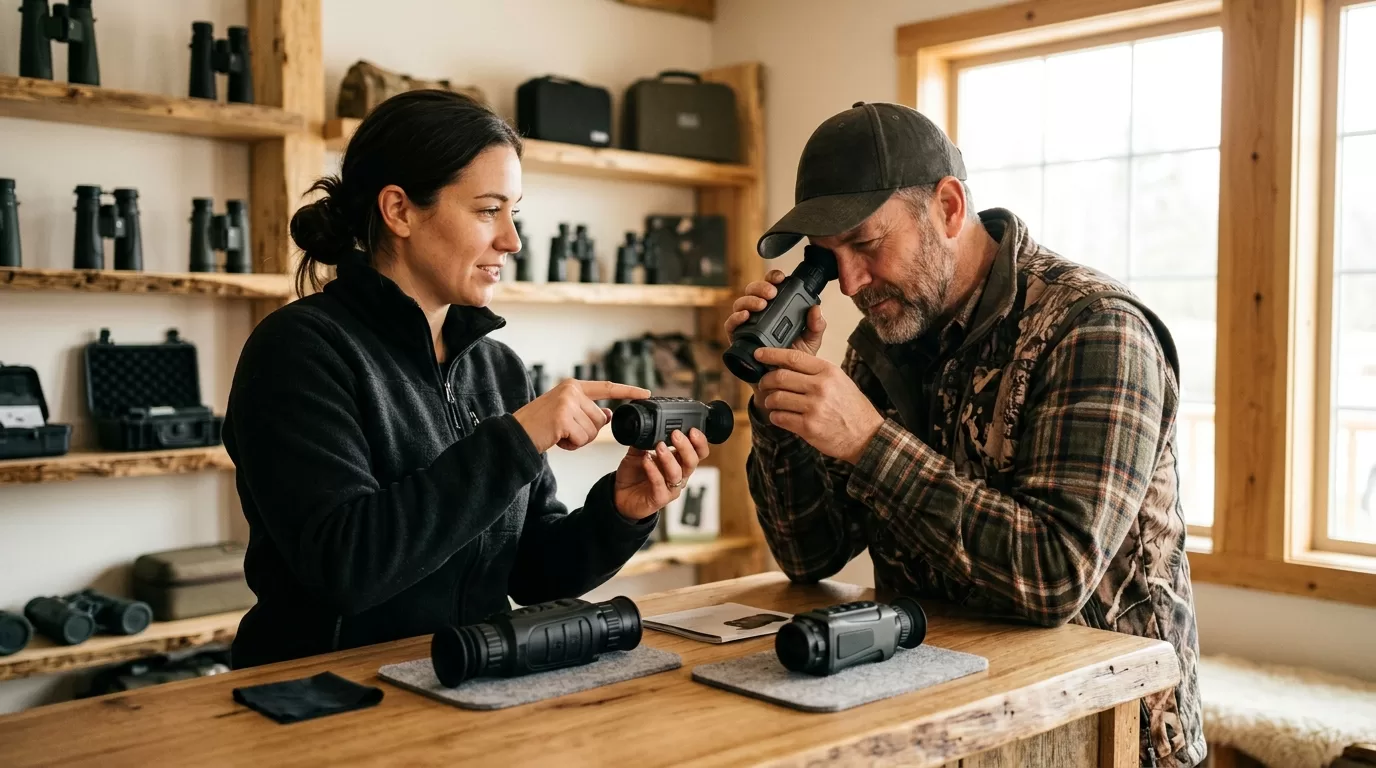
Pixfra gives dealers a useful spread. Sirius 640 is positioned as a long-range thermal monocular with up to 2600m detection, 18mK NETD, and an F0.9 lens. Arc LRF adds laser rangefinder use, with a 1000m rangefinder claim on Pixfra’s product page. Draco combines thermal imaging, 4K digital night vision, laser rangefinder, and infrared illumination. Mile 2 fits the compact buyer. Taurus fits thermal scope customers who ask for up to 640×512 detector resolution and 18mK NETD or lower.
| Starter role | Pixfra example | Best buyer match |
|---|---|---|
| Compact scanner | Seria Mile 2 | First thermal buyer, backpack user |
| Long-range handheld | Sirius 640 | Ranch, predator, open-field scanning |
| Rangefinder handheld | Arc LRF | Hunters who need distance confidence |
| Multi-mode optic | Draco | Buyers comparing thermal and night vision |
| Thermal scope | Seria Taurus | Mounted hunting setup |
A dealer should demo at dusk, not at noon in a parking lot. Thermal sells when a buyer sees heat contrast: tree lines, parked trucks, dogs at distance, warm rocks cooling after sunset. A daytime demo can still explain ergonomics, menus, and screen quality, but it won’t close as well.
If your team needs brand context before choosing models, the Pixfra thermal imaging optics site is a practical place to compare current outdoor lines before building a stocking plan. Keep the product story simple: what the customer sees, how far the customer can detect, how easy the device is to carry, and what problem the device solves at night.
Thermal optics sales touch export control, hunting law, platform rules, and customer safety. The Electronic Code of Federal Regulations, 2026, publishes the Export Administration Regulations Commerce Control List under 15 CFR Part 774, including Category 6 for sensors and lasers. The Bureau of Industry and Security regulations are the source dealers should check before export, reexport, or international shipment.
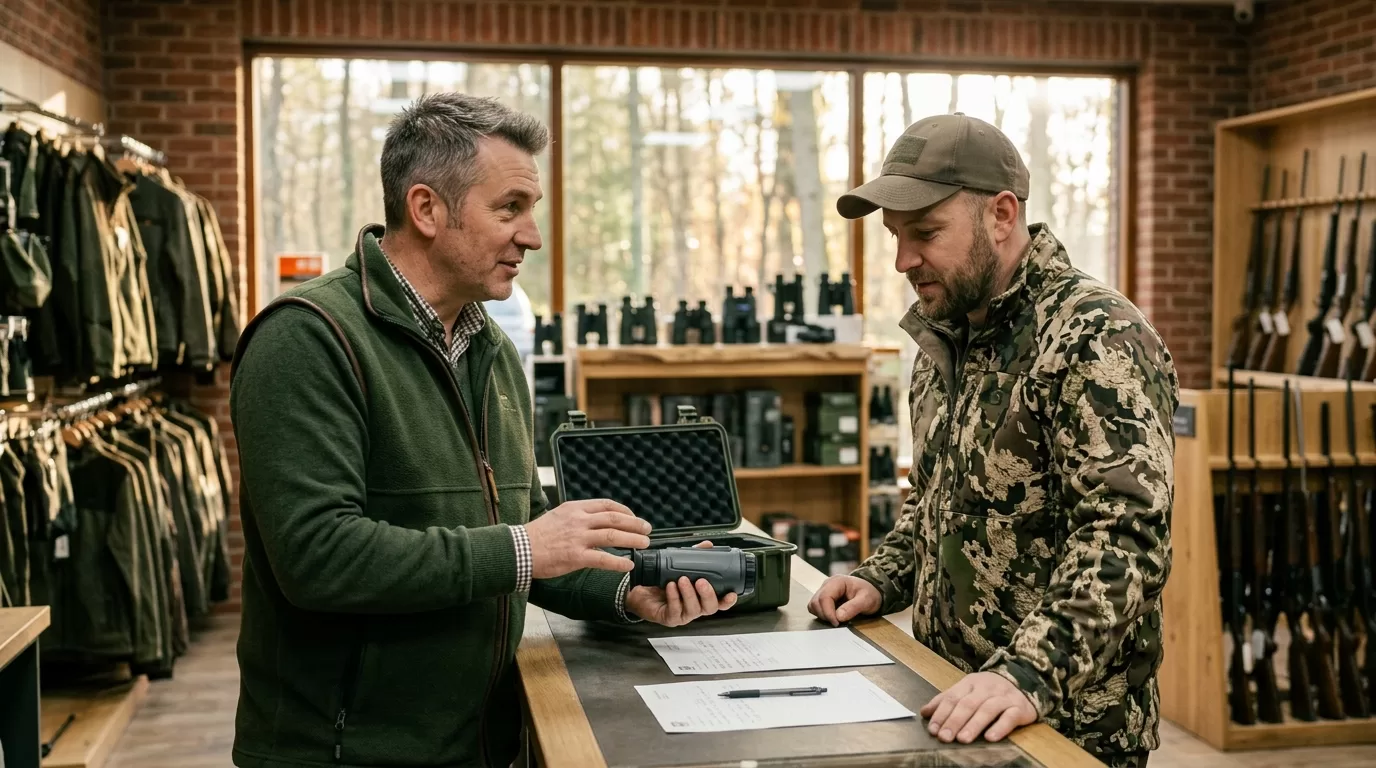
Domestic hunting use is a separate issue. Thermal devices may be legal for scouting, predator control, or certain night hunts in one state and restricted in another. The U.S. Fish and Wildlife Service says refuge hunting can be limited by federal, refuge-specific, and state law, according to its General Hunting Laws. Train staff to say, “Check your state wildlife agency before using thermal equipment to hunt.” That sentence prevents bad advice.
Dealer rule: sell the device, document the buyer, explain lawful-use limits, and avoid giving legal advice beyond official links.
Sprzedaż internetowa wymaga własnych mechanizmów kontroli. Jeśli prowadzisz sprzedaż za pośrednictwem swojej strony internetowej, zablokuj możliwość realizacji zamówień międzynarodowych do czasu sprawdzenia klasyfikacji eksportowej oraz przepisów dotyczących miejsca przeznaczenia. Jeśli sprzedajesz na platformach handlowych, przed wystawieniem oferty zapoznaj się z zasadami platformy dotyczącymi akcesoriów do broni i optyki. Jeśli prowadzisz sprzedaż stacjonarną, trzymaj krótki, pisemny skrypt przy kasie. Fluktuacja personelu jest faktem; skrypt zapewnia spójność udzielanych odpowiedzi.
This is where expert dealers separate themselves from box movers. A buyer may ask, “Can I take this to Mexico for a hunt?” The answer isn’t a shrug. It’s a process: identify the exact model, classify the item, check export rules, check destination rules, then decide whether the sale or shipment is allowed. Fast answers can be expensive.
Before you contact Pixfra or a distributor, build a one-page dealer profile. Keep it factual. Include your company name, state, business type, current product categories, website, monthly foot traffic or online traffic, target customer group, requested Pixfra product lines, and who will manage service. If you’re a new business, say that. A clear new dealer is better than a vague established one.

Add a 90-day launch plan. For example: two staff training sessions in week one, one evening demo event in week three, 20 outreach calls to ranches or hunting guides, five short product videos, and a reorder review after the first 10 units sold. You don’t need a giant plan. You need a believable one.
Dealer application packet
| Document | Why it helps |
|---|---|
| Business license or registration | Confirms legal business identity |
| Resale certificate | Supports wholesale purchasing |
| Website or storefront photos | Shows sales channel quality |
| Product-line list | Shows related category fit |
| Buyer segment plan | Proves you know who will buy |
| Service contact | Gives warranty and support ownership |
| Compliance workflow | Shows responsible thermal optics sales |
When you apply, ask direct commercial questions. What are the opening order requirements? Which SKUs are best for US outdoor dealers? Is MAP enforced? What is the warranty process? Are demo units available? Who handles replacement parts or firmware questions? How long do reorders take? What marketing assets can dealers use?
The strongest dealer applications sound like operators wrote them. “We sell to predator hunters in Texas and Oklahoma through a retail store and two night-hunting demo events per month” beats “we want to expand into thermal.” Specific wins.
Yes, thermal optics resale can be profitable when margin, MAP, freight, card fees, and warranty time are priced correctly. A dealer chasing discounts can lose money even on high-ticket products.
A normal US resale business may not need a special optics license for domestic sales, but export control and hunting-use rules still matter. Check BIS rules and state wildlife agency rules before shipping or advising buyers.
Compact monoculars often sell first because the price is easier for new thermal buyers. Serious hunters usually move toward Sirius, Arc LRF, Draco, or Taurus once they understand range, resolution, and use case.
Yes, dealers can sell thermal scopes online if manufacturer terms, platform rules, tax setup, shipping limits, and export controls are handled. Block international orders until classification and destination checks are complete.
Dealer approval time varies by brand, paperwork quality, and territory review. A complete application with resale documents, sales channels, buyer plan, and compliance workflow will usually move faster than a casual inquiry.
If you’re ready to build a serious thermal category, start with one demo kit for hunters, one kit for ranch or property use, and a written staff script for compliance questions. Pixfra can support dealers who treat thermal optics as a specialist category, not a side shelf.
Spec sheets tell you what a thermal device should do. The field tells you what it actually does. We took our Pixfra thermal devices — monoculars, scopes, and front attachments — into real hunting and observation conditions across varying terrain, weather, and lighting to see how they held up when it counted. Here’s what we found.
Too many thermal device reviews in 2026 rely on manufacturer claims, controlled lab numbers, and best-case scenarios. And while those specs give you a starting point, they don’t tell you how a device handles at 2 AM in a foggy tree line, or whether your battery dies before the hogs show up, or if you can actually tell a coyote from a stump at 400 meters in heavy humidity. That gap between on-paper performance and real-world results is exactly why we ran this field test. We wanted to push our own gear hard — not to prove that every number is perfect, but to show you what our thermal devices do when conditions get ugly. If you’re shopping for a thermal monocular, thermal scope, or thermal front attachment in 2026, this case study gives you field data, not marketing talk. And if you want a breakdown of the specs that matter most before you buy, our guide to the 6 najważniejszych cech, jakie powinno posiadać najlepsze urządzenie termiczne w 2026 roku is worth reading alongside this one.
There’s a reason experienced hunters and wildlife observers focus on field-tested results over spec sheets: the real world doesn’t cooperate with ideal testing conditions. A thermal monocular rated for 2,000-meter detection in a climate-controlled lab may perform very differently across a humid Southern pasture or a cold Rocky Mountain ridge. Temperature swings, fog, rain, ambient heat radiating off the ground — all of these mess with thermal imaging in ways that a product page never mentions.

We built this case study around that reality. Instead of running bench tests in a controlled room, we took our Pixfra lineup — including models from the Sirius HD, Mile 2, Arc LRF, Chiron LRF, Taurus LRF, and Volans series — and used them in conditions that match how real buyers actually use them. Night hunts for hogs and predators. Pre-dawn wildlife observation in dense tree cover. Property scans in rain and fog. Extended sessions where battery life and ergonomics become the deciding factors. We logged detection distances, image clarity ratings, battery drain rates, and usability notes across every outing.
The approach mirrors what field testers across the thermal optics industry are doing in 2026. Hands-on testing under real conditions — not lab environments — is how you separate the thermal devices that work from the ones that frustrate you by the third outing. And that’s exactly where our Pixfra devices had to prove themselves.
We ran our tests over a three-week stretch across two distinct environments: open ranch land in the South (flat, warm, humid) and mixed woodland-field terrain in the mid-Atlantic (rolling hills, dense vegetation, cooler nights). This gave us a spread of conditions that cover most hunting and outdoor scenarios you’d run into across the U.S.

Each device went through a standardized set of evaluations: detection range at measured distances using human-sized and deer-sized heat targets, image clarity at various magnifications, battery life under continuous use, ergonomic handling with and without gloves, and performance under adverse weather including light rain, heavy fog, and temperature drops below 35°F. We tested during full darkness, twilight, and — for our Volans series — broad daylight to evaluate its all-day vision capability with the adjustable aperture (F1.2 to F3.0).
Here’s a snapshot of our testing conditions and protocols:
| Test Parameter | Conditions/Method |
|---|---|
| Zasięg wykrywania | Measured targets at 200m, 500m, 1,000m, 1,500m, and 2,500m+ |
| Image clarity | Rated 1–10 at each distance under clear, fog, and rain conditions |
| Żywotność baterii | Continuous use, screen brightness at 70%, Wi-Fi off, ambient 40–75°F |
| Cold weather battery drain | Same protocol at 28–35°F to measure cold-induced performance drop |
| Gloved operation | Full menu navigation with insulated hunting gloves |
| LRF accuracy | Verified rangefinder readings against known-distance markers |
| Trwałość | Exposure to rain, drops onto packed dirt, sustained use in dusty terrain |
| Startup time | Cold boot to usable thermal image |
Every Pixfra model we tested uses our proprietary heat-detection technology paired with 12μm pixel pitch sensors. NETD ratings across our lineup sit at ≤18mK, which places them at the high end of thermal sensitivity for hunting-grade optics. That sensitivity became a key differentiator in our fog and humidity tests, where devices with higher NETD values tend to wash out and lose contrast between targets and background heat.
This is where the rubber met the road. On clear nights with big temperature differentials between targets and the background, most thermal devices on the market look decent. The real test comes when conditions compress that temperature gap — warm summer nights, fog, rain, or when ground heat lingers after a hot day. That’s where NETD separates a sharp, usable image from a blurry mess.

Our Pixfra devices, with NETD values of ≤18mK, delivered defined target outlines even in the toughest sessions. During one fog-heavy evening on the ranch, we spotted a group of hogs at roughly 600 meters using the Sirius HD — not just as heat blobs, but with enough definition to count individual animals and see their direction of movement. The Sirius HD series pushes detection out to 3,600 meters under ideal conditions, and during our clear-night tests, we consistently picked up heat signatures beyond 2,500 meters. At that distance, identification wasn’t possible, but detection was reliable and repeatable.
The Mile 2 series, aimed at everyday hunters and outdoor enthusiasts, hit its sweet spot between 200 and 600 meters. Image quality at 3x and 4x base magnification stayed clean and high-contrast. Pushing the digital zoom past 8x softened the image, as expected, but targets remained usable for detection out to about 1,000 meters. For most recreational hunters working inside 300–600 meters — which covers the majority of whitetail, hog, and predator hunting in the U.S. — the Mile 2 delivered more than enough image quality to make clean target IDs.
One standout finding: sensor resolution alone doesn’t tell the full story. We paired our 384×288 and 640×512 sensor models against each other in identical conditions, and while the 640×512 models produced sharper images at distance, the 384×288 models with strong NETD and well-tuned image processing still gave usable identification at practical hunting ranges. The takeaway? Resolution matters, but thermal sensitivity and pixel pitch matter just as much — if not more — when conditions turn against you.
Battery life is the feature nobody talks about until it fails. And in our testing, it became one of the clearest performance separators between a device that lasts through a full hunt and one that leaves you in the dark — literally.
Our Pixfra devices range from approximately 4.5 hours to 15 hours of battery life depending on the model and usage. We tested each at 70% screen brightness with Wi-Fi off, which represents realistic hunting use. The models running standard 18650 batteries — including the Arc LRF, Mile 2, and Chiron LRF — gave us the most flexibility. When a battery started dipping toward the end of a session, we swapped in a fresh 18650 from a jacket pocket in under 10 seconds. That swap-and-go design is a deliberate choice on our part, and it proved its value on every all-night session we ran. Proprietary sealed batteries might shave a few grams off the weight, but when you’re deep in a hunt and the power drops, having a spare 18650 ready is worth every gram.
Cold weather tested our batteries hard. At temperatures around 30°F, we measured roughly a 30–40% drop in effective battery life compared to our warm-weather sessions. That tracks with industry-wide data on lithium battery performance in cold conditions. Our field tip: keep your spare batteries in an inside jacket pocket where body heat keeps them warm. We did this throughout testing and never ran out of power during a single outing.
On the build quality side, all of our tested models survived the full three-week test period without a single failure. We exposed every device to rain, dust, accidental drops onto packed dirt, and the kind of rough pack-and-carry treatment that comes with real fieldwork. Our IP67-rated housings handled full water exposure without issue — one unit took a direct dunk into a shallow creek crossing and came out working perfectly. The controls stayed responsive even when wet or operated with heavy insulated gloves, which matters a lot more than you’d think when you’re scanning a tree line at 3 AM in freezing drizzle.
The Draco series earned special mention for its lightweight design. During extended 4+ hour observation sessions, we noticed significantly less arm fatigue compared to heavier units. That weight difference sounds minor on paper, but after a few hours of repeated scanning, your muscles notice.
A thermal device in 2026 isn’t just a sensor with a screen — it’s a connected field tool. And during our testing, the smart features on our Pixfra lineup didn’t just check a box; they made real differences in how efficiently we worked in the field.

The integrated laser rangefinders on our LRF models — Arc LRF, Chiron LRF, and Taurus LRF — gave us instant, accurate distance readings out to 1,000 meters. We verified LRF accuracy against known-distance markers and found the readings consistently landed within ±1 meter. For hunters taking shots beyond 150 yards at night, that kind of precision removes guesswork and directly improves shot confidence. Paired with the built-in ballistic calculators on the Chiron LRF and Taurus LRF, we had computed bullet drop and adjusted aiming points available on-screen without switching devices or pulling out a separate rangefinder. That integration saved us time and kept our workflow smooth during fast-paced hog encounters.
The Pixfra Outdoor App, which supports all our current models including the Sirius, Arc LRF, Mile 2, Pegasus Pro, Chiron LRF, Taurus, and Taurus LRF series, handled firmware updates, settings adjustments, and image transfers without issues during our test period. We transferred hunt footage to smartphones for quick review between sessions and shared scouting data with other team members in real time. The color palette options — White Hot, Black Hot, Red Hot, Iron Bow, and Rainbow — let us adapt display modes to different conditions and personal preferences. Black Hot became our team favorite for predator hunts, giving us better body detail on animals against mixed-temperature backgrounds.
Our Volans series stood out with its all-day vision capability. We ran it in broad daylight, through twilight, and into total darkness, adjusting the aperture between F1.2 and F3.0 as lighting changed. The result was one device that handled every lighting condition we threw at it — no need to carry a separate optic for daytime use. The 50Hz refresh rate across our lineup also delivered the smooth, fluid imaging we needed to track fast-moving targets without the blur or stutter that lower refresh rates produce.
The Taurus and Taurus LRF thermal front attachments also proved their value as a flexible option for hunters who don’t want to replace their existing daylight scope. With ultra-fine 0.9cm@100m click value for zeroing, we achieved precise alignment that held through repeated sessions without drift. For hunters already running a quality daylight optic, the Taurus clips on and adds thermal capability without changing your primary setup — a practical approach that’s popular with European hunters and gaining ground fast in the U.S.
We didn’t run this test to claim perfection. We ran it to show you, with real data from real conditions, what our Pixfra thermal devices actually deliver in the field. The ≤18mK NETD sensitivity, 12μm pixel pitch sensors, swappable 18650 batteries, IP67-rated builds, integrated LRFs and ballistic calculators, companion app connectivity, and all-day vision on the Volans series — these aren’t just features on a spec sheet. They’re tools that performed when conditions got tough, sessions ran long, and weather turned ugly.
Whether you’re a hog hunter in Texas, a predator hunter in the Midwest, a wildlife observer on the East Coast, or a property owner keeping an eye on your land after dark, the results from this case study give you a clear picture of what you’re getting. Thermal imaging technology has reached a point in 2026 where mid-range devices deliver performance that was premium-only just two years ago. Our lineup at Pixfra reflects that shift — from the entry-accessible Mile 2 series all the way to the professional-grade Sirius HD.
If you want to dig deeper into the specific features that define a great thermal device this year, head over to our breakdown of the 6 najważniejszych cech, jakie powinno posiadać najlepsze urządzenie termiczne w 2026 roku. And when you’re ready to choose the right model for how you hunt, explore, or observe, you’ll find every product in our lineup at Pixfra.com.
What is the real detection range vs. identification range on a thermal device?
Detection range tells you how far the sensor can pick up a heat signature. Identification range — where you can confirm what you’re looking at — is always shorter. In our field tests, real-world identification range typically ran about 30–40% of the stated detection range. Our Pixfra models range from around 500 meters for entry-level devices up to 3,600 meters for the Sirius HD series, but we always recommend checking identification range for your specific use case, not just the headline detection number.
How does cold weather affect thermal device battery life?
Cold temperatures hit lithium battery performance hard. During our testing at around 30°F, we saw a 30–40% drop in effective battery life compared to warm conditions. The solution: use models with swappable 18650 batteries and carry spares in an inside pocket where body heat keeps them warm. Many of our Pixfra models use 18650s specifically for this reason — you can swap a fresh battery in seconds without downtime.
Can you use a thermal device during the day?
Yes. Thermal devices detect heat, not visible light, so they work in full daylight just as well as total darkness. Our Pixfra Volans series goes a step further with an adjustable aperture (F1.2 to F3.0) designed for all-day vision, making it one of the few thermal devices that adapts smoothly across every lighting condition from noon sun to midnight.
Is a built-in laser rangefinder worth it on a thermal monocular or scope?
For hunters shooting beyond 150 yards at night, absolutely. A built-in LRF removes the need for a separate ranging device and gives you exact distance data with the press of a button. Our Pixfra Arc LRF, Chiron LRF, and Taurus LRF models all include integrated laser rangefinders with 1,000-meter range. Paired with onboard ballistic calculators, they deliver a complete targeting solution in one unit.
What IP rating do I need for a thermal device used outdoors?
For any real outdoor use — hunting, hiking, wildlife observation, property monitoring — you want at least an IP67 rating. IP67 means the device is fully sealed against dust and can handle temporary water submersion, covering rain, stream crossings, snow, and accidental drops into puddles. Our Pixfra devices are built to handle these conditions, and our IP67-rated models survived direct water exposure during our field tests without any issues.
Od nocnych patroli po przeszukiwanie terenu – urządzenia termowizyjne zapewniają służbom ochrony i organom ścigania przewagę taktyczną, której nie są w stanie zapewnić latarki ani standardowe kamery. Na stronie Pixfra, produkujemy monokularowe urządzenia termowizyjne, lunety i nakładki przednie przeznaczone do rzeczywistych warunków terenowych — i przygotowaliśmy listę 8 najlepszych urządzeń termowizyjnych dla służb bezpieczeństwa i organów ścigania w 2026 roku.
Termowizja przestała być niszowym narzędziem wojskowym, stając się standardowym elementem wyposażenia policji, prywatnych firm ochroniarskich oraz zespołów patrolujących tereny prywatne w całych Stanach Zjednoczonych. Kamery termowizyjne wykrywają ciepło, umożliwiając funkcjonariuszom organów ścigania widzenie w całkowitej ciemności. W przeciwieństwie do kamer noktowizyjnych kamery termowizyjne nie wymagają światła otoczenia i zachowują ostrość obrazu w każdych warunkach oświetleniowych. Jeśli ktoś ukrywa się za krzakiem, pod samochodem lub kuca w ciemnej uliczce, ciepło jego ciała pojawia się na ekranie termowizyjnym jako świecący kontur. Ręczne kamery termowizyjne działają poprzez tworzenie wirtualnego obrazu przedstawiającego sygnatury cieplne obiektów znajdujących się w polu widzenia, a urządzenia te zapewniają służbom ratowniczym dyskretną metodę nadzoru, dając im przewagę taktyczną w nocy. Dla funkcjonariuszy organów ścigania pracujących na późnej zmianie lub reagujących na wezwanie w zalesionym terenie nie jest to tylko miły dodatek — to linia ratunkowa, która zapewnia im większe bezpieczeństwo i skuteczność podczas każdej zmiany.

Rynek urządzeń termowizyjnych w 2026 roku wygląda zupełnie inaczej niż jeszcze kilka lat temu. Rozdzielczość czujników wzrosła, a ceny spadły. Rozdzielczość 640×512, która kiedyś należała do segmentu premium, jest obecnie standardem w klasie średniej, a czułość NETD poniżej 20 mK jest dostępna również w sprzęcie innym niż ten przeznaczony wyłącznie do zastosowań wojskowych. Dzięki tym postępom policja, agencje ochrony oraz właściciele prywatnych nieruchomości mają teraz dostęp do kamer termowizyjnych zapewniających wyraźny obraz o wysokim kontraście za ułamek ceny z zaledwie trzech czy czterech lat temu. Jeśli chcesz dowiedzieć się więcej o tym, co odróżnia doskonałe urządzenie termowizyjne od tego, o którym szybko się zapomina, zapoznaj się z naszym zestawieniem 6 najważniejszych cech, jakie powinno posiadać najlepsze urządzenie termiczne w 2026 roku.
Niezależnie od tego, czy jesteś funkcjonariuszem patrolującym parking, członkiem oddziału SWAT przeprowadzającym akcję oczyszczania budynku, funkcjonariuszem straży granicznej obserwującym linię ogrodzenia, czy też prywatnym ochroniarzem patrolującym dzielnicę magazynową – odpowiednie urządzenie termowizyjne zmienia sposób Twojej pracy na każdym poziomie. Wcześniej wykrywasz zagrożenia. Podejmujesz szybsze i trafniejsze decyzje. Jednocześnie zapewniasz sobie większe bezpieczeństwo. W dzisiejszym, szybko zmieniającym się świecie bezpieczeństwa technologia termowizyjna dla organów ścigania stała się nieodzownym narzędziem dla policji, oddziałów SWAT i specjalistów ds. bezpieczeństwa na całym świecie. A dzięki funkcjom, takim jak wbudowane dalmierze laserowe, transmisja strumieniowa przez Wi-Fi do smartfonów, wbudowana funkcja nagrywania wideo oraz wytrzymała, odporna na warunki atmosferyczne obudowa o stopniu ochrony IP67, które są obecnie standardem w profesjonalnych urządzeniach, współczesny sprzęt termowizyjny stanowi kompletny zestaw narzędzi terenowych — a nie tylko zaawansowaną lunetę.
Opracowaliśmy tę listę w oparciu o cechy, które faktycznie mają znaczenie w pracy służb bezpieczeństwa i organów ścigania: zasięg wykrywania, czułość czujnika, wytrzymałość, żywotność baterii oraz funkcje inteligentnej łączności, które zapewniają wydajność podczas 10-godzinnej zmiany. Każde urządzenie z tej listy pochodzi z naszej serii Pixfra i każde z nich zostało zaprojektowane z myślą o rzeczywistych warunkach terenowych — od mroźnych zimowych nocy po zakurzone letnie patrole. Nasza autorska technologia wykrywania ciepła zapewnia każdemu modelowi wartości NETD na poziomie ≤18 mK, co plasuje je w czołówce czułości termicznej wśród optyki klasy taktycznej. Oto porównanie naszych 8 wybranych modeli:
| # | Urządzenie | Typ | Zasięg wykrywania | LRF | Najlepsze dla |
|---|---|---|---|---|---|
| 1 | Sirius HD | monokular termowizyjny | Do 3 600 m | — | Nadzór dalekiego zasięgu i patrolowanie granic |
| 2 | Arc LRF | monokular termowizyjny | ~500 m+ | Tak (1 000 m) | Patrolowanie i kontrole na obwodzie |
| 3 | Mile 2 | monokular termowizyjny | ~500 m+ | — | Codzienne patrole i zwiad |
| 4 | Chiron LRF | Celownik termowizyjny | Średni i daleki zasięg | Tak (1 000 m) | Operacje taktyczne i SWAT |
| 5 | Pegasus 2 LRF | Celownik termowizyjny | Średni i daleki zasięg | Tak | Precyzyjne namierzanie celu |
| 6 | Taurus LRF | Nasadka termowizyjna | Średni i daleki zasięg | Tak (1 000 m) | Kamery termowizyjne montowane na broni |
| 7 | Draco | Nasadka termowizyjna | Średnia półka | — | Lekkie zastosowania taktyczne |
| 8 | Volans | Luneta do widzenia w dzień i w nocy | Średnia półka | Dostępne | Całodobowa działalność |
Ten Sirius HD to nasz najpotężniejszy model przeznaczony dla agencji, które muszą monitorować rozległe obszary. Dzięki zasięgowi wykrywania sięgającemu 3 600 metrów urządzenie to zostało zaprojektowane z myślą o operacjach straży granicznej, nadzorowaniu rozległych terenów oraz wszelkich sytuacjach, w których konieczne jest skanowanie otwartych przestrzeni z ustalonej pozycji. Na drugim końcu spektrum znajduje się model Arc LRF oraz Mile 2 Seria ta stanowi najlepszy wybór, jeśli potrzebujesz kompaktowego, kieszonkowego monokularu termowizyjnego do nocnych patroli. Model Arc LRF wyposażony jest w zintegrowany dalmierz laserowy o zasięgu 1 000 metrów, dzięki czemu jednym naciśnięciem przycisku uzyskasz natychmiastowe dane dotyczące odległości do celu — bez konieczności szukania w ciemnościach osobnego urządzenia. Model Mile 2 zapewnia prostotę i niezawodność funkcjonariuszom, którzy potrzebują obrazowania termowizyjnego podczas każdej zmiany bez zbędnych komplikacji. Oba modele charakteryzują się czułością NETD ≤18 mK, dzięki czemu zobaczysz wyraźne kontury osób i obiektów nawet w ciepłe noce, kiedy różnica temperatur między podejrzanym a tłem jest niewielka.

Dla zespołów taktycznych i funkcjonariuszy, którzy potrzebują kamery termowizyjnej zamontowanej na karabinie, Chiron LRF oraz Pegasus 2 LRF to nasze najlepsze celowniki termowizyjne. Model Chiron LRF jest wyposażony w zintegrowany dalmierz laserowy oraz wbudowany kalkulator balistyczny, który oblicza spadek pocisku i na bieżąco koryguje punkt celowania — to kompleksowe rozwiązanie do celowania w jednym urządzeniu, przeznaczone dla oddziałów SWAT i jednostek taktycznych działających w warunkach zerowej widoczności. Model Taurus LRF oraz Draco Urządzenia z tej serii pełnią funkcję przednich nakładek termowizyjnych, montowanych przed posiadaną już lunetą dzienną, co pozwala przekształcić ją w optykę termowizyjną bez konieczności zmiany zerowania. Model Taurus LRF charakteryzuje się wyjątkowo precyzyjnym zerowaniem z wartością kliknięcia 0,9 cm na 100 m, co ma znaczenie, gdy liczy się każdy strzał. Model Draco wyróżnia się lekką konstrukcją, stworzoną z myślą o funkcjonariuszach, którzy potrzebują wielofunkcyjności bez zwiększania wagi swojego wyposażenia. A jeśli Twoja drużyna pełni dyżury obejmujące zarówno dzień, jak i noc, to Volans Seria ta zapewnia widoczność przez cały dzień dzięki regulowanej przysłonie w zakresie od F1,2 do F3,0, dostosowującej się do wszelkich warunków oświetleniowych — co czyni ją jednym z nielicznych urządzeń termowizyjnych, które działają równie dobrze w południe, jak i o północy.
Dwa parametry decydują o skuteczności urządzenia termowizyjnego w terenie: NETD i rozdzielczość czujnika. NETD — różnica temperatur równoważna szumowi — mierzy wrażliwość czujnika termowizyjnego na niewielkie zmiany temperatury. Niższe wartości oznaczają wyraźniejsze i bardziej szczegółowe obrazy. W przypadku działań organów ścigania i służb bezpieczeństwa minimalna wymagana wartość to ≤25 mK, a w przypadku poważnych działań nocnych lub taktycznych — ≤18 mK. Wszystkie nasze urządzenia Pixfra osiągają wartość ≤18 mK, co oznacza, że widzisz wyraźne, kontrastowe kontury osób i pojazdów — a nie rozmyte plamy. W połączeniu z technologią o rozstawie pikseli 12 μm zapewnia to ostry obraz w rozdzielczościach czujnika od 256×192 (dobry do patroli z bliskiej odległości) do 640×512 (standard w profesjonalnych zastosowaniach związanych z ochroną i egzekwowaniem prawa). Jednak sama rozdzielczość to nie wszystko. Częstotliwość odświeżania 50 Hz stanowi podstawowy wymóg dla każdego urządzenia termowizyjnego, które warto zabrać na służbę w 2026 roku — zapewnia ona płynny obraz, umożliwiający śledzenie ruchomych celów, takich jak uciekający podejrzani, bez rozmycia czy zacięć. Częstotliwość poniżej 30 Hz spowoduje, że obraz będzie się zacinał, co utrudni śledzenie szybko poruszających się celów.
Według badania przeprowadzonego przez IACP w 2024 r. 78% jednostek policji korzystających z kamer termowizyjnych odnotowało 40% spadek liczby wypadków w nocy, 35% szybsze zatrzymywanie podejrzanych oraz 60% wzrost skuteczności akcji poszukiwawczo-ratowniczych. Takie wyniki nie wynikają z arkuszy specyfikacji — wynikają one z jakości obrazu, czułości czujnika, niezawodności baterii i ogólnej wytrzymałości. Nasze urządzenia Pixfra mają czas pracy na baterii wynoszący od około 4,5 do 15 godzin w zależności od modelu, a wiele z nich wykorzystuje standardowe baterie 18650, które można wymienić w ciągu kilku sekund, gdy poziom naładowania spadnie. Jeśli chodzi o wytrzymałość, standardem jest klasa IP67 — pełna szczelność przed pyłem oraz odporność na tymczasowe zanurzenie w wodzie, co pozwala na użytkowanie w deszczu, podczas przekraczania strumieni, w śniegu oraz w przypadku przypadkowego upadku do kałuży. Nasza aplikacja Pixfra Outdoor łączy się z każdym aktualnym modelem (Sirius, Arc LRF, Mile 2, Pegasus Pro, Chiron LRF, Taurus i Taurus LRF), umożliwiając aktualizację oprogramowania sprzętowego, sterowanie ustawieniami oraz przesyłanie zdjęć bezpośrednio na telefon. Przesyłanie strumieniowe przez Wi-Fi, wbudowana funkcja nagrywania wideo oraz wiele palet kolorów — White Hot, Black Hot, Red Hot, Iron Bow — dopełniają zestaw funkcji, na których na co dzień polegają profesjonaliści pracujący w terenie.
Podczas typowego nocnego patrolu ręczny monokular termowizyjny zamienia rutynowe przeszukiwanie terenu w prawdziwą akcję zabezpieczającą. Funkcjonariusze mogą wykorzystywać urządzenia termowizyjne do wykrywania niedawno ściganego samochodu — ciemny, zaparkowany samochód na parkingu pełnym innych pojazdów lub stojący samotnie na środku otwartego pola może być trudny do zauważenia, ale widziany przez lunetę na podczerwień rozgrzany samochód wyróżnia się tak, jakby był oświetlony reflektorem. Oprócz pościgów samochodowych funkcjonariusze mogą wykrywać osoby ukrywające się w linii drzew, dostrzegać porzucone dowody, takie jak ciepła broń palna wrzucona do krzaków, lub przeszukiwać rozległy obszar z jednego punktu obserwacyjnego za pomocą urządzenia o zasięgu wykrywania ponad 500 metrów. Kamery termowizyjne mają zdolność wyświetlania różnicy temperatur między obiektami, a także sygnatury cieplnej obiektu i jego sygnatury cieplnej resztkowej; urządzenia te są wykorzystywane przez służby ratownicze podczas akcji poszukiwawczo-ratowniczych, w dochodzeniach oraz w celu poprawy widoczności w mgle, dymie, pyle, deszczu i przy nadmiernym oślepianiu. Taka wydajność w każdych warunkach oznacza, że funkcjonariusz wyposażony w monokular termowizyjny, taki jak nasz Arc LRF lub Mile 2, nigdy nie musi polegać na świetle otoczenia, latarniach ulicznych ani wiązce światła latarki, które zdradzają jego pozycję.

W przypadku oddziałów SWAT i zespołów taktycznych celowniki termowizyjne oraz nakładki na lufę umożliwiają namierzanie celów w warunkach zerowej widoczności — w budynkach wypełnionych dymem, zaciemnionych magazynach lub podczas operacji na zewnątrz w środku nocy. Sprzęt termowizyjny dla oddziałów SWAT zapewnia wyspecjalizowanym zespołom taktycznym zwiększone możliwości podczas operacji wysokiego ryzyka, umożliwiając im prowadzenie rozpoznania, śledzenie podejrzanych w złożonym terenie oraz zachowanie orientacji sytuacyjnej podczas dynamicznych wejść do obiektów. Przednie modułowe urządzenia termowizyjne, takie jak nasz Taurus LRF, montuje się na istniejącej optyce, dzięki czemu funkcjonariusze nie muszą ponownie zerować ani przechodzić szkolenia z obsługi nowego systemu celowniczego — wystarczy je przypiąć, aby uzyskać pełną funkcjonalność termowizyjną. W przypadku akcji poszukiwawczo-ratowniczych monokular termowizyjny pozwala zlokalizować zagubioną osobę w terenie leśnym w ciągu kilku minut zamiast godzin. W przypadku dyskretnej inwigilacji termowizja zapewnia pasywny obraz, niewymagający oświetlenia, który nie ujawnia pozycji obserwatora. Prokuratorzy coraz częściej wykorzystują nagrania termowizyjne do uzyskania wyroków skazujących, a wbudowane funkcje nagrywania w urządzeniach takich jak nasz Chiron LRF ułatwiają dokumentowanie wszystkiego w czasie rzeczywistym.
Również prywatne firmy ochroniarskie coraz częściej wdrażają urządzenia termowizyjne. Patrolowanie magazynów, przeszukiwanie obiektów przemysłowych oraz monitorowanie osiedli mieszkaniowych – we wszystkich tych zastosowaniach przydatne są ręczne monokularowe kamery termowizyjne, które pozwalają szybko objąć obserwacją duże obszary. Ręczne kamery termowizyjne są coraz częściej wykorzystywane do zastosowań związanych z bezpieczeństwem osobistym, a te przenośne urządzenia pozwalają pracownikom ochrony na szybkie wykrywanie źródeł ciepła w każdym środowisku — niezależnie od tego, czy patrolują duży obszar, monitorują tłum, czy też szukają intruzów w odległych lokalizacjach. Nasza seria Volans jest szczególnie praktyczna dla zespołów ochroniarskich pracujących na 12-godzinnych zmianach, które obejmują zarówno dzień, jak i noc. Zamiast przełączać się między optyką dzienną a sprzętem nocnym, zespół nosi przy sobie jedno urządzenie, które radzi sobie z obydwoma zadaniami — widoczność przez cały dzień dzięki regulowanej przysłonie oznacza koniec z wymianą sprzętu w trakcie zmiany.
Jeśli zastanawiasz się, czy do zadań związanych z ochroną lub egzekwowaniem prawa wybrać termowizję, czy tradycyjny noktowizor, oto prosta odpowiedź: termowizja sprawdza się lepiej w niemal każdym rzeczywistym scenariuszu. W dziedzinie bezpieczeństwa termowizja wykorzystuje kamery wykrywające promieniowanie podczerwone — ciepło — zamiast światła widzialnego, tworząc obrazy na podstawie różnic temperatur między obiektami a ich otoczeniem. W przeciwieństwie do standardowych kamer optycznych, kamery termowizyjne działają w całkowitej ciemności, w lekkiej mgle i nie mają na nie wpływu cienie, odblaski ani celowe zmiany oświetlenia. Noktowizja wzmacnia dostępne światło — światło księżyca, gwiazd, latarni ulicznych — i tworzy obraz widzialny. Działa dobrze w warunkach słabego oświetlenia przy pewnym oświetleniu otoczenia, ale traci skuteczność w całkowitej ciemności, gęstej mgle lub dymie. Termowizja wykrywa ciepło, a nie światło, dzięki czemu działa w całkowitej ciemności, w mgle, podczas lekkiego deszczu, w kurzu, a nawet przy częściowym zasłonięciu przez liście. Dla każdego zespołu ochrony lub organów ścigania działających w nocy ta różnica oznacza, czy uda się dostrzec podejrzanego, czy też po prostu się obok niego przejdzie.

Jedyną dziedziną, w której noktowizja ma przewagę, jest generowanie obrazów o wysokiej rozdzielczości i wiernym odwzorowaniu kolorów w warunkach bardzo słabego oświetlenia — co przydaje się do identyfikacji twarzy lub odczytywania tablic rejestracyjnych. Jednak w zakresie wykrywania, śledzenia i orientacji sytuacyjnej lepszym narzędziem jest termowizja. W zastosowaniach związanych z bezpieczeństwem termowizja doskonale sprawdza się w wykrywaniu — potwierdzając obecność obiektu — podczas gdy kamery optyczne i analityka oparta na sztucznej inteligencji zajmują się klasyfikacją. Dzięki urządzeniom takim jak nasza seria Volans, oferującym widoczność przez cały dzień dzięki regulowanej przysłonie (od F1,2 do F3,0), nie musisz nawet wybierać między trybem dziennym a nocnym. Otrzymujesz obie funkcje w jednym urządzeniu — a tym samym o jeden element wyposażenia mniej do noszenia, ładowania czy martwienia się o jego uszkodzenie. Dla większości specjalistów ds. bezpieczeństwa i organów ścigania wysokiej jakości urządzenie termowizyjne przewyższy noktowizor podczas każdego patrolu, każdej zmiany i za każdym razem, gdy warunki stają się trudne.
Czy policja może korzystać z kamer termowizyjnych bez nakazu?
Jest to jedna z najczęściej dyskutowanych kwestii prawnych związanych z wykorzystaniem termowizji w działaniach organów ścigania. W przełomowej sprawie Kyllo przeciwko Stanom Zjednoczonym W tej sprawie Sąd Najwyższy orzekł, że obrazowanie termiczne domu stanowi “przeszukanie” w rozumieniu Czwartej Poprawki. Oznacza to, że użycie urządzenia termowizyjnego do skanowania wnętrza czyjegoś domu z zewnątrz zasadniczo wymaga nakazu. Jednak wykorzystanie obrazowania termicznego na otwartych przestrzeniach zewnętrznych — podczas pościgu pieszo, przeszukiwania terenu lub patrolowania przestrzeni publicznych — stanowi odrębną sytuację i jest powszechnie stosowane przez organy ścigania w całym kraju. Funkcjonariusze powinni zawsze zapoznać się z wytycznymi swojej jednostki oraz skonsultować się z radcą prawnym w konkretnych sytuacjach.
Z jakiej odległości urządzenie termowizyjne może wykryć osobę?
Zasięg wykrywania zależy od rozdzielczości czujnika urządzenia, rozmiaru obiektywu oraz czułości NETD. Podstawowe monokularowe kamery termowizyjne zazwyczaj wykrywają sygnatury cieplne obiektów wielkości człowieka w odległości około 300–500 metrów. Modele średniej klasy z czujnikami o rozdzielczości 384×288 lub 640×512 zwiększają ten zasięg do 1 000–1 500 metrów. Nasza seria Pixfra Sirius HD osiąga zasięg do 3 600 metrów, co pozwala na monitorowanie rozległych obszarów oraz patrolowanie granic. Należy pamiętać, że zasięg wykrywania – czyli odległość, z której można stwierdzić, że “coś tam jest” – jest zawsze większy niż zasięg identyfikacji, czyli odległość, z której można dokładnie potwierdzić, co się obserwuje. W przypadku zastosowań związanych z bezpieczeństwem przed zakupem należy zawsze zapytać o obie te wartości.
Czy kamery termowizyjne widzą przez ściany?
Nie. Kamery termowizyjne wykrywają promieniowanie cieplne z powierzchni — nie widzą przez solidne ściany, szkło ani metal. Jeśli jednak ktoś stoi przy cienkiej ścianie lub drzwiach i przekazuje ciepło ciała na powierzchnię, urządzenie termowizyjne może czasami wychwycić ten ślad cieplny na samej powierzchni. Dzięki temu termowizja jest przydatna do wykrywania obecności osób w pobliżu ścian, drzwi lub okien, mimo że nie pozwala uzyskać obrazu tego, co znajduje się za nimi. Dla organów ścigania jest to pomocne narzędzie wykrywania podczas przeszukiwania budynków, ale nie jest to „wzrok rentgenowski”.
Jaka jest optymalna wartość NETD dla termowizora przeznaczonego dla służb porządkowych?
For most law enforcement, security, and outdoor patrol work, you want a thermal device with NETD of ≤25mK or lower. A device with ≤18mK — like every model in our Pixfra lineup — picks up extremely small temperature differences, producing sharp, detailed images even in challenging conditions like fog, humidity, or warm summer nights when everything radiates heat at similar levels. Lower NETD numbers translate directly to better image contrast, which means you can distinguish a person from their background faster and at greater distances.
Is thermal better than night vision for security?
For most security applications, yes. Thermal imaging works in total darkness, through fog, smoke, and light rain, and it detects heat signatures that are completely invisible to night vision. Night vision needs at least some ambient light to function and can be blinded by bright light sources like headlights or flashlights. Thermal devices are also passive — they don’t emit any light or signal, so they won’t reveal your position during covert operations. The only edge night vision holds is higher-resolution color imagery in low-light scenes with some available illumination, which helps with facial identification. For detection, tracking, and all-conditions awareness, thermal imaging is the stronger tool.
Whether you’re tracking hogs after dark, scanning backcountry trails, or watching wildlife without spooking it, a solid thermal device changes everything. At Pixfra, we build thermal monoculars, thermal scopes, thermal front attachments, and multispectral binoculars — all made for real outdoor conditions. Here are the 9 best thermal devices for survival and outdoor enthusiasts in 2026.
Thermal imaging technology has come a long way. What used to be a military-only tool is now something everyday hunters, hikers, campers, and survivalists can carry in their pockets. These devices detect infrared radiation — heat — instead of visible light. That means they work in complete darkness, through fog, in rain, and even when smoke fills the air. You’re not relying on moonlight or a flashlight to see what’s out there. You’re reading heat signatures, and heat doesn’t hide. A deer in a field, a person on a trail, a hot engine in a parking lot — all of it lights up on a thermal screen even when your eyes see nothing. For anyone who spends time outdoors, that kind of awareness isn’t just nice to have. It’s a game changer for safety, for success on a hunt, and for pure enjoyment of the wilderness.

The survival use case alone makes thermal devices worth it. If you’re lost, a thermal camera can help you spot warm structures, vehicles, or other people from a distance. If you’re camping, it lets you scan around your site for animals you’d rather not surprise in the dark. If you’re a search-and-rescue volunteer, thermal imaging cuts search time down drastically because you’re reading body heat through brush, foliage, and low-visibility conditions. Thermal monoculars are the most common entry point for outdoor users because they’re handheld, lightweight, and quick to deploy. You can sweep fields, tree lines, and brush edges to spot animals or people before deciding your next move. And since they don’t emit any visible light, you stay hidden while getting a full picture of your surroundings.
For hunters specifically, thermal devices have become a go-to tool for predator control, hog management, and scouting. Night hunting for coyotes and feral hogs is legal in many U.S. states — including Texas, Florida, Georgia, Louisiana, and Oklahoma — and thermal makes it safer and more effective. But even outside of night hunting, thermal monoculars are used for pre-dawn scouting, post-shot blood trailing, and property surveillance. If you’ve been curious about what features actually separate a great thermal device from a mediocre one, we wrote an in-depth guide on the 6 najważniejszych cech, jakie powinno posiadać najlepsze urządzenie termiczne w 2026 roku — it covers NETD, detection range, battery life, durability, and smart connectivity in detail.
We’ve picked nine devices from our Pixfra lineup that cover every use case, from everyday carry to long-range professional detection. Each one is built with our proprietary heat-detection technology, 12μm pixel pitch sensors, and rugged construction made for the field — not the shelf. Here’s the breakdown.
1. Sirius HD — The Long-Range Powerhouse. If you need to scan massive areas without moving a step, the Sirius HD is the device to reach for. It pushes out to a 3,600-meter detection range, making it the farthest-reaching thermal monocular in our lineup. It’s built for law enforcement, wildlife managers, and serious hunters who need to see what’s happening at distances most people can’t even imagine covering with a thermal device. The Sirius HD sits at the premium end, but the level of detail and reach it delivers is unmatched. This is the kind of device where every dollar goes straight into performance — high-resolution sensors, top-tier NETD sensitivity at ≤18mK, and rock-solid build quality.
2. Sirius Series — More Than the Perception of Sight. The standard Sirius Series delivers the same core imaging DNA as the HD version, with a focus on versatility. It’s a well-rounded thermal monocular that handles everything from nighttime wildlife observation to property security sweeps. The image quality is sharp enough to distinguish between targets at distance, and the ergonomics are designed so you can use it for hours without fatigue. For outdoor enthusiasts who want pro-level performance in a manageable package, the Sirius Series hits that sweet spot.
3. Mile 2 — New Miles to Go. The Mile 2 is our everyday thermal monocular — the one you toss in your pack and reach for first. It pairs a high-resolution sensor with 12μm pixel pitch technology for sharp, high-contrast images in any condition. It’s compact, straightforward to operate, and delivers the kind of thermal clarity that makes spotting animals or scanning trails easy even in complete darkness. For most recreational hunters and outdoor enthusiasts, the Mile 2 gives you everything you need without overcomplicating it. Think of this as your no-excuses field companion: reliable, clear, and always ready to go.
4. Arc LRF — Performance and Precision in Your Hand. Here’s where things get dialed in. The Arc LRF adds an integrated laser rangefinder with 1,000-meter range capability to the mix. You get exact distance to your target with the press of a button — no fumbling for a separate device. For hunters taking shots beyond 150 yards at night, a built-in LRF makes a real difference in shot placement confidence. The Arc LRF sits in our mid-range tier, meaning it balances detection performance with a price point that doesn’t make your wallet weep. If you want one device that covers scanning, detection, and ranging, this is the one.
5. Pegasus 2 LRF — Make Precision Target Locking Effortless. The Pegasus 2 LRF is a thermal scope designed for shooters who need to acquire targets fast and lock on with confidence. It combines our thermal imaging sensor with an integrated laser rangefinder so you’re getting distance data and a clear thermal image at the same time. This is a weapon-mounted optic built for hog and predator hunting where speed and precision both matter. It handles heavy recoil, rough handling, and the kind of weather that sends most gear running home.
6. Pegasus Pro Series — Shoot in a Pro Way. The Pegasus Pro takes our thermal scope platform and pushes it further for experienced shooters. It offers multiple reticle options, smooth thermal imaging at a 50Hz refresh rate, and the kind of sensor resolution that lets you tell the difference between a target and a stump at distance. The Pro series is made for hunters who already know what they’re doing and want a scope that keeps up with their skill level. If you’re running thermal hunts on a regular basis, this is the setup that stays locked in season after season.
7. Chiron LRF — Lock-On, Readiness, Fire. The Chiron LRF is our fully loaded thermal scope. It has an integrated laser rangefinder and a built-in ballistic calculator that computes bullet drop and gives you an adjusted aiming point in real time. That’s not a gimmick — it’s the difference between a clean shot and a miss. The Chiron LRF takes the guesswork out of night shooting, especially at extended distances where manual holdover gets dicey. For predator hunters working coyotes across open pasture or managing feral hogs on large properties, this scope does the math for you.
8. Taurus LRF — LRF Locked, Ballistics at the Trigger. The Taurus LRF is a thermal front attachment — meaning it clips onto your existing daytime optic and turns it into a thermal-capable system. It features high-definition zeroing with an ultra-fine 0.9cm@100m click value, a built-in laser rangefinder, and a ballistic calculator. The Taurus LRF comes in multiple configurations (T425 LRF, T450 LRF, T650 LRF), so you can match the model to your specific setup. If you’ve already invested in a quality daytime scope and don’t want to buy a whole separate thermal scope, the Taurus front attachment gives you the best of both worlds.
9. Volans Series — See Beyond Time. The Volans is different from everything else on this list. It’s a digital day-and-night vision scope with an adjustable aperture from F1.2 to F3.0 — one of the few devices on the market that works just as well in broad daylight as in total darkness. It also includes a built-in ballistic calculator for distance-adjusted shot placement. The Volans is the “carry one device instead of two” answer for hunters and wildlife observers who need all-day coverage. If you’re in the field from pre-dawn to well past midnight, this is the device that stays on the whole time.
With so many models and brands flooding the market, it’s easy to get distracted by flashy numbers that don’t mean much in real conditions. So let’s cut through the noise and talk about the specs that make or break your experience. NETD — Noise Equivalent Temperature Difference — is the single most telling spec on any thermal device. It measures how sensitive the sensor is to small changes in temperature. A lower number means better sensitivity. For context, our Pixfra devices achieve NETD values of ≤18mK, which places them at the high end of sensitivity for hunting-grade thermal optics. That kind of sensitivity means you’re not squinting at blurry blobs — you’re seeing defined outlines of animals even when the ground, air, and foliage are all radiating heat at similar levels. If the device you’re looking at has an NETD above 30mK, you’re going to notice the difference on warm nights.

Sensor resolution is the other half of image quality. The most common options are 256×192 (entry-level), 384×288 (mid-tier), and 640×512 (premium). Higher resolution means sharper images and better target identification at distance — but resolution alone isn’t the whole story. Pixel pitch matters too. A 12μm pixel pitch, which we use across our Pixfra product lines, gives you sharper thermal images because each pixel is smaller, resulting in finer detail. Pair that with a 50Hz refresh rate and you get smooth, fluid thermal imaging that lets you track moving targets — running coyotes, sprinting hogs — without blur or chop. Anything below 30Hz creates a stuttering image that makes fast-moving animals hard to follow.
Here’s a quick reference table to compare how these specs stack up for different use cases:
| Spec | Entry-Level | Mid-Range | Premium |
|---|---|---|---|
| Rozdzielczość czujnika | 256×192 | 384×288 | 640×512 |
| NETD (Thermal Sensitivity) | ≤40mK | ≤25mK | ≤18mK |
| Odległość między pikselami | 17μm | 12μm | 12μm |
| Zasięg wykrywania | ~500m | ~1,500m | ~3,600m |
| Refresh Rate | 30Hz | 50Hz | 50Hz |
| Dalmierz laserowy | Rare | Common | Standard |
| Żywotność baterii | 4–6 hrs | 6–10 hrs | 8–15 hrs |
| IP Rating | IP54 | IP67 | IP67/IP68 |
This table reflects the general landscape in 2026. Our Pixfra lineup covers every tier shown above — from the Mile 2 for everyday use to the Sirius HD for premium, long-range detection.
Having a great thermal device is one thing. Knowing how to use it well is another. One of the most overlooked factors is battery management. Our Pixfra devices range from about 4.5 to 15 hours of battery life depending on the model and settings. Many of our models use standard 18650 batteries that you can swap out in seconds — a design choice we made on purpose. When you’re deep in a hunt at 2 AM and the power dies, popping in a fresh battery from your pocket beats packing up and going home. Here’s a pro tip from our field experience: cold weather can slash battery performance by 30–50%. Always carry spares in an inside pocket where your body heat keeps them warm. If you’re planning an all-night predator hunt or a multi-day backcountry trip, pack at least two spare batteries and keep one warming against your body at all times.
Color palettes are another tool that experienced users rely on heavily. White Hot is the most common mode — heat sources show up white against a darker background — and it works great for general scanning. Black Hot, where heat sources appear black, is preferred by many professional hunters for reading animal body detail more clearly. Red Hot highlights the warmest areas in red and helps you pick out a target fast in busy environments. Iron Bow and Rainbow modes display a full spectrum of temperatures, which is helpful for reading environmental heat patterns. You can switch between these palettes on the fly without changing the device’s detection ability — it’s purely a display preference that helps you adapt to different terrain, weather, and lighting. Don’t just stick with the default. Experiment with palettes during different conditions and you’ll quickly find which ones click for you.
Your choice should start with one question: what will you use it for most? If you’re a recreational hunter who runs a few night hunts per season and wants to scan fields before dark, a monocular like the Mile 2 or Arc LRF is your best bet. These models deliver sharp thermal images, reliable detection range, and the portability to toss in a pack or jacket pocket. If you’re a dedicated predator or hog hunter who shoots at night, step up to a weapon-mounted thermal scope like the Pegasus 2 LRF or Chiron LRF — these are built to handle recoil, zero in tight, and give you distance data when it counts.

For those who already own a quality daytime scope and don’t want to replace it, our Taurus LRF thermal front attachments are the play. They clip onto your existing optic and add thermal capability without forcing you to swap out your whole setup. And if you need all-day coverage — dawn to midnight — the Volans series is the one device that does it all with its adjustable aperture system. Budget matters, obviously. But don’t just chase the cheapest price tag. A thermal device that looks great on paper but dies after two hours, fogs up in the rain, or gives you washed-out images on warm nights isn’t saving you money — it’s wasting your time. Match your expected use to the right device and you’ll end up with gear that pays for itself season after season. Firmware updates for all our Pixfra devices can be performed through the Pixfra Outdoor App, which supports the Sirius, Arc LRF, Mile 2, Pegasus Pro, Chiron LRF, Taurus, and Taurus LRF series — so your device keeps getting better even after you buy it.
Can you use a thermal device during the day?
Yes. Thermal devices detect heat, not light, so they work just as well in daylight as they do at night. Our Pixfra Volans series goes a step further with all-day vision capability and an adjustable aperture (F1.2–F3.0) that adapts to changing light conditions. That makes it one of the few thermal devices on the market that performs equally well in bright sun and total darkness.
What is the best thermal device for survival situations?
For general survival and outdoor use, a compact thermal monocular gives you the most versatility. It lets you scan for people, animals, and warm structures in any visibility condition — darkness, fog, smoke, or heavy rain. Our Mile 2 series is a great pick for this because it’s lightweight, easy to operate, and delivers clear thermal images with ≤18mK sensitivity. If you need more range for search-and-rescue-style scenarios, the Sirius HD pushes detection out to 3,600 meters.
How far can a thermal monocular detect an animal?
Detection range depends on the model. Entry-level devices detect heat signatures at around 500 meters, while premium models like our Sirius HD series reach up to 3,600 meters. Keep in mind that detection range and identification range are different — you can detect a heat source at one distance, but identifying what it is (deer vs. coyote vs. stump) happens at a shorter range. Always ask about both numbers before you buy.
Is a thermal monocular better than night vision for hunting?
For most hunting scenarios, yes. Night vision amplifies available light, which means it needs at least some ambient light (moonlight, starlight) to work. Thermal imaging reads heat signatures and works in absolute darkness — plus it sees through fog, light rain, and brush that blocks visible light. Thermal also makes animals stand out sharply against their backgrounds, even when they’re camouflaged in natural cover. That’s why thermal monoculars have become the go-to handheld optic for hog, predator, and nighttime wildlife work.
What IP rating do I need for an outdoor thermal device?
For any serious outdoor use — hunting, hiking, survival, property security — you want at least an IP67 rating. IP67 means the device is fully sealed against dust and can survive temporary water submersion, which covers rain, snow, stream crossings, and accidental drops into puddles. Devices with an IP54 rating handle light splashes but won’t hold up if you dunk them or use them in heavy downpours. All Pixfra thermal devices are built to handle real-world field conditions, including heavy recoil on our scopes and corrosion resistance over years of use.