







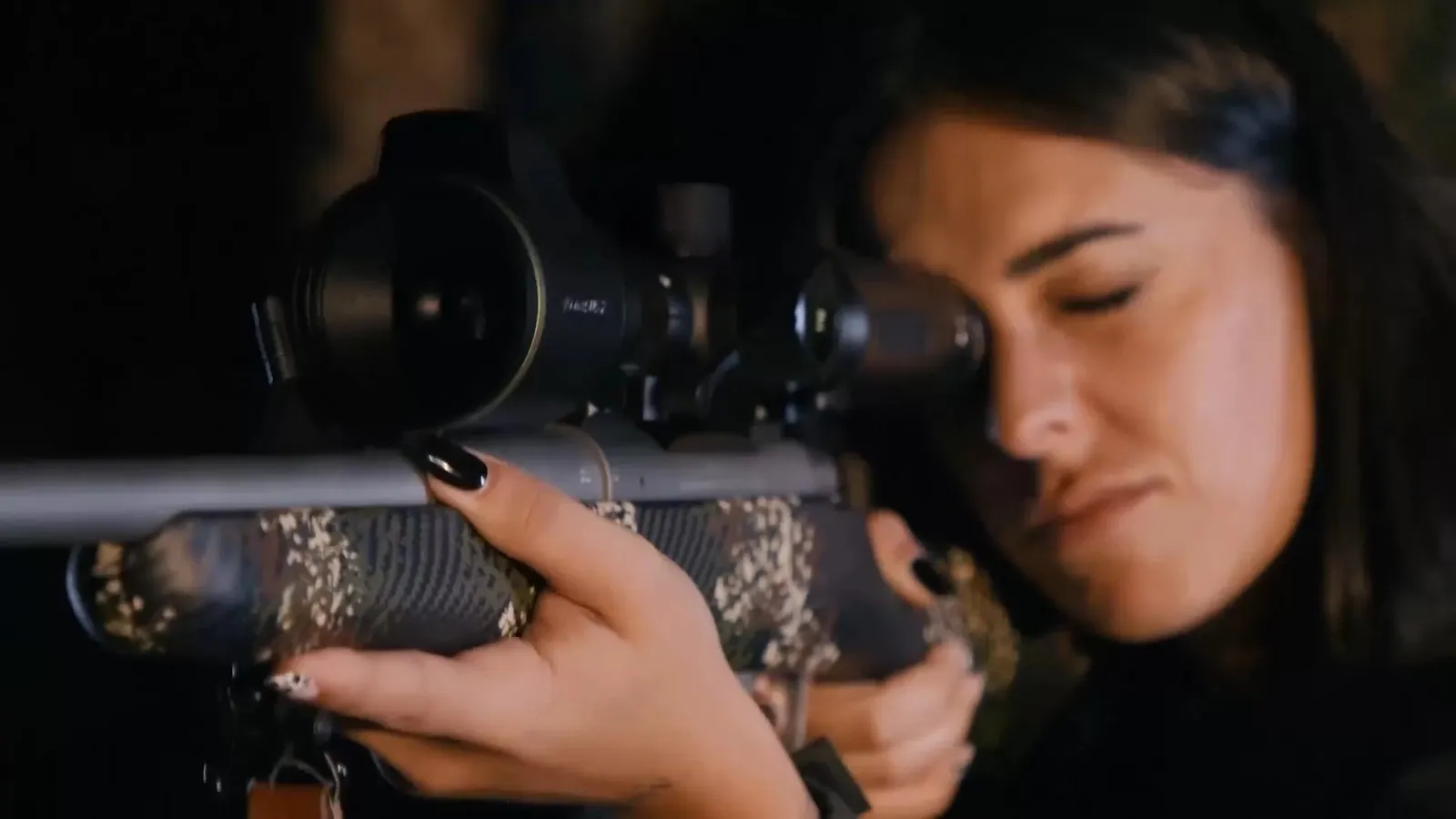
A thermal scope with LRF has a laser rangefinder built in, so you can measure the distance to the animal you’re aiming at without a second device. Ballistic calculation is a separate feature that helps you work out where to aim at different distances. Knowing the range matters most at night. A thermal image gives you few of the cues you’d use to judge distance in daylight, so a measured number beats a guess. At Pixfra, two thermal riflescope series have both features: the Pegasus 2 LRF and the Chiron LRF.
How a Thermal Scope With LRF Works
A laser rangefinder measures the distance to the point you aim it at and shows it on the display. PFI-C425 LRF, PFI-C435 LRF, PFI-C450 LRF, PFI-C635 LRF and PFI-C650 LRF list a rangefinder range of up to 1,000 m with ±1 m accuracy. Keep the aiming point on the animal.
Ballistic calculation is a separate function, and both of our LRF series list it. On Chiron LRF it is an integrated calculator for aiming at different distances. How it works alongside the rangefinder, and how to set it up, is covered in the user manual for your model in our Download Center. If anything is unclear, our after-sales team can walk you through it.
What you gain is fewer devices. With a separate rangefinder you range with one device and then find the animal again in the scope. With the rangefinder built into the scope, you take the reading without switching devices.
Detection Distance vs. Recognition: Reading Thermal Specs
Detection distance is the farthest point at which a thermal sensor can register a heat source. It tells you something warm is out there. It is not the distance at which you can see the animal’s details, recognize what it is or identify it well enough to shoot. Treat every detection figure in our tables that way.
Three spec-sheet details tell you more about real-world distances:
- Focal length. With the same sensor, a longer lens puts more pixels on the animal, so you keep detail farther out. The cost is a narrower field of view.
- Sensor resolution. PFI-P335LRF and PFI-P635LRF share a 35 mm lens, a 12 μm pixel pitch and the same 1,800 m detection distance. The 640 × 512 PFI-P635LRF covers a 12.5° horizontal field of view, against 7.5° for the 384 × 288 PFI-P335LRF. The wider view makes it easier to scan and to keep a moving animal in view.
- Sensitivity (NETD). A lower number means the sensor can tell apart smaller temperature differences. That matters most when the animal and its background are close in temperature.
Digital zoom doesn’t belong on that list, because it enlarges the pixels you already have without adding detail. Also check units when you compare spec sheets. Ours give meters first, and a meter is about 9% longer than a yard, so 1,000 m is roughly 1,094 yards.
Pegasus 2 LRF vs. Chiron LRF
These two series are the only way to get a thermal scope with LRF from us. Choosing between them comes down to body size, battery setup, lens and sensor.
Model codes starting with PFI-P are Pegasus 2 LRF; codes starting with PFI-C are Chiron LRF.
| Model | Sensor | Lens | Powiększenie | Detection distance | Żywotność baterii |
|---|---|---|---|---|---|
| PFI-P335LRF | 384 × 288 | 35 mm | 4.1× | 1 800 m | ≥10 h |
| PFI-P635LRF | 640 × 512 | 35 mm | 2.5× | 1 800 m | ≥9 h |
| PFI-P650LRF | 640 × 512 | 50 mm | 3.6× | 2 600 m | ≥9 h |
| PFI-C425 LRF | 384 × 288 | 25 mm | 2.11× | 1 300 m | ≥7,5 godz. |
| PFI-C435 LRF | 384 × 288 | 35 mm | 2.95× | 1 800 m | ≥7,5 godz. |
| PFI-C450 LRF | 384 × 288 | 50 mm | 4.21× | 2 600 m | ≥7,5 godz. |
| PFI-C635 LRF | 640 × 512 | 35 mm | 1.80× | 1 800 m | ≥6,5 godz. |
| PFI-C650 LRF | 640 × 512 | 50 mm | 2.57× | 2 600 m | ≥6,5 godz. |
Detection distance in this table is the farthest point at which a heat source can be noticed. You’ll recognize or identify an animal at much shorter range. Pegasus 2 LRF battery life is listed at 25 °C with Wi-Fi off.
| Spec | Pegasus 2 LRF (3 models) | Chiron LRF (5 models) |
|---|---|---|
| Laser rangefinder | Built-in compact LRF module | 1,000 m range, ±1 m accuracy |
| Czułość (NETD) | ≤15 mK@f/1.0 | ≤20 mK@f/1.0 |
| Wyświetlacz | 0.5-inch OLED, 1600 × 1200 | 0.41-inch OLED |
| Battery | Internal rechargeable 18650 plus a replaceable external 18650 | One replaceable 18650, 3,200 mAh |
| Przechowywanie | 64 GB built-in | 32 GB built-in |
| Length | 409.0 mm (16.10 in) | 213.4–223.4 mm (8.4–8.8 in), by lens |
If you want the larger display, the lower NETD rating (≤15 mK@f/1.0 against ≤20 mK@f/1.0) and a second battery, the Pegasus 2 LRF is the stronger pick. The tradeoff is bulk. It has a 409.0 mm magnesium alloy body. PFI-P335LRF and PFI-P635LRF weigh up to 0.82 kg (1.81 lb), and PFI-P650LRF weighs up to 0.84 kg (1.85 lb).
If you want a compact scope for a short, light rifle, the Chiron LRF is the better fit at roughly half the length of a Pegasus 2 LRF. All five Chiron LRF models also start recording video automatically when the rifle recoils. PFI-C425 LRF has the only 25 mm lens among our LRF scopes.
Within either series, match the lens to how you hunt:
- Close shots in cover: PFI-P635LRF (12.5° × 10.0°) and PFI-C635 LRF (21.9 m × 17.6 m at 100 m) have the widest views in their series.
- Narrower view, more magnification: PFI-P650LRF, PFI-C450 LRF and PFI-C650 LRF use a 50 mm lens. Compared with the 35 mm model that has the same sensor, each one gives a narrower view and higher base magnification.
LRF Scope or Scope Plus Handheld?
An LRF scope saves you switching devices when you take a range reading. That helps most when distances are hard to predict, such as open ground where an animal could step out anywhere.
The case for carrying a handheld anyway is safety. Scanning through a riflescope means pointing the muzzle at every heat source you check, and some of those can turn out to be people, pets or livestock. A handheld monokular termowizyjny lets you search and identify with the rifle pointed somewhere safe. You bring the scope up only once you’ve identified the animal.
An LRF adds the least when most of your shots are short and at distances you already know. For that kind of hunting, a non-LRF Pegasus, Pegasus Pro, Chiron or Cetus from our thermal scope lineup paired with a handheld for scanning is the simpler setup.
Start by writing down your longest realistic distance and the smallest animal you hunt. Those two answers point you to a lens and sensor before you pick a series. Then compare how each series sets up ballistic calculation in the user manuals from our Download Center.
Pricing varies by country. For a quote, contact our sales team.
To find a dealer near you, see our Gdzie kupić page.
Najczęściej zadawane pytania
Which Pixfra Thermal Scopes Have a Rangefinder?
Only the Pegasus 2 LRF and Chiron LRF series. Our Pegasus, Pegasus Pro, Chiron and Cetus thermal scopes don’t have a built-in laser rangefinder.
What Range Does the Chiron LRF Rangefinder Cover?
PFI-C425 LRF, PFI-C435 LRF, PFI-C450 LRF, PFI-C635 LRF and PFI-C650 LRF list a 1,000 m rangefinder range with ±1 m accuracy. For Pegasus 2 LRF rangefinder details, ask our sales team.
Is Detection Distance How Far I Can Shoot?
No, it’s the farthest point at which a heat source can be noticed. You’ll recognize and identify an animal much closer, and neither distance tells you how far you can shoot.