Pixfra Technology, the thermal imaging specialist known for its award-winning outdoor products, is breaking new ground in product demonstrations with an innovative mobile exhibition concept in Slovakia. The company’s local distributor has introduced a custom brand exhibition vehicle that transforms traditional trade show participation.

This unique setup features a dedicated exhibition trailer specifically designed to showcase Pixfra’s extensive thermal imaging product portfolio. The trailer, which can be opened to create an instant showroom, is pulled by a black transport vehicle, creating a mobile exhibition space that can travel directly to customers and events.
“This mobile exhibition approach represents the future of trade show participation,” explained the Slovakia distributor. “Instead of renting expensive booth space at exhibitions, we can now bring the entire Pixfra experience directly to our customers, allowing them to experience our products in various locations.”
The mobile showroom features Pixfra’s latest thermal imaging innovations, including the compact Mile 2 series monocular that recently won the prestigious Red Dot Design Award 2024. With its 640×512 pixel sensor, 25mm lens, and exceptional thermal sensitivity of less than 25mK, the Mile 2 weighs just 320 grams while delivering detection capabilities up to 1,300 meters. The device offers 6.5 hours of battery life, making it perfect for extended outdoor use.
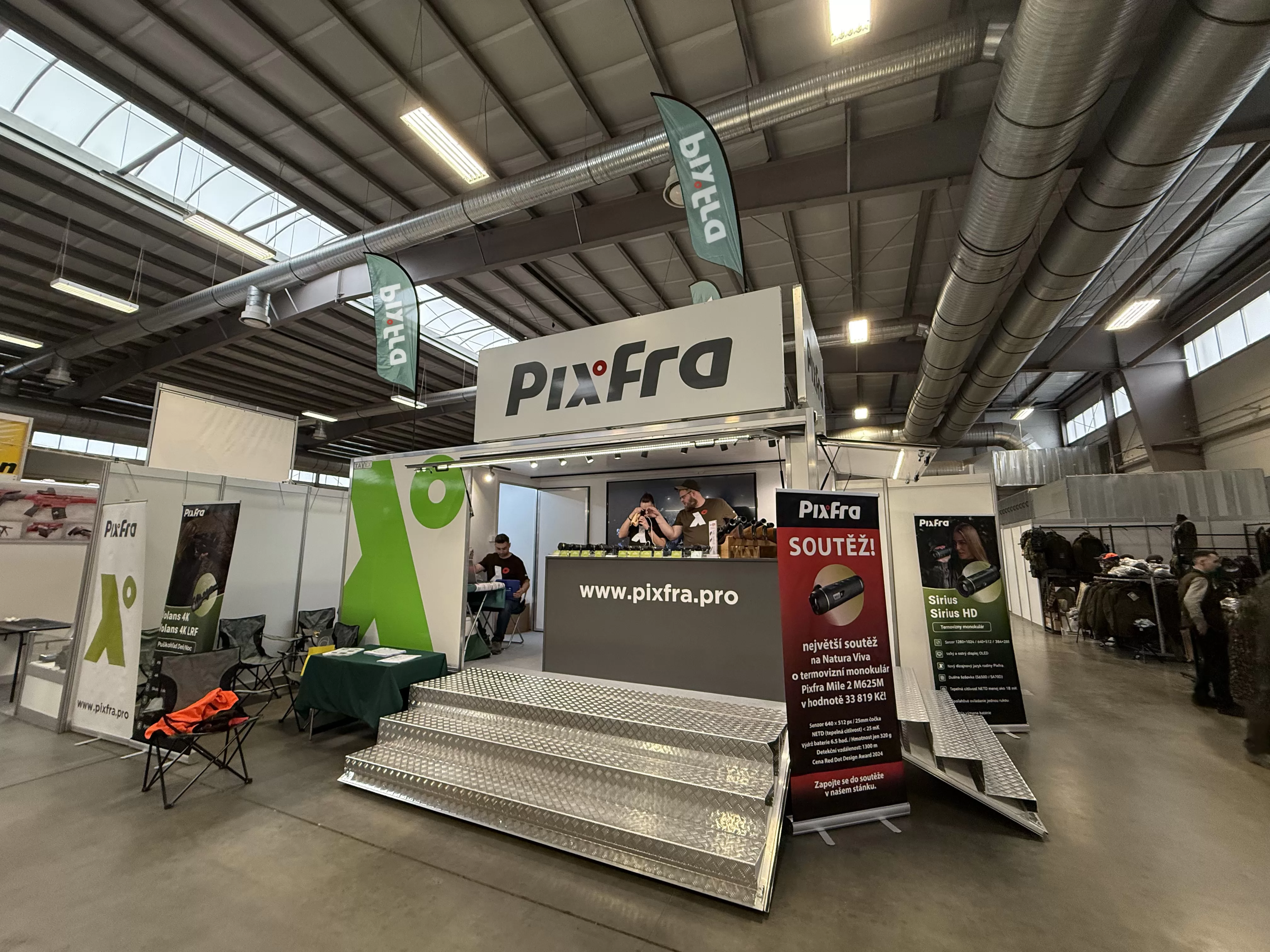
Visitors to the mobile exhibition can explore Pixfra’s complete product range, from the high-performance Sirius HD series with its 1280×1024 HD sensor, to the versatile Taurus thermal front attachments, and the advanced Chiron LRF series with integrated laser rangefinder capabilities.
Founded in 2015 and headquartered in Hangzhou, China, Pixfra has rapidly grown to serve over 150 countries with its thermal imaging solutions. The company’s products are widely used in wildlife observation, outdoor sports, emergency management, and various industrial applications.
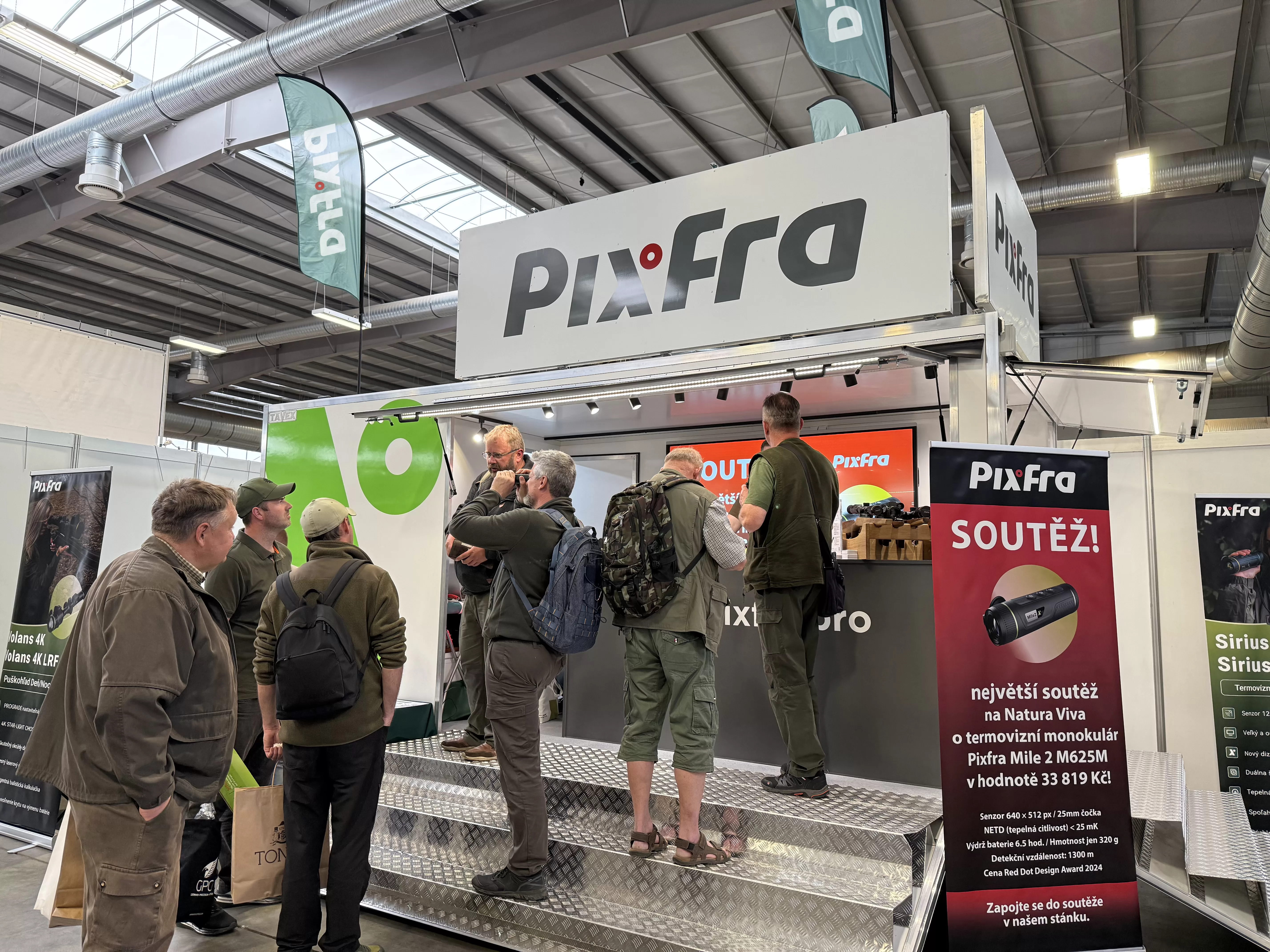
This mobile exhibition initiative in Slovakia demonstrates Pixfra’s commitment to innovative customer engagement and reflects the company’s forward-thinking approach that has earned it recognition as a national high-tech enterprise and multiple design awards.
The exhibition vehicle will be touring various locations across Slovakia and neighboring countries, bringing Pixfra’s cutting-edge thermal imaging technology directly to outdoor enthusiasts, hunters, and professional users.
W technologia termowizyjna, rozmiar plamki jest jednym z parametrów, które mają bezpośredni wpływ na zdolność wykrywania, dokładność pomiaru oraz ogólną wydajność systemu. Mówiąc prościej, rozmiar plamki oznacza najmniejszy obszar, który system termowizyjny jest w stanie skutecznie rozróżnić z danej odległości. Parametr ten decyduje o tym, jakie obiekty można wykryć i dokładnie zmierzyć na obrazie termowizyjnym, dlatego jest to niezbędna wiedza dla każdego, kto pragnie uzyskać optymalną wydajność urządzeń termowizyjnych.
Zasady fizyczne leżące u podstaw wielkości plamki są związane z rozdzielczością optyczną układu, na którą wpływają rozdzielczość detektora, jakość soczewki oraz odległość od obiektu. Wraz ze wzrostem odległości rozmiar plamki wzrasta proporcjonalnie, co ogranicza możliwość wykrywania mniejszych obiektów lub różnic temperatur. Zależność ta wynika z zasad fizyki optycznej, zgodnie z którymi najmniejszy szczegół, jaki można rozróżnić, jest ograniczony zarówno przez układ optyczny, jak i podstawowe właściwości falowe promieniowania podczerwonego.
Zgodnie z wynikami badań opublikowanymi przez Europejski Instytut Termowizji:
“Niewystarczająca znajomość zasad obliczania rozmiaru plamki odpowiada za około 64% problemów z dokładnością zgłaszanych w systemach termowizyjnych stosowanych w terenie, zwłaszcza w zastosowaniach wymagających precyzyjnych pomiarów lub wykrywania małych obiektów”.”
Dla użytkowników zaawansowanych systemów termowizyjnych, takich jak seria Pixfra Sirius HD z czujnikiem HD o rozdzielczości 1280×1024, zrozumienie zasad obliczania rozmiaru plamki obrazowej pozwala w pełni wykorzystać możliwości tych systemów o wysokiej rozdzielczości w celu uzyskania maksymalnej wydajności wykrywania przy optymalnych odległościach roboczych.
Obliczanie wielkości plamki w termowizji opiera się na prostym zależeniu matematycznym, które łączy parametry optyczne z odległością pomiarową. Podstawowy wzór na obliczenie wielkości plamki brzmi:
Rozmiar plamki = (odległość od celu × IFOV)
Gdzie IFOV (chwilowe pole widzenia) oznacza rozdzielczość kątową systemu mierzoną w miliradianach (mrad) lub stopniach. Wartość IFOV zależy od rozmiaru detektora i ogniskowej układu optycznego:
IFOV = (wielkość elementu detekcyjnego / ogniskowa)
W przypadku kompletnego systemu przekłada się to na praktyczny wzór, w którym:
Rozmiar plamki (mm) = Odległość (m) × IFOV (mrad)
Zależność ta określa tzw. współczynnik odległości do punktu (współczynnik D:S), który często stosuje się jako parametr techniczny w systemach termowizyjnych. Wyższy współczynnik D:S oznacza lepszą zdolność do pomiaru mniejszych obiektów z większej odległości.
Na przykład seria Pixfra Pegasus Pro, dzięki wysokiej klasy optyce i konfiguracji czujników, zapewnia doskonałą wydajność w zakresie wielkości plamki, co pozwala na wykrywanie mniejszych anomalii temperatury z większych odległości w porównaniu z systemami o niższej rozdzielczości optycznej.
Rozdzielczość detektora stanowi podstawowe ograniczenie wielkości plamki w każdym systemie termowizyjnym. Detektory o wyższej rozdzielczości, zawierające większą liczbę pikseli w tym samym polu widzenia, z natury rzeczy zapewniają mniejsze wielkości plamki i lepszą rozdzielczość przestrzenną przy dowolnej odległości.
Zależność tę można zilustrować, porównując różne rozdzielczości czujników dostępne w nowoczesnych urządzeniach termowizyjnych:
| Rozdzielczość czujnika | Typowa wartość IFOV (mrad) | Rozmiar plamki przy 100 m | Zastosowanie praktyczne |
|---|---|---|---|
| 256×192 | 1.308 | 130,8 mm | Podstawowe wykrywanie |
| 384×288 | 0.873 | 87,3 mm | Ogólnego przeznaczenia |
| 640×512 | 0.524 | 52,4 mm | Zaawansowane wykrywanie |
| 1280×1024 | 0.262 | 26,2 mm | Pomiar klasy premium |
(Uwaga: Podane wartości mają charakter orientacyjny i mogą się różnić w zależności od konkretnych konfiguracji optycznych)
Oferta produktów Pixfra odzwierciedla ten postęp – seria Mile 2 obejmuje konfiguracje o rozdzielczości już od 256×192, przeznaczone do podstawowych zadań wykrywania, natomiast seria Sirius HD klasy premium zapewnia wyjątkową rozdzielczość przestrzenną czujnika HD o rozdzielczości 1280×1024, przeznaczoną do zastosowań wymagających maksymalnej precyzji wykrywania.
Według Międzynarodowej Organizacji ds. Standardów Termowizji:
“Podwojenie rozdzielczości detektora liniowego przekłada się na poprawę minimalnego wykrywalnego rozmiaru obiektu o około 30–401 TP3T przy równoważnych odległościach, przy założeniu porównywalnej jakości optycznej”.”
Zależność ta podkreśla, dlaczego rozdzielczość czujnika stanowi tak kluczową specyfikację wpływającą na wydajność termowizji w zastosowaniach, w których niezbędne jest wykrywanie małych obiektów.
Chociaż rozdzielczość czujnika wyznacza punkt odniesienia dla parametrów wielkości plamki, wybór obiektywu odgrywa równie istotną rolę w określaniu rzeczywistych możliwości systemu termowizyjnego w zakresie wielkości plamki. Ogniskowa obiektywu ma bezpośredni wpływ na IFOV (chwilowe pole widzenia) – dłuższe ogniskowe zapewniają mniejsze wartości IFOV, a co za tym idzie, mniejsze wielkości plamki przy dowolnej odległości.
Zależność ta wyjaśnia, dlaczego urządzenia termowizyjne przeznaczone do wykrywania obiektów z dużej odległości, takie jak seria Pixfra Taurus LRF z opcjonalnym obiektywem 50 mm, mogą osiągać lepsze wyniki pod względem wielkości plamki w porównaniu z systemami o szerszym kącie widzenia, nawet przy identycznej rozdzielczości czujnika.
Praktyczne skutki wyboru obiektywu można zilustrować poprzez porównanie różnych opcji ogniskowych:
W przypadku czujnika o rozdzielczości 640×512 i odległości między pikselami wynoszącej 12 μm:
Zależność ta stanowi istotny czynnik, który należy wziąć pod uwagę przy wyborze systemu termowizyjnego do konkretnych zastosowań. Obiektywy szerokokątne (o krótszej ogniskowej) zapewniają szersze pole widzenia, ale kosztem większego rozmiaru plamki, natomiast obiektywy teleobiektywowe (o dłuższej ogniskowej) zapewniają mniejszy rozmiar plamki, ale węższe pole widzenia.
Wszechstronność systemów takich jak model Pixfra Sirius S650D, wyposażonych w innowacyjny obiektyw z płynną regulacją ogniskowej w zakresie 25–50 mm, pozwala rozwiązać ten dylemat, umożliwiając użytkownikom optymalne dostosowanie pola widzenia i wielkości plamki w zależności od konkretnych wymagań i warunków wykrywania.
W przypadku zastosowań myśliwskich właściwe zrozumienie sposobu obliczania wielkości plamki przekłada się bezpośrednio na skuteczność wykrywania i identyfikacji celów w terenie. Wielkość plamki określa minimalny rozmiar obiektu, który można niezawodnie wykryć z różnych odległości, co ma kluczowe znaczenie dla identyfikacji zwierzyny łownej na tle złożonego otoczenia.
Rozważmy następujące praktyczne sytuacje myśliwskie, w których znajomość rozmiaru plamki okazuje się kluczowa:
Według badań przeprowadzonych przez Europejskie Stowarzyszenie Łowieckie:
“Myśliwi korzystający z urządzeń termowizyjnych odpowiednio dobranych do typowych odległości strzału zgłaszają o 37% wyższy wskaźnik prawidłowej identyfikacji oraz o 42% lepszą celność strzału zgodną z zasadami etyki łowieckiej w porównaniu z osobami korzystającymi z systemów o rozmiarze plamki nieodpowiadającym ich potrzebom”.”
Seria Pixfra Arc LRF spełnia te praktyczne wymagania łowieckie dzięki wyważonej konstrukcji optycznej, oferując parametry wielkości plamki zoptymalizowane pod kątem typowych europejskich warunków łowieckich, a jednocześnie wykorzystując technologię dalmierza laserowego do precyzyjnego pomiaru odległości — co stanowi kluczowy element obliczania wielkości plamki w warunkach terenowych.
Aby ułatwić stosowanie zasad dotyczących wielkości plamki w terenie, opracowano różne narzędzia obliczeniowe — od podstawowych wzorów po zaawansowane aplikacje cyfrowe. Kalkulatory te pomagają użytkownikom określić praktyczne ograniczenia ich systemów termowizyjnych przy różnych odległościach i dla różnych rozmiarów obiektów.
Podstawowy wzór na obliczenie rozmiaru plamki:
Rozmiar plamki (mm) = Odległość (m) × IFOV (mrad)
Zaawansowane kwestie związane z kalkulatorem:
Profesjonalne aplikacje termowizyjne często zawierają wbudowane w interfejsy kalkulatory wielkości plamki, co pozwala na ocenę możliwości wykrywania w czasie rzeczywistym na podstawie aktualnych ustawień i zmierzonych odległości. W przypadku systemów wyposażonych w zintegrowane dalmierze laserowe, takich jak seria Pixfra Chiron LRF, obliczenia te mogą być wykonywane automatycznie, zapewniając użytkownikom natychmiastową informację zwrotną na temat ograniczeń wykrywania dla danego celu.
Aplikacja Pixfra Outdoor, kompatybilna z urządzeniami termowizyjnymi Pixfra, zawiera zaawansowany kalkulator rozmiaru plamki, który uwzględnia konkretne właściwości optyczne podłączonych urządzeń, umożliwiając użytkownikom:
To połączenie teoretycznych obliczeń wielkości plamki z praktycznymi zastosowaniami w terenie stanowi znaczący krok naprzód w udostępnianiu złożonych zasad optyki użytkownikom nieposiadającym specjalistycznej wiedzy technicznej.
Jednym z najczęściej spotykanych nieporozumień w dziedzinie termowizji jest interpretacja podawanych przez producentów zasięgów wykrywania bez uwzględnienia ograniczeń związanych z rozmiarem plamki. Wielu użytkowników błędnie zakłada, że podany maksymalny zasięg wykrywania odnosi się w równym stopniu do obiektów o dowolnych rozmiarach, co prowadzi do nierealistycznych oczekiwań co do wydajności urządzenia w terenie.
W rzeczywistości zasięg wykrywania zawsze zależy od wielkości wykrywanego obiektu. Urządzenie termowizyjne może wykryć duże źródło ciepła (np. pojazd) z odległości kilku kilometrów, ale jego zasięg wykrywania obiektów wielkości człowieka może wynosić jedynie 1–2 kilometry, a małych zwierząt – jeszcze mniej; wszystko to wynika z ograniczeń związanych z rozmiarem plamki obrazowej.
Do typowych błędnych przekonań należą:
Błędne przekonanie: “Ten celownik termowizyjny może wykrywać cele z odległości 2 000 metrów” (bez podania rozmiaru celu)
Rzeczywistość: Na wysokości 2 000 metrów system może wykrywać jedynie obiekty o średnicy większej niż 1 metr, co uniemożliwia wykrywanie małych zwierząt z tej odległości.
Błędne przekonanie: “Większe powiększenie zawsze poprawia zdolność wykrywania”
Rzeczywistość: Powiększenie optyczne nie zmienia podstawowych ograniczeń dotyczących rozmiaru plamki świetlnej wynikających z połączenia matrycy i obiektywu; sprawia jedynie, że ta ograniczona rozdzielczość staje się bardziej widoczna dla oka.
Błędne przekonanie: “Zoom cyfrowy zwiększa zasięg wykrywania”
Rzeczywistość: Zoom cyfrowy nie jest w stanie pokonać fizycznych ograniczeń związanych z rozmiarem plamki; służy jedynie do powiększania pikseli, nie zwiększając przy tym zdolności wykrywania.
Zrozumienie tych ograniczeń poprzez prawidłowe zastosowanie obliczeń dotyczących wielkości plamki pozwala użytkownikom sformułować realistyczne oczekiwania wobec sprzętu termowizyjnego oraz dobrać systemy odpowiednio dostosowane do ich wymagań w zakresie wykrywania.
Matematyka związana z obliczaniem wielkości plamki może wydawać się skomplikowana, ale jej praktyczne zastosowania są proste i niezbędne dla każdego, kto pragnie w pełni wykorzystać możliwości technologii termowizyjnej. Niezależnie od tego, czy chodzi o polowanie, obserwację dzikiej przyrody, ochronę czy inne zastosowania, świadomość wielkości plamki gwarantuje użytkownikom możliwość pełnego wykorzystania potencjału posiadanych systemów termowizyjnych.
Wraz z postępem technologii termowizyjnej, charakteryzującym się coraz wyższą rozdzielczością czujników i ulepszoną optyką, parametry wielkości plamki również będą się poprawiać — jednak podstawowe zasady obliczeń i ich praktyczne implikacje pozostaną niezmienne.
Jeśli chcesz dowiedzieć się, jak obliczenia wielkości plamki mają zastosowanie w konkretnych zastosowaniach termowizyjnych lub chcesz dobrać optymalny system do swoich wymagań w zakresie wykrywania, specjaliści techniczni firmy Pixfra służą fachową poradą. Nasza kompleksowa oferta produktów — od wszechstronnej serii Mile 2 po serię Sirius HD klasy premium — obejmuje rozwiązania dostosowane do różnorodnych potrzeb w zakresie wykrywania, wraz z jasnymi specyfikacjami dotyczącymi parametrów wielkości plamki.
Aby uzyskać szczegółowe obliczenia dotyczące rozmiaru plamki dostosowane do konkretnego zastosowania lub omówić możliwości dystrybucji na rynkach europejskich, prosimy o kontakt z naszym zespołem technicznym pod adresem info@pixfra.com lub odwiedź stronę pixfra.com, aby zapoznać się z naszą pełną ofertą produktów. Pozwól naszym ekspertom pomóc Ci w wyborze rozwiązania termowizyjnego, które zapewni precyzyjną wielkość plamki obrazowej, niezbędną do sprostania Twoim konkretnym wyzwaniom związanym z wykrywaniem.
Technologia termowizyjna has revolutionized the way we detect water leaks by leveraging the fundamental principle that water affects surface temperatures in predictable ways. As water leaks through structures, it creates temperature differentials that become visible to thermal imaging devices even when the moisture itself remains hidden from view. This capability stems from water’s high thermal conductivity and specific heat capacity, which cause it to absorb and transfer heat differently than surrounding dry materials. When water infiltrates building materials or ground surfaces, it creates distinct thermal patterns that appear as temperature anomalies on thermal imaging displays.
The physics behind this detection method relies on several key properties: water typically evaporates and creates cooling effects on surfaces; it changes the thermal conductivity of materials it saturates; and it retains temperature differently than dry materials during ambient temperature fluctuations. High-sensitivity thermal imaging devices, such as the Pixfra Sirius Series with its exceptional ≤18mK NETD (Noise Equivalent Temperature Difference), can detect these subtle temperature variations with remarkable precision, revealing water intrusion long before visible damage occurs.Besides this application,there are many other applications, together,they make thermal imaging cameras useful
According to research published by the European Building Research Institute:
“Thermal imaging detection can identify water leaks in building structures up to 6-8 weeks before visible signs appear, potentially reducing water damage restoration costs by 45-60% through early intervention.”
This early detection capability makes thermal imaging an invaluable tool for property maintenance, especially in regions like Central and Northern Europe where building water damage represents a significant annual economic impact.
The effectiveness of water leak detection through thermal imaging depends significantly on the technological sophistication of the equipment used. Modern thermal imaging systems have advanced well beyond basic infrared cameras, incorporating multiple enhancements that dramatically improve detection capabilities for water-related issues.
High-resolution thermal sensors, like the 640×512 detector found in Pixfra’s premium devices, provide the pixel density necessary to identify subtle temperature patterns indicative of water infiltration. This resolution allows for detailed examination of larger areas while still capturing the minute temperature differentials that might indicate early-stage water leaks. When combined with advanced optics, such as the F0.9 large aperture lens found in the Sirius Series, these systems can deliver exceptional clarity in thermal imaging.
Perhaps even more significant for water leak detection applications is the processing technology that enhances raw thermal data. Pixfra’s PIPS 2.0 (Pixfra Imaging Processing System) exemplifies these advancements, employing sophisticated algorithms that:
These technological advancements transform thermal imaging from a specialized tool into an accessible and highly effective solution for water leak detection across multiple applications and environments.
In residential settings across Europe, thermal imaging has evolved from a luxury inspection method to an essential preventive maintenance tool. Water damage represents one of the most common and costly home insurance claims, with the European Insurance Association reporting that water-related claims account for approximately 29% of all residential property insurance payouts, exceeding €5.2 billion annually across EU member states.
Thermal imaging offers homeowners and property managers a non-invasive method to:
Portable thermal devices like the Pixfra Mile 2 Series Thermal Monocular provide sufficient sensitivity (≤25mK NETD) for most residential applications while offering exceptional portability and ease of use. These compact systems allow for comprehensive property inspections without specialized training, making thermal imaging accessible to a broader range of users than ever before.
According to a study by the European Property Management Association:
“Properties that implement regular thermal imaging inspections for water intrusion report 72% fewer catastrophic water damage incidents and realize average maintenance cost savings of €0.37 per square meter annually.”
The stakes of water damage increase dramatically in commercial and industrial settings, where leaks can damage expensive equipment, disrupt operations, and create safety hazards. Thermal imaging provides a powerful preventive tool for protecting these high-value assets and ensuring operational continuity.
In industrial facilities, thermal imaging can detect:
| Application | Detection Target | Potential Savings |
|---|---|---|
| Process Piping | Leaks in water, steam, and chemical lines | Prevent costly product loss and contamination |
| Roof Systems | Moisture infiltration in flat commercial roofs | Extend roof lifespan by 30-40% |
| Cooling Systems | Water leaks in cooling towers and HVAC | Reduce energy costs and prevent equipment damage |
| Electrical Systems | Water intrusion near electrical infrastructure | Prevent catastrophic failures and fire hazards |
| Data Centers | Moisture near critical IT infrastructure | Avoid equipment damage and data loss |
The precision requirements for these applications often necessitate higher-end thermal systems. Devices like the Pixfra Sirius HD Series, with its 1280×1024 HD sensor and exceptional thermal sensitivity, provide the detailed imaging necessary for inspecting complex industrial systems where small leaks can have major consequences.
European industrial facility managers report that incorporating thermal imaging into preventive maintenance programs for water leak detection yields an average return on investment of 310% within the first 18 months, primarily through avoided downtime and equipment damage.
Beyond buildings and infrastructure, thermal imaging offers significant advantages for agricultural water management—a growing concern across Europe as climate change impacts water availability and cost. Thermal imaging can identify irrigation system leaks and inefficiencies that waste water and energy while potentially damaging crops through uneven distribution.
Modern thermal imaging devices can detect:
For agricultural applications, thermal systems with wider fields of view are often most effective. The Pixfra Arc LRF Series, with its broad detection capability and integrated laser rangefinder, allows agricultural professionals to efficiently survey large areas while precisely measuring distances to identified problem spots.
According to research from the European Agricultural Water Management Institute:
“Thermal imaging detection of irrigation system leaks has helped participating farms reduce water consumption by an average of 18.7% while improving crop yield uniformity by 12.3%, representing significant economic and environmental benefits.”
In water-stressed regions of Southern Europe, these efficiency improvements translate directly to substantial cost savings and improved agricultural sustainability.
An emerging application for thermal water leak detection extends beyond built infrastructure into environmental monitoring and conservation efforts. European environmental agencies and conservation organizations increasingly utilize thermal imaging to monitor natural waterways, detect groundwater seepage, and identify unauthorized water diversions.
These environmental applications leverage the same temperature differential principles used in building inspections but apply them to natural systems. Water moving through soil or emerging from springs creates distinct thermal signatures that can be detected with sensitive thermal imaging equipment, especially during periods when ambient and water temperatures differ significantly.
Conservation organizations have successfully employed thermal imaging to:
For these environmental applications, thermal devices with extended detection range, such as the Pixfra Pegasus Pro Series with its detection capability up to 2,600 meters, provide the standoff distance necessary to survey waterways and natural areas without disturbing wildlife or sensitive habitats.
European conservation agencies report that thermal surveys can reduce the cost of comprehensive waterway monitoring by up to 64% compared to traditional methods while significantly increasing detection rates for small-scale unauthorized water diversions.
Maximizing the effectiveness of thermal imaging for water leak detection requires understanding several key operational best practices that significantly impact results. These techniques enhance detection capabilities beyond simply pointing a thermal camera at a suspect area:
Optimal Timing: Water leak detection is most effective when temperature differentials between wet and dry areas are maximized. Early morning inspections (before solar heating) often provide ideal conditions as wet areas will have retained heat or cold differently than surrounding dry materials throughout the night.
Comparative Imaging: Establishing baseline thermal images during dry conditions provides valuable reference points for identifying anomalies during subsequent inspections.
Environmental Considerations: Wind, precipitation, and direct sunlight can all affect surface temperatures and potentially mask or create false indicators of water intrusion. Inspections should account for these environmental factors.
Multiple Angle Assessment: Viewing potential leak areas from multiple angles helps distinguish between actual moisture issues and reflective or emissivity-related anomalies.
Complementary Testing: While thermal imaging excels at identifying potential problem areas, complementary moisture meter testing of suspicious locations can confirm findings and quantify moisture levels.
According to professional water damage restoration experts:
“The combination of proper thermal imaging techniques with focused moisture meter confirmation has shown to improve leak detection accuracy by 83% compared to traditional visual inspection methods.”
Implementing these best practices ensures thermal imaging delivers consistent, reliable results across various water leak detection scenarios.
Thermal imaging has evolved from a specialized tool into an essential technology for comprehensive water leak detection across residential, commercial, industrial, agricultural, and environmental applications. By visualizing the otherwise invisible temperature patterns created by water infiltration, modern thermal devices enable early detection of issues long before visible damage occurs, offering significant economic and environmental benefits through water conservation and damage prevention.
The applications of this technology continue to expand as thermal imaging devices become more sophisticated, affordable, and user-friendly. From homeowners protecting their investments to industrial facility managers safeguarding critical infrastructure, the ability to “see” water through its thermal signature provides a powerful advantage in maintenance and conservation efforts.
As water scarcity and infrastructure aging increasingly impact European communities, the importance of effective leak detection will only grow. Thermal imaging represents not merely an improved detection method but a fundamental shift in how we approach water management and conservation across multiple sectors.
If you’re interested in incorporating thermal imaging into your water management, property maintenance, or conservation efforts, Pixfra offers a range of devices suitable for various detection applications. From the compact Mile 2 Series for residential inspections to the high-definition Sirius HD Series for demanding commercial applications, our product lineup delivers the sensitivity and resolution needed for effective water leak detection.
For more information about our thermal imaging solutions or to discuss distribution opportunities in European markets, contact our specialists at info@pixfra.com or visit pixfra.com to explore our full product range. Our team can provide expert guidance on selecting the optimal thermal system for your specific water leak detection requirements, ensuring you maximize the benefits of this powerful technology.
To address the question of whether celowniki termowizyjne can see infrared, we must first understand the relationship between thermal imaging and the infrared spectrum. The electromagnetic spectrum encompasses radiation of varying wavelengths, from gamma rays (shortest) to radio waves (longest). Infrared radiation sits between visible light and microwave radiation on this spectrum, covering wavelengths from approximately 700 nanometers to 1 millimeter.
It’s crucial to recognize that infrared (IR) is a broad category that includes multiple sub-bands. Near-infrared (NIR) ranges from 0.7-1.4 μm, short-wavelength infrared (SWIR) from 1.4-3 μm, mid-wavelength infrared (MWIR) from 3-8 μm, and long-wavelength infrared (LWIR) from 8-15 μm. What we commonly call “thermal imaging” primarily operates in the MWIR and LWIR bands, detecting the heat signatures naturally emitted by objects,and this feature is a major advantage for hunters.
According to the International Commission on Illumination:
“All objects with temperatures above absolute zero emit infrared radiation. The wavelength distribution and intensity of this radiation are directly related to the object’s temperature.”
This scientific principle forms the foundation of thermal imaging technology. Modern thermal scopes like the Pixfra Pegasus Pro Series and Chiron LRF Series are specifically designed to detect and visualize MWIR or LWIR radiation, which corresponds to the heat signatures emitted by animals, humans, and objects in the environment. Therefore, thermal scopes do indeed “see” infrared radiation—specifically, the mid to long-wavelength infrared emissions that correspond to heat signatures.
An important technical distinction exists between the different technologies used to detect infrared radiation. This distinction helps clarify what exactly thermal scopes can and cannot detect in terms of infrared light.
Passive Infrared Detection (Thermal Imaging): Devices like the Pixfra Sirius Series Thermal Monocular use uncooled microbolometer sensors to detect naturally emitted infrared radiation (heat) without requiring any external light source. These operate primarily in the LWIR spectrum (8-14 μm) and create images based solely on temperature differences.
Active Infrared Technologies: These include night vision devices that actively project near-infrared light (NIR, 0.7-1.4 μm) to illuminate an area, similar to a flashlight that human eyes cannot see. This projected light is then detected by specialized cameras.
Near-Infrared Illuminators: These devices project NIR light that standard thermal scopes cannot detect, as they are tuned to detect MWIR and LWIR radiation instead.
| Technology Type | Wavelength | Requires Light Source | What It Detects | Pixfra Example |
|---|---|---|---|---|
| Termowizja | 8-14 μm (LWIR) | Nie | Heat signatures | Pegasus Pro Series |
| Night Vision | 0.7-1.4 μm (NIR) | Yes (either ambient or IR illuminator) | Reflected NIR light | Volans Series (supports day/night use) |
| Daytime Optics | 0.4-0.7 μm (Visible) | Yes (natural light) | Reflected visible light | N/A |
This distinction explains why thermal imaging devices like the Pixfra Taurus Series Thermal Front Attachment can function in complete darkness without any external illumination—they detect the LWIR radiation naturally emitted by all objects with temperatures above absolute zero, rather than requiring reflected light of any kind.
At the core of a modern thermal scope’s ability to detect infrared radiation is the microbolometer sensor technology. Understanding this component helps clarify what specific types of infrared radiation thermal scopes can detect and visualize.
Microbolometer sensors consist of arrays of microscopic detector elements made from materials (typically vanadium oxide or amorphous silicon) that change electrical resistance when exposed to infrared radiation. These minute resistance changes are measured, processed, and converted into a visible thermal image.
The sensitivity of these sensors is measured by Noise Equivalent Temperature Difference (NETD), expressed in millikelvin (mK). Premium thermal devices like the Pixfra Sirius HD Series feature sensors with NETD values of ≤18mK, indicating exceptional sensitivity to minute temperature differences—critical for detecting subtle thermal signatures at extended ranges.
Resolution also plays a vital role in a thermal scope’s capability to detect and display infrared radiation clearly. Higher resolution sensors like the 640×512 detector in the Pixfra Arc LRF Series provide more detailed visualization of thermal patterns compared to lower resolution alternatives.
According to thermal imaging expert Dr. Heinrich Müller from the European Institute of Thermal Science:
“Advancements in microbolometer technology have reduced NETD values from approximately 100mK in early commercial devices to below 20mK in current premium systems, representing a five-fold improvement in temperature sensitivity over the past decade.”
This technological advancement directly translates to improved detection capabilities for hunters and wildlife observers using thermal imaging equipment in challenging environmental conditions.
While the physical sensor detects infrared radiation, the processing of this thermal data is equally crucial in determining what a thermal scope can effectively “see.” Modern thermal imaging systems incorporate sophisticated signal processing to enhance detection capabilities beyond what raw sensor data might provide.
Pixfra’s proprietary PIPS 2.0 (Pixfra Imaging Processing System) exemplifies how advanced processing algorithms can significantly improve the visualization of infrared data. This system enhances image clarity through multiple processing stages:
These processing enhancements effectively expand the range of infrared radiation that can be meaningfully detected and interpreted by the user. For instance, in challenging conditions like light fog or rain, which can partially attenuate LWIR radiation, processing algorithms can amplify subtle signals that might otherwise be lost.
The real-world impact of these processing capabilities is particularly evident in the field, where environmental conditions constantly change. A European Hunting Association field test found that:
“Thermal devices with advanced processing capabilities demonstrated up to 40% greater effective detection range in challenging environmental conditions compared to systems with similar sensors but less sophisticated signal processing.”
The ability of thermal scopes to detect infrared radiation at distance is influenced by multiple factors beyond just the sensor specifications. Understanding these factors helps users develop realistic expectations about detection capabilities in various scenarios.
Rozdzielczość czujnika: Higher resolution sensors (e.g., 640×512 vs. 384×288) provide more detailed infrared information at greater distances. The Pixfra Mile 2 Series offers options ranging from 256×192 to 640×512 resolution to address different detection range requirements.
Lens Specifications: Focal length and aperture significantly impact detection range. Longer focal length optics like the 50mm lens on the Pixfra Sirius S650 model provide greater magnification and detection range compared to shorter focal length alternatives.
Atmospheric Conditions: Water vapor, dust, and precipitation can attenuate LWIR radiation. High humidity, rain, and fog reduce effective detection ranges.
Target Size and Thermal Contrast: Larger targets with greater temperature differential from the background are detectable at greater distances. A typical detection range matrix might look like:
| Target Size | Thermal Contrast | Detection Range with 640×512 Sensor | Recognition Range |
|---|---|---|---|
| Large (Human/Deer) | High (>10°C) | 1,800-2,600m | 500-900m |
| Medium (Fox) | Medium (5-10°C) | 900-1,400m | 300-500m |
| Small (Rabbit) | Low (<5°C) | 400-700m | 150-250m |
These ranges represent optimal conditions and will decrease with adverse weather or when targets have minimal thermal contrast with their surroundings.
While thermal scopes excel at detecting emitted infrared radiation (heat), they cannot detect certain infrared phenomena related to reflectivity rather than emission. This limitation is important for users to understand when considering the capabilities and constraints of thermal imaging equipment.
Thermal scopes cannot detect:
According to Dr. Anna Kowalski of the European Optical Systems Institute:
“The common misconception that thermal imagers can detect all infrared frequencies leads to unrealistic expectations. These devices are specifically tuned to detect emitted thermal radiation in the 8-14 μm range, making them blind to near-infrared illumination and laser systems operating in shorter wavelengths.”
This distinction is particularly important for professional users who might be operating in environments where multiple infrared technologies are in use simultaneously, such as in wildlife management or security applications.
Understanding the specific infrared detection capabilities of thermal scopes helps users identify the optimal applications for this technology. Thermal imaging devices like the Pixfra Taurus LRF Series excel in scenarios that leverage their ability to detect mid and long-wave infrared radiation:
Wildlife Detection in Dense Vegetation: The LWIR radiation emitted by animals penetrates light vegetation more effectively than visible light, making thermal scopes superior for detecting wildlife in moderately dense cover.
Tracking After Shot: The residual heat signature left by game animals provides a distinct thermal trail that can be followed even when visible blood trails are difficult to detect.
Nocturnal Wildlife Management: For species active primarily during nighttime hours, such as wild boar, thermal detection capabilities enable effective population management without disturbing natural behavior patterns.
Environmental Hazard Identification: Thermal scopes can identify potential environmental dangers like forest fire hotspots that emit distinctive infrared signatures before they become visible to the naked eye.
The European Wildlife Management Consortium reports:
“In controlled field tests, experienced hunters using thermal imaging equipment demonstrated 78% higher detection rates of camouflaged wildlife compared to traditional optics, with the advantage increasing to 94% in low-light conditions.”
These practical advantages stem directly from the thermal scope’s ability to detect specific infrared wavelengths associated with heat signatures rather than relying on reflected visible light.
To directly answer the original question: Yes, thermal scopes do see infrared radiation—specifically, they detect mid and long-wavelength infrared radiation (MWIR and LWIR) that corresponds to heat signatures emitted by objects in the environment. However, they cannot detect near-infrared (NIR) illumination used by night vision devices or IR laser systems.
This specific infrared detection capability makes thermal imaging technology uniquely valuable for applications requiring the visualization of heat signatures regardless of lighting conditions. Modern thermal scopes like those in the Pixfra lineup combine sensitive microbolometer technology with sophisticated image processing to provide exceptional thermal infrared detection capability across diverse environmental conditions.
Understanding these technical capabilities and limitations allows users to make informed decisions about when thermal imaging technology represents the optimal solution for their specific requirements, whether for wildlife observation, hunting, or security applications.
If you’re interested in exploring how thermal imaging technology can enhance your hunting or observation capabilities, Pixfra offers a comprehensive range of products designed to meet diverse requirements and budgets. From the compact Mile 2 Series to the premium Pegasus Pro Series, our thermal imaging lineup delivers exceptional infrared detection capabilities backed by PIPS 2.0 processing technology.
For more information about our thermal imaging solutions or to discuss distribution opportunities in European markets, contact our specialists at info@pixfra.com or visit pixfra.com to explore our full product range and technical specifications. Our team can provide expert guidance on selecting the optimal thermal system for your specific application requirements, ensuring you maximize the benefits of this advanced technology.
Technologia termowizyjna has revolutionized the hunting landscape by fundamentally changing how hunters detect, identify, and track game. Unlike traditional night vision that amplifies available light, thermal imaging detects heat signatures emitted by all objects, creating a distinct visual representation based on temperature differences. This core capability makes thermal scopes uniquely valuable in hunting scenarios where visual identification through conventional optics would be challenging or impossible.It should be noted that different countries have varies of restrictions on thermal imaging technology, make sure to check the related regulations before using it.
The technology works by detecting infrared radiation (heat) emitted by animals, which typically stand out prominently against cooler backgrounds regardless of ambient lighting conditions. Modern thermal imaging devices, such as the Pixfra Pegasus Pro Series with its exceptional ≤18mK NETD (Noise Equivalent Temperature Difference), can detect minute temperature variations, allowing hunters to identify game at significant distances even through environmental obstacles like light fog or sparse vegetation.
According to research published in the European Journal of Wildlife Research:
“Thermal imaging technology has demonstrated detection efficiency improvements of 65-78% in low-light hunting scenarios compared to traditional optics, with particularly significant advantages in densely vegetated environments.”
This fundamental capability addresses one of hunting’s primary challenges: reliably locating game in suboptimal conditions. For hunters pursuing nocturnal species like wild boar or managing predators like foxes, thermal imaging provides detection capabilities that traditional optics simply cannot match, regardless of quality or price point.
The detection range offered by quality thermal scopes represents a significant advantage for hunters across various environments and hunting scenarios. Premium thermal imaging devices can detect large game animals at distances exceeding 2,000 meters in optimal conditions, though identification range is typically more limited. This extended detection capability allows hunters to spot game long before being detected themselves, providing valuable time for strategic positioning.
The Pixfra Chiron LRF Series exemplifies this capability, offering detection ranges up to 2,600 meters for large game. When combined with integrated laser rangefinder technology, these systems provide not just detection but precise distance measurement, critical for ethical shot placement and effective hunting.
Comparative Detection Capabilities:
| Environmental Condition | Traditional Optics | Entry Thermal | Premium Thermal (≤20mK NETD) |
|---|---|---|---|
| Clear Night | 50-200m | 500-800m | 1,800-2,600m |
| Light Fog/Rain | 20-50m | 300-500m | 800-1,300m |
| Dense Vegetation | 30-80m | 200-400m | 500-900m |
| Full Daylight | 200-1,000m+ | 300-600m | 1,000-2,000m |
This extended detection capability translates directly to hunting success, particularly for species that are primarily active during twilight or nighttime hours. The technology’s effectiveness is further enhanced by advanced image processing systems like PIPS 2.0 (Pixfra Imaging Processing System), which improves contrast, reduces noise, and enhances detail recognition—critical factors for positive species identification at extended ranges.
Perhaps the most significant contribution thermal imaging makes to hunting is in the realm of ethical practices. Superior target identification capabilities allow hunters to:
These capabilities directly support responsible hunting practices and wildlife conservation efforts. With devices like the Pixfra Taurus Series Thermal Front Attachment, which features high-definition zeroing with ultra-fine 0.9cm@100m click value, hunters can achieve exceptional precision in shot placement once a target has been ethically identified.
The European Hunting Federation notes:
“Thermal imaging technology, when properly utilized, has contributed to a 43% reduction in wounded game and non-recovered animals during managed night hunting operations across multiple European study sites.”
This ethical advantage becomes particularly pronounced in wildlife management contexts, such as controlling invasive species or managing populations causing agricultural damage. The ability to confidently identify specific target animals while avoiding protected or non-target species represents a significant advancement in hunting ethics and efficiency.
One of thermal imaging’s most valuable attributes for hunters is its effectiveness across virtually all weather conditions and times of day. Unlike conventional optics that may be severely limited by fog, light rain, snow, or darkness, thermal imaging maintains consistent performance across these variables, with only heavy precipitation causing significant degradation in imaging capability.
The Pixfra Arc LRF Series demonstrates this versatility with its robust environmental rating and high-sensitivity ≤20mK NETD sensor, allowing it to function effectively across a wide spectrum of hunting conditions. For European hunters facing diverse and often rapidly changing weather conditions, this weather independence provides crucial reliability for planned hunting expeditions.
Key Environmental Advantages:
This consistency across environmental variables means hunters can plan activities with greater confidence and maintain effectiveness regardless of time of day or weather changes. For many European hunting regions where weather conditions can shift rapidly, this capability transforms previously unhuntable conditions into productive opportunities.
Beyond recreational hunting, thermal imaging technology has become an essential tool for wildlife management professionals and conservation organizations. The technology’s ability to efficiently conduct population surveys, monitor movement patterns, and implement targeted control measures makes it invaluable for evidence-based wildlife management.
The Pixfra Sirius HD Series, with its 1280×1024 HD sensor, exemplifies the type of high-resolution thermal imaging system that wildlife managers use for accurate population assessment and monitoring. These applications extend beyond game species to include:
According to research published by the International Association for Wildlife Management:
“Thermal imaging surveys have demonstrated accuracy improvements of 31-47% in population estimates for nocturnal ungulate species compared to traditional spotlight counting methods, providing more reliable data for hunting quota determinations.”
This improved data collection directly contributes to more sustainable hunting practices by ensuring harvest quotas are based on accurate population assessments. For European regions implementing adaptive management approaches to hunting, thermal imaging provides the precision monitoring tools needed to make evidence-based decisions about sustainable harvest levels.
While thermal imaging technology offers significant advantages for hunters, its use is subject to varying regulations across European countries. Understanding these legal frameworks is essential for hunters considering thermal equipment investments. The regulatory landscape can be summarized as follows:
| Kraj | Thermal for Hunting | Primary Restrictions | Notable Exceptions |
|---|---|---|---|
| Hiszpania | Generally Permitted | Species-specific regulations | Broadly allowed for invasive species |
| Francja | Limited Permission | Authorized for specific species/situations | Wild boar management programs |
| Niemcy | Generally Restricted | Limited to professional use | Some pest control exceptions |
| Wielka Brytania | Dozwolone | Primarily for non-game species | Extensive use for pest control |
| Włochy | Varies by Region | Administrative authorizations | Wild boar management programs |
These regulations continue to evolve as wildlife management needs change and as the technology becomes more widely adopted. For example, increasing wild boar populations and associated agricultural damage have prompted regulatory adjustments in countries like France and Germany that previously maintained stricter limitations.
The Pixfra Outdoor App, compatible with devices like the Sirius Series and Pegasus Pro Series, includes features that help hunters maintain compliance with local regulations while maximizing the utility of their thermal equipment within legal parameters. This integration of technology with regulatory awareness represents an important advancement in responsible thermal imaging use for hunting applications.
Thermal imaging devices represent a significant investment, with quality systems ranging from €2,000 to €8,000 depending on specifications and capabilities. This investment merits careful cost-benefit analysis for hunters considering adoption of the technology. Key factors to consider include:
Hunting Frequency: For frequent hunters or those involved in wildlife management, the per-use cost becomes more reasonable over time.
Target Species: For hunters focusing on nocturnal species like wild boar, the effectiveness improvement may justify higher costs compared to primarily daytime hunting.
Professional Applications: For professional hunting guides, wildlife managers, or agricultural protection, the investment may be offset by professional benefits or damage reduction.
Technical Requirements: Not all hunting scenarios require the highest specifications. For example, the Pixfra Mile 2 Series offers excellent performance for many hunting applications at a more accessible price point than the premium Pegasus Pro Series.
According to a survey conducted by the European Hunting Equipment Association:
“83% of hunters who invested in quality thermal imaging equipment reported that the technology significantly improved their hunting success rate, with 76% indicating the investment had proven worthwhile within the first year of ownership.”
For distributors and dealers, understanding this cost-benefit equation is essential for guiding customers toward appropriate thermal imaging solutions that match their specific hunting needs and budget constraints.
Thermal scopes have undeniably transformed modern hunting, offering capabilities that extend beyond conventional optics in critical dimensions: detection range, environmental adaptability, and target identification precision. For hunters operating in European contexts—particularly those involved in wildlife management, nocturnal species hunting, or challenging environmental conditions—thermal imaging provides advantages that directly translate to increased effectiveness and enhanced ethical practices.
The technology’s ability to operate across environmental conditions, detect game at extended ranges, and provide precise target identification supports both recreational hunting success and professional wildlife management objectives. While regulatory frameworks vary across European nations, the trend appears to be toward increasing acceptance of thermal imaging as a valuable tool for specific hunting applications, particularly in wildlife damage control contexts.
For hunters considering thermal imaging technology, the investment should be evaluated against specific hunting objectives, frequency of use, and regulatory context. When properly matched to these factors, thermal imaging devices like those in the Pixfra lineup can significantly enhance the hunting experience while supporting responsible and ethical practices.
If you’re interested in elevating your hunting capabilities with state-of-the-art thermal imaging technology, Pixfra offers a comprehensive range of products designed specifically for European hunting applications. From the compact Mile 2 Series for mobile hunting to the precision-focused Pegasus Pro Series for demanding applications, our product line addresses the full spectrum of hunting scenarios while ensuring regulatory compliance.
To learn more about which thermal solution best matches your specific hunting requirements, contact our European specialists at info@pixfra.com or visit pixfra.com to explore our product lineup in detail. Our team can provide guidance on regulatory considerations for your region and help identify the optimal thermal imaging solution for your hunting objectives.